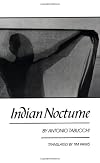
Indian Nocturne
by Antonio Tabucchi
On This Page
Description
Translated from the Italian, this winner of the Prix Medicis Etrangerfor 1987 is an enigmatic novel set in modern India. Roux, the narrator,is in pursuit of a mysterious friend named Xavier. His search, whichdevelops into a quest, takes him from town to town across thesubcontinent.Tags
Recommendations







































Member Reviews
Leaving Your Atma on the Plane
I wonder if Tabucchi realised that characters like myself would emerge out of the reading of his books. Characters who keep reading his books, going over them, the way his characters go over their own lives, seeking that which is as elusive as Xavier who the narrator is trying to find in Indian Nocturne.
If you wonder what a journey like this was like back in the author’s time of the 1970s or 1980s find a really old copy of India, a Travel Survival Kit by Lonely Planet, a book that also makes an appearance in another story of Tabucchi’s The Trains that Go to Madras , and the guide book plays the same character in both – it gives some useful advice – but not what we might expect – if it’s just a show more travel guide, it tells us not to have any expectations, which is good advice in a number of life circumstances.
For the most part of this novella we are guided to consider who Xavier is. But we should be wondering who the narrator is. He after all is taking the journey. He reaches dead ends wherever he goes, but saying that is not a spoiler, as the dead ends are the point. Or one of them.
From the opening scene, the taxi ride to the hotel, we encounter the narrator in European mode, experiencing the place through the European mind - the taxi driver provokes an altercation with his narrator customer over the place he wanted to go. The driver it seems was thinking that this European gentleman won’t like such a bad place as the Cage District. The narrator has his own reasons. So, of course reading a book by Tabucchi called Indian Nocturne is exactly like being taken on a taxi ride to a destination we did not ask for.
“I’d seen it (the Cage District) in the photographs of a famous photographer and thought I was prepared for human misery, but photographs enclose the visible in a rectangle.”
As do books.
Tabucchi has done something interesting here, he has engaged us in the Indian traveller’s first encounter story – the Indian taxi driver is always trying to take the fresh traveller somewhere other than where they want to go – I have a similar story. And the other stock experience for the first time Indian traveller is the confrontation with human misery on a vast scale. These are as much expectations as the Taj Mahal, the ghats of Varanasi or the erotic sculptures on the Khajuraho temples. Nothing is as it seems inside the rectangle of a book either. One narrative frames another and so on. The opening pages maker reference to places visited in the book – Khajuraho features as the name of a hotel in Bombay – advertisers place names on signage as pointers to their premises, but Tabucchi offers them in a similar way - as the promise we have of our destination – India is always framed for us, seducing us with our own impressions.
The other stock in trade of the European travelling in India is the journey of discovery. Naturally, this is the one Tabucchi plays with the most, though if I go on there may be a spoiler there. Herman Hesse, the Beatles, friends of mine looking for ashrams and gurus, drugs and experiences. Like Hesse, our narrator has an interest in Theosophy, if only to look for his friend, Xavier, who was in communication with the Madras Theosophical Society. Somehow India is always framed as spirit, what we can know is as elusive.
The European visitor-narrator always brings their own journey of discovery references. Perhaps the traveller is lucky if this framework offers them the opportunity to confront themselves, and if they are not confronted with themselves most of all, there is the suggestion that they are not really there. This is confirmed late in the story when our traveller narrator meets a grotesque fortune teller in the middle of the night at a bus exchange - as likely an event in India as a voyage of discovery since stoppages happen with their own logic and never when we expect them. There, the monstrously deformed sibling carried by his brother on his back performs a kind of oracle function but here he cannot actually tell the mans’ fortune:
“He said it is not a question of rupees… you are not there, he cannot tell you where you are.”
For the student of Indian religion, the narrator has no atma (the self, or the soul).
Perhaps that’s how we all travel through India, without a kind of soul, just our bodies our suitcases that carry us around all our lives - as the man on his way to Varanasi to die says early on, we won’t see each other in this form next time. show less
I wonder if Tabucchi realised that characters like myself would emerge out of the reading of his books. Characters who keep reading his books, going over them, the way his characters go over their own lives, seeking that which is as elusive as Xavier who the narrator is trying to find in Indian Nocturne.
If you wonder what a journey like this was like back in the author’s time of the 1970s or 1980s find a really old copy of India, a Travel Survival Kit by Lonely Planet, a book that also makes an appearance in another story of Tabucchi’s The Trains that Go to Madras , and the guide book plays the same character in both – it gives some useful advice – but not what we might expect – if it’s just a show more travel guide, it tells us not to have any expectations, which is good advice in a number of life circumstances.
For the most part of this novella we are guided to consider who Xavier is. But we should be wondering who the narrator is. He after all is taking the journey. He reaches dead ends wherever he goes, but saying that is not a spoiler, as the dead ends are the point. Or one of them.
From the opening scene, the taxi ride to the hotel, we encounter the narrator in European mode, experiencing the place through the European mind - the taxi driver provokes an altercation with his narrator customer over the place he wanted to go. The driver it seems was thinking that this European gentleman won’t like such a bad place as the Cage District. The narrator has his own reasons. So, of course reading a book by Tabucchi called Indian Nocturne is exactly like being taken on a taxi ride to a destination we did not ask for.
“I’d seen it (the Cage District) in the photographs of a famous photographer and thought I was prepared for human misery, but photographs enclose the visible in a rectangle.”
As do books.
Tabucchi has done something interesting here, he has engaged us in the Indian traveller’s first encounter story – the Indian taxi driver is always trying to take the fresh traveller somewhere other than where they want to go – I have a similar story. And the other stock experience for the first time Indian traveller is the confrontation with human misery on a vast scale. These are as much expectations as the Taj Mahal, the ghats of Varanasi or the erotic sculptures on the Khajuraho temples. Nothing is as it seems inside the rectangle of a book either. One narrative frames another and so on. The opening pages maker reference to places visited in the book – Khajuraho features as the name of a hotel in Bombay – advertisers place names on signage as pointers to their premises, but Tabucchi offers them in a similar way - as the promise we have of our destination – India is always framed for us, seducing us with our own impressions.
The other stock in trade of the European travelling in India is the journey of discovery. Naturally, this is the one Tabucchi plays with the most, though if I go on there may be a spoiler there. Herman Hesse, the Beatles, friends of mine looking for ashrams and gurus, drugs and experiences. Like Hesse, our narrator has an interest in Theosophy, if only to look for his friend, Xavier, who was in communication with the Madras Theosophical Society. Somehow India is always framed as spirit, what we can know is as elusive.
The European visitor-narrator always brings their own journey of discovery references. Perhaps the traveller is lucky if this framework offers them the opportunity to confront themselves, and if they are not confronted with themselves most of all, there is the suggestion that they are not really there. This is confirmed late in the story when our traveller narrator meets a grotesque fortune teller in the middle of the night at a bus exchange - as likely an event in India as a voyage of discovery since stoppages happen with their own logic and never when we expect them. There, the monstrously deformed sibling carried by his brother on his back performs a kind of oracle function but here he cannot actually tell the mans’ fortune:
“He said it is not a question of rupees… you are not there, he cannot tell you where you are.”
For the student of Indian religion, the narrator has no atma (the self, or the soul).
Perhaps that’s how we all travel through India, without a kind of soul, just our bodies our suitcases that carry us around all our lives - as the man on his way to Varanasi to die says early on, we won’t see each other in this form next time. show less
Quite a charming little travelogue disguised as a novella. An original moving and mysterious adventure seemingly focused on the perpetual visiting of continually unrequited romances of dreamlike places, luxurious hotels, sophisticated relationships, and fine food. In a spirit of a likable indifference, or in the manner of swift flight from despair, the fact that nothing ever is resolved for us matters little in the end.
This left me kind of indifferent; nicely written (and/or translated), mostly unpretentious, and easy to read. I imagine it will appeal to anyone who likes Sebaldian walking-novels that don't really go anywhere, but lead you by slightly unfamiliar paths (here, various locations in India) to extremely familiar ideas (aren't we all searching for something that might really be ourselves?). But it's more sufferable than many such books. Tabucchi has a comparatively light touch, and I'm encouraged to read some more of his stuff. But this probably wasn't the best place to start.
read in english but I saw the french movie from A.Corneau.
The book is intersting but lack something to be perfect! As I travelled in India since a long time, but not in Goa I found the author must have come ; its description is accurate even if some change happened.
Style and story quite nice.
The book is intersting but lack something to be perfect! As I travelled in India since a long time, but not in Goa I found the author must have come ; its description is accurate even if some change happened.
Style and story quite nice.
L'eleganza di Tabucchi e la misteriosa e carezzevole atmosfera indiana. Cosa si può volere di più?
Enigmatic search for a friend in an allucinating and miserable India. Feels like unachieved.
okay. didn't really click for me though.
Members
- Recently Added By
Lists

Italian Literature
558 works; 42 members

Best Italian Novels
25 works; 3 members
Author Information

203+ Works 7,800 Members
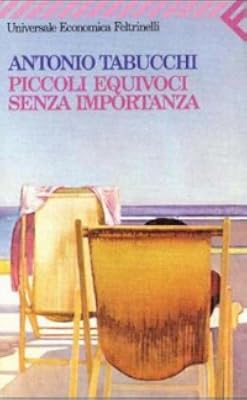
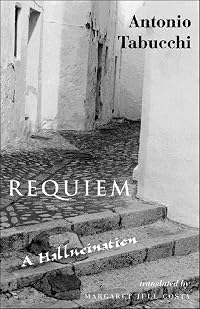
Antonio Tabucchi was born in Pisa, Italy on September 24, 1943. He studied literature and philosophy at the city's university. He was a writer and academic. He was professor of Portuguese literature at the University of Siena and the Italian Cultural Institute in Lisbon. His works include Piazza d'Italia, Piccoli Equivoci Senza Importanza (Little show more Misunderstandings of No Importance), Requiem, uma Alucinaçaõ (Requiem: A Hallucination), Tristano Muore (Tristan Is Dying), and Racconti con Figure. Many of his works were adapted into films including Sostiene Pereira (Pereira Maintains) and Notturno Indiano (Indian Nocturne). In addition to his fictional writing, he translated works by Fernando Pessoa and other Portuguese writers into Italian. He received numerous literary prizes including the Chevalier des Arts et des Lettres in France. In 1993, he was one of the founder members of the International Parliament of Writers and contributed articles to its journal, Autodafé. He died of cancer on March 25, 2012 at the age of 68. (Bowker Author Biography) show less
Awards and Honors
Awards
Series
Belongs to Publisher Series
Common Knowledge
- Canonical title
- Indian Nocturne
- Original title
- Notturno indiano
- Original publication date
- 1984
- Important places*
- Neu-Dehli, Indien; Madras, Indien; Goa, Indien
- Epigraph
- Those who sleep badly seem to a greater or less degree guilty; what do they do? They make the night present.
-- Maurice Blanchot - First words
- The taxi driver wore a hairnet and had a pointed beard and a short ponytail tied with a white ribbon.
- Blurbers
- Rushdie, Salman
- Original language*
- Italien
*Some information comes from Common Knowledge in other languages. Click "Edit" for more information.
Classifications
- Genres
- Fiction and Literature, General Fiction
- DDC/MDS
- 853.914 — Literature & rhetoric Italian, Romanian & related literatures Italian fiction 1900- 20th Century 1945-1999
- LCC
- PQ4880 .A24 .N6813 — Language and Literature French, Italian, Spanish and Portuguese literatures Italian literature Individual authors, 1961-2000
- BISAC
Statistics
- Members
- 581
- Popularity
- 50,672
- Reviews
- 17
- Rating
- (3.75)
- Languages
- 16 — Catalan, Dutch, English, Estonian, Finnish, French, German, Italian, Norwegian (Bokmål), Norwegian, Farsi/Persian, Portuguese, Croatian, Spanish, Swedish, Turkish
- Media
- Paper, Audiobook, Ebook
- ISBNs
- 46
- ASINs
- 11