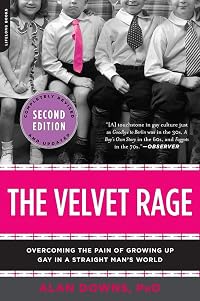
The Velvet Rage: Overcoming the Pain of Growing Up Gay in a Straight Man's World
by Alan Downs
On This Page
Description
The most important issue in a gay man's life is not coming out, but coming to terms with the invalidating past. Despite the progress made in recent years, many gay men still wonder, Are we better off? The byproduct of growing up gay in a straight world continues to be the internalization of shame, rejection, and anger, a toxic cocktail that can lead to drug abuse, promiscuity, alcoholism, depression, and suicide. Drawing on contemporary psychological research, the author's own journey, and show more the stories of many of his friends and clients, Velvet Rage addresses the myth of gay pride and outlines three stages to emotional well-being for gay men. The revised and expanded edition covers issues related to gay marriage, a broader range of examples that extend beyond middle-class gay men in America, and expansion of the original discussion on living authentically as a gay man. show lessTags
Recommendations





























Member Reviews
I was looking for a therapist and during one consultation this book was recommended to me. This work addresses problems that are classically inherent to gay men: body fascism, objectification, perfectionism, inauthenticity, "instamacy", abuse / self-abuse, shame. The author is at his best when focusing on the clinical aspects / analysis of the particular gay male subject is being discussed. In general -- This work is a very fast read.
When I arrived in NYC in the fall of 1980, promiscuity was the norm and rampant -- That's how I was introduced to gay life. I was relatively innocent and inexperienced; at first I was frightened by the gay bars. I was in over my head and I found many aspects of the cruising / pick up scenes to be show more overwhelming. The AIDS crisis arrived shortly thereafter, which in my case, amounted to living life in a state of fear. As a person who's sought out "harm reduction" by means of therapy, group therapy and 12 Step groups over the years -- I recognize that much of what Alan Downs, PhD recommends within this tome is derived from the 12 Step method. Mainly the idea of acceptance and how acceptance, when used as a tool, can change one's life; or from a Buddhist perspective -- Seeking "detachment"; learning to let go. "The Velvet Rage" also deconstructs the profound effect of shame, and how by refusing to let go of shame -- One ends up being inauthentic. Many of the gay men described in this book also suffer from a problem that I can relate to; one that causes tremendous existential angst-- That being the "inability to discern between, love, sex and affection".
A major weakness of this book, that has been commented on extensively in other reviews, is its tendency to focus on a particular type of gay man -- The capable, confident, fast lane, fast track to success kind of guy who jumps form one city, and or apartment, to the next; the "glistening" phony who'll hang on your every word -- Just to drop you like a hot potato. Although I've observed many of these types of men from afar, the queer men I've known have never been as driven or privileged as those described in this work. Thus at certain times while reading this text and searching for the common ground / attempting to empathize -- I couldn't help feeling like an "outsider among outsiders".
It's unfortunate that gay men can be cruel to one another; omnipresent rainbow flags notwithstanding, this lack of mutual empathy among queer men is the downside of the "rapier wit" that Dr. Downs references in this book. Sex for its own sake (more likely for "men of a certain age" like myself) often becomes more trouble than it's worth. Ultimately, after reading this text, I'm faced once again with the same questions that I encounter when seeking whatever method of "self-improvement": Does a gray area between "fast track party animal" and "morally superior reformed sinner" actually exist? How does one find "contentment" without turning into a veritable saint? ..... I'm still not sure. show less
When I arrived in NYC in the fall of 1980, promiscuity was the norm and rampant -- That's how I was introduced to gay life. I was relatively innocent and inexperienced; at first I was frightened by the gay bars. I was in over my head and I found many aspects of the cruising / pick up scenes to be show more overwhelming. The AIDS crisis arrived shortly thereafter, which in my case, amounted to living life in a state of fear. As a person who's sought out "harm reduction" by means of therapy, group therapy and 12 Step groups over the years -- I recognize that much of what Alan Downs, PhD recommends within this tome is derived from the 12 Step method. Mainly the idea of acceptance and how acceptance, when used as a tool, can change one's life; or from a Buddhist perspective -- Seeking "detachment"; learning to let go. "The Velvet Rage" also deconstructs the profound effect of shame, and how by refusing to let go of shame -- One ends up being inauthentic. Many of the gay men described in this book also suffer from a problem that I can relate to; one that causes tremendous existential angst-- That being the "inability to discern between, love, sex and affection".
A major weakness of this book, that has been commented on extensively in other reviews, is its tendency to focus on a particular type of gay man -- The capable, confident, fast lane, fast track to success kind of guy who jumps form one city, and or apartment, to the next; the "glistening" phony who'll hang on your every word -- Just to drop you like a hot potato. Although I've observed many of these types of men from afar, the queer men I've known have never been as driven or privileged as those described in this work. Thus at certain times while reading this text and searching for the common ground / attempting to empathize -- I couldn't help feeling like an "outsider among outsiders".
It's unfortunate that gay men can be cruel to one another; omnipresent rainbow flags notwithstanding, this lack of mutual empathy among queer men is the downside of the "rapier wit" that Dr. Downs references in this book. Sex for its own sake (more likely for "men of a certain age" like myself) often becomes more trouble than it's worth. Ultimately, after reading this text, I'm faced once again with the same questions that I encounter when seeking whatever method of "self-improvement": Does a gray area between "fast track party animal" and "morally superior reformed sinner" actually exist? How does one find "contentment" without turning into a veritable saint? ..... I'm still not sure. show less
As self-help books go (and I will admit that I am not a fan of the genre), The Velvet Rage is actually quite good. The problematic issue with many self-help books is that the underlying philosophy (or approach, or methodology, or treatment, etc.) is based on the assumption that everyone who reads the book is suffering with or struggling with the same condition (e.g., obesity, addiction, unhealthy relationship). This kind of essentializing or pathologizing of a condition usually results in overly generic (i.e., pretty much useless) strategies for correcting the condition. This book, however, is based on a more solid foundation—the belief that most gay men face similar challenges during the course of their development. These challenges show more result in deep-seated shame that often precludes any ability to maintain healthy, loving adult relationships with other men. And on this point, Dr. Downs pretty much gets it right.
I recognized more of myself than I care to admit in Downs’ descriptions of men crippled by a shame that dooms any attempt at a loving relationship with another man. The book is therapeutic and enlightening without being overly patronizing. In other words, Downs explains how and why our contemporary culture (20th century America, to be exact) makes it well-nigh impossible for a gay man to grow up as a healthy, self-actualized person, yet he does not excuse any of us for our failure to overcome these obstacles. He uses clear, frank language and relates anecdotes from his private practice to illustrate the various ways in which gay men sabotage their own relationships. (Unfortunately, Downs’ practice seems limited to middle-class or upper middle-class white men, so there is not much diversity within the stories he tells. We do not get, for example, a clear idea of what it might be like to grow up poor and gay or black and gay or Latino and gay or Asian and gay…). More importantly, he offers practical, specific advice for overcoming the various stages of shame many of us grew up with. Downs never explicitly draws the comparison, but the shame-redemption process he describes seems to closely parallel the coming out process in general. And for many gay men, coming out is merely the first step on the long road toward mental, emotional health and self-acceptance. show less
I recognized more of myself than I care to admit in Downs’ descriptions of men crippled by a shame that dooms any attempt at a loving relationship with another man. The book is therapeutic and enlightening without being overly patronizing. In other words, Downs explains how and why our contemporary culture (20th century America, to be exact) makes it well-nigh impossible for a gay man to grow up as a healthy, self-actualized person, yet he does not excuse any of us for our failure to overcome these obstacles. He uses clear, frank language and relates anecdotes from his private practice to illustrate the various ways in which gay men sabotage their own relationships. (Unfortunately, Downs’ practice seems limited to middle-class or upper middle-class white men, so there is not much diversity within the stories he tells. We do not get, for example, a clear idea of what it might be like to grow up poor and gay or black and gay or Latino and gay or Asian and gay…). More importantly, he offers practical, specific advice for overcoming the various stages of shame many of us grew up with. Downs never explicitly draws the comparison, but the shame-redemption process he describes seems to closely parallel the coming out process in general. And for many gay men, coming out is merely the first step on the long road toward mental, emotional health and self-acceptance. show less
This book attempts to address the shame that colours the early life of so many gay men, and it is the potential of this promise that makes the actual product so disappointing. I almost felt it was reinforcing gay shame in a whole new way as it railed against promiscuity (I'm not promiscuous), being in the closet (I'm totally out) and overachievement (I'm a full-time student at age 36). I kept waiting for the generalisations to end and the exercises to start. I wanted ways to uncover that shame and work through it, but instead all I got was a sense that I should be getting laid more, be more politically active and collect antique clocks.
Every time I read self help, I realise that reading the right novel would be so much more helpful for show more the self. show less
Every time I read self help, I realise that reading the right novel would be so much more helpful for show more the self. show less
If you have any questions about how growing up gay in a straight world impacts adult behavior, this is a good solid read. Gay men aren't so very different from men generally (except in choice of partners). All men, straight or gay, have to face up issues to do with shame and authenticity but for straight men coming to grips with these issues is usually achieved by the late twenties or early thirties. For gay men overcoming shame is much harder as it is intensified and then reified by their experiences in the world from adolescence on. Gay men will do almost anything to avoid shame. Downs divides the evolution of the gay man into three stages, wild, denial, and falling apart--and rebuilding an authentic self. (The third stage doesn't show more always happen.) I'm simplifying this but this makes a lot of sense to me. This book would go well with Brene Brown's [Daring Greatly] where she addresses shame the ways shame drives us all. Here, however, Downs makes the case that gay men experience shame squared. **** show less
While there were of course many generalized assumptions or observances about the gay community, for the most part this I book offered a very interesting and profound theory into the struggles of gay men that I came away from feeling so much more enlightened.
I have never in my life underlined, highlighted or written in the margins more in my life, then when reading this book. There was so much of myself I found in there, and so much for me to really think about and ingest.
I do think this is an important book, and even if you do not identify with everything Downs has to offer, it's still worth the read. I found insight into my friends, my past relationships, and of course myself throughout the entire book.
Insightful and in depth, Downs show more has really put forth a powerful theory that is worth knowing and discussing. I think every gay man should read this book. show less
I have never in my life underlined, highlighted or written in the margins more in my life, then when reading this book. There was so much of myself I found in there, and so much for me to really think about and ingest.
I do think this is an important book, and even if you do not identify with everything Downs has to offer, it's still worth the read. I found insight into my friends, my past relationships, and of course myself throughout the entire book.
Insightful and in depth, Downs show more has really put forth a powerful theory that is worth knowing and discussing. I think every gay man should read this book. show less
This fascinating book is about the search for authenticity. And about how difficult it is to grow up gay in a straight society,
and how for gay men, that manifests itself into feelings of shame.
There are three phases that gay men go through, Dr. Alan Downs claims:
1) Overwhelmed by shame. We are so ashamed of this part of ourselves that we masquerade as something we're not.
Often we hide who we really are, or split off different parts of ourselves. Some never leave this stage. They marry, or
hide all their lives. This is called "foreclosing" on shame.
2) Compensating for shame. In stage two, we come out, to ourselves and to others. But we have not dealt with the core
feeling that we are somehow shameful, unworthy of validation. In this show more stage, we try to neutralize shame by being bigger
and better and more fabulous than we are. Proof of this stage is the way so many gay men work so hard at the gym, or to
climb to the top of our professions. Also included here is promiscuity, which can be a way to manipulate one's mood and
not deal with an emotion. Many men never get past this phase, either.
3) Discovering Authenticity. Those who reach this stage, leave those trappings behind, and work to figure out who
they really are, rather than proving to themselves (and others) that they are desirable and lovable.
Dr. Downs fully explores the stages of life that cause the Velvet Rage and how to break
through them. Many men spend their lives in the first two stages, never reaching for the
true authenticity of the third stage.
It is much more than a self help book. Every page it is like having a therapy session or
two or three times over. Dr. Down's has amazing insights, explanations and answers for the
gay community that I believe can doubly apply to those who have or have not come out of
the broom closet as well. Things that we all have felt and experienced both consiously and
subconsiously that have caused us to grow, develop and behave in certain ways are explored.
The pain of shame from events that we have ALL gone through get displaced and eventually
turn into many different emotions and states of being very often negative, are addressed as
well as the healing of those wounds.
I think many gay men will relate to the emotions and experiences he
describes in the book. Truly an enlightening experience!
-Junior Cain show less
and how for gay men, that manifests itself into feelings of shame.
There are three phases that gay men go through, Dr. Alan Downs claims:
1) Overwhelmed by shame. We are so ashamed of this part of ourselves that we masquerade as something we're not.
Often we hide who we really are, or split off different parts of ourselves. Some never leave this stage. They marry, or
hide all their lives. This is called "foreclosing" on shame.
2) Compensating for shame. In stage two, we come out, to ourselves and to others. But we have not dealt with the core
feeling that we are somehow shameful, unworthy of validation. In this show more stage, we try to neutralize shame by being bigger
and better and more fabulous than we are. Proof of this stage is the way so many gay men work so hard at the gym, or to
climb to the top of our professions. Also included here is promiscuity, which can be a way to manipulate one's mood and
not deal with an emotion. Many men never get past this phase, either.
3) Discovering Authenticity. Those who reach this stage, leave those trappings behind, and work to figure out who
they really are, rather than proving to themselves (and others) that they are desirable and lovable.
Dr. Downs fully explores the stages of life that cause the Velvet Rage and how to break
through them. Many men spend their lives in the first two stages, never reaching for the
true authenticity of the third stage.
It is much more than a self help book. Every page it is like having a therapy session or
two or three times over. Dr. Down's has amazing insights, explanations and answers for the
gay community that I believe can doubly apply to those who have or have not come out of
the broom closet as well. Things that we all have felt and experienced both consiously and
subconsiously that have caused us to grow, develop and behave in certain ways are explored.
The pain of shame from events that we have ALL gone through get displaced and eventually
turn into many different emotions and states of being very often negative, are addressed as
well as the healing of those wounds.
I think many gay men will relate to the emotions and experiences he
describes in the book. Truly an enlightening experience!
-Junior Cain show less
Well, Downs has truly captured aspects of the Gay man's psyche. This book is downright scary, disturbing and enlightening. It's a book that you will identify with, underline and go back and read passages. Doesn't matter if you've been through years of therapy, this book captures it all and is cheaper. From shame to acknowledgment to acceptance. A must read.
Members
- Recently Added By
Lists

Books Read in 2016
4,666 works; 197 members
Author Information
12 Works 733 Members
Alan Downs, Ph.D., is a psychologist and the author of four previous titles on psychology and business. He has a private therapy and consulting practice in Santa Fe, New Mexico.
Common Knowledge
- Dedication
- Dedicated to Blake Hunter and Bob Ward | May I grow as young in spirit, as wise in life, and as steadfast in love as you.
Classifications
- Genres
- Nonfiction, LGBTQ+, Sexuality and Gender Studies, General Nonfiction, Biography & Memoir
- DDC/MDS
- 306.76 — Society, government, & culture Social sciences, sociology & anthropology Social Behavior - Dating, Marriage, Divorce Sexual relations Sexual orientation, transgender identity, intersexuality
- LCC
- HQ76 .D69 — Social sciences The family. Marriage, Women and Sexuality The Family. Marriage. Women Sexual life Homosexuality. Lesbianism
- BISAC
Statistics
- Members
- 628
- Popularity
- 46,561
- Reviews
- 13
- Rating
- (3.66)
- Languages
- English
- Media
- Paper, Audiobook, Ebook
- ISBNs
- 8
- ASINs
- 9