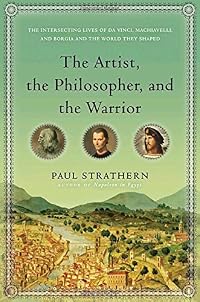
The Artist, the Philosopher, and the Warrior: The Intersecting Lives of Da Vinci, Machiavelli, and Borgia and the World They Shaped
by Paul Strathern
On This Page
Description
A meticulous account of Renaissance Italy during the turbulent decade around 1500, with emphasis on several important players: Alexander Borgia (also known as Pope Alexander VI) and his son Cesare, Machiavelli the philosopher-diplomat and author of The Prince, and Leonardo da Vinci--inventor, artist, and military engineer.Tags
Recommendations







Member Reviews
Leonardo da Vinci and Machiavelli are two Renaissance figures who have earned immortal fame, Leonardo for his fantastical notebooks, artistic masterpieces and proto-scientific approach to the natural world, Machiavelli for his foundational text on the cynicism of realistic politics with The Prince. Cesare Borgia is the most colorful member of the extremely colorful Borgia clan, notorious as the worst thing that ever happened to Catholicism. And for a few key months in 1502, they were in the same place, influencing each other as the world lurched from Medieval superstition to modern clarity.
Strathern spins a fascinating study of these three characters, but one which dissipates in the gaps in his sources. Much of the meat of the story is show more Borgia's critical 1502 campaign to secure his rule of Romagna as the first step towards a united Italy under Borgia rule. In this case, Borgia outmaneuvered a conspiracy against him, winning a war with treachery and boldness against his dithering and divided enemies.
The second viewpoint is Leonardo da Vinci, a bastard son raised in the rural hinterlands of Florence, who by sheer talent became one of the major artists and engineers of the age. In 1502, Leonardo was a military engineer working for Borgia, creating maps, updating fortresses, and building diabolical engines of destruction. While Leonardo had always had pacifists impulses, he was fascinated by tempests and engines of destruction. Strathern claims that seeing the aftermath of battles and sacked towns traumatized Leonardo, turning him from war, and likely also exacerbated the psychological block that prevented him from finishing his masterpieces or organizing his notebooks.
The third viewpoint is Machiavelli, who was a hard-travelling Florentine envoy posted to the Borgia court, to keep an eye on one of the many titans which threatened to crush his beloved city. Machiavelli is the most normal of the viewpoints, a civil servant who loves gossip and a bawdy joke with his drinking buddies, as contrasted against the genius of Leonardo and the overweening ambition of Borgia.
After 1502, their paths diverged. But Borgia's boldness and fortune did not long survive his father, Pope Alexander VI (and yeah, Popes should not have children, which is about the least scandalous thing about the Borgias), who'd been the strategic force behind Cesare's tactics. Imprisoned by his enemies, stripped of his riches and titles, and eventually exiled to Navarre, Cesare died in a pointless skirmish, a failure.
Leonardo's artistic block got worse and worse, but he found a comfortable retirement with the French and eventually painted the Mona Lisa. His unpublished notebooks are full of wonderous fragments of genius, though the scientific revolution would wait for a century after his death.
Machiavelli suffered the hardest fall. He'd been a major booster of Leonardo's in Florence, and his reputation was damaged when two of Leonardo's projects, an immense fresco and a plan to divert a river in the war against Pisa, came to nothing. Worse, the Medicis overthrew his republic and he lost his office. He wrote The Prince to try and curry favor with the Medicis, but the infamous manuscript doomed his chances when the Medici left power.
This book is often fascinating and plausible, and while there's frustratingly little hard proof of key elements, particularly of a friendship between Leonardo and Machiavelli, it's not like there lots of clever Florentines hanging around Borgia in 1502. show less
Strathern spins a fascinating study of these three characters, but one which dissipates in the gaps in his sources. Much of the meat of the story is show more Borgia's critical 1502 campaign to secure his rule of Romagna as the first step towards a united Italy under Borgia rule. In this case, Borgia outmaneuvered a conspiracy against him, winning a war with treachery and boldness against his dithering and divided enemies.
The second viewpoint is Leonardo da Vinci, a bastard son raised in the rural hinterlands of Florence, who by sheer talent became one of the major artists and engineers of the age. In 1502, Leonardo was a military engineer working for Borgia, creating maps, updating fortresses, and building diabolical engines of destruction. While Leonardo had always had pacifists impulses, he was fascinated by tempests and engines of destruction. Strathern claims that seeing the aftermath of battles and sacked towns traumatized Leonardo, turning him from war, and likely also exacerbated the psychological block that prevented him from finishing his masterpieces or organizing his notebooks.
The third viewpoint is Machiavelli, who was a hard-travelling Florentine envoy posted to the Borgia court, to keep an eye on one of the many titans which threatened to crush his beloved city. Machiavelli is the most normal of the viewpoints, a civil servant who loves gossip and a bawdy joke with his drinking buddies, as contrasted against the genius of Leonardo and the overweening ambition of Borgia.
After 1502, their paths diverged. But Borgia's boldness and fortune did not long survive his father, Pope Alexander VI (and yeah, Popes should not have children, which is about the least scandalous thing about the Borgias), who'd been the strategic force behind Cesare's tactics. Imprisoned by his enemies, stripped of his riches and titles, and eventually exiled to Navarre, Cesare died in a pointless skirmish, a failure.
Leonardo's artistic block got worse and worse, but he found a comfortable retirement with the French and eventually painted the Mona Lisa. His unpublished notebooks are full of wonderous fragments of genius, though the scientific revolution would wait for a century after his death.
Machiavelli suffered the hardest fall. He'd been a major booster of Leonardo's in Florence, and his reputation was damaged when two of Leonardo's projects, an immense fresco and a plan to divert a river in the war against Pisa, came to nothing. Worse, the Medicis overthrew his republic and he lost his office. He wrote The Prince to try and curry favor with the Medicis, but the infamous manuscript doomed his chances when the Medici left power.
This book is often fascinating and plausible, and while there's frustratingly little hard proof of key elements, particularly of a friendship between Leonardo and Machiavelli, it's not like there lots of clever Florentines hanging around Borgia in 1502. show less
Warfare, Terror, Murder and da Vinci: Paul Strathern's "The Artist, the Philosopher, and the Warrior"
Leonardo da Vinci is an artist whose name is instantly recognizable but whose artwork can seem so familiar to 21st century eyes that the actual paintings feel lost behind a veil of cultural expectations. Paul Strathern's new book, "The Artist, the Philosopher, and the Warrior: The Intersecting Lives of da Vinci, Machiavelli, and Borgia and the World They Shaped", allows us to see Leonardo as a living man and artist shaped by his time, friendships and experiences.
Strathern's book opens with an epigraph spoken by Orson Welles' character, Harry Lime, in "The Third Man". From the vantage point of a ferris wheel high above Vienna, Orson show more Welles surveys the battered post-war city beneath him and says:
"In Italy, for thirty years under the Borgias, they had warfare, terror, murder and bloodshed, but they produced Michelangelo, Leonardo da Vinci and the Renaissance. In Switzerland, they had brotherly love, they had five hundred years of democracy and peace—and what did that produce? The cuckoo clock."
A Brief Convergence
Paul Strathern who has a background in philosophy, and writes often on the subject, approaches the brief convergence of Leonardo, Borgia and Machiavelli as a sort of biographical/philosophical thought experiment. Like a good professor, Strathern asks questions:
"What was it precisely that made Leonardo agree to work for Borgia?"
What were Leonardo's "real intentions"?
How did Leonardo "become involved with Machiavelli?"
Paul Strathern defines his terms with background and analysis of the three major characters. Like Orson Welles, Paul Strathern uses a keen eye and a sense of humor to survey the events surrounding Machiavelli's Florentine diplomatic mission in 1502 which put Leonardo in the service of Cesare Borgia. Strathern vividly describes Renaissance Italy in the 1500's, which was not a unified country under the banner of Italy but instead a collection of constantly battling city states and principalities dominated by Milan, Venice, Naples, Florence and the pope in Rome. The book's narrative introduces us to da Vinci, Machiavelli and Borgia and then weaves, in a Rashomon view, their lives and the events surrounding them from three different vantage points. Strathern helps us see the vibrance and struggle of Renaissance Italy from the viewpoints of the artist, the philosopher, and the warrior.
A Visual Realm of Ideas
In a way that I find new to biographies of Leonardo, Paul Strathern concerns himself not only with the events in da Vinci's life, but especially in how Leonardo learned to think, ponder and dream. Leonardo da Vinci was born as the illegitimate son of Piero da Vinci. Because of the circumstances around his birth, Leonardo was not allowed to receive a classical education and so did not learn Latin as a youth. How did the young da Vinci grow into such a deep thinker?
Strathern clearly shows that Leonardo's artistic and scientific investigations were prompted by his own curiosity and massive intelligence. Without having learned Latin, Leonardo was able to read the classics in translation. Through his study of the Roman author Lucretius, whose epic poem "De Rerum Natura" (On the Nature of Things) sought to explain the world in scientific terms, Leonardo learned that accurate understanding derives from investigation and experience.
"Reflect that the most wicked act of all is to take the life of a man. For if his external form appears to be a marvelously subtle construction, realize that this is nothing compared with the soul which dwells within this structure."
- Leonardo da Vinci, from his notebooks
Leonardo cherished life so much that he became a vegetarian but at the same time he devised weapons and instruments of war. This conflict runs throughout Leonardo's adult life and Paul Strathern addresses this paradox throughout his book:
Leonardo "served with no apparent show of unwillingness (even in the privacy of his notebooks), as military engineer to the ruthless murderer Cesare Borgia, a monster whose name would enter history as a byword for infamy."
Perhaps an answer can be found in the zeitgeist of the era. As Strathern explains, the Renaissance prompted a more rational humanist outlook in the worlds of art and literature, but medieval fears and prejuidices remained strong. In troubled times, a collective mania could take hold. A similar, collective mania, took hold in the United States after the terrible events of September 11, 2001. This collective mania was hidden in the richly nuanced shadows in Leonardo's paintings. Caught in the sfumato in "The Adoration of the Magi", now in the Uffizi Gallery in Florence, warriors on horseback battle. Lost to time, but remembered in Peter Paul Rubens' restoration and reworking of an Italian 16th-century drawing, horses lock forelegs and armored soldiers scream as they battle for the standard in Leonardo's "Battle of Anghiari."
Legacies
Like a figure from da Vinci's "Battle of Anghiari", Cesare Borgia died on a battlefield.
After the Medici returned to power in Florence in 1510, Machiavelli was stripped of his Florentine citizenship, kicked out of his political office, fined 1,000 florins which left him almost penniless, banned from the city of Florence, and cast into an early forced retirement at his tiny family farm seven miles outside the city walls. At 43, Machiavelli had lost his career and his wealth. But he still could write:
"For four hours, I forget all my worries and boredom. I am afraid neither of poverty nor death. I am utterly absorbed in this world of my mind. And because Dante says that no one understands anything unless he remembers what he has understood, I have noted down what I have learned from these conversations. The result is a short book, called 'The Prince', in which I delve as deeply as I can into the subject of how to rule."
Leonardo da Vinci left a legacy of unpublished volumes, uncast sculptures, unrealized engineering projects, and unfinished paintings. Strathern theorizes that Leonardo's time with Cesare Borgia was brutish and caused Leonardo to doubt that humans were essentially good. Among diagrams and plans for weapons and machines, Leonardo wrote, "I will not publish or divulge such things." Leonardo saw the evil nature in men and did not trust humanity with his genius. A weapon, elegantly realized with a quill pen on a sheet of costly paper, becomes horrible when realized in the physical world and used to tear flesh and bone. Ultimately, Leonardo's discoveries lay hidden for centuries.
Leonardo's inability to finish his projects had aesthetic reasons as well. Since the classical age, unfinished artworks were cherished because they seemed to reveal the living thoughts of the artist. Leonardo da Vinci saw that an initial sketch captured the very instant of inspiration. Inspiration was valued as being more urgent and vital than a finished work of art itself. The initial idea or conception is what truly mattered to da Vinci. Once Leonardo had grasped the artistic idea, a finished work of art already existed in his mind.
Strathern's "The Artist, the Philosopher, and the Warrior: The Intersecting Lives of da Vinci, Machiavelli, and Borgia and the World They Shaped" lights a darkened era. From the smoky depths of sfumato glazes we peer into da Vinci's world of nuance and suggestion. In Leonardo's artistic legacy and Strathern's satisfying book we are left with existential questions, mere hints about our time on earth and the threads of history and influence that link us to the past. show less
Leonardo da Vinci is an artist whose name is instantly recognizable but whose artwork can seem so familiar to 21st century eyes that the actual paintings feel lost behind a veil of cultural expectations. Paul Strathern's new book, "The Artist, the Philosopher, and the Warrior: The Intersecting Lives of da Vinci, Machiavelli, and Borgia and the World They Shaped", allows us to see Leonardo as a living man and artist shaped by his time, friendships and experiences.
Strathern's book opens with an epigraph spoken by Orson Welles' character, Harry Lime, in "The Third Man". From the vantage point of a ferris wheel high above Vienna, Orson show more Welles surveys the battered post-war city beneath him and says:
"In Italy, for thirty years under the Borgias, they had warfare, terror, murder and bloodshed, but they produced Michelangelo, Leonardo da Vinci and the Renaissance. In Switzerland, they had brotherly love, they had five hundred years of democracy and peace—and what did that produce? The cuckoo clock."
A Brief Convergence
Paul Strathern who has a background in philosophy, and writes often on the subject, approaches the brief convergence of Leonardo, Borgia and Machiavelli as a sort of biographical/philosophical thought experiment. Like a good professor, Strathern asks questions:
"What was it precisely that made Leonardo agree to work for Borgia?"
What were Leonardo's "real intentions"?
How did Leonardo "become involved with Machiavelli?"
Paul Strathern defines his terms with background and analysis of the three major characters. Like Orson Welles, Paul Strathern uses a keen eye and a sense of humor to survey the events surrounding Machiavelli's Florentine diplomatic mission in 1502 which put Leonardo in the service of Cesare Borgia. Strathern vividly describes Renaissance Italy in the 1500's, which was not a unified country under the banner of Italy but instead a collection of constantly battling city states and principalities dominated by Milan, Venice, Naples, Florence and the pope in Rome. The book's narrative introduces us to da Vinci, Machiavelli and Borgia and then weaves, in a Rashomon view, their lives and the events surrounding them from three different vantage points. Strathern helps us see the vibrance and struggle of Renaissance Italy from the viewpoints of the artist, the philosopher, and the warrior.
A Visual Realm of Ideas
In a way that I find new to biographies of Leonardo, Paul Strathern concerns himself not only with the events in da Vinci's life, but especially in how Leonardo learned to think, ponder and dream. Leonardo da Vinci was born as the illegitimate son of Piero da Vinci. Because of the circumstances around his birth, Leonardo was not allowed to receive a classical education and so did not learn Latin as a youth. How did the young da Vinci grow into such a deep thinker?
Strathern clearly shows that Leonardo's artistic and scientific investigations were prompted by his own curiosity and massive intelligence. Without having learned Latin, Leonardo was able to read the classics in translation. Through his study of the Roman author Lucretius, whose epic poem "De Rerum Natura" (On the Nature of Things) sought to explain the world in scientific terms, Leonardo learned that accurate understanding derives from investigation and experience.
"Reflect that the most wicked act of all is to take the life of a man. For if his external form appears to be a marvelously subtle construction, realize that this is nothing compared with the soul which dwells within this structure."
- Leonardo da Vinci, from his notebooks
Leonardo cherished life so much that he became a vegetarian but at the same time he devised weapons and instruments of war. This conflict runs throughout Leonardo's adult life and Paul Strathern addresses this paradox throughout his book:
Leonardo "served with no apparent show of unwillingness (even in the privacy of his notebooks), as military engineer to the ruthless murderer Cesare Borgia, a monster whose name would enter history as a byword for infamy."
Perhaps an answer can be found in the zeitgeist of the era. As Strathern explains, the Renaissance prompted a more rational humanist outlook in the worlds of art and literature, but medieval fears and prejuidices remained strong. In troubled times, a collective mania could take hold. A similar, collective mania, took hold in the United States after the terrible events of September 11, 2001. This collective mania was hidden in the richly nuanced shadows in Leonardo's paintings. Caught in the sfumato in "The Adoration of the Magi", now in the Uffizi Gallery in Florence, warriors on horseback battle. Lost to time, but remembered in Peter Paul Rubens' restoration and reworking of an Italian 16th-century drawing, horses lock forelegs and armored soldiers scream as they battle for the standard in Leonardo's "Battle of Anghiari."
Legacies
Like a figure from da Vinci's "Battle of Anghiari", Cesare Borgia died on a battlefield.
After the Medici returned to power in Florence in 1510, Machiavelli was stripped of his Florentine citizenship, kicked out of his political office, fined 1,000 florins which left him almost penniless, banned from the city of Florence, and cast into an early forced retirement at his tiny family farm seven miles outside the city walls. At 43, Machiavelli had lost his career and his wealth. But he still could write:
"For four hours, I forget all my worries and boredom. I am afraid neither of poverty nor death. I am utterly absorbed in this world of my mind. And because Dante says that no one understands anything unless he remembers what he has understood, I have noted down what I have learned from these conversations. The result is a short book, called 'The Prince', in which I delve as deeply as I can into the subject of how to rule."
Leonardo da Vinci left a legacy of unpublished volumes, uncast sculptures, unrealized engineering projects, and unfinished paintings. Strathern theorizes that Leonardo's time with Cesare Borgia was brutish and caused Leonardo to doubt that humans were essentially good. Among diagrams and plans for weapons and machines, Leonardo wrote, "I will not publish or divulge such things." Leonardo saw the evil nature in men and did not trust humanity with his genius. A weapon, elegantly realized with a quill pen on a sheet of costly paper, becomes horrible when realized in the physical world and used to tear flesh and bone. Ultimately, Leonardo's discoveries lay hidden for centuries.
Leonardo's inability to finish his projects had aesthetic reasons as well. Since the classical age, unfinished artworks were cherished because they seemed to reveal the living thoughts of the artist. Leonardo da Vinci saw that an initial sketch captured the very instant of inspiration. Inspiration was valued as being more urgent and vital than a finished work of art itself. The initial idea or conception is what truly mattered to da Vinci. Once Leonardo had grasped the artistic idea, a finished work of art already existed in his mind.
Strathern's "The Artist, the Philosopher, and the Warrior: The Intersecting Lives of da Vinci, Machiavelli, and Borgia and the World They Shaped" lights a darkened era. From the smoky depths of sfumato glazes we peer into da Vinci's world of nuance and suggestion. In Leonardo's artistic legacy and Strathern's satisfying book we are left with existential questions, mere hints about our time on earth and the threads of history and influence that link us to the past. show less
 This review was written for LibraryThing Early Reviewers.
[LT early reviewer - These comments apply to the advance uncorrected proof]
Well, i thoroughly enjoyed this one. 400 pages of history could be a tough slog, but Strathern does a remarkable job of keeping it moving, keeping it interesting, and keeping a large cast of characters from getting all confused. This book is essentially a Venn diagram of worlds of da Vinci, Machiavelli, and Cesare Borgia, and their individual stories are interesting enough. But from where they intersect, Strathern has coaxed some great insights, and intriguing possibilities regarding the mutual influence these three giants may have had on each other and on the events swirling around them.
The way Strathern keeps track of the threads of these three lives is a show more major victory. As I mentioned above, a lot of characters move across this stage. Fortunately, a 'dramatis persona' is provided, as well as a timeline, to help keep track. This ones a winner.
Os. show less
Well, i thoroughly enjoyed this one. 400 pages of history could be a tough slog, but Strathern does a remarkable job of keeping it moving, keeping it interesting, and keeping a large cast of characters from getting all confused. This book is essentially a Venn diagram of worlds of da Vinci, Machiavelli, and Cesare Borgia, and their individual stories are interesting enough. But from where they intersect, Strathern has coaxed some great insights, and intriguing possibilities regarding the mutual influence these three giants may have had on each other and on the events swirling around them.
The way Strathern keeps track of the threads of these three lives is a show more major victory. As I mentioned above, a lot of characters move across this stage. Fortunately, a 'dramatis persona' is provided, as well as a timeline, to help keep track. This ones a winner.
Os. show less
This review was written for LibraryThing Early Reviewers.Strathern attempts to weave together the combined fortunes of da Vinci, Machiavelli, and Borgia. And while he provides a great many fascinating details about each man -- and perhaps a more illuminating picture of da Vinci than the other two -- the use of one to illuminate the other is of limited success. This is partly because of the limited facts about the crucial points of intersection (at least crucial for Strathern's method) between da Vinci and the other two (especially between da Vinci and Machiavelli). These limitations lead to a rather forced conjunction, instead of a convincing account.
If one can focus on the information at hand, and the sometimes lively storytelling, and leave the forced conjunctions problem aside, it's a show more fascinating book. If one cannot, it becomes increasing irritating. show less
If one can focus on the information at hand, and the sometimes lively storytelling, and leave the forced conjunctions problem aside, it's a show more fascinating book. If one cannot, it becomes increasing irritating. show less
This review was written for LibraryThing Early Reviewers.In different ways, Cesare Borgia, Leonardo da Vinci, and Niccolo Machiavelli are all men who shaped what we know as the Italian Renaissance. Here, Strathern discusses their achievements and examines the ways in which these intersected. The ties between Machiavelli and Borgia are well-documented (after all, the ideal ruler of Machiavelli's most famous work is modelled after Borgia), as are those between Borgia and Leonardo, who worked at Florence's request as Borgia's military engineer for a time.
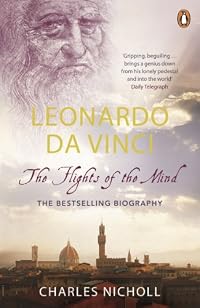
Where Strathern stretches too much, I think, is in the ties between Machiavelli and Leonardo. Clearly they had some level of interaction and were linked in several different Florentine projects; Leonardo's biographer Charles Nicholl thinks it show more likely that they had a "cordial relationship". Strathern simply takes this too far, in my estimation, making all sorts of unsupported speculations about how Leonardo could have taken care of Machiavelli during an illness at Imola, or how Leonardo might have visited "his old friend Machiavelli" on his way to France to the court of Francis I.
In the end, Strathern produces a reasonably interesting work of popular history, which I might recommend to someone who didn't know much about the period. From a historical viewpoint, though, he simply stretches his thesis too far, on too little documentary evidence, to be completely convincing. show less
Where Strathern stretches too much, I think, is in the ties between Machiavelli and Leonardo. Clearly they had some level of interaction and were linked in several different Florentine projects; Leonardo's biographer Charles Nicholl thinks it show more likely that they had a "cordial relationship". Strathern simply takes this too far, in my estimation, making all sorts of unsupported speculations about how Leonardo could have taken care of Machiavelli during an illness at Imola, or how Leonardo might have visited "his old friend Machiavelli" on his way to France to the court of Francis I.
In the end, Strathern produces a reasonably interesting work of popular history, which I might recommend to someone who didn't know much about the period. From a historical viewpoint, though, he simply stretches his thesis too far, on too little documentary evidence, to be completely convincing. show less
This review was written for LibraryThing Early Reviewers.This is an interesting analysis of Leonardo Da Vinci, Machiavelli and Cesare Borgia's relationship. It focuses upon the short period when Leonardo was coerced by the Florentine government to work for Borgia as a weapons designer and Machiavelli served as its diplomatic envoy. Strathern provides a detailed and frightening account of Borgia's amoral quest for power and attempts to assess the impact
of this brutal behavior on these two famous eyewitnesses.
The book is well written and researched. I read while travelling through Italy which made it all the more real.
of this brutal behavior on these two famous eyewitnesses.
The book is well written and researched. I read while travelling through Italy which made it all the more real.
Paul Strathern's account of the intersecting lives of Cesare Borgia, Niccolo Machiavelli, and Leonardo da Vinci is well researched and interesting. While each individual affected the Italian Renaissance in different ways, Strathern's thesis is that the three men influenced each other and their subsequent careers: Leonardo as Borgia's military engineer, Machiavelli as a friend and political supporter of Leonardo's state commissions, and Borgia as a general influence on Machiaelli's later political writings.
The book proceeds in a chronological account of the three individuals lives and the circumstances that brought them together. With the majority of attention paid to the years of Borgia's military campaigns, in which Machiavelli was a show more Florentine diplomat and Leonardo employed as Borgia's chief military engineer, the author discusses the various influences and consequences of this time. If nothing else, it is an enjoyable narrative describing the relationship between three Renaissance icons. An interesting story of Italian politics, papal power and ambition, with a motif of artistic brilliance. While some may disagree with the degree of influence of Borgia toward Leonardo in many respects, Strathern supports his claim with logical arguments; however, I found a few instances to be a bit of a stretch.
The thing I most enjoyed about this book is the way Strathern lectures on such a detailed historic topic without sounding boring and dry. The writing and explanations are easy to understand, and he rightly provides background information when necessary. Someone who isn't familiar with the nuances of the Italian Renaissance could easy read this book and not be lost. I also felt that the tone of the work was upbeat and interested. One could tell that that author not only was knowledgeable about the subject, but was intellectually stimulated by it. The way he weaves the three lives together, yet still maintaining a forward chronology was well handled. While it does not read as a substantial academic thesis, I found the book enjoyable, educational, and stimulating. show less
The book proceeds in a chronological account of the three individuals lives and the circumstances that brought them together. With the majority of attention paid to the years of Borgia's military campaigns, in which Machiavelli was a show more Florentine diplomat and Leonardo employed as Borgia's chief military engineer, the author discusses the various influences and consequences of this time. If nothing else, it is an enjoyable narrative describing the relationship between three Renaissance icons. An interesting story of Italian politics, papal power and ambition, with a motif of artistic brilliance. While some may disagree with the degree of influence of Borgia toward Leonardo in many respects, Strathern supports his claim with logical arguments; however, I found a few instances to be a bit of a stretch.
The thing I most enjoyed about this book is the way Strathern lectures on such a detailed historic topic without sounding boring and dry. The writing and explanations are easy to understand, and he rightly provides background information when necessary. Someone who isn't familiar with the nuances of the Italian Renaissance could easy read this book and not be lost. I also felt that the tone of the work was upbeat and interested. One could tell that that author not only was knowledgeable about the subject, but was intellectually stimulated by it. The way he weaves the three lives together, yet still maintaining a forward chronology was well handled. While it does not read as a substantial academic thesis, I found the book enjoyable, educational, and stimulating. show less
This review was written for LibraryThing Early Reviewers.Members
- Recently Added By
Published Reviews
ThingScore 75
[...] with more imagination and speculative flair, Strathern could have produced a truly wonderful book, but at the crucial moments he seems to lack the belief to bridge convincingly the gaps in his story and relies on stock phrases such as: "We can only speculate as to what these two men talked about."
This is a shame because the story he has to tell is exciting and revealing; the characters show more are in some ways antithetical and in others oddly similar (all three, for instance, were atheists and almost ludicrously ambitious); and the narrative has a natural arc, beginning in hope and fear and climaxing in deceit and bloodshed. A great tale that could have been even better told. show less
This is a shame because the story he has to tell is exciting and revealing; the characters show more are in some ways antithetical and in others oddly similar (all three, for instance, were atheists and almost ludicrously ambitious); and the narrative has a natural arc, beginning in hope and fear and climaxing in deceit and bloodshed. A great tale that could have been even better told. show less
added by bewogenlucht
Author Information

116 Works 7,387 Members
Awards and Honors
Awards
Common Knowledge
- People/Characters
- Leonardo da Vinci; Cesare Borgia; Niccolò Machiavelli; Rodrigo Borgia; Lorenzo de' Medici; Charles VIII, King of France (show all 10); Louis XII, King of France; Salaì (Gian Giacomo Caprotti da Orena); Luca Pacioli; Alexander VI, Pope (Rodrigo de Borja or Borgia)
- Important places
- Florence, Tuscany, Italy; Milan, Lombardy, Italy; Papal States, Italy; Rome, Italy
Classifications
- Genres
- History, Nonfiction, General Nonfiction, Biography & Memoir, Art & Design
- DDC/MDS
- 945.060922 — History & geography History of Europe Italy Italy Age of invasions 1492-1527
- LCC
- DG540.8 .A1 .S77 — History of Europe, Asia, Africa and Oceania City History of Italy Medieval and modern Italy, 476- History By period Modern, 1492- 16th-18th centuries
- BISAC
Statistics
- Members
- 384
- Popularity
- 81,142
- Reviews
- 26
- Rating
- (3.54)
- Languages
- English, Portuguese, Spanish
- Media
- Paper, Audiobook, Ebook
- ISBNs
- 8
- ASINs
- 4