
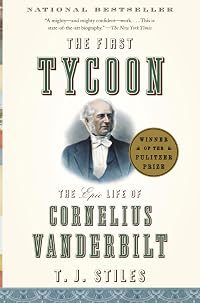
The First Tycoon: The Epic Life of Cornelius Vanderbilt
by T. J. Stiles
On This Page
Description
A gripping, groundbreaking biography of the combative man whose genius and force of will created modern capitalism. We see Vanderbilt help to launch the transportation revolution, propel the Gold Rush, reshape Manhattan, and invent the modern corporation.Tags
Recommendations

Member Reviews
Just fantastic... A balance between the personal, the social and the financial transformations happening in society within that particular era. Starting with Cornelius humble beginnings, M. Stiles takes us from the New York debut all the way thru Vanderbilt's life until his grand finale: Grand Central Station. Only minor point is that at some point, Stiles goes a little too deep into the financial explanations of certain events. Other than that, a very entertaining read. It gives us a full view of this complex character that was Vanderbilt; from his way of dealing with his children to his relation with his wife and mistresses and especially his business enemies.
Overall would recommend it for any biography readers.
Overall would recommend it for any biography readers.
Biography of a man at the heart of huge changes in American economics and therefore politics; he started with boats across the Hudson, became a steamship mogul, then ended life as a railroad mogul. Beginning as a critic of monopolies granted to the already-rich (and a prime mover in Gibbons v. Ogden!), Cornelius Vanderbilt ended life in support of monopolies, albeit ones assembled by new money. Stiles is kind of in awe of Vanderbilt for reasons that I find a little hard discern from his character, which seemed laser-focused on making money no matter what, but he does a great job setting Vanderbilt in his social and economic context. Also, I saw shades of Elon Musk in this Mark Twain quote about Vanderbilt in1869: “You seem to be the show more idol of only a crawling swarm of small souls, who love to glorify your most flagrant unworthiness in print or praise your vast possessions worshippingly; or sing of your unimportant private habits and sayings and doings, as if your millions gave them dignity.” show less
There were the rich, the super rich, and Cornelius Vanderbilt. T.J. Stiles takes you through the life of the Commodore in The First Tycoon: The Epic Life of Cornelius Vanderbilt.
Sons are notoriously prone to exaggerate the importance of their fathers, as are biographers with their subjects...
Vanderbilt founded a dynasty. The First Tycoon starts with one of the final challenges to that dynasty. The Commodore had left the vast majority of his estate to one of his children. The rest were challenging his will. He wanted his business empire to continue through his children, without it being severed and control lost.
Cornelius “Commodore” Vanderbilt was born in relatively humble family on Staten Island during George Washington’s show more presidency. He started in his father's footsteps as a boatman. He latched onto the power of steam and assembled a huge fleet of steamships. After conquering the water, he assembled a railroad empire. We see Vanderbilt's role in transportation revolutions, battling the physical growth of the nation with better and faster means of transportation. Along the way he helped shape the growth of the modern corporation
T. J. Stiles argues that Vanderbilt did more than perhaps any other individual to create the current economic world. His steamships and railroad lines took vast amounts of capital, requiring more than one individual to fund the growth and expansion.
Compliance professionals and securities law aficionados may be fascinated by the growth of the corporate entity. At the time they offered less liability protection than we would expect today.
The history of Vanderbilt is also full of stock manipulation and anti-trust issues. Transportation companies routinely gathered together to set rates and limit competition. When competition did break out, it was a vicious battle between the rivals. Sometimes the battle was waged in the stock market with the players trying to corner securities and punish the wealth of their rivals.
The book does a remarkable job of balancing the epics tales with a fast-moving narrative. show less
Sons are notoriously prone to exaggerate the importance of their fathers, as are biographers with their subjects...
Vanderbilt founded a dynasty. The First Tycoon starts with one of the final challenges to that dynasty. The Commodore had left the vast majority of his estate to one of his children. The rest were challenging his will. He wanted his business empire to continue through his children, without it being severed and control lost.
Cornelius “Commodore” Vanderbilt was born in relatively humble family on Staten Island during George Washington’s show more presidency. He started in his father's footsteps as a boatman. He latched onto the power of steam and assembled a huge fleet of steamships. After conquering the water, he assembled a railroad empire. We see Vanderbilt's role in transportation revolutions, battling the physical growth of the nation with better and faster means of transportation. Along the way he helped shape the growth of the modern corporation
T. J. Stiles argues that Vanderbilt did more than perhaps any other individual to create the current economic world. His steamships and railroad lines took vast amounts of capital, requiring more than one individual to fund the growth and expansion.
Compliance professionals and securities law aficionados may be fascinated by the growth of the corporate entity. At the time they offered less liability protection than we would expect today.
The history of Vanderbilt is also full of stock manipulation and anti-trust issues. Transportation companies routinely gathered together to set rates and limit competition. When competition did break out, it was a vicious battle between the rivals. Sometimes the battle was waged in the stock market with the players trying to corner securities and punish the wealth of their rivals.
The book does a remarkable job of balancing the epics tales with a fast-moving narrative. show less
Alexander Hamilton, America’s first Treasury Secretary, is often credited with forming the nation’s new economic system. Not far behind him (or even beside him) sits Cornelius Vanderbilt. In modern times, his name is most associated with a university in Nashville, but his legacy touched many turning points of nineteenth-century America. In this biography, Stiles describes Vanderbilt’s story beginning with the waning years of the eighteenth century and continuing after the Civil War until railroads united the country.
A full examination of Vanderbilt’s life is beyond the scope of this essay because, well, there’s so much to his life. Stiles does an excellent job condensing the story into less than 1,000 pages. Everything from show more the formation of the corporation to the reach of steamboats and railroads, from inter-state commerce to the economic union of the American east and west, from the defeat of the Confederate rebellion to attempts to reunify the country – all these things were touched upon by this great man. He was the first of the big men in an era of big (and rich) men.
Stiles details each of these stories and sketches the personality of a difficult man. From his early years as a steamboat captain to later years as an economic giant, the portrait that emerges is one of financial acumen, strategic clarity, and determination. Stiles inspects the economic forces carefully – much more carefully than I am capable of – and shows how the American system of life was founded outside of government. His work in business helped unify the country’s economy, perhaps more than anyone else.
I read this book because I work at a medical center that bears the Vanderbilt name. Having gathered outlines of his life from prior history classes, I wanted to learn more about the life of this giant. Given his relative lack of formal education, his continual social and financial ascent is quite impressive. We can only hope that the huge gap between rich and poor in the Gilded Age never repeats itself, but a giant of business and transportation such as Vanderbilt should be appreciated even in our era of fiber-optic cables and the microchip. show less
A full examination of Vanderbilt’s life is beyond the scope of this essay because, well, there’s so much to his life. Stiles does an excellent job condensing the story into less than 1,000 pages. Everything from show more the formation of the corporation to the reach of steamboats and railroads, from inter-state commerce to the economic union of the American east and west, from the defeat of the Confederate rebellion to attempts to reunify the country – all these things were touched upon by this great man. He was the first of the big men in an era of big (and rich) men.
Stiles details each of these stories and sketches the personality of a difficult man. From his early years as a steamboat captain to later years as an economic giant, the portrait that emerges is one of financial acumen, strategic clarity, and determination. Stiles inspects the economic forces carefully – much more carefully than I am capable of – and shows how the American system of life was founded outside of government. His work in business helped unify the country’s economy, perhaps more than anyone else.
I read this book because I work at a medical center that bears the Vanderbilt name. Having gathered outlines of his life from prior history classes, I wanted to learn more about the life of this giant. Given his relative lack of formal education, his continual social and financial ascent is quite impressive. We can only hope that the huge gap between rich and poor in the Gilded Age never repeats itself, but a giant of business and transportation such as Vanderbilt should be appreciated even in our era of fiber-optic cables and the microchip. show less
This book starts off well with the very interesting details of Vanderbilt's early life on the waters around New York and his transition from a minor entrepreneur to a major player in the development of shipping lines around the world as well as ferries and railroads in the northeast. However, the last third of the book, covering his activities as a major trader and manipulator of railroads, gets somewhat dull as quite a lot of it deals with stock trading, corporates shenanigans and backroom deals. Overall a pretty good however and worth the time if you are interested in nineteen century America.
Yes, but how did he make his decisions?
T. J. Stiles thinks Cornelius Vanderbilt has gotten a bad rap.
Born during George Washington's presidency, Vanderbilt built a massive business empire starting with steamships and then railroads. His life spanned an epic period of the growth of the United States. During his life he saw New York grow from a population of 40,000 to over 1 million, the introduction of the railroad and steamships, building the Erie canal, the gold rush, the telegraph, and the American civil war.
Vanderbilt comes across as tenaciously driven in business, opportunistic, and personally aloof. During the development of the country during the 18th century, Vanderbilt was always there -capitalizing upon and in turn, providing show more the infrastructure that enabled the country's growth.
Vanderbilt's response to the California gold rush of 1849 is illustrative. He built a steamship line that transported passengers to the east coast of Nicaragua, transferred them to a small riverboat for the trip up the San Juan river. Shipped and reassembled a larger ferry boat for the trip across Lake Nicaragua, and then used pack animals to make the 12 miles trip to the Pacific. Finally, another steamship took them to San Francisco. Doing so required political deftness, engineering expertise, financial backing, and a keen business acumen.
Vanderbilt then began shifting his business from steamships to railroads. Shortly after the civil war he had essentially shifted his entire business focus away from steamships to railroads.
I wondered how he made these decisions. Did he ponder long and hard the future of the country and decide where he needed to be? How did he see these changes coming? Another strength of Vanderbilt's business practices was his ruthless efficiency enabling him to cut costs and operate profitably when others couldn't. How did he achieve these efficiencies? Was he an early version of Sam Walton? Unfortunately, the author can't help us much here.
Vanderbilt, with his embracing of unfettered competition, crushing of workers (at one point he fired all his enginehands on his personal yacht and hired an entire new set on the eve of the underway), and manipulation of markets to gain control and wealth seems an unlikely hero for the current environment. You would think he'd be reviled even more. He had an aversion to government handouts because many of his competitors benefitted unfairly from special treatment. That has made the success of the book more remarkable in my mind.
In the end, Vanderbilt saw the Panic of 1873, the most severe financial meltdown of his career, as caused by an asset bubble in Railroad stocks. It would be interesting to know what he would think of today's situation. show less
T. J. Stiles thinks Cornelius Vanderbilt has gotten a bad rap.
Born during George Washington's presidency, Vanderbilt built a massive business empire starting with steamships and then railroads. His life spanned an epic period of the growth of the United States. During his life he saw New York grow from a population of 40,000 to over 1 million, the introduction of the railroad and steamships, building the Erie canal, the gold rush, the telegraph, and the American civil war.
Vanderbilt comes across as tenaciously driven in business, opportunistic, and personally aloof. During the development of the country during the 18th century, Vanderbilt was always there -capitalizing upon and in turn, providing show more the infrastructure that enabled the country's growth.
Vanderbilt's response to the California gold rush of 1849 is illustrative. He built a steamship line that transported passengers to the east coast of Nicaragua, transferred them to a small riverboat for the trip up the San Juan river. Shipped and reassembled a larger ferry boat for the trip across Lake Nicaragua, and then used pack animals to make the 12 miles trip to the Pacific. Finally, another steamship took them to San Francisco. Doing so required political deftness, engineering expertise, financial backing, and a keen business acumen.
Vanderbilt then began shifting his business from steamships to railroads. Shortly after the civil war he had essentially shifted his entire business focus away from steamships to railroads.
I wondered how he made these decisions. Did he ponder long and hard the future of the country and decide where he needed to be? How did he see these changes coming? Another strength of Vanderbilt's business practices was his ruthless efficiency enabling him to cut costs and operate profitably when others couldn't. How did he achieve these efficiencies? Was he an early version of Sam Walton? Unfortunately, the author can't help us much here.
Vanderbilt, with his embracing of unfettered competition, crushing of workers (at one point he fired all his enginehands on his personal yacht and hired an entire new set on the eve of the underway), and manipulation of markets to gain control and wealth seems an unlikely hero for the current environment. You would think he'd be reviled even more. He had an aversion to government handouts because many of his competitors benefitted unfairly from special treatment. That has made the success of the book more remarkable in my mind.
In the end, Vanderbilt saw the Panic of 1873, the most severe financial meltdown of his career, as caused by an asset bubble in Railroad stocks. It would be interesting to know what he would think of today's situation. show less
One thing is obvious after reading this book, Cornelius Vanderbilt was an impressive man in many ways. Going from being a son in a small merchant family to one of the richest and most powerful men in our modern history is not something for everyone. Being at the right place at the right time helps, but there must have been thousands or millions of people with the same basic start as him that still never came close.
But if we return to the book. This is the first real biography I've read and it is a big one and, what I think, not an excellent one as a literary work. Cornelius Vanderbilt wasn't a man who left a lot of sources for people to dig into, so apparently this is as far as anyone has come. Instead of good material a lot has to be show more inferred from second hand sources which are always coloured by sources and readers alike. So why did the author decide to grab this hard task? I cannot be sure but I have the feeling he wants to modify the picture other, more shallow, biographies paint and also learn more about a man of very little is really known.
According to the author, Cornelius Vanderbilt was a hard man with a very strict morale code that he applied to himself and others. Even when he seemingly broke agreements it's possible to show how it was not so from his own point of view. The author also wants to show that he was not aggressive, except in self defense, though he then spared no bullet which most of the time ended in overwhelming business victories. That he was compassionate, but never willing to let it show. That he was patriotic but also forgiving to his enemies (once they were defeated).
Is this true? Well, who am I to tell. Maybe. People seem to think so. I'm impressed by him even if only some of it is true, and the author is clearly impressed by him. I do wish there had been more material closer to the source and I do wish for more technical details about the inventions he did, and the methods he applied to cut costs in a way that made him so successful.
It did make me want to know more about the American Civil War though so that might be my next project in the historical genre. That, or something about one of the other tycoons from the mid/second half of the 19th century to get another angle on things. show less
But if we return to the book. This is the first real biography I've read and it is a big one and, what I think, not an excellent one as a literary work. Cornelius Vanderbilt wasn't a man who left a lot of sources for people to dig into, so apparently this is as far as anyone has come. Instead of good material a lot has to be show more inferred from second hand sources which are always coloured by sources and readers alike. So why did the author decide to grab this hard task? I cannot be sure but I have the feeling he wants to modify the picture other, more shallow, biographies paint and also learn more about a man of very little is really known.
According to the author, Cornelius Vanderbilt was a hard man with a very strict morale code that he applied to himself and others. Even when he seemingly broke agreements it's possible to show how it was not so from his own point of view. The author also wants to show that he was not aggressive, except in self defense, though he then spared no bullet which most of the time ended in overwhelming business victories. That he was compassionate, but never willing to let it show. That he was patriotic but also forgiving to his enemies (once they were defeated).
Is this true? Well, who am I to tell. Maybe. People seem to think so. I'm impressed by him even if only some of it is true, and the author is clearly impressed by him. I do wish there had been more material closer to the source and I do wish for more technical details about the inventions he did, and the methods he applied to cut costs in a way that made him so successful.
It did make me want to know more about the American Civil War though so that might be my next project in the historical genre. That, or something about one of the other tycoons from the mid/second half of the 19th century to get another angle on things. show less
Members
- Recently Added By
Lists

Top Five Books of 2018
802 works; 264 members
Author Information

9 Works 2,374 Members
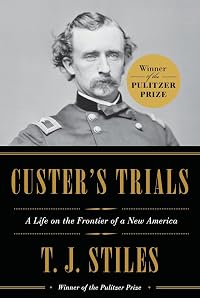
T. J. Stiles received a B. A. in history from Carleton College and a M. A. and M.Phil. in European history from Columbia University. He is the author of Jesse James: Last Rebel of the Civil War, The First Tycoon: The Epic Life of Cornelius Vanderbilt, which won the Pulitzer Prize for biography in 2010, and Custer's Trials: A Life on the Frontier show more of a New America, which won Pulitzer Prize for history in 2016. (Bowker Author Biography) show less
Some Editions
Awards and Honors
Awards
Common Knowledge
- Original publication date
- 2009
- People/Characters
- Cornelius Vanderbilt; Robert Livingston; Robert Fulton; Thomas Gibbons; Daniel Tompkins; Daniel Webster (show all 40); Marquis de Lafayette; Andrew Jackson; Philip Hone; William H. Vanderbilt; James Polk; Daniel Drew; Henry John Temple, 3rd Viscount Palmerston; James Buchanan; Edwin M. Stanton; Abraham Lincoln; Erastus Corning; William Walker; Horace Clark; George Templeton Strong; Ulysses S. Grant; Andrew Johnson; Horace Greeley; Jay Gould; James Fisk, Sr.; Amasa Stone, Jr.; Braxton Bragg; Victoria Woodhull; Thomas A. Scott; Charles Francis Adams, Jr.; Daniel Allen; Jacob Vanderbilt; John Morrissey; Cornelius Garrison; John D. Rockefeller; Chauncey M. Depew; Joseph White; John Davidson; Jared Linsly; William Lewis
- Important places
- New York, New York, USA; Albany, New York, USA; New Brunswick, New Jersey, USA; London, England, UK; San Francisco, California, USA; Washington, D.C., USA (show all 7); Saratoga Springs, New York, USA
- Important events
- Steamboat invention; War of 1812; Panic of 1837; California Gold Rush (1848–1855); American Civil War (1861 | 1865); Erie War (show all 8); Panic of 1873; Black Friday
- Dedication
- To Jessica and Dillon, for giving me the future
- First words
- They came to learn his secrets.
- Quotations
- They never learned his secrets.
- Last words
- (Click to show. Warning: May contain spoilers.)"The work will go on, though the master workman is gone."
- Publisher's editor
- Segal, Jonathan
- Original language
- English
Classifications
Statistics
- Members
- 1,234
- Popularity
- 19,949
- Reviews
- 15
- Rating
- (3.87)
- Languages
- English
- Media
- Paper, Audiobook, Ebook
- ISBNs
- 6
- ASINs
- 11