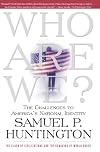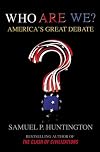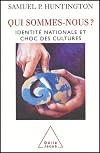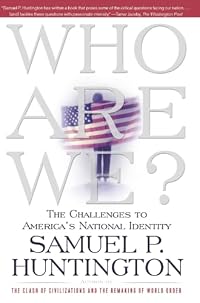
Who Are We: The Challenges to America's National Identity
by Samuel P. Huntington
On This Page
Description
America was founded by settlers who brought with them a distinct culture including the English language, Protestant values, individualism, religious commitment, and respect for law. The waves of later immigrants came gradually accepted these values and assimilated into America's Anglo-Protestant culture. More recently, however, national identity has been eroded by the problems of assimilating massive numbers of immigrants, bilingualism, multiculturalism, the devaluation of citizenship, and show more the "denationalization" of American élites. September 11 brought a revival of American patriotism, but already there are signs that this is fading. This book shows the need for us to reassert the core values that make us Americans.--From publisher description. show lessTags
Recommendations











Member Reviews
Huntington has written good books. This is not one of them. He laments the decline of WASP ("English") and Christian influence in the USA (although, the near-WASPs JFK and the Roosevelts excepted, all US presidents so far were WASPs and the USA is a religious anomaly among the developed nations). In his search for villains, he identifies secularists (subsumed as leftists), Muslims and especially (poor) Mexican immigrants.
The problem starts with his insufficient definition of the American idea. On the one hand, his definition fails to exclude a good number of European protestant nations (if one discounts the influence of the Queen's language). On the other hand, his insistence on Christianism sends many a founding father overboard show more (Franklin, Jefferson). Huntington's view of America is casuistic (including and excluding earlier immigrant and black diversity at will).
The book never addresses its main internal contradiction that while the Mexicanos reduce the influence of English in certain parts of America, they contribute to the upkeep of Christianism, even if only in the form of Catholicism. Huntington never realizes that he is faced with the main trade-off of secularism: More development usually means less religious attitudes. The US is a huge, puzzling exception, a fact he notes and lauds but can not explain.
Apart from him not having fully thought through his argument, the book suffers from methological problems. While he cites numerous opinion surveys to advance his positions (often veiling a soft form of racism), he never seems to realize the internal contradiction, eg in one part of the book he laments the average Americans's ignorance of US history, in another part he attacks the (leftist) professors' disdain for ignorant Americans' positions. He cannot be in both camps at the same time.
Huntington is horrified by two languages spoken in the US, eg forms should not be offered in different languages (Why? As a good scientist, he should be interested in correct data.). Instead of lamenting it, a good scientist would have studied examples where two or more languages exist. A large country to the north or various European nations could have supplied ample data for study. Instead, his fears and biases drive his argumentation and crash this book. show less
The problem starts with his insufficient definition of the American idea. On the one hand, his definition fails to exclude a good number of European protestant nations (if one discounts the influence of the Queen's language). On the other hand, his insistence on Christianism sends many a founding father overboard show more (Franklin, Jefferson). Huntington's view of America is casuistic (including and excluding earlier immigrant and black diversity at will).
The book never addresses its main internal contradiction that while the Mexicanos reduce the influence of English in certain parts of America, they contribute to the upkeep of Christianism, even if only in the form of Catholicism. Huntington never realizes that he is faced with the main trade-off of secularism: More development usually means less religious attitudes. The US is a huge, puzzling exception, a fact he notes and lauds but can not explain.
Apart from him not having fully thought through his argument, the book suffers from methological problems. While he cites numerous opinion surveys to advance his positions (often veiling a soft form of racism), he never seems to realize the internal contradiction, eg in one part of the book he laments the average Americans's ignorance of US history, in another part he attacks the (leftist) professors' disdain for ignorant Americans' positions. He cannot be in both camps at the same time.
Huntington is horrified by two languages spoken in the US, eg forms should not be offered in different languages (Why? As a good scientist, he should be interested in correct data.). Instead of lamenting it, a good scientist would have studied examples where two or more languages exist. A large country to the north or various European nations could have supplied ample data for study. Instead, his fears and biases drive his argumentation and crash this book. show less
An iteresting xenophobic diatribe. Huntington says that the United States is losing its anglo identity. He believes that the massive influx of immigrants, particularly Mexicans. Huntington makes some good points on the impact of that influx and how America has become a multicultural society beginning in the 1960's. Where he fails is convincing that immigrants are a danger to our society. He also fails to provide any historical context on previous immigration waves that Jeremiads said would destroy our society.
Having announced that the Russians, the Muslims, and the Chinese were coming, now Huntington says that the Hispanics and multiculturalists are coming. American civilisation is under threat from immigrants whose values aren't those of traditional American Protestant bigotry. Drat.
Book Review
Title: Who Are We? The Challenges to America’s National Identities
Author: Samuel P. Huntington
Over the course of the last few decades and in an accelerating fashion our national identity has been eroded by the problems of assimilating huge numbers of primarily Hispanic immigrants. Actually it is there non assimilation and their demand for bilingualism and multiculturalism that is different from previous mass immigration movements over the past centuries.
Other factors are also in play that the author attributes to a variety of “elites” that are leading to “denationalization” of the American society. The elites are identified as, governmental leaders, private institutions, international corporations, academics, dual show more citizens, and the effects of globalization. All of these entities have interests, financial and intellectual, that diminish their identification with the best interests of the homeland U.S.A.
The American public however overwhelmingly holds to the more original traditional ideas of patriotism. “The American establishment, governmental and private, has become increasingly devorced from the American people”.
Who Are We is indeed a scholarly work by a renowned political scientist who has written other widely acclaimed books concerning global politics. I don’t consider it a polemic but the author raises issues that must be addressed by a wider range of citizens in order to balance the current tendency to allow multi- culturalism and diversity to overpower the basic fundamentals and ideals upon which our country was founded.
One instance of how this is affecting the continental United States is the current recapture of the southwest by the Mexicans simply by sheer numbers In population and their density.. show less
Title: Who Are We? The Challenges to America’s National Identities
Author: Samuel P. Huntington
Over the course of the last few decades and in an accelerating fashion our national identity has been eroded by the problems of assimilating huge numbers of primarily Hispanic immigrants. Actually it is there non assimilation and their demand for bilingualism and multiculturalism that is different from previous mass immigration movements over the past centuries.
Other factors are also in play that the author attributes to a variety of “elites” that are leading to “denationalization” of the American society. The elites are identified as, governmental leaders, private institutions, international corporations, academics, dual show more citizens, and the effects of globalization. All of these entities have interests, financial and intellectual, that diminish their identification with the best interests of the homeland U.S.A.
The American public however overwhelmingly holds to the more original traditional ideas of patriotism. “The American establishment, governmental and private, has become increasingly devorced from the American people”.
Who Are We is indeed a scholarly work by a renowned political scientist who has written other widely acclaimed books concerning global politics. I don’t consider it a polemic but the author raises issues that must be addressed by a wider range of citizens in order to balance the current tendency to allow multi- culturalism and diversity to overpower the basic fundamentals and ideals upon which our country was founded.
One instance of how this is affecting the continental United States is the current recapture of the southwest by the Mexicans simply by sheer numbers In population and their density.. show less
Este libro es una fascinante exploración sobre la naturaleza de la identidad cultural estadounidense, todavía en estado de shock tras los acontecimientos del 11 de septiembre de 2001. De hecho, la devoción patriótica que siguió a los atentados se plasmó, entre otras cosas, en la venta de 250.000 banderas en unos conocidos grandes almacenes a lo largo de un solo día. Pero esta súbita reivindicación de la enseña nacional era sólo la evidencia física de algo mucho más importante: el renacimiento del orgullo en gran parte del pueblo de Estados Unidos, un sentimiento que había permanecido en estado de letargo desde hacía mucho tiempo. Para algunos todo se redujo a los McDonalds, a Walt Disney y al béisbol. Para otros, la show more reivindicación de esos valores debía remontarse a los primeros británicos que se establecieron en aquellas tierras, a la que legaron su cultura y su lengua. Para los afroamericanos y los latinos, sin embargo, no se trató de nada de todo esto. Estados Unidos ha debido lidiar desde sus primeros días con los problemas de asimilación que supone la existencia en su territorio de culturas distintas. No obstante, hoy debe enfrentarse a una situación aún más peliaguda: la facilidad con que los inmigrantes pueden mantener los vínculos afectivos con su cultura de origen; llamadas a larga distancia, emisoras de televisión en su propio idioma, billetes de avión a muy bajo precio--, con el distanciamiento que ello supone respecto a los nuevos valores de su país de adopción. ¿Quiénes somos? es uno de los libros más importantes de los últimos tiempos, una investigación a la vez histórica y cultural que, como los trabajos previos de su autor, provocará sin duda un encendido debate político e intelectual. show less
Jul 15, 2016Spanish
Ratings
Members
- Recently Added By
Lists

Shaykh Hamza's Book Recommendations
439 works; 3 members
Author Information

Samuel P. Huntington was the Albert J. Weatherhead III University Professor at Harvard University and chairman of the Harvard Academy for International and Area Studies. He was previously director of security planning for the National Security Council in the Carter administration, the founder and coeditor of Foreign Policy, and president of the show more American Political Science Association. Mr. Huntington died in 2008. show less
Some Editions
Common Knowledge
- Canonical title*
- Qui sommes-nous ? Identité nationale et choc des cultures
- Original title
- Who are we ? The challenges to America's national identity
- Original publication date
- 2004 (1e édition originale américaine, Simon and Schuster) (1e édition originale américaine, Simon and Schuster); 2004-11-12 (1e traduction et édition française, Odile Jacob) (1e traduction et édition française, Odile Jacob); 2018-08-29 (Réédition française, Poche, Odile Jacob) (Réédition française, Poche, Odile Jacob)
- Epigraph*
- /
- Dedication*
- A Candace, Max, Elisa
et leur avenir américain - First words*
- Préface
Le présent ouvrage examine les transformations qui affectent ce que l'on appellera la saillance et la substance de l'identité nationale américaine. [...]
Première partie
La question de l'identité
Chapitre premier
La crise de l'identité nationale
Saillance : les drapeaux sont-ils encore là ?
Charles Street... (show all), artère principale du quartier de Beacon Hill à Boston, est une rue plaisante bordée d'immeubles en briques de quatre étages. [...] - Original language*
- Anglais (Etats-Unis) (Etats-Unis)
*Some information comes from Common Knowledge in other languages. Click "Edit" for more information.
Classifications
Statistics
- Members
- 561
- Popularity
- 52,496
- Reviews
- 5
- Rating
- (3.39)
- Languages
- 8 — Dutch, English, French, German, Hungarian, Italian, Spanish, Turkish
- Media
- Paper
- ISBNs
- 18
- ASINs
- 3