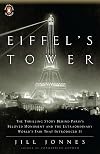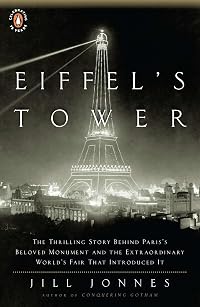
Eiffel's Tower: The Thrilling Story Behind Paris's Beloved Monument and the Extraordinary World's Fair That Introduced It
by Jill Jonnes
On This Page
Description
Presents a compelling account of the Eiffel Tower's creation and a superb portrait of Belle Epoque France. As Gustave Eiffel held court that summer atop his one-thousand-foot tower, a remarkable host of artists and personalities--Buffalo Bill, Annie Oakley, Gauguin, Whistler, and Edison--traveled to Paris and the Exposition Universelle (1889 World's Fair) to mingle and make their mark.Tags
Recommendations



















Member Recommendations
Member Reviews
There is only one true Eiffel Tower. There may be copies in China or Las Vegas, but the Tower only has its sense of power and sheer gravitas amidst the Parisian landscape. While it is not viewable from every window in Paris (contrary to its depiction in movies), it is an iconic and uniquely noticeable landmark. Originally conceived and drafted in 1884 by Maurice Koechlin and Emile Nouguier—engineers under the employ of Gustave Eiffel—, it received the go-ahead for construction in 1887 to be ready for the 1889 Exposition Universelle. Jill Jonnes Eiffel’s Tower is quite an illuminating look into the history of, reaction to, and culture surrounding France’s steel pyramid.
Sadly, the construction of the Tower is hardly dramatic. Each show more piece was painstakingly measured and assembled in a factory, then carted out to the work site for placement. Eiffel and his team of engineers thought of many things to get ahead of possible problems: there were hydraulic jacks in each of the “feet” to help re-align them in case the joining levels were off-center and stringent safety protocols meant that only one person died during its construction. What makes for more fun reading is the social landscape during the lead up to and culmination of the Exposition. Annie Oakley, Thomas Edison, Vincent van Gogh, and even the future Csar Nicholas II of Russia attended the fair, each bringing an interesting perspective to this global event. Thankfully, their stories help to spice up the rather tidy and bland history of the tower itself. All in all, it was a fun read that ends just when it needs to. show less
Sadly, the construction of the Tower is hardly dramatic. Each show more piece was painstakingly measured and assembled in a factory, then carted out to the work site for placement. Eiffel and his team of engineers thought of many things to get ahead of possible problems: there were hydraulic jacks in each of the “feet” to help re-align them in case the joining levels were off-center and stringent safety protocols meant that only one person died during its construction. What makes for more fun reading is the social landscape during the lead up to and culmination of the Exposition. Annie Oakley, Thomas Edison, Vincent van Gogh, and even the future Csar Nicholas II of Russia attended the fair, each bringing an interesting perspective to this global event. Thankfully, their stories help to spice up the rather tidy and bland history of the tower itself. All in all, it was a fun read that ends just when it needs to. show less
Jill Jonnes' new book is Eiffel's Tower: And the World's Fair Where Buffalo Bill Beguiled Paris, the Artists Quarreled, and Thomas Edison Became a Count (Viking, 2009). It tackles each of those elements in alternating and intersecting narratives, not breaking significant new scholarly ground but telling a fascinating story about the 1889 Paris World's Fair and its characters. One of those characters was Eiffel's Tower, the iconic behemoth now instantly recognizable to us as the very symbol of Paris. Its design, construction, use and fate are the framework of Jonnes' book, but I liked the way she was able to weave in the human characters of the fair (from Annie Oakley to the Shah of Persia to James Gordon Bennett, Jr.), documenting their show more interactions with the Tower and with each other.
Perhaps the most enlightening sections of the book for me where those in which Jonnes highlighted the great challenges which accompanied the construction of the Tower, from the debate over its design (many thought it hideous) to the technological difficulties involved (including how to create functioning elevators) and to the businesses it would house (numerous restaurants, plus a satellite office of Le Figaro which published a special edition De la Tour during the Fair).
Quite a pleasant read, well enhanced with many photographs (interspersed throughout the book rather than plunked in a center section) and with reasonable source notes, even if these are not indicated in the text as they should be. show less
Perhaps the most enlightening sections of the book for me where those in which Jonnes highlighted the great challenges which accompanied the construction of the Tower, from the debate over its design (many thought it hideous) to the technological difficulties involved (including how to create functioning elevators) and to the businesses it would house (numerous restaurants, plus a satellite office of Le Figaro which published a special edition De la Tour during the Fair).
Quite a pleasant read, well enhanced with many photographs (interspersed throughout the book rather than plunked in a center section) and with reasonable source notes, even if these are not indicated in the text as they should be. show less
Regular readers know that I'm a big fan of all the "NPR-worthy" nonfiction books that are being published these days, manuscripts that take a quirky event from history to instead examine the entire culture of that time and place, in a way that's easy to read and always fascinating; but there's an inherent danger that comes with such books too, that in their zeal to churn out a volume with the exact same standards as all the rest of these types of books (300 pages plus footnotes? Check. Ridiculously long subtitle? Check. Could be easily made into a Ken Burns PBS documentary? Check!), many of these authors and publishers will overlook the fact that the subject at hand simply cannot fully support these standards needed for an NPR-Worthy show more Nonfiction Book. Take for example Eiffel's Tower, by NPR-Worthy Nonfiction Book veteran Jill Jonnes, which I want to make clear from the start is well-written for what it is; but unfortunately for her, it turns out that railroad engineer Gustave Eiffel's late-Victorian ode to industrialism pretty much went up with barely any hitches at all (you know, once he convinced the public that the whole thing wasn't going to topple over with the first strong wind), making a 300-page book about its construction (and the 1889 world fair it was the centerpiece of) feel awfully stretched out at points. How Jonnes compensates for this, then, as can be seen in her own book's ridiculous long subtitle, is by tracking the simultaneous histories of such other fairgoers that year as entertainer Buffalo Bill, painter James Whistler, inventor Thomas Edison and more; but that unfortunately tends to compound the problem rather than help it, with for example sharpshooter and book subject Annie Oakley's entire timeline from this period being not much more than, "She got ready for the fair, then she went to the fair, and then she went home from the fair." Like I said, it's not a bad book at all, which is why it's getting a decent score today; it's just that it's padded out, 150 pages of interesting story stretched to twice that length, which is why it gets such a small write-up today, and why most people will find themselves rather flying through the manuscript when reading it. It comes somewhat recommended.
Out of 10: 8.2 show less
Out of 10: 8.2 show less
I truly enjoyed the story of Eiffel and his tower, its controversy and his dealings with the various elevator companies. The use of Thomas Edison and his phonograph, Buffalo Bill's Wild West Show, and Gauguin and Whistler's interaction with the art exhibitions helped to flesh out the major components of the Fair. Also relevant were Le Figaro and the Paris Herald which did much to publicize the Fair and the Tower. However, other characters seemed to be questionable additions, i.e., the van Gogh brothers who except for their contact with Gauguin had no connection to the Fair but were woven throughout. A major purpose of the Fair was to showcase industry and technology, but little was actually covered other than Edison's work and the show more things that he found of interest when he did finally show up at the Fair and made a tour of the technology sections. I was disappointed. show less
The author loves words like "ineluctably", "inimitable", and "vertiginous" (who doesn't?). An excellent job of telling the story of the people that made the World's fair the tremendous event that it was. And entwined with that story is the story of the building of Eiffel's tower. I learned a lot about the tower. It was pretty unpopular in the idea stages and on expected it to become the symbol of France to the world.
One of the interesting parts that made me laugh was envisioning stands full of American Indians in full traditional garb from Buffalo Bill's Wild West show watching Scotts in their kilts doing the Caber toss.
Well told and fairly interesting.
One of the interesting parts that made me laugh was envisioning stands full of American Indians in full traditional garb from Buffalo Bill's Wild West show watching Scotts in their kilts doing the Caber toss.
Well told and fairly interesting.
An excellent "narrative" nonfiction read. The book covers not only the planning, controversy and building of the tower, but includes the other events of the 1889 World's Fair as well.
The only reason it didn't garner a full 5 star rating is that some of the sections that "drifted" from the tower narrative seemed to go on a little long. Since they were interspersed (for the most part) throughout the building of the tower itself, I found myself wanting to get back to the construction/elevator engineering/lawsuits and "see" the tower built. While I think these side stories were added to break up the monotony of a single topic, but in the end, I think the author may have bitten off just a tad too much to cover in one book - clearly the show more story of Buffalo Bill's show with Annie Oakley could become a book on its own (that narrative took up a LOT of space). But overall, still a great read show less
The only reason it didn't garner a full 5 star rating is that some of the sections that "drifted" from the tower narrative seemed to go on a little long. Since they were interspersed (for the most part) throughout the building of the tower itself, I found myself wanting to get back to the construction/elevator engineering/lawsuits and "see" the tower built. While I think these side stories were added to break up the monotony of a single topic, but in the end, I think the author may have bitten off just a tad too much to cover in one book - clearly the show more story of Buffalo Bill's show with Annie Oakley could become a book on its own (that narrative took up a LOT of space). But overall, still a great read show less
The title is a bit misleading, as the work is about 1889 Paris Fair, the key people involved and of course the tower. Very well researched and engaging narrative. If you are fond of this historical period (as I am), it’s a very satisfying read.
Members
- Recently Added By
Lists

All Things France
100 works; 8 members

r/AskHistorians' Recommended Books
1,068 works; 19 members
Author Information

6 Works 1,713 Members
Common Knowledge
- Original publication date
- 2009
- People/Characters
- Gustave Eiffel; Buffalo Bill Cody; James McNeill Whistler; Vincent van Gogh; Paul Gauguin; Thomas Edison (show all 7); Annie Oakley
- Important places
- Paris, France; Eiffel Tower, Paris, France
- Important events
- World's Fair (1889)
- Quotations
- The autumn fogs often hid the aerial work-place; though in the twilight of late-winter afternoons, you could see the red fires of the forges up in the sky and hear the hammers hitting the iron fittings. This was what was so s... (show all)triking- you almost never saw the workers on the tower; the tower appeared to grow all by itself, as if by the spell of a genie.
- Publisher's editor
- Kot, Rick
Classifications
Statistics
- Members
- 570
- Popularity
- 51,820
- Reviews
- 10
- Rating
- (3.79)
- Languages
- English, French
- Media
- Paper, Audiobook, Ebook
- ISBNs
- 9
- ASINs
- 8