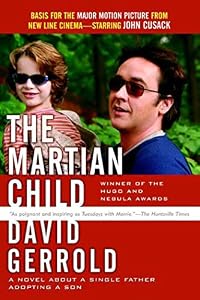
The Martian Child: A Novel About A Single Father Adopting A Son
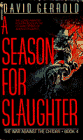
by David Gerrold
On This Page
Description
Gerrold, a science fiction writer from California, adopts a son who has been classified as "unadoptable" due to his violent emotional outbursts resulting from abuse. Another side-effect of his turbulent early years is that he believes himself to be a Martian. Gerrold begins the long, involving work of trying to earn the acceptance of Dennis, a hyperactive eight-year-old who desperately wants a father's love, but is so insecure he feels he must be an alien. Gerrold's recounting of the first show more two years with Dennis ends with the climax of Dennis running away and waiting in a city park at night for the flying saucers to come and reclaim him. Funny, endearing, and at times, heartbreaking, this is a beautifully written testament to fatherhood.This book is semiautobiographical. Gerrold did adopt a son, but he heard about a boy who thought he was a Martian from another adoptive father. show lessTags
Recommendations









Member Reviews
What was supposed to be a random book picked up from the cheap pile to be read during a particularly tedious train trip turned out to be an honest, heartwarming, and heartfelt account of two people fighting tooth and nail to create and sustain a human connection in a cold and confusing world.
David has been preparing to adopt a child for over a year. He has read countless books, watched countless videos, talked to countless people, and even redecorated his house. When he sees Dennis’ picture and hears his story, sci-fi author David knows he has finally found his son, and is prepared to do anything not to be the next one in the line of adults who have disappointed and abandoned the eight-year-old.
In the process of trying to be a good show more father to abused, mistrustful, and emotionally unstable Dennis, who claims to be a Martian who must one day return to his home planet, David has to come to terms with his own childhood, identity, fears, with all he has lost and all he hopes to gain by loving somebody again.
This short read brilliantly explores what forms the basis of human interaction, and our capacity to understand each other’s pain and find the best way to be there for each other. It manages to be deep, emotional, and clever, without ever once seeming pathetic, forced, or clichéd, and is one of those books that will make you laugh out loud right before moving you to tears. show less
David has been preparing to adopt a child for over a year. He has read countless books, watched countless videos, talked to countless people, and even redecorated his house. When he sees Dennis’ picture and hears his story, sci-fi author David knows he has finally found his son, and is prepared to do anything not to be the next one in the line of adults who have disappointed and abandoned the eight-year-old.
In the process of trying to be a good show more father to abused, mistrustful, and emotionally unstable Dennis, who claims to be a Martian who must one day return to his home planet, David has to come to terms with his own childhood, identity, fears, with all he has lost and all he hopes to gain by loving somebody again.
This short read brilliantly explores what forms the basis of human interaction, and our capacity to understand each other’s pain and find the best way to be there for each other. It manages to be deep, emotional, and clever, without ever once seeming pathetic, forced, or clichéd, and is one of those books that will make you laugh out loud right before moving you to tears. show less
I was trying to remember why I picked up the film version of The Martian Child several years ago. It could have been because of John Cusack. Or because I'm adopted. Probably John Cusack. Most of what I remember is that I cried all through the credits. So, when I came across the book in our library's catalog I decided to give it a try. It's a good thing it's a short book... because I cried. I completely didn't expect it because I'm usually pretty detached when reading, but the story brought up a lot of feelings for me regarding the way my Mom and I came to be family. It's not a sad book, it's very funny in places, although it doesn't paint a very kind picture about the adoption process. It's also quite different from the film. Anyway, if show more you're interested in adoption stories or just need a little cathartic experience, I'd recommend it. show less
"Today, I recognize that being human is the greatest adventure of all. And being a parent is the best part of that adventure," David Gerrold writes in the afterward of the Kindle edition of The Martian Child - an autobiographical piece about his adoptive son. "[A]nyone who hasn't experienced that hasn't finished the job of learning how to be human."
I caught the film adaptation Thursday morning, staying up until three to watch it - after baking pies all Wednesday night for Thanksgiving, I needed some quiet time with the TV and my eyes were too heavy for book reading. The film stars John Cusack as science fiction writer David Gordon - the straight version of David Gerrold, the author of the novelette turned novel turned film (not really show more sure which order that falls in, though). And like with most movies I fall in love with, I instantly wonder whether or not there was a book before hand. Even before the film was rolling its credits, I had downloaded the novelette to my Kindle - one can never be sure if you'll like the writer's style, so I opted for the novelette rather than the novel. The fact that it was under $4 also didn't hurt.
David Gerrold's writer, as I learned, is marvelous. There's a certain wit that most writers lack these days - whatever happened to them, I wonder. The story's a great, short read and I do look forward to purchasing the novel the moment I have placed this story behind me - if it's too familiar, I tend to lose interest in a story. Also, I'd want a hard copy of the book so I can lug it around to show people what I'm reading.
As a soon-to-be father, I feel that I can relate - sort of. Aren't all children aliens to new parents? And while I hope my little bundle of joy doesn't grow up to think she's a Martian, I do hope she is blessed with such a wonderful imagination, one that puts my childhood antics to shame.
It's a must read for all parents, new, old and adoptive. And I hope to learn as much from my child that David Gerrold learned from his. show less
I caught the film adaptation Thursday morning, staying up until three to watch it - after baking pies all Wednesday night for Thanksgiving, I needed some quiet time with the TV and my eyes were too heavy for book reading. The film stars John Cusack as science fiction writer David Gordon - the straight version of David Gerrold, the author of the novelette turned novel turned film (not really show more sure which order that falls in, though). And like with most movies I fall in love with, I instantly wonder whether or not there was a book before hand. Even before the film was rolling its credits, I had downloaded the novelette to my Kindle - one can never be sure if you'll like the writer's style, so I opted for the novelette rather than the novel. The fact that it was under $4 also didn't hurt.
David Gerrold's writer, as I learned, is marvelous. There's a certain wit that most writers lack these days - whatever happened to them, I wonder. The story's a great, short read and I do look forward to purchasing the novel the moment I have placed this story behind me - if it's too familiar, I tend to lose interest in a story. Also, I'd want a hard copy of the book so I can lug it around to show people what I'm reading.
As a soon-to-be father, I feel that I can relate - sort of. Aren't all children aliens to new parents? And while I hope my little bundle of joy doesn't grow up to think she's a Martian, I do hope she is blessed with such a wonderful imagination, one that puts my childhood antics to shame.
It's a must read for all parents, new, old and adoptive. And I hope to learn as much from my child that David Gerrold learned from his. show less
An interesting peek into David Gerrold's heart and mind, this is the true story of his first year with his adopted son. Gerrold, a single father (and the talented writer who wrote Star Trek's "The Trouble with Tribbles" original episode, as well as the War with the Chtorr series) and a gay man, had little difficulty with the legal barriers of our national adoption system. He seemed to have sailed through those with only the usual bureaucratic hassles. So this book is in no way a "how-to" guide for prospective adoptive parents.
It is instead an intense examination of Gerrold's struggles to determine just what kind of a father he wants to be. Written in Gerrold's trademark conversational style, the book is much more of an examination of show more Gerrold himself than it is of the daily strains of living with the demands of a special needs child.
And that may be my only real criticism of the work. While it was fascinating to peer into the mind of one of my favorite authors, at the end of the day I found the book strangely lacking in the very real clashes that take place between any child and its parents. I'm not an adoptive parent, but I am a single mom, and there were many times I found myself teetering on the edge of abusive behavior. And even when I overcame my early conditioning and learned to be the loving and supportive mother my kids deserved, the constant second-guessing I engage in about how much to say to my children and when to say it can be exhausting. Gerrold's account is strangely lacking in this area.
Oh, there are a few internal struggles, where he seems to half-heartedly confront the desire to chuck the adoption and go back to childless freedom -- but the issue is never really at stake. And for me, that gives the entire story a pretty bloodless feeling. My children, though not adopted, were all desperately wanted -- but I could write a tome the size of WAR AND PEACE about my struggles to appropriately parent each of them, and their struggles to live with me. At the end of the day, Gerrold's account, though interesting, just seems too facile.
To give the man credit, there are circumstances that might play into the seeming ease of his transition to full-time parenting, that I lacked. For one thing, Gerrold was older than I when he first entered fatherhood -- and he was a very successful author and teacher. His financial circumstances were certainly far removed from mine when I found myself a single mother -- and from long acquaintance with the truly economically disadvantaged, I can tell you that lack of money makes a real difference in a parent's peace of mind. Gerrold had also soaked up every piece of information he could on being a dad -- and though I had read a myriad of parenting guides in my time, when I was struggling with my children's issues there wasn't a lot of literature out there on their particular needs. Gerrold also had a strong local support system -- a close-knit and loving family and good friends who backed his decision to become a parent one hundred percent. My own family fairly defines the word dysfunctional, and my children and I had to become our own support system -- which became all too much like the worm Oubourous, devouring its own tail.
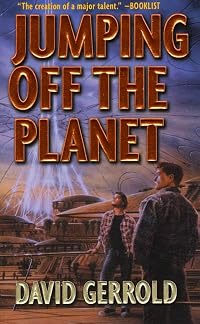
Still and all, when I closed the covers of this book, I felt that there was something missing in Gerrold's account. I had just read his LEAPING TO THE STARS, and found more seriously engaging introspection in the characters in his science fiction series of a family struggling to overcome its past than in his real life account of parenting his son. I just don't buy that parenting any child, much less a special needs one, is that easy. Gerrold, by his own account, seemed to have few internal doubts about his parenting skills, and to make almost no mistakes in dealing with his troubled boy. Oddly enough, I found that breeziness off-putting. Life is just not that simple, is it? I found much more internal self-examination when I went back and reread Gerrold's WAR WITH THE CHTORR books. It seems to me that those books, and his painstaking investigation of what it means to really be part of a family in the JUMPING OFF THE PLANET series, offers a more realistic glimpse of the real Gerrold than the too facile practically perfect dad presented in THE MARTIAN CHILD. It may be just me, struggling single mother of three, desperately struggling to keep my family afloat financially and emotionally, but my own story of being a parent is a good deal grittier than Gerrold's account.
Worth reading -- with a grain of salt. show less
It is instead an intense examination of Gerrold's struggles to determine just what kind of a father he wants to be. Written in Gerrold's trademark conversational style, the book is much more of an examination of show more Gerrold himself than it is of the daily strains of living with the demands of a special needs child.
And that may be my only real criticism of the work. While it was fascinating to peer into the mind of one of my favorite authors, at the end of the day I found the book strangely lacking in the very real clashes that take place between any child and its parents. I'm not an adoptive parent, but I am a single mom, and there were many times I found myself teetering on the edge of abusive behavior. And even when I overcame my early conditioning and learned to be the loving and supportive mother my kids deserved, the constant second-guessing I engage in about how much to say to my children and when to say it can be exhausting. Gerrold's account is strangely lacking in this area.
Oh, there are a few internal struggles, where he seems to half-heartedly confront the desire to chuck the adoption and go back to childless freedom -- but the issue is never really at stake. And for me, that gives the entire story a pretty bloodless feeling. My children, though not adopted, were all desperately wanted -- but I could write a tome the size of WAR AND PEACE about my struggles to appropriately parent each of them, and their struggles to live with me. At the end of the day, Gerrold's account, though interesting, just seems too facile.
To give the man credit, there are circumstances that might play into the seeming ease of his transition to full-time parenting, that I lacked. For one thing, Gerrold was older than I when he first entered fatherhood -- and he was a very successful author and teacher. His financial circumstances were certainly far removed from mine when I found myself a single mother -- and from long acquaintance with the truly economically disadvantaged, I can tell you that lack of money makes a real difference in a parent's peace of mind. Gerrold had also soaked up every piece of information he could on being a dad -- and though I had read a myriad of parenting guides in my time, when I was struggling with my children's issues there wasn't a lot of literature out there on their particular needs. Gerrold also had a strong local support system -- a close-knit and loving family and good friends who backed his decision to become a parent one hundred percent. My own family fairly defines the word dysfunctional, and my children and I had to become our own support system -- which became all too much like the worm Oubourous, devouring its own tail.
Still and all, when I closed the covers of this book, I felt that there was something missing in Gerrold's account. I had just read his LEAPING TO THE STARS, and found more seriously engaging introspection in the characters in his science fiction series of a family struggling to overcome its past than in his real life account of parenting his son. I just don't buy that parenting any child, much less a special needs one, is that easy. Gerrold, by his own account, seemed to have few internal doubts about his parenting skills, and to make almost no mistakes in dealing with his troubled boy. Oddly enough, I found that breeziness off-putting. Life is just not that simple, is it? I found much more internal self-examination when I went back and reread Gerrold's WAR WITH THE CHTORR books. It seems to me that those books, and his painstaking investigation of what it means to really be part of a family in the JUMPING OFF THE PLANET series, offers a more realistic glimpse of the real Gerrold than the too facile practically perfect dad presented in THE MARTIAN CHILD. It may be just me, struggling single mother of three, desperately struggling to keep my family afloat financially and emotionally, but my own story of being a parent is a good deal grittier than Gerrold's account.
Worth reading -- with a grain of salt. show less
It was great. I was sorta skeptic at first because it's written by a sci-fi author, but I snuck to the back shelves of the library and read the first few pages when I was supposed to be working. I couldn't put it down because it's just written so well, so I brought it home.
I loved practically everything about it: the dad's sarcastic sense of humor, how he expresses his complete and total love and devotion for his new son, the personal and philosophical insight, the fear I literally felt when he described the earthquake (he lives in CA), the Jewish mother allusions....
I actually cried reading this book. There are probably only 3 or 4 tear-inducing books that I've read so far.
Hm... you should read it.
I loved practically everything about it: the dad's sarcastic sense of humor, how he expresses his complete and total love and devotion for his new son, the personal and philosophical insight, the fear I literally felt when he described the earthquake (he lives in CA), the Jewish mother allusions....
I actually cried reading this book. There are probably only 3 or 4 tear-inducing books that I've read so far.
Hm... you should read it.
When David decides to adopt a boy from foster care as a single father he’s prepared to deal with the boy’s ADHD, reactive attachment disorder and history of abuse … but he’s not expecting to hear that little Dennis also thinks that he’s actually a Martian. Fortunately for both of them, this David is David Gerrold, an accomplished science fiction writer best known for writing the Star Trek episode The Trouble with Tribbles, so a boy with a fantasy of being a Martian isn’t going to be a problem. But as the pressures and demands of fatherhood mount, soon David begins to wonder … maybe it isn’t just a fantasy after all. This is a true story about adopting from the foster care system and the process of trying to become a good show more father. Gerrold is wholly honest without being brutal, depicting not only the realities of foster care and adoption but also the emotional challenges that are an everyday part of fatherhood. Every father, regardless of how he is parenting, will recognize himself in the story of Gerrold’s journey. show less
It worked better as a memoir than a novel. As a novel it was bland and sentimental, without enough detail of character or scene to make it work. As a memoir I forgive all and feel happy to know someone like David Gerrold is in the world. I forgive even the lack of detail, because it makes me feel that this dad didn't want to intrude too much on his son's privacy. I liked that about him--that he is so obviously a loving person and a good father. So many writers are willing to invade every corner of their family's privacy for a good story and I feel here that the author was deliberately avoiding this type of trespass.
Members
- Recently Added By
Lists

Adoption and Foster Care
19 works; 3 members
Author Information

138+ Works 12,219 Members
David Gerrold is one of the most popular science fiction writers working today. His first professional sale, the Star Trek episode "Trouble With Tribbles," won a Hugo Award. He has written for television, published more than forty books, and had columns in six different magazines. In 1995, his novelette "The Martian Child" won both the Hugo and show more Nebula Awards. Gerrold lives in San Fernando, California, and teaches writing at Pepperdine University show less
Awards and Honors
Awards
Work Relationships
Has the adaptation
Common Knowledge
- Original publication date
- 2002
- People/Characters
- David Gerrold; Dennis
- First words
- "Toward the end of the meeting, the caseworker remarked, "Oh-and one more thing. Dennis thinks he's a Martian."
"I beg your pardon?" - Last words
- (Click to show. Warning: May contain spoilers.)He held on forever.
Martians aren't the only ones who can wish."We walked out of the park together. He didn't look back. I snuck a peek, just in case.
But, no-
They never did come.
(Click to show. Warning: May contain spoilers.)Afterword: There are lots of nice things in the world to wish for, but it's more fun making them happen the old-fashioned way.
Classifications
Statistics
- Members
- 306
- Popularity
- 104,054
- Reviews
- 23
- Rating
- (3.86)
- Languages
- English, Spanish
- Media
- Paper, Audiobook, Ebook
- ISBNs
- 17
- ASINs
- 2