Slow Reading
by John Miedema 
On This Page
Description
"A study of voluntary slow reading from diverse angles"--Provided by publisher.Tags
Recommendations






Member Reviews
Jacket Blurb: Slow Reading examines the research in voluntary slow reading, from the earliest references in religion and philosophy, to the practice of close reading in the humanities, and the recent swell of interest associated with the Slow Movement. It looks at the diverse angles from which slow reading has been approached in education, library sciences and media studies. Research in psychology and neurophysiology provides a tentative explanation for the ongoing role of slow reading. The theme of locality in the Slow Movement provides insight into the importance of physical location in our relationship with information. Most of all, Slow Reading represents a rediscovery of the pleasure of reading for its own sake. /Jacket show more Blurb
Miedema's tiny volume is meant to be a scholarly argument for reading: reading for pleasure, reading for comprehension, reading as escape. In five essays, he picks apart different aspects of speed reading and its associated trends, and argues that slow reading is as valid in modern times as speed and efficiency.
It's clear from the outset that this book was meant to be academic, and while it is clear and readable, it often requires concentration from its readers (which, I suppose, was intentional). So, readers should be aware that this is what they're getting into with this book.
This isn't to say that Miedema's work is without emotion or art. He often speaks of the inherent sacredness of reading, its therapeutic powers, and its timelessness as both deliverer of information, and pleasant hobby. He also makes resounding and compelling arguments for libraries and their use in modern times. His proposed make-believe book, A Librarian's Guide to Getting Lost would be an excellent next project for him. I would love to read it.
However, there are times when Miedema shows his prejudices on this topic. This book was written just before the current boom in eReaders, and so he doesn't understand them as well as he would now. However, he argues that they could never replace books because they have too many "bells and whistles" and that they, like hypertext online, are too distracting to allow true concentration. To me, this seems to be a bit of projection. I'm pretty old school about reading: I really don't like reading lengthy texts online either. However, I adore my eReader because it feels like reading a book, and it allows me to carry two hundred books in my purse. It would be interesting to see what Miedema would write a year after receiving a current-generation eReader as a gift.
The real shame is that this book was written as an argument at all. When Miedema speaks about slow reading, books, and reading and writing in general, he becomes almost rhapsodic. That is the book I wanted to read: a gift from one bibliophile to another. But then, that's my prejudice. Miedema writes one hell of an essay, and makes some excellent points all through the book. It's a quick read (har har) but a deep one, and any problems with it do not outweigh the importance of what Miedema's saying here. If you're feeling rushed, and want motivation and justification to take a breath and enjoy your life for once, Slow Reading will give you that and much more. show less
Miedema's tiny volume is meant to be a scholarly argument for reading: reading for pleasure, reading for comprehension, reading as escape. In five essays, he picks apart different aspects of speed reading and its associated trends, and argues that slow reading is as valid in modern times as speed and efficiency.
It's clear from the outset that this book was meant to be academic, and while it is clear and readable, it often requires concentration from its readers (which, I suppose, was intentional). So, readers should be aware that this is what they're getting into with this book.
This isn't to say that Miedema's work is without emotion or art. He often speaks of the inherent sacredness of reading, its therapeutic powers, and its timelessness as both deliverer of information, and pleasant hobby. He also makes resounding and compelling arguments for libraries and their use in modern times. His proposed make-believe book, A Librarian's Guide to Getting Lost would be an excellent next project for him. I would love to read it.
However, there are times when Miedema shows his prejudices on this topic. This book was written just before the current boom in eReaders, and so he doesn't understand them as well as he would now. However, he argues that they could never replace books because they have too many "bells and whistles" and that they, like hypertext online, are too distracting to allow true concentration. To me, this seems to be a bit of projection. I'm pretty old school about reading: I really don't like reading lengthy texts online either. However, I adore my eReader because it feels like reading a book, and it allows me to carry two hundred books in my purse. It would be interesting to see what Miedema would write a year after receiving a current-generation eReader as a gift.
The real shame is that this book was written as an argument at all. When Miedema speaks about slow reading, books, and reading and writing in general, he becomes almost rhapsodic. That is the book I wanted to read: a gift from one bibliophile to another. But then, that's my prejudice. Miedema writes one hell of an essay, and makes some excellent points all through the book. It's a quick read (har har) but a deep one, and any problems with it do not outweigh the importance of what Miedema's saying here. If you're feeling rushed, and want motivation and justification to take a breath and enjoy your life for once, Slow Reading will give you that and much more. show less
 This review was written for LibraryThing Early Reviewers.
John Miedema's Slow Reading (Litwin Books, 2009) was written based on the author's library school research at the University of Western Ontario. It's a short (65-page) exploration of the idea that "reading slowly allows for a deeper relationship with stories and ideas" (p. 1).
Miedema offers four essays: the first, "The Personal Nature of Slow Reading," provides a short history of the concept and various metaphorical approaches to reading (particularly the idea of reading as consuming, a la Francis Bacon). He differentiates "slow reading" as a voluntary act from "close reading" as a professional practice; its voluntary nature, he suggests, is the key aspect - it's not just reading slowly, but actively engaging with the text.
In the show more second essay, "Slow Reading in an Information Ecology," Miedema fleshes out his major point: that print remains the "superior technology for reading anything of length, quality, or substance" (p. 20), and that there is "something enduring about print" (p. 26) that e-readers (no matter their technical capacities) can manage. "Print," he writes, "enlists the hands, signalling the brain where to read next, and how much more there is to read. Digital reading shifts all the work to the eyes" (p. 31). While this is one of the things that has kept me from reading anything long-form in e-form (I find that I like to riffle the pages as I read, and often use a finger to trace my progress down the page), I'm not sure in the long run it's going to be what "saves print." As Miedema notes, there are important uses for both print and digital form (i.e. reference is better digitally, while long-form reading is best done in print).
Perhaps more controversially, Miedema suggests that digital books have not evolved into anything other than a sort of metadata for print books (that they exist "only for evaluative purposes before the reader seeks out the physical copy") (p. 37). I think it's too early to say that this is the case; while the statistics aren't in yet, it seems likely that many adopters of reading via the Kindle or iPad may not go out and buy physical copies of all the books they purchase for those devices (on the other hand, the amount of money I've spent on print copies of Google Books titles makes Miedema's point work in my specific case).
In the third essay, "The Slow Movement and Slow Reading," Miedema connects his idea of slow reading to the more general "slow movement," (slow food, &c.). As part of this, he suggests, we might look to some of the same principles that govern those concepts, like locality (reading local authors, or books about your home region). And in "The Psychology of Slow Reading," he offers a very wide-angle overview of the neuroscience behind reading. Finally, in "The Practice of Slow Reading," Miedema suggests ways to "do" slow reading, and fully engage your faculties in reading a text. These are the fairly intuitive things that many of us do when we really want to read: pick a comfortable spot, collect your thoughts, grab a notepad, &c. One of his hints is one I've found very useful - always read like you're going to write a review.
I'm very glad to see Miedema's research in published form, although I wish that some of the academic paraphernalia and style had been edited away. The in-text citations break up the flow of the text, and the introduction of cited authors in this book is a bit stilted (they're only rarely referred to by first name, and usually just dropped into the text in the form of a surname and a publication date). There were certain areas that warranted more fleshing out, and I hope they will be in future works (by Miedema or others).
Overall, a valuable examination of the issues concerned, and a valuable reminder that you'll get more out of a book (no matter its form) if you engage with it fully and carefully.
http://philobiblos.blogspot.com/2010/07/book-review-slow-reading.html show less
Miedema offers four essays: the first, "The Personal Nature of Slow Reading," provides a short history of the concept and various metaphorical approaches to reading (particularly the idea of reading as consuming, a la Francis Bacon). He differentiates "slow reading" as a voluntary act from "close reading" as a professional practice; its voluntary nature, he suggests, is the key aspect - it's not just reading slowly, but actively engaging with the text.
In the show more second essay, "Slow Reading in an Information Ecology," Miedema fleshes out his major point: that print remains the "superior technology for reading anything of length, quality, or substance" (p. 20), and that there is "something enduring about print" (p. 26) that e-readers (no matter their technical capacities) can manage. "Print," he writes, "enlists the hands, signalling the brain where to read next, and how much more there is to read. Digital reading shifts all the work to the eyes" (p. 31). While this is one of the things that has kept me from reading anything long-form in e-form (I find that I like to riffle the pages as I read, and often use a finger to trace my progress down the page), I'm not sure in the long run it's going to be what "saves print." As Miedema notes, there are important uses for both print and digital form (i.e. reference is better digitally, while long-form reading is best done in print).
Perhaps more controversially, Miedema suggests that digital books have not evolved into anything other than a sort of metadata for print books (that they exist "only for evaluative purposes before the reader seeks out the physical copy") (p. 37). I think it's too early to say that this is the case; while the statistics aren't in yet, it seems likely that many adopters of reading via the Kindle or iPad may not go out and buy physical copies of all the books they purchase for those devices (on the other hand, the amount of money I've spent on print copies of Google Books titles makes Miedema's point work in my specific case).
In the third essay, "The Slow Movement and Slow Reading," Miedema connects his idea of slow reading to the more general "slow movement," (slow food, &c.). As part of this, he suggests, we might look to some of the same principles that govern those concepts, like locality (reading local authors, or books about your home region). And in "The Psychology of Slow Reading," he offers a very wide-angle overview of the neuroscience behind reading. Finally, in "The Practice of Slow Reading," Miedema suggests ways to "do" slow reading, and fully engage your faculties in reading a text. These are the fairly intuitive things that many of us do when we really want to read: pick a comfortable spot, collect your thoughts, grab a notepad, &c. One of his hints is one I've found very useful - always read like you're going to write a review.
I'm very glad to see Miedema's research in published form, although I wish that some of the academic paraphernalia and style had been edited away. The in-text citations break up the flow of the text, and the introduction of cited authors in this book is a bit stilted (they're only rarely referred to by first name, and usually just dropped into the text in the form of a surname and a publication date). There were certain areas that warranted more fleshing out, and I hope they will be in future works (by Miedema or others).
Overall, a valuable examination of the issues concerned, and a valuable reminder that you'll get more out of a book (no matter its form) if you engage with it fully and carefully.
http://philobiblos.blogspot.com/2010/07/book-review-slow-reading.html show less
This brief, attractively designed book is a master's thesis. It reads like a master's thesis. It is very, very important that readers, information science professionals, and policy-makers read this cogent, well-argued tract on the role of reading and the varying styles that reading follows.
John Miedema writes with concision and care of the subject at hand, the absorptive reading of text. He doesn't denigrate the role of any type of reading...he explicitly states that scanning, skimming, skipping all have roles in the reader's tool-box...but he is bucking a trend in his inclusiveness. He presents us with a good overview of the current research on and thinking about reading in a digital age. He notes that many information professionals show more take an all-or-nothing view of the practice of reading: A slow reader must be a defective reader, and in need of intervention and help.
Miedema says that slow reading, deep reading, whatever label one applies to the immersive and absorptive act of book consumption, is appropriate for some types of texts in some siituations, not all texts in all situations. His point is borne out in research done in the past 20 years, as the digital information revolution has occurred; one reads, and it IS reading, snippets and chunks of text on the Internet or in electronic formats; full-on absorptive reading is still more often done in physical print by most people. Miedema gives full and deserved marks to digital media for their vast superiority in enabling and delivering research and citation to the academic or student. Most of us fit the student category at least some of the time, and so we tend to use the Internet and other electronic sources to fulfil those functions because they are so fast, so easy, and so pervasive. However, learning-reading is still done with a tree-book in hand not an e-book on a desktop.
The brevity of this text, only some 65pp, doesn't admit of depth in presentation of the discovered facts. The author himself proposes, within his text, two books that I would like to see published, and will purchase as soon as they are available: "The Librarian's Guide to Getting Lost", a text intended to guide the cicerones behind the check-out rostrum in overcoming the urge to offer perplexed readers more of the same thing they already read; and "100-Mile Stories: A Year of Reading Locally", a book that argues for the creation, maintenance, and consumption of stories written within and about the near vicinity of your home. This plays off the bible of the Slow Food movement, "The 100-Mile Diet: A Year of Local Eating", in both title and inspiration.
I recommend this book highly to the reader whose search for story goes beyond the need to distract one's self, to the seeker after answers to the eternal "why?" of life, and to anyone even remotely connected with, or planning to join, the universe of library-science practicioners. Don't even pick it up if you have a low tolerance for academic style. The citations alone would make you homicidal.
Go! Now! The publisher is waiting for your VISA card at http://www.litwinbooks.com/ show less
John Miedema writes with concision and care of the subject at hand, the absorptive reading of text. He doesn't denigrate the role of any type of reading...he explicitly states that scanning, skimming, skipping all have roles in the reader's tool-box...but he is bucking a trend in his inclusiveness. He presents us with a good overview of the current research on and thinking about reading in a digital age. He notes that many information professionals show more take an all-or-nothing view of the practice of reading: A slow reader must be a defective reader, and in need of intervention and help.
Miedema says that slow reading, deep reading, whatever label one applies to the immersive and absorptive act of book consumption, is appropriate for some types of texts in some siituations, not all texts in all situations. His point is borne out in research done in the past 20 years, as the digital information revolution has occurred; one reads, and it IS reading, snippets and chunks of text on the Internet or in electronic formats; full-on absorptive reading is still more often done in physical print by most people. Miedema gives full and deserved marks to digital media for their vast superiority in enabling and delivering research and citation to the academic or student. Most of us fit the student category at least some of the time, and so we tend to use the Internet and other electronic sources to fulfil those functions because they are so fast, so easy, and so pervasive. However, learning-reading is still done with a tree-book in hand not an e-book on a desktop.
The brevity of this text, only some 65pp, doesn't admit of depth in presentation of the discovered facts. The author himself proposes, within his text, two books that I would like to see published, and will purchase as soon as they are available: "The Librarian's Guide to Getting Lost", a text intended to guide the cicerones behind the check-out rostrum in overcoming the urge to offer perplexed readers more of the same thing they already read; and "100-Mile Stories: A Year of Reading Locally", a book that argues for the creation, maintenance, and consumption of stories written within and about the near vicinity of your home. This plays off the bible of the Slow Food movement, "The 100-Mile Diet: A Year of Local Eating", in both title and inspiration.
I recommend this book highly to the reader whose search for story goes beyond the need to distract one's self, to the seeker after answers to the eternal "why?" of life, and to anyone even remotely connected with, or planning to join, the universe of library-science practicioners. Don't even pick it up if you have a low tolerance for academic style. The citations alone would make you homicidal.
Go! Now! The publisher is waiting for your VISA card at http://www.litwinbooks.com/ show less
This review was written for LibraryThing Early Reviewers.Based on the title, I assumed that Slow Reading would tell me all the things I'm doing wrong. I read at a fairly fast pace, averaging about two books a week, and often chose teen books over Literature. I expected that, while having an interesting premise, I would ultimately disagree with the author if he told me I should slow down and read only "good" books.
That's not what this book is about. "Slow reading" is less about pace (though that tends to be a factor) that it is a deliberate mental shift from task-oriented purpose to pleasure: "The most obvious sense of slowness in reference to quality is temporal - we stop racing against the clock to better appreciate a meal or a book" (43). In five short chapters, Miedema calls for a return show more to this pleasurable savoring of books, Literature or no. He draws on such diverse subjects as the connection between religion and slow reading, the innate differences between online and from-the-page reading, and neuroscience to make his points. Besides agreeing more than I thought I would, I found myself slow reading his book as I stopped to ponder my own reading experiences, talk back about a point that struck me, or looked through the thorough list of references in the back to follow up an intriguing idea. show less
That's not what this book is about. "Slow reading" is less about pace (though that tends to be a factor) that it is a deliberate mental shift from task-oriented purpose to pleasure: "The most obvious sense of slowness in reference to quality is temporal - we stop racing against the clock to better appreciate a meal or a book" (43). In five short chapters, Miedema calls for a return show more to this pleasurable savoring of books, Literature or no. He draws on such diverse subjects as the connection between religion and slow reading, the innate differences between online and from-the-page reading, and neuroscience to make his points. Besides agreeing more than I thought I would, I found myself slow reading his book as I stopped to ponder my own reading experiences, talk back about a point that struck me, or looked through the thorough list of references in the back to follow up an intriguing idea. show less
This review was written for LibraryThing Early Reviewers.As I write this, I find that my relationship with the work is entangled in multiple ironies.
1. "Slow Reading" is a title that I took to heart: although the text weighs in at a mere 65 pages, I spent a good three months getting to the end of it. This review is, consequently, appearing rather later than it should be. Perhaps the author would be pleased.
2. Slow reading, we learn, encourages a measured, perhaps leisurely, approach to the absorption and ingestion of a piece of text. It can involve stopping to question or even argue with a work, mulling over its meaning, challenging the author's assertions or being challenged by them in return. It is, I felt, a very necessary reminder in today's world of information overload and ever-faster show more living. Thus, ironically, I had to make an effort to follow Miedema's advice — not because I was unaware of the need (how could someone read a book like this without being continually aware, every moment, of what the act of reading entails?), but because I agreed with so much of what was being said that it was easy to slip along without pausing to consider the arguments in detail.
When I did bring myself to concentrate, I could perhaps quibble with some of the assertions made. (Every computer is connected to a printer? No, I don't think so — and yet, he says it twice!) But these were minor details. I find myself in agreement with, and approval of, the overall message. Having been conscious for several years now of my own reading style and attention slipping away in favor of the multitasking, quick-skim approach encouraged by online tasks, I could hardly fail to approve. Perhaps this book may serve as a wake-up call to those who experience the same gradual loss.
3. Although the book characterizes print as a "superior technology" for deep, complex works, a "fixed" and enduring medium, the binding of this particular edition is exceptionally poor: several pages came completely unglued from the spine during a single pass through the contents.
Overall rating: 4 out of 5 stars. show less
1. "Slow Reading" is a title that I took to heart: although the text weighs in at a mere 65 pages, I spent a good three months getting to the end of it. This review is, consequently, appearing rather later than it should be. Perhaps the author would be pleased.
2. Slow reading, we learn, encourages a measured, perhaps leisurely, approach to the absorption and ingestion of a piece of text. It can involve stopping to question or even argue with a work, mulling over its meaning, challenging the author's assertions or being challenged by them in return. It is, I felt, a very necessary reminder in today's world of information overload and ever-faster show more living. Thus, ironically, I had to make an effort to follow Miedema's advice — not because I was unaware of the need (how could someone read a book like this without being continually aware, every moment, of what the act of reading entails?), but because I agreed with so much of what was being said that it was easy to slip along without pausing to consider the arguments in detail.
When I did bring myself to concentrate, I could perhaps quibble with some of the assertions made. (Every computer is connected to a printer? No, I don't think so — and yet, he says it twice!) But these were minor details. I find myself in agreement with, and approval of, the overall message. Having been conscious for several years now of my own reading style and attention slipping away in favor of the multitasking, quick-skim approach encouraged by online tasks, I could hardly fail to approve. Perhaps this book may serve as a wake-up call to those who experience the same gradual loss.
3. Although the book characterizes print as a "superior technology" for deep, complex works, a "fixed" and enduring medium, the binding of this particular edition is exceptionally poor: several pages came completely unglued from the spine during a single pass through the contents.
Overall rating: 4 out of 5 stars. show less
This review was written for LibraryThing Early Reviewers.I loved the idea of "Slow Reading," but I found the book to be a little dry, a bit too academic for me. It was apparently written as the author's Masters thesis, so the tenor of it is, perhaps, understandable, but I think I was hoping for something a little lighter. I'm a fairly fast reader, but I've discovered that for books that I really want to take my time with, reading them on my iPhone on eReader or Kindle forces me to take my time, to read with more consciousness, and I find I get a lot more out of a book that way. "Slow reading" is, to my mind, something very worthwhile. I've never been a fan of speed reading unless it's absolutely necessary. When I read for pleasure, I like to take my time.
This review was written for LibraryThing Early Reviewers.I picked this book up at ALA and failed to take its advice; I read it on the plane home, on the short flight between Chicago and Minneapolis. I like the link it makes between reading thoughtfully and the 'slow' movement, and the fact that print has certain qualities that e-books don't; that e-books are 'metadata' for print books. (The Myth of the Paperless Office does a good job of explaining why paper offers 'affordances' not found in digital texts.) He points out the interesting fact that reading slowly is, one the one hand a sign of deficiency in children but, when pressed into critical service, is seen as a more 'professional' (if often implicitly joyless) kind of reading. I would have liked to see more attention to the author's show more claims for slow reading in connection to ludic reading (as Nell terms it); I wasn't convinced that the way he describes the practice of slow reading works with that feeling of being 'lost in a book,' so totally absorbed you are not aware of reading at all. I am also curious about the popular perception that enjoyable books are ones that can be read quickly: page-turners. I've had students whose highest praise for a book is that 'it was a fast read.' I'd like to have seen that perception addressed more thoroughly. But that's just because this little book left me thinking, and ready to keep thinking after reading it.
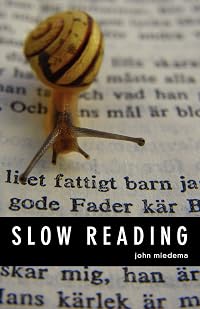
As an aside, I really love the cover. show less
As an aside, I really love the cover. show less
Members
- Recently Added By
Author Information

1 Work 103 Members
John Miedema is a LibraryThing Author, an author who lists their personal library on LibraryThing.
Common Knowledge
- Original publication date
- 2009
Classifications
- Genres
- Nonfiction, General Nonfiction
- DDC/MDS
- 028.9 — Computer science, information & general works Library & information sciences Reading and use of other information media Character of reading in libraries
- LCC
- Z1003 .M58 — Bibliography, Library Science and Information Resources General bibliography Biography of bibliographers
Statistics
- Members
- 103
- Popularity
- 313,812
- Reviews
- 24
- Rating
- (3.20)
- Languages
- English
- Media
- Paper, Ebook
- ISBNs
- 2
- ASINs
- 1