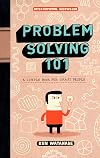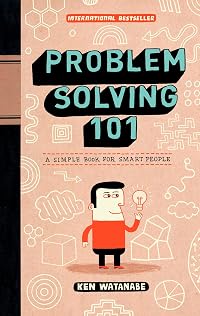
Problem Solving 101: A Simple Book for Smart People
by Ken Watanabe
On This Page
Description
Outlines a popular Japanese problem-solving strategy, explaining how the author's philosophies about critical thinking can be applied to American business environments to enable better decision making.Tags
Recommendations




Member Reviews
I wish this book were available to me when I was a kid. It made me realize so many of my decisions were quick, spontaneous and sometimes without any rational altogether.
Adults can also benefit from this book although adults might find it going at a sluggish pace.
But if you are a kid or a have a kid, do read it. It prepares one is going about any problem systematically without the need for unnecessary and rather stressful panic we tend to feel at times.
Any thing in our lives can be thought of as problem and we have to be systematic and disciplined about it if we were to do anything about it.
"Problem solving is easy when you know how to set a clear goal, figure out how to reach it, and follow through while reviewing your progress and show more making changes to your plan as necessary."
"Spend less time worrying about things and more time thinking about actions you can take to get closer to your goals, then actually take action."
“Luck is what happens when preparation meets opportunity.”
Must read book. I hope there is an adult version that discusses case studies of real world problems one faces commonly. show less
Adults can also benefit from this book although adults might find it going at a sluggish pace.
But if you are a kid or a have a kid, do read it. It prepares one is going about any problem systematically without the need for unnecessary and rather stressful panic we tend to feel at times.
Any thing in our lives can be thought of as problem and we have to be systematic and disciplined about it if we were to do anything about it.
"Problem solving is easy when you know how to set a clear goal, figure out how to reach it, and follow through while reviewing your progress and show more making changes to your plan as necessary."
"Spend less time worrying about things and more time thinking about actions you can take to get closer to your goals, then actually take action."
“Luck is what happens when preparation meets opportunity.”
Must read book. I hope there is an adult version that discusses case studies of real world problems one faces commonly. show less
This is a very brief book that translates fancy problem-solving techniques from the world of management consulting into terms that kids (including big 'kids' like me) can understand. As a former business PR consultant, I recognized many of the analysis techniques and was delighted to see them applied to issues like: forming a rock band, buying a computer and choosing a school to attend. It reminded me that applying a little bit of rigorous thought to everyday problems probably isn't a bad idea in many cases.
This review is based on the Blinkist version of the book...thus a summary and my review needs to be qualified as such. Presumably the original full text has much more details and research.....but it also takes much longer to read. If I like the Blinkist version, I might seek out and read the full book. I remember one of y ex bosses commenting that he had worked with Ken Watenabe, the author, at some stage in McKinsey’s in Japan and had a very high opinion of him. A few ex-McKinsey people have written books on problem solving. Meanwhile, here are some snippets that caught my attention:
No matter the scale of the problems we face, not all of us are well-equipped to solve them.
That’s where the four essential steps come in. They can help show more you solve any problem.
1. The first step is to identify what your problem is really about. To do so, you have to take the problem and break it down into smaller parts.....Once you’ve pinpointed your weak spot, you can begin to solve the problem much more effectively by focusing all your attention on.....So now you know exactly where your problem is. However, you haven’t solved it yet.
2. Next up, work out what exactly is causing your problem. “Problem-solving isn’t a talent that some people have and others....To discover what’s causing your problem, brainstorm the potential reasons and test your ideas......you have to work out why it’s a problem. In other words, what’s causing it?...
a. First list all the possible causes you can come up with......a great method of testing is to use a tool called a yes/no tree to answer a few yes/no questions that help clarify your hypothesis.
b. If the answer is “yes,” the tree unfolds into more branches, and the band [ example is a music band] have to answer another yes/no question: Did the group of people who knew about the concert actually attend?......Keep asking yes/no questions until you have all the answers to support your hypotheses....Then you’ll have your root cause and be ready for the next step:
3. Analyzing that cause so you can form an action plan......Start by asking yourself: What information do I need to analyze the situation?.....Now you’ve collated and analyzed all the information; It’s time to develop possible solutions......
a. All these possible solutions were written down and laid out in a table.
b. Then they arranged each solution under one column or another, according to how and where they were impactful..With many possible solutions, you need to prioritize and determine which will be included in your action plan.
c. If you want to successfully hunt down a big dream, you need to break it up into smaller goals. Make sure the goals are obvious and set them one at a time.
d. You must create ways to close the gap between your current situation and your goal. You can achieve this by making a list of all the possible solutions before choosing the best one, which will become the hypothesis for a potential solution......to choose the best idea, form a logic tree,
e. When the tree is complete, Eric eliminates the branches that seem neither achievable nor particularly effective, like winning the lottery and making investments. In the end, the good and feasible ideas are left.
f. Next up, step four: make an action plan. .....So, you’ve nailed down your problem, you know the root cause and you’ve created a hypothesis to solve it. You’re pretty much ready to take action. But first, you need to analyze your hypothesis to work out how exactly to implement it.
4. With the analysis done, it’s finally time for the fourth step: execution. Remember, a plan is worth nothing if you don’t execute it. So be sure to execute it well.And be prepared to make adjustments along the way!
The key message in this book: Everyone faces problems, from small ones like a geometry sum to big ones like fulfilling a lifelong dream. Luckily it only takes four steps to solve any problem: break it down, see what’s causing the problem, analyze the cause, and, finally, execute an action plan.
I guess that they did call this problem solving 101 and that sort of sums it up. It IS pretty basic stuff. Reasonable but not original or exciting. And I got a bit lost in his four steps: was analysis a step or only part of the action plan? Not obvious. Two stars from me. show less
No matter the scale of the problems we face, not all of us are well-equipped to solve them.
That’s where the four essential steps come in. They can help show more you solve any problem.
1. The first step is to identify what your problem is really about. To do so, you have to take the problem and break it down into smaller parts.....Once you’ve pinpointed your weak spot, you can begin to solve the problem much more effectively by focusing all your attention on.....So now you know exactly where your problem is. However, you haven’t solved it yet.
2. Next up, work out what exactly is causing your problem. “Problem-solving isn’t a talent that some people have and others....To discover what’s causing your problem, brainstorm the potential reasons and test your ideas......you have to work out why it’s a problem. In other words, what’s causing it?...
a. First list all the possible causes you can come up with......a great method of testing is to use a tool called a yes/no tree to answer a few yes/no questions that help clarify your hypothesis.
b. If the answer is “yes,” the tree unfolds into more branches, and the band [ example is a music band] have to answer another yes/no question: Did the group of people who knew about the concert actually attend?......Keep asking yes/no questions until you have all the answers to support your hypotheses....Then you’ll have your root cause and be ready for the next step:
3. Analyzing that cause so you can form an action plan......Start by asking yourself: What information do I need to analyze the situation?.....Now you’ve collated and analyzed all the information; It’s time to develop possible solutions......
a. All these possible solutions were written down and laid out in a table.
b. Then they arranged each solution under one column or another, according to how and where they were impactful..With many possible solutions, you need to prioritize and determine which will be included in your action plan.
c. If you want to successfully hunt down a big dream, you need to break it up into smaller goals. Make sure the goals are obvious and set them one at a time.
d. You must create ways to close the gap between your current situation and your goal. You can achieve this by making a list of all the possible solutions before choosing the best one, which will become the hypothesis for a potential solution......to choose the best idea, form a logic tree,
e. When the tree is complete, Eric eliminates the branches that seem neither achievable nor particularly effective, like winning the lottery and making investments. In the end, the good and feasible ideas are left.
f. Next up, step four: make an action plan. .....So, you’ve nailed down your problem, you know the root cause and you’ve created a hypothesis to solve it. You’re pretty much ready to take action. But first, you need to analyze your hypothesis to work out how exactly to implement it.
4. With the analysis done, it’s finally time for the fourth step: execution. Remember, a plan is worth nothing if you don’t execute it. So be sure to execute it well.And be prepared to make adjustments along the way!
The key message in this book: Everyone faces problems, from small ones like a geometry sum to big ones like fulfilling a lifelong dream. Luckily it only takes four steps to solve any problem: break it down, see what’s causing the problem, analyze the cause, and, finally, execute an action plan.
I guess that they did call this problem solving 101 and that sort of sums it up. It IS pretty basic stuff. Reasonable but not original or exciting. And I got a bit lost in his four steps: was analysis a step or only part of the action plan? Not obvious. Two stars from me. show less
Awesome book! Pointless reading 200 page self-help books about changing, motivation etc; when this is all you need. All those things are problems and this book gives you step by step guide on how to solve problems.
This book was a super quick read. It is clearly aimed at children (something they make clear at the beginning) and to someone who is already reasonably logical and a "list person" it was a little on the rudimentary side. Stepping outside of my head for a moment, it is a great primer on problem solving and thinking logically. It is especially interesting how in all of the "case studies" the subjects end up going through a re-frame, where they get to challenge their assumptions and correct them based on new information. This would be a great addition to school (and board room) curriculum.
It might help to be disciplined in the use of some of these "tools"—to follow them slavishly with the idea that the model is tried and true, even if intellectually incomplete. But mostly this is "thinking step-wise for dummies."
This book was originally conceived of as a book for Japanese schoolchildren and has apparently become a big hit with adults. The goal is to teach a systematic approach to problem solving by using some imaginary case studies involving 3 different scenarios. There is some useful processes outlined in these cases, but I'm finding it hard to believe that this book really was for kids. The case studies are, to my mind's eye, pretty abstract and I'm finding it tough to imagine any kid who could get engaged with these stories. But maybe that says more about American kids than it does about Japanese kids.
In all, the book is a quick read and does in fact provide some nice tools for decision-making. There's nothing revolutionary here and show more everything is common-sense, but it is nice to have it presented in such a clear fashion.
My only caveat: I purchased the book on my Kindle and the diagrams are really tough to read. I strongly recommend that you buy the atomic version. show less
In all, the book is a quick read and does in fact provide some nice tools for decision-making. There's nothing revolutionary here and show more everything is common-sense, but it is nice to have it presented in such a clear fashion.
My only caveat: I purchased the book on my Kindle and the diagrams are really tough to read. I strongly recommend that you buy the atomic version. show less
Members
- Recently Added By
Lists

Mind Expanding Books by hackerkid
581 works; 8 members
Author Information

7+ Works 287 Members
Classifications
- Genres
- Nonfiction, Business, General Nonfiction, Science & Nature
- DDC/MDS
- 153.43 — Philosophy & psychology Psychology Conscious mental processes and intelligence Thought, thinking, reasoning, intuition, value, judgment Problem Solving
- LCC
- BF449 .W37 — Philosophy, Psychology and Religion Psychology Psychology Consciousness. Cognition
- BISAC
Statistics
- Members
- 265
- Popularity
- 122,016
- Reviews
- 11
- Rating
- (3.86)
- Languages
- 6 — Dutch, English, Polish, Portuguese, Spanish, Turkish
- Media
- Paper, Ebook
- ISBNs
- 10
- ASINs
- 3