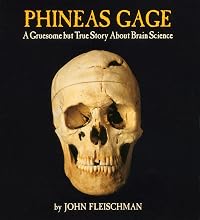
Phineas Gage: A Gruesome but True Story About Brain Science
by John Fleischman
On This Page
Description
Phineas Gage was truly a man with a hole in his head. Phineas, a railroad construction foreman, was blasting rock near Cavendish, Vermont, in 1848 when a thirteen-pound iron rod was shot through his brain. Miraculously, he survived to live another eleven years and become a textbook case in brain science.At the time, Phineas Gage seemed to completely recover from his accident. He could walk, talk, work, and travel, but he was changed. Gage "was no longer Gage," said his Vermont doctor, show more meaning that the old Phineas was dependable and well liked, and the new Phineas was crude and unpredictable.
His case astonished doctors in his day and still fascinates doctors today. What happened and what didn't happen inside the brain of Phineas Gage will tell you a lot about how your brain works and how you act human.
. show less
Tags
Recommendations
























Member Reviews
A couple of my kids have read this so I wanted to, as well. It was super interesting, for sure! The following quote provided interesting food for thought, though I'm not sure of the answer:
"If there are exact locations in the brain that allow for the ability to hear or to breathe, is there a place that generates human social behavior? If that place is damaged, do you stop acting human?"
"If there are exact locations in the brain that allow for the ability to hear or to breathe, is there a place that generates human social behavior? If that place is damaged, do you stop acting human?"
Phineas Gage: A popular science book that doesn't underestimate children, and presents a fascinating medical oddity for their enrichment and entertainment.
In Phineas Gage John Fleischman chronicles the adult life of a man who has the extreme misfortune to experience an iron rod fly through his head and out the top of his skull ... and live to tell the tale. Literally, in fact, as he sat chatting with his landlord about the accident while he waited the half hour for the nearest doctor to arrive. Despite the extreme improbability given the state of medical treatment in 1848, Phineas recovers from the incident and goes on to live an additional eleven years. However, the true subject of Fleischman's narrative is not really Phineas Gage as show more an individual, but rather how he helped inspire the medical community. In life, aspiring surgeons look at Gage's recovery as proof of a number of neurological theories. After his death his doctor finally reveals that his patient's recovery was not as "complete" as first suggested, and Phineas' medical history and remains go on to inspire and enlighten medical minds for decades to come.
Phineas Gage is remarkable all on his own, and Fleischman makes his story available to young readers. show less
In Phineas Gage John Fleischman chronicles the adult life of a man who has the extreme misfortune to experience an iron rod fly through his head and out the top of his skull ... and live to tell the tale. Literally, in fact, as he sat chatting with his landlord about the accident while he waited the half hour for the nearest doctor to arrive. Despite the extreme improbability given the state of medical treatment in 1848, Phineas recovers from the incident and goes on to live an additional eleven years. However, the true subject of Fleischman's narrative is not really Phineas Gage as show more an individual, but rather how he helped inspire the medical community. In life, aspiring surgeons look at Gage's recovery as proof of a number of neurological theories. After his death his doctor finally reveals that his patient's recovery was not as "complete" as first suggested, and Phineas' medical history and remains go on to inspire and enlighten medical minds for decades to come.
Phineas Gage is remarkable all on his own, and Fleischman makes his story available to young readers. show less
In 1848, Phineas Gage was a strong, well-liked railroad foreman who suffered a terrible accident. An explosion shot a three and a half foot tamping iron through his eye and skull. Miraculously, Gage survived. But he had changed. Now, he was crude and disrespectful. The accident eventually killed him, but it took eleven years to do so. In the meantime, Gage became a living experiment in the new science of the brain. He was the first case where doctors were able to link personality change to brain injury, and this link made great strides in neurology.
It seems like it would be very difficult to get kids interested in brain science, but this book combines exciting storytelling with full color graphics to tell a story that is both show more interesting and informative. Gage becomes a very real character, and students will both be sympathetic and fascinated. The brain science portions are written in easily understood language, and accompanied by photographs, illustrations, and graphs. There is also a very good glossary and comprehensive index at the end. But what will really grab readers' attention is the blood splatters, brain matter, and cracked skulls that litter the pages. As long as you aren't above using gore to get kids reading nonfiction, you'll find this to be an awesome addition to your library.
Grades 7-10 show less
It seems like it would be very difficult to get kids interested in brain science, but this book combines exciting storytelling with full color graphics to tell a story that is both show more interesting and informative. Gage becomes a very real character, and students will both be sympathetic and fascinated. The brain science portions are written in easily understood language, and accompanied by photographs, illustrations, and graphs. There is also a very good glossary and comprehensive index at the end. But what will really grab readers' attention is the blood splatters, brain matter, and cracked skulls that litter the pages. As long as you aren't above using gore to get kids reading nonfiction, you'll find this to be an awesome addition to your library.
Grades 7-10 show less
Read this in a single sitting last night. I bought it for my son to read because it was on our state's Battle of the Books list last year and he usually enjoys those titles, but he has not yet expressed interest in it. I think he is afraid it will frighten him.
I found it fascinating. I have long said that the best way to learn about any new subject is to start with children's books, which usually have simple language and good illustrations. This book, which is geared for middle grades, is a wonderful example. It gives a narrative about Phineas Gage, a railroad worker who suffered brain trauma when an iron bar went completely through his head, from his left jaw, up through the top of his skull. He made a full physical recovery and lived show more 11 more years, but his personality was greatly changed. The case of Phineas Gage provided much data for physicians studying brain function, and it is also a fascinating human story.
I'm going to hold on to this book in hopes of getting my son to read it. I highly recommend it! show less
I found it fascinating. I have long said that the best way to learn about any new subject is to start with children's books, which usually have simple language and good illustrations. This book, which is geared for middle grades, is a wonderful example. It gives a narrative about Phineas Gage, a railroad worker who suffered brain trauma when an iron bar went completely through his head, from his left jaw, up through the top of his skull. He made a full physical recovery and lived show more 11 more years, but his personality was greatly changed. The case of Phineas Gage provided much data for physicians studying brain function, and it is also a fascinating human story.
I'm going to hold on to this book in hopes of getting my son to read it. I highly recommend it! show less
This is a great read for kids and adults. It is a first look at traumatic brain injuries, how they happen and the resulting after effects. Phineas Gage was a 26-year-old foreman of a track construction gang building a railway. He is well-regarded on the job, is fair and kind. Then tragedy strike and a 13 pound iron rod enters just under his left cheek and into the left side of his brain. Most people would have died, but Phineas was actually alert and talking! He is something of a medical miracle when he survives after narrowly escaping a few infections that almost killed him.
But something was never quite right after the accident. Aside from his scar, Phineas looked the same, but his personality was forever altered. He became show more short-tempered, forgetful and mean and was dismissed from his job.
The book goes into what happened inside his brain to cause this change. I think it is a fascinating book that would appeal to both boys and girls. I have just the girl in mind for this book! show less
But something was never quite right after the accident. Aside from his scar, Phineas looked the same, but his personality was forever altered. He became show more short-tempered, forgetful and mean and was dismissed from his job.
The book goes into what happened inside his brain to cause this change. I think it is a fascinating book that would appeal to both boys and girls. I have just the girl in mind for this book! show less
This is a non-fiction novel about a man named Phineas Gage who had a hole in his head! What happened was Phineas was doing construction work when all of a sudden a thirteen pound rock went through his brain. Surprisingly, he survived and was able to live about another eleven years before he passed. Within that time, he became a case in the world of brain science. Phineas seemed as if he was perfectly fine after this incident, however doctors begged to differ. They said that before the accident he was dependable, but now he is "unrefined'. The book talks about how your brain works and how you act as human. What happened to Phineas still astonishes doctors and health practitioners today.
Honestly, this book was pretty interesting. What show more happened to Phineas was no joke. I mean a thirteen pound rock comes straight through your head yet you're still able to speak, walk, work, and travel. It's just fascinating really. I learned a lot about how the brain functions. This man was also just an ordinary railroad construction foreman. Who ever would've guessed that a rock would shoot through poor Phineas Gage's brain that day. On the bright side, if that never happened I wouldn't be sitting here writing a review on this book. show less
Honestly, this book was pretty interesting. What show more happened to Phineas was no joke. I mean a thirteen pound rock comes straight through your head yet you're still able to speak, walk, work, and travel. It's just fascinating really. I learned a lot about how the brain functions. This man was also just an ordinary railroad construction foreman. Who ever would've guessed that a rock would shoot through poor Phineas Gage's brain that day. On the bright side, if that never happened I wouldn't be sitting here writing a review on this book. show less
Children's book but it tells a fascinating story. Way back when--around the time of the 'wild west'--a man working with explosives at a mine amazingly survived a horrific accident. A tamping rod was blown through his head! He survived but his personality was never the same. Science at the time could not explain this, but now we know how different parts of the brain affect personality. The book talks about Phineas' life and clearly explains what is known about the brain and how scientists used his accident and later research to develop modern theories about how the brain works. It's all easy to understand (good for a children's book!) and fascinating stuff for those interested in science, human personality, or gruesome accidents. Child show more or not, I'd recommend it to anyone with an interest on those things! show less
Members
- Recently Added By
Lists

Children's Books About Science and Math
461 works; 12 members

Books for Fans of Stranger Things
84 works; 7 members

Ambleside Year 8
80 works; 1 member
Author Information
7 Works 1,249 Members
Awards and Honors
Awards
Distinctions
Common Knowledge
- People/Characters
- Dr. Henry Bigelow; Phineas Gage; Dr. John Harlow
- Important places
- Cavendish, Vermont, USA
- Quotations
- "I said at the beginning that you decide for yourself what kind of luck he had at the end. This is what I think: Phineas Gage was lucky. His accident was terrible. It changed him into someone else, and yet Phineas figured o... (show all)ut how to live as that new person for eleven years. He was limited in ways that are important to all human beings, but he found a way to live, working with horse. He took care of himself. He saw the world. He died with his family around him, the only people who knew both the old and new Phineas."
Classifications
- Genres
- Nonfiction, Tween, Kids
- DDC/MDS
- 362.1 — Society, government, & culture Social problems and social services Social Welfare People with physical illnesses
- LCC
- RC387.5 .F565 — Medicine Internal medicine Internal medicine Neurosciences. Biological psychiatry. Neuropsychiatry Neurology. Diseases of the nervous system
- BISAC
Statistics
- Members
- 1,172
- Popularity
- 21,435
- Reviews
- 42
- Rating
- (3.80)
- Languages
- English
- Media
- Paper, Audiobook, Ebook
- ISBNs
- 20
- UPCs
- 2
- ASINs
- 2
