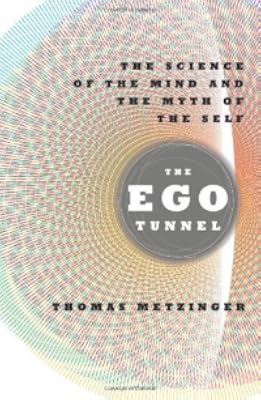
The Ego Tunnel: The Science of the Mind and the Myth of the Self
by Thomas Metzinger
On This Page
Description
Examine the inner workings of the mind and learn what consciousness and a sense of self really means-and if it even exists. We're used to thinking about the self as an independent entity, something that we either have or are. In "The Ego Tunnel", philosopher Thomas Metzinger claims otherwise: No such thing as a self exists. The conscious self is the content of a model created by our brain-an internal image, but one we cannot experience as an image. Everything we experience is "a virtual self show more in a virtual reality."But if the self is not "real," why and how did it evolve? How does the brain construct it? Do we still have souls, free will, personal autonomy, or moral accountability? In a time when the science of cognition is becoming as controversial as evolution, "The Ego Tunnel" provides a stunningly original take on the mystery of the mind. show lessTags
Recommendations









Member Recommendations
Member Reviews
What is it with philosophers? Nine times out of ten it’s not their ideas (once you’ve understood what those actually are) which are hard, it’s the language they’re “explained” in.
The Ego Tunnel is a good example. It’s about the nature of consciousness—“tunnel” being its central metaphor, based on the “reality tunnel” concept of virtual-reality research—and Metzinger first gives us his model of consciousness, contrasting the cut-down picture of the world each of us has inside our head with the actual world outside it. He discusses some of the features of this “tunnel”; he takes a closer look at what some of the brain’s more peculiar quirks, such as “out-of-body” experiences and lucid dreaming, show more might be telling us; then at empathy and social cognition; and, finally, he considers some of the ethical dilemmas posed by both the creation of artificial consciousness and the alteration and/or enhancement of our own
Fair enough, and some of the book’s ideas are interesting too. But unfortunately, its author being a philosopher, one of its most impressive features is the sheer silliness of some of the half-strangulated language used. Other parts are so woolly it’s like flying through dense fog. Why do philosophers do this? Are they sadists who enjoy dangling juicy ideas forever just out of reach? Or is it an ever-present anxiety that what they’re saying is actually utter nonsense?
Just to emphasise: I’m not giving this a one-star rating for its content (other reviewers have given it a three, four or five, and I might have done myself if it were written in plain English); my rating is for its unreadability. It’s time professional philosophers hired professional authors to write their books. show less
The Ego Tunnel is a good example. It’s about the nature of consciousness—“tunnel” being its central metaphor, based on the “reality tunnel” concept of virtual-reality research—and Metzinger first gives us his model of consciousness, contrasting the cut-down picture of the world each of us has inside our head with the actual world outside it. He discusses some of the features of this “tunnel”; he takes a closer look at what some of the brain’s more peculiar quirks, such as “out-of-body” experiences and lucid dreaming, show more might be telling us; then at empathy and social cognition; and, finally, he considers some of the ethical dilemmas posed by both the creation of artificial consciousness and the alteration and/or enhancement of our own
Fair enough, and some of the book’s ideas are interesting too. But unfortunately, its author being a philosopher, one of its most impressive features is the sheer silliness of some of the half-strangulated language used. Other parts are so woolly it’s like flying through dense fog. Why do philosophers do this? Are they sadists who enjoy dangling juicy ideas forever just out of reach? Or is it an ever-present anxiety that what they’re saying is actually utter nonsense?
Just to emphasise: I’m not giving this a one-star rating for its content (other reviewers have given it a three, four or five, and I might have done myself if it were written in plain English); my rating is for its unreadability. It’s time professional philosophers hired professional authors to write their books. show less
I have a psychology background, so I am deeply interested in neuroscience and AI research. I've even read Metzinger several times in the past, ranking him up there with Dennet and also a number of bleeding edge modern philosophers. :)
So I had to read this DESPITE that HORRIBLE TITLE. Ego Tunnel? Seriously? I mean, sure, he explains it as the outward connection after we've formulated our internal modality of consciousness, but STILL... EGO TUNNEL?
Enough bitching. And no crude jokes, please. This book is actually some pretty awesome philosophy, metaphysics, and neuroscience. He asks the big questions.
Such as, what is consciousness when it's being ignored by neuroscience or being butchered by quacks?
No laughter. He takes it seriously and show more it's well worth the effort to ask. We've all been asking it on one level or another, but everyone agrees: consciousness cannot and will not be reducible. No simple explanation will take away the quantity or the quality of anyone's experience. We all recognize our being conscious as highly subjective and reproducible. That's not an issue.
But what is an issue is HOW consciousness is formed. This is important for not only AI research or our damaged selves or any number of psychological needs-based therapy... but because of the fact of knowing causes a qualitative and quantifiable dimension to the nature of what we are. And from there, we have a lot more tools in our toolbox.
The book is a lot denser than I can give good treatment for a review, but let me explain some of my most exciting discoveries.
We are what we say we are. And by "say" I mean unconscious and conscious self-references. If we lose a leg, we might have a phantom limb, but we work around it because we have included our "body" in our reference frame. When we drive and get good at it, we often just "feel" if we'll make a tight parking space because we've included the car in our reference frame. It is our new "body". Pick up a baseball bat or a sword and make it an extension of you. Video games. You become your avatars if you're doing it right.
It is a meta-understanding of your surroundings that is infinitely adjustable. Reality itself is just a shadow, of course, in both physics and in the Platonic ideal, but our conscious and unconscious restructuring of our "body" field gives us better and better understanding of our surroundings. Connecting with other people with meta-narratives, models, modes, is an effort in sidestepping "reality" in order to fit the two models and narratives together. Hence... the tunnel. :)
Cool, right? Next comes the experiments and confirmation, but so much of this feels intuitively RIGHT.
We make up a meta-structure of reality inside our own heads, make our own body, and see if it conforms with everyone else's. The nature of Consciousness is just the self-awareness that springs up from having told a story and seeing whether it works with the observations or whether it needs to be thrown out.
So cool.
Mind you, that's just a minor feature of the whole book, but to me, it's pure gold. :) show less
So I had to read this DESPITE that HORRIBLE TITLE. Ego Tunnel? Seriously? I mean, sure, he explains it as the outward connection after we've formulated our internal modality of consciousness, but STILL... EGO TUNNEL?
Enough bitching. And no crude jokes, please. This book is actually some pretty awesome philosophy, metaphysics, and neuroscience. He asks the big questions.
Such as, what is consciousness when it's being ignored by neuroscience or being butchered by quacks?
No laughter. He takes it seriously and show more it's well worth the effort to ask. We've all been asking it on one level or another, but everyone agrees: consciousness cannot and will not be reducible. No simple explanation will take away the quantity or the quality of anyone's experience. We all recognize our being conscious as highly subjective and reproducible. That's not an issue.
But what is an issue is HOW consciousness is formed. This is important for not only AI research or our damaged selves or any number of psychological needs-based therapy... but because of the fact of knowing causes a qualitative and quantifiable dimension to the nature of what we are. And from there, we have a lot more tools in our toolbox.
The book is a lot denser than I can give good treatment for a review, but let me explain some of my most exciting discoveries.
We are what we say we are. And by "say" I mean unconscious and conscious self-references. If we lose a leg, we might have a phantom limb, but we work around it because we have included our "body" in our reference frame. When we drive and get good at it, we often just "feel" if we'll make a tight parking space because we've included the car in our reference frame. It is our new "body". Pick up a baseball bat or a sword and make it an extension of you. Video games. You become your avatars if you're doing it right.
It is a meta-understanding of your surroundings that is infinitely adjustable. Reality itself is just a shadow, of course, in both physics and in the Platonic ideal, but our conscious and unconscious restructuring of our "body" field gives us better and better understanding of our surroundings. Connecting with other people with meta-narratives, models, modes, is an effort in sidestepping "reality" in order to fit the two models and narratives together. Hence... the tunnel. :)
Cool, right? Next comes the experiments and confirmation, but so much of this feels intuitively RIGHT.
We make up a meta-structure of reality inside our own heads, make our own body, and see if it conforms with everyone else's. The nature of Consciousness is just the self-awareness that springs up from having told a story and seeing whether it works with the observations or whether it needs to be thrown out.
So cool.
Mind you, that's just a minor feature of the whole book, but to me, it's pure gold. :) show less
Ego Tunnel is not an undertaking of ontologic philosophy, but rather an attempt to introduce and make a case for the metaphor of an ego tunnel (a refining of what Metzinger identifies as a “reality tunnel” having its roots in virtual reality technologies). He is acting the part of an interlocutor or integrator of neuroscientific discoveries with philosophy and ethics. It is a radical and world-shifting work for the vast majority of modern humanity. This book was not written for cognitive scientists so much as for the “naïve materialist” which includes just about everybody on the planet (including you and me when we habitually fail to maintain the extraordinary awareness that we are looking at the inside of our own heads when we show more look at “out there”).
It’s problematic to discern M.’s view of the Ultimate Reality. However, here’s something from the introduction which gives some insight.
"Throughout the book, I use one central metaphor for conscious experience: the “Ego Tunnel”. Conscious Experience is like a tunnel. Modern neuroscience has demonstrated that the content of our conscious Experience is not only an internal construct but also an extremely selective way of representing information. This is why it is a tunnel: what we see and hear, or what we feel and smell and taste, is only a small fraction of what actually exists out there. Our conscious model of reality is a low-dimensional projection of the inconceivably richer physical reality surrounding and sustaining us [my italics]. Our sensory organs are limited: they evolved for reasons of survival, not for depicting the enormous wealth and richness of reality in all its unfathomable depth. Therefore, the ongoing process of conscious experience is not so much an image of reality as a tunnel through reality."
I think it’s safe to say Metzinger is a materialist. He looks at consciousness as a bottom-up epiphenomenon, the child of the increasing complexity and centricity of blind evolutionary forces. But, now that it’s here (we’re here), the exploration of consciousness via chemically- or meditationally-induced altered states of consciousness, lucid dreaming and out-of-body experiences is the new order of evolution. And an ethics of what is “good” consciousness and how to instil that in our children is part and parcel of a responsible way forward.
"We may well develop better meditative techniques than the Tibetan monks discussed in chapter 2. If dream research comes up with risk-free ways of improving dream recall and mastering the art of lucid dreaming, shouldn’t we make this knowledge available to our children? What about controlled out-of-body experiences? If research into mirror neurons clarifies the ways in which children develop empathy and social awareness, shouldn’t we make use of this knowledge in our schools?"
Metzinger is not a reductionist; he wishes to co-opt evolution with scientific knowledge/exploration. He sees religion as a survival-based aspect of the ego tunnel (for purposes of helping humans to feel “at home” where it’s ipso facto impossible) and which is being rendered obsolete and displaced by neuroscience and books/information like his. He then goes on to address the issues of this “consciousness revolution” resulting in a new social context and need for developing a neuroethics of same. show less
It’s problematic to discern M.’s view of the Ultimate Reality. However, here’s something from the introduction which gives some insight.
"Throughout the book, I use one central metaphor for conscious experience: the “Ego Tunnel”. Conscious Experience is like a tunnel. Modern neuroscience has demonstrated that the content of our conscious Experience is not only an internal construct but also an extremely selective way of representing information. This is why it is a tunnel: what we see and hear, or what we feel and smell and taste, is only a small fraction of what actually exists out there. Our conscious model of reality is a low-dimensional projection of the inconceivably richer physical reality surrounding and sustaining us [my italics]. Our sensory organs are limited: they evolved for reasons of survival, not for depicting the enormous wealth and richness of reality in all its unfathomable depth. Therefore, the ongoing process of conscious experience is not so much an image of reality as a tunnel through reality."
I think it’s safe to say Metzinger is a materialist. He looks at consciousness as a bottom-up epiphenomenon, the child of the increasing complexity and centricity of blind evolutionary forces. But, now that it’s here (we’re here), the exploration of consciousness via chemically- or meditationally-induced altered states of consciousness, lucid dreaming and out-of-body experiences is the new order of evolution. And an ethics of what is “good” consciousness and how to instil that in our children is part and parcel of a responsible way forward.
"We may well develop better meditative techniques than the Tibetan monks discussed in chapter 2. If dream research comes up with risk-free ways of improving dream recall and mastering the art of lucid dreaming, shouldn’t we make this knowledge available to our children? What about controlled out-of-body experiences? If research into mirror neurons clarifies the ways in which children develop empathy and social awareness, shouldn’t we make use of this knowledge in our schools?"
Metzinger is not a reductionist; he wishes to co-opt evolution with scientific knowledge/exploration. He sees religion as a survival-based aspect of the ego tunnel (for purposes of helping humans to feel “at home” where it’s ipso facto impossible) and which is being rendered obsolete and displaced by neuroscience and books/information like his. He then goes on to address the issues of this “consciousness revolution” resulting in a new social context and need for developing a neuroethics of same. show less
Becomes surprisingly preachy in the last chapters but it's thoroughly enjoyable and stimulating.
Dieses Buch hab ich gedanklich in zu viele Einzelteile zerlegt, um zu wissen, wie es mir gefällt, Lesekreis ftw. – Spannend wird es im letzten Drittel. Neue Ideen konnte es mir immer wieder bieten. Und so. Recht lesenswert, denk ich wohl. [Elaborierte Meinungen zu Büchern auch ftw.]
A philosophy-of-consciousness popularization, quite readable, and taking account of some results from neuroscience and some societal applications. Metzinger acknowledges that a true understanding of consciousness is far off.
Metzinger, a scientist and Buddhist practitioner, brings clarity and insight to the topic of ego/brain/consciousness. Highly recommended.
Members
- Recently Added By
Author Information

15+ Works 844 Members
Thomas Metzinger directs the Theoretical Philosophy Group and the Neuroethics Research Unit at the Johannes Gutenberg University in Mainz, Germany, and is an Adjunct Fellow at the Frankfurt Institute for Advanced Studies. He is currently President of the Association for the Scientific Study of Consciousness. He has written and edited ten books show more including Being No One, Conscious Experience, and Neural Correlates of Consciousness. He lives near Frankfurt, Germany. show less
Common Knowledge
- Original publication date
- 2009
- Dedication
- To Anja and my family
- First words
- In this book, I will try to convince you that there is no such thing as a self.
- Quotations
- Consciousness is the appearance of a world.
Classifications
Statistics
- Members
- 514
- Popularity
- 58,295
- Reviews
- 9
- Rating
- (3.70)
- Languages
- 6 — Dutch, English, German, Italian, Polish, Spanish
- Media
- Paper, Audiobook, Ebook
- ISBNs
- 13
- ASINs
- 8