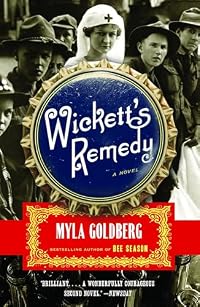
Wickett's Remedy
by Myla Goldberg
On This Page
Description
In a multidimensional, intricately wrought narrative, Myla Goldberg leads us back to Boston in the early part of the twentieth century and into two completely captivating worlds. One is that of Lydia, an Irish American shopgirl with bigger aspirations than your average young woman from South Boston. She seems to be well on her way to the life she has dreamed of when she marries Henry Wickett, a shy medical student and the scion of a Boston Brahmin family. However, soon after their wedding, show more Henry abruptly quits medical school to create a mail-order patent medicine called Wickett's Remedy, and just as Lydia begins to adjust to her husband's new vocation, the infamous Spanish influenza epidemic of 1918 begins its deadly sweep across the world, irrevocably changing their lives. In a world turned almost unrecognizable by swift and sudden tragedy, Lydia finds herself working as a nurse in an experimental ward dedicated to understanding the raging epidemic, through the use of human subjects. Meanwhile, a parallel narrative explores the world of QD Soda, the illegitimate offspring of Wickett's Remedy, stolen away by Henry Wickett's one-time business partner Quentin Driscoll, who goes about transforming it into a soft drink empire. Throughout the novel we hear from a chorus of other voices who offer a running commentary from the book's margins, playing off the ongoing narrative and cleverly illuminating the slippery interplay of perception and memory. Based on years of research and evoking actual events, Wickett's Remedy perfectly captures the texture of the times and brings a colorful cast of characters vividly to life, none more so than Lydia, a heroine as winning and appealing as Eliza, the beloved spelling champion of Bee Season. With dazzling dexterity, Goldberg has fashioned a novel that beautifully combines the intimate and the epic. Wickett's Remedy announces her arrival as a major novelist. Dreaming of a better life, Lydia, an Irish-American shopgirl from South Boston, gets her chance when she marries medical student Henry Wickett, the scion of a Boston family, but her life is turned upside down when Henry quits medical school. show lessTags
Recommendations




Member Reviews
This novel tells the story of Lydia, who longs to experience more of the world than the Southie neighborhood of Boston. She gets a job in a department store across the river, where she eventually meets and marries Henry Wickett, an odd man who has an idea of how to cure people. And so Wickett's Remedy is born.
[Wickett's Remedy] is a novel about the Spanish influenza epidemic that hit the United States during the First World War, and about a young woman who is determined to do what she can to help care for influenza patients despite her lack of medical training. Lydia is a fantastic character to follow as she works to adapt to whatever circumstances she finds herself in and the story is superbly researched. Goldberg also plays with the show more format of the novel, adding sidenotes where various characters comment on the events taking place, as well as articles, vignettes and even a secondary storyline taking place at the end of each chapter. Goldberg's writing is very good and the way she plays with structure fits well with the novel as a whole. I look forward to reading more by her. show less
[Wickett's Remedy] is a novel about the Spanish influenza epidemic that hit the United States during the First World War, and about a young woman who is determined to do what she can to help care for influenza patients despite her lack of medical training. Lydia is a fantastic character to follow as she works to adapt to whatever circumstances she finds herself in and the story is superbly researched. Goldberg also plays with the show more format of the novel, adding sidenotes where various characters comment on the events taking place, as well as articles, vignettes and even a secondary storyline taking place at the end of each chapter. Goldberg's writing is very good and the way she plays with structure fits well with the novel as a whole. I look forward to reading more by her. show less
The best audio book I've ever read, and by far the best "read by the author" edition I've ever come across. The story itself is interesting, following a young lady through her early career as a sales clerk, young wife, and then discovering nursing during the influenza epidemic. The Wickett's Remedy aspect is more of a subplot. However, the way the Wickett's Remedy story is told is really unique and interesting. The audio makes this book so much more interesting than it would have been to read -- think of listening to a radio during the 40s, with different voices and background music, a variety of genres, and you have a glimpse as to how this book comes across aurally. That the author, and not a famous actor (though perhaps she is an show more actress), does all the accents and voices is wonderful. All, except the side commentary from the characters of the beyond -- another really unique and interesting feature of the book.
It all makes for a very entertaining listen, with a side of history that I haven't read much about (and therefore an added bonus!) show less
It all makes for a very entertaining listen, with a side of history that I haven't read much about (and therefore an added bonus!) show less
On the first page of Wickett's Remedy, you (a) meet Lydia Kilkenny, (b) find yourself in a historical novel, with horse-drawn drays and cobblestones, and (c) see a note in the right-hand margin. If you're like me, you saw the note first and it made you flip through the book to see if there are others. Indeed, there are. In fact, at first I wondered if Wickett's Remedy was actually non-fiction because the notes reminded me of academic writing, with so many important bits at the bottoms of pages and hidden in appendices. But the notes are not scholarly at all. Though there is something distanced about them, that's true: about a quarter of the way into the novel, I understood why. Once you realize what it's all about, it's not gimicky; it show more makes sense in the context of the story.In many ways, Myla Goldberg's second novel is a story about distance, about the spaces between. Not only structurally (the spaces between the marginalia and the narrative text itself), but thematically. (If you're interested, there is a longer discussion of the distances in the novel here.)Through Lydia's tale, readers are brought to ask questions that are still relevant today, the biggest question being "Doesn't it mean something?" The history books would have little to say about stories like Lydia's; the stories of ordinary families often fall into those spaces between and are left untold because they don't mean much. It's reassuring to catch a glimpse of them in Wickett's Remedy, reassuring to know that writers like Myla Goldberg are concerned with matters of meaning. show less
I was intrigued by this book with its comments in the margins, and I'd enjoyed the author' first novel. Unlike some of the other LT reviewers, I was not disappointed.
The is the story of Lydia Kilkenny who wants to escape her South Boston neighbourhood. She does this by getting a job across the bridge and by marrying Henry Wickett, who is in medical school. After some time mourning Henry's untimely death, Lydia becomes compelled by helping those who are suffering from the Spanish Influenza and wants to become a nurse. She ends up working as a nurse's aide. The main narrative arc is this story of the devastating impact of the Spanish Influenza.
In a parallel story line, Henry had developed "Wickett's Remedy" -- basically flavoured water; show more the real cure was in the long, personal letters Henry would write to each customer. As Henry says: "How much illness is caused by loneliness? By lack of sympathy?" Upon Henry's death, his business partner cheats Lydia out of her share of the profits he makes from her flavoured water.
The author shows how perceptions matter, and how imperfect memory is, by having a sort of "Greek chorus" of voices from the dead who were present at key moments in the main narratives.
It's a bit quirky, but it works. I wish the story about the flavoured water was as well developed at that of the Spanish Influenza -- I thought an opportunity to bring them together had been missed. In spite of that, I liked the book and the excellent writing. show less
The is the story of Lydia Kilkenny who wants to escape her South Boston neighbourhood. She does this by getting a job across the bridge and by marrying Henry Wickett, who is in medical school. After some time mourning Henry's untimely death, Lydia becomes compelled by helping those who are suffering from the Spanish Influenza and wants to become a nurse. She ends up working as a nurse's aide. The main narrative arc is this story of the devastating impact of the Spanish Influenza.
In a parallel story line, Henry had developed "Wickett's Remedy" -- basically flavoured water; show more the real cure was in the long, personal letters Henry would write to each customer. As Henry says: "How much illness is caused by loneliness? By lack of sympathy?" Upon Henry's death, his business partner cheats Lydia out of her share of the profits he makes from her flavoured water.
The author shows how perceptions matter, and how imperfect memory is, by having a sort of "Greek chorus" of voices from the dead who were present at key moments in the main narratives.
It's a bit quirky, but it works. I wish the story about the flavoured water was as well developed at that of the Spanish Influenza -- I thought an opportunity to bring them together had been missed. In spite of that, I liked the book and the excellent writing. show less
I am all for books with funky narrators and interesting narrative styles. Though I’m still unsure about postmodernism, I love novels that push the limits on our expectations for genre. When I picked up “Wickett’s Remedy”, I thought that I was just in for an interesting story on the Spanish influenza. Oh boy, how wrong I was! What I wound up with was a great novel about South Boston during WWI, but written in a style that includes voices from those who had already past. Additionally, the author uses a bit of a scrapbook technique that includes letters, newsletters, and newspaper clippings. All of these forms are beautifully woven into the story in a way that gives it many dimensions and a great story.
Lydia is an Irish girl from show more South Boston who yearns to live and work on Washington Avenue. While all of her neighbors are going about their lives in Southie, Lydia lands a job working at a famous department store on her dream street. It is there that she meets her future husband who is studying to be a doctor. However, he abandons that path when he and Lydia marry and instead decides to produce a remedy tonic. When the Spanish Influenza strikes, Lydia’s (along with the rest of the country’s) life is completely turned upside down. Her story is interspersed with newsletters regarding the world famous QD soda. These stories are masterfully braided together to reveal the full extent of Lydia’s life and losses.
To say I couldn’t put this book down is a grave understatement. This novel had come to my attention a couple of times before I finally picked it up. Even once I did, I was a bit startled by the fact that there is the complete text in the center of the page with a couple of lines of subscript in the margins of each page. It took a bit of time to figure out how to handle this but it soon became natural to read the standard text and then glance over at the marginal notes. The notes are written in the first person plural and seem to be from the viewpoint of those who have passed on. Typically, they are used as a way for secondary characters to voice how they viewed a certain situation. This is incredibly interesting because it shows the shortcomings of the overall narrator while calling into question our personal memories and their accuracy. Each chapter is constructed a bit like a scrapbook. The majority of the pages focus on the overall plot with the marginal notes supplementing it. Towards the end of each chapter, the author throws in some news clippings, letters, and various kinds of dialog. It’s a little bit of a game to try to figure out what it all means but as it comes together it’s clear that the whole book is a beautiful tapestry of narrative techniques.
As a history buff, I was extremely impressed by the amount of meticulous research the author performed. Most historical fiction focuses on a historical event but than manipulates it to fit the author’s characters and views. This is not true of “Wickett’s Remedy”. The history is not only accurate but vital to the characters and the story. The plot is not merely dropped into a certain time period but instead is about that time and the people in it. This adds a realness to the characters that is often lacking in fiction. Overall, I think that this is a fantastic book both for its story and its technique. I have no qualms recommending it to book groups, friends, family, enemies, and strangers.
www.iamliteraryaddicted.blogspot.com show less
Lydia is an Irish girl from show more South Boston who yearns to live and work on Washington Avenue. While all of her neighbors are going about their lives in Southie, Lydia lands a job working at a famous department store on her dream street. It is there that she meets her future husband who is studying to be a doctor. However, he abandons that path when he and Lydia marry and instead decides to produce a remedy tonic. When the Spanish Influenza strikes, Lydia’s (along with the rest of the country’s) life is completely turned upside down. Her story is interspersed with newsletters regarding the world famous QD soda. These stories are masterfully braided together to reveal the full extent of Lydia’s life and losses.
To say I couldn’t put this book down is a grave understatement. This novel had come to my attention a couple of times before I finally picked it up. Even once I did, I was a bit startled by the fact that there is the complete text in the center of the page with a couple of lines of subscript in the margins of each page. It took a bit of time to figure out how to handle this but it soon became natural to read the standard text and then glance over at the marginal notes. The notes are written in the first person plural and seem to be from the viewpoint of those who have passed on. Typically, they are used as a way for secondary characters to voice how they viewed a certain situation. This is incredibly interesting because it shows the shortcomings of the overall narrator while calling into question our personal memories and their accuracy. Each chapter is constructed a bit like a scrapbook. The majority of the pages focus on the overall plot with the marginal notes supplementing it. Towards the end of each chapter, the author throws in some news clippings, letters, and various kinds of dialog. It’s a little bit of a game to try to figure out what it all means but as it comes together it’s clear that the whole book is a beautiful tapestry of narrative techniques.
As a history buff, I was extremely impressed by the amount of meticulous research the author performed. Most historical fiction focuses on a historical event but than manipulates it to fit the author’s characters and views. This is not true of “Wickett’s Remedy”. The history is not only accurate but vital to the characters and the story. The plot is not merely dropped into a certain time period but instead is about that time and the people in it. This adds a realness to the characters that is often lacking in fiction. Overall, I think that this is a fantastic book both for its story and its technique. I have no qualms recommending it to book groups, friends, family, enemies, and strangers.
www.iamliteraryaddicted.blogspot.com show less
Might push this to 3.5. It was an engaging story, gave me a feel (as far as I can tell) what it may have been like to live through that long-ago pandemic (some similarities to today, yes), and I came to really enjoy the commentary from "us," as well as the Dos Passos-like additions of newspaper articles, letters, etc. at the end of each chapter. Finally decided against a 4 only because, at the end, I didn't feel like I really came to know the characters.
Lydia, a young Irish girl living in South Boston right before World War I, is looking for a way out, and seems to find it in marriage to Henry Wickett. Together, they concoct a patent medicine to sell by mail, along with a personal note from Henry. But when Henry dies, a young pharmacist steals the recipe and turns it into a best-selling soft drink.
Meanwhile, Lydia and her family deal with the war and with the flu epidemic of 1918. Feeling at loose ends, she ends up working as a nurse on a island of experiments that are trying to understand the transmission of the flu, using human subjects.
It is a little disjointed, in that each chapter ends with a newspaper article, current information about "QD Soda," and side conversations show more pertaining to the chapter, and there are notes in the margin of each page that act as a "chorus of the dead." These take some getting used to, but overall, it was a good book and I enjoyed it. show less
Meanwhile, Lydia and her family deal with the war and with the flu epidemic of 1918. Feeling at loose ends, she ends up working as a nurse on a island of experiments that are trying to understand the transmission of the flu, using human subjects.
It is a little disjointed, in that each chapter ends with a newspaper article, current information about "QD Soda," and side conversations show more pertaining to the chapter, and there are notes in the margin of each page that act as a "chorus of the dead." These take some getting used to, but overall, it was a good book and I enjoyed it. show less
Members
- Recently Added By
Author Information

8+ Works 5,578 Members
Common Knowledge
- Canonical title
- Wickett's Remedy
- Original publication date
- 2005
- People/Characters
- Lydia Kilkenny; Henry Wickett; Michael Kilkenny; Cora Kilkenny; Dan Kilkenny; Quentin Driscoll (show all 27); Ralph Finnister; James Kilkenny; Thomas Kilkenny; John Kilkenny; Frank Bentley; Percival Cole; Joseph Gold, Dr.; Cynthia Foley; Harry Able; Bertram Peterson, Dr.; George Denson; Teddy Evert; Joe Cohen; Tommy Fells; Tony Cataldo; Alice Feeney; Malachy O'Toole; Brian O'Toole; Jennie Feeney; Meagan O'Toole; Patty O'Toole
- Important places
- Boston, Massachusetts, USA
- Important events
- Influenza pandemic (1918)
- Dedication
- For Jason
- First words
- On D Street there was no need for alarm clocks: the drays, ever punctual, were an army storming the gates of sleep.
- Last words
- (Click to show. Warning: May contain spoilers.)I think it is precisely this attitude that has spared my family from serious illness.
- Blurbers
- Lent, Jeffrey
Classifications
Statistics
- Members
- 686
- Popularity
- 41,575
- Reviews
- 32
- Rating
- (3.35)
- Languages
- Dutch, English, German
- Media
- Paper, Audiobook, Ebook
- ISBNs
- 13
- ASINs
- 6