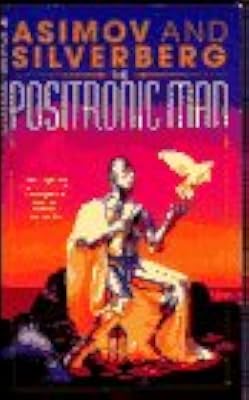
The Positronic Man
by Isaac Asimov, Robert Silverberg
On This Page
Description
Powerful and haunting, The Positronic Man is an unforgettable novel that redefines Isaac Asimov's and Robert Silverberg's place among the greatest science fiction authors of all time. In the twenty-first century the creation of the positronic brain leads to the development of robot laborers and revolutionizes life on Earth. But to the Martin family, their household robot NDR-113 is more than a trusted friend, a confidant, a member of the family. For through some unknown manufacturing glitch, show more Andrew has been blessed with a capacity for love and a drive toward self-awareness and devlopment that are almost ... human. But almost is not enough. Andrew's dream is to become fully human. Facing human prejudice, the laws of robotics, and his own mechanical limitations, Andrew will use science and law in his quest for the impossible, arriving at last at a terrifying choice: to make his dream a reality, he must pay the ultimate price. - Publisher. show lessTags
Recommendations


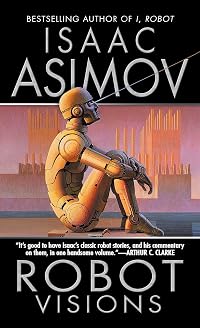











Member Reviews
For such a quick and easy read, at least on the technical level; intellectually, it will blow your mind.
There is so much more to this story than that of an individual's struggle to evolve to an autonomous entity in a society that considers him to be nothing more than a appliance. Is he any less human or sentient simply because he was manufactured not developed? The story will have you thinking quite a bit about subjugation, slavery, autonomy, humanity, prejudice, and more.
Readers who have seen "Bicentennial Man" and "I, Robot" will recognize names and situations and will enjoy seeing where the ideas for these movies was born.
This is a book I would recommend to those who've been hesitant to read science fiction, or want to introduce it show more to a younger or reluctant reader. It is definitely one I will keep multiple copies of because I plan on giving away/loaning them when I have enough on hand. show less
There is so much more to this story than that of an individual's struggle to evolve to an autonomous entity in a society that considers him to be nothing more than a appliance. Is he any less human or sentient simply because he was manufactured not developed? The story will have you thinking quite a bit about subjugation, slavery, autonomy, humanity, prejudice, and more.
Readers who have seen "Bicentennial Man" and "I, Robot" will recognize names and situations and will enjoy seeing where the ideas for these movies was born.
This is a book I would recommend to those who've been hesitant to read science fiction, or want to introduce it show more to a younger or reluctant reader. It is definitely one I will keep multiple copies of because I plan on giving away/loaning them when I have enough on hand. show less
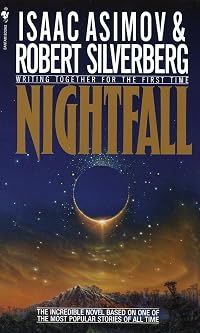
Like Nightfall and The Ugly Little Boy, this is Silverberg expanding an Asimov short story into a novel, and this is the most successful of the lot. Unlike Nightfall, where the extra bits felt extraneous, Silverberg's expansions onto the already-excellent "The Bicentennial Man" just make a good story even better, providing detail where Asimov skimped-- it is, after all, a story that has to cover two centuries! One of my favorite Asimov stories, and it was even made into a decent Asimov movie. (originally written January 2008)
It's amazing sometimes to see the differences between books and the movies they inspire. There are definite similarities to both and there are major discrepancies between them. Thankfully the book is not nearly as schmuckish (not sure that is even a word) as the movie was. I am so glad that there was so much artistic licensing in the second half of the movie, since it turns out to be more or less a Robin Williams vehicle. As is usually the case, the book is much better than the movie.
This is Asimov at his best I think, with the help Silverberg fleshing out the characters more than Asimov did in the Bicentennial Man short story. You can see the difference in styles when comparing this to the Foundation Series that Asimov wrote alone. show more This really gives the Three Laws a thorough going over legally as the story progresses. Highly recommended. show less
This is Asimov at his best I think, with the help Silverberg fleshing out the characters more than Asimov did in the Bicentennial Man short story. You can see the difference in styles when comparing this to the Foundation Series that Asimov wrote alone. show more This really gives the Three Laws a thorough going over legally as the story progresses. Highly recommended. show less
This is a fantastic sci-fi story examining the nature of humanity and culture. I quite liked it. Very refreshing to read real sci-fi every now and then when there's so much "Conan in space" type stuff
This book is really excellent. We follow the struggles of the robot Andrew Martin, who strives to become human. He faces a very long opposition and undergoes dramatic changes to accomplish his goal. The writing style is rather descriptive, with which I don't mean there are loads of descriptions, but that the book is not very emotional. It simply describes what happens and lets the events carry the emotions, instead of the language. As a result, the book is not highly exciting, as some others are, but it is very appealing nonetheless, the kind of book you keep picking up almost involuntarily.
This book is really excellent. We follow the struggles of the robot Andrew Martin, who strives to become human. He faces a very long opposition and undergoes dramatic changes to accomplish his goal. The writing style is rather descriptive, with which I don't mean there are loads of descriptions, but that the book is not very emotional. It simply describes what happens and lets the events carry the emotions, instead of the language. As a result, the book is not highly exciting, as some others are, but it is very appealing nonetheless, the kind of book you keep picking up almost involuntarily.
This is an excellent story of robots and men in its own right, but, at first, I thought there appeared to be some inconsistency with some of Asimov's other books. It is obviously set in the same fictional universe, but the previous advancement of robotic science and creating lifelike androids on planets other than Earth (e.g. Aurora) seems to be unknown. Then, I realized this is actually a prequel to the events told in the other robot books (The Caves of Steel, The Naked Sun, The Robots of Dawn).
Members
- Recently Added By
Lists

Isaac Arthur’s Book Recommendations
98 works; 3 members
Author Information

2,405+ Works 294,464 Members
Isaac Asimov was born in Petrovichi, Russia, on January 2, 1920. His family emigrated to the United States in 1923 and settled in Brooklyn, New York, where they owned and operated a candy store. Asimov became a naturalized U.S. citizen at the age of eight. As a youngster he discovered his talent for writing, producing his first original fiction at show more the age of eleven. He went on to become one of the world's most prolific writers, publishing nearly 500 books in his lifetime. Asimov was not only a writer; he also was a biochemist and an educator. He studied chemistry at Columbia University, earning a B.S., M.A. and Ph.D. In 1951, Asimov accepted a position as an instructor of biochemistry at Boston University's School of Medicine even though he had no practical experience in the field. His exceptional intelligence enabled him to master new systems rapidly, and he soon became a successful and distinguished professor at Columbia and even co-authored a biochemistry textbook within a few years. Asimov won numerous awards and honors for his books and stories, and he is considered to be a leading writer of the Golden Age of science fiction. While he did not invent science fiction, he helped to legitimize it by adding the narrative structure that had been missing from the traditional science fiction books of the period. He also introduced several innovative concepts, including the thematic concern for technological progress and its impact on humanity. Asimov is probably best known for his Foundation series, which includes Foundation, Foundation and Empire, and Second Foundation. In 1966, this trilogy won the Hugo award for best all-time science fiction series. In 1983, Asimov wrote an additional Foundation novel, Foundation's Edge, which won the Hugo for best novel of that year. Asimov also wrote a series of robot books that included I, Robot, and eventually he tied the two series together. He won three additional Hugos, including one awarded posthumously for the best non-fiction book of 1995, I. Asimov. "Nightfall" was chosen the best science fiction story of all time by the Science Fiction Writers of America. In 1979, Asimov wrote his autobiography, In Memory Yet Green. He continued writing until just a few years before his death from heart and kidney failure on April 6, 1992. (Bowker Author Biography) show less

988+ Works 62,613 Members
Some Editions
Series
Belongs to Publisher Series
Los jet de Plaza & Janes (136.02)
Work Relationships
Has the adaptation
Is an expanded version of
Common Knowledge
- Original publication date
- 1993
- People/Characters
- Andrew Martin; Lucie Martin; Gerald Martin; Amanda Martin; Melissa Martin; Elliot Smythe (show all 24); Dr. Mervin Mansky; John Feingold; Jimmy Robertson; Lloyd Charney; George Charney; Harold Krame; Stanley Feingold; James van Buren; Ethel Adams; Paul Charney; Harley Smythe-Robertson; Dr. Alvin Magdescu; Sandra; David; Carlos; Simon DeLong; Chee Li-hsing; Roger Hennessey
- Related movies
- Bicentennial Man (1999 | IMDb)
- Epigraph
- THE THREE LAWS OF ROBOTICS
1. A robot may not injure a human being, or, through inaction, allow a human being to come to harm.
2. A robot must obey the orders given it by human beings except where such orders would co... (show all)nflict with the First Law.
3. A robot must protect its own existence as long as such protection does not conflict with the First or Second Law. - Dedication
- For Janet and Karen - with much love
- First words
- "If you'll take a seat, sir," the surgeon said, gesturing toward the chair in front of his desk.
- Last words
- (Click to show. Warning: May contain spoilers.)And then he closed his eyes and the darkness engulfed him fully and - fully human at last - he gave himself up to it without regret.
- Original language
- English
Classifications
Statistics
- Members
- 1,197
- Popularity
- 20,909
- Reviews
- 21
- Rating
- (4.04)
- Languages
- 10 — Czech, Dutch, English, Estonian, French, German, Hungarian, Italian, Polish, Spanish
- Media
- Paper, Audiobook, Ebook
- ISBNs
- 26
- ASINs
- 7