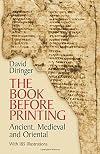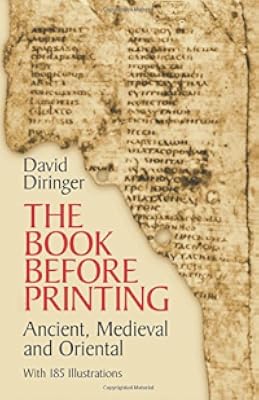
The Book Before Printing: Ancient, Medieval and Oriental
by David Diringer
On This Page
Description
Rich authoritative study of the book before Gutenberg. Nearly 200 photographic facsimiles of priceless documents. Comprehensive.Tags
Recommendations




















Member Reviews
Interesting but mostly beyond my level of scholarship. Author David Diringer produced books on the alphabet, on illumination and binding, and this one (originally titled The Hand-Produced Book but reprinted by Dover Press as The Book Before Printing). Diringer expected the reader to also have read, or at least have access to, his other two books; for example, he frequently refers to a book’s writing as “majuscule”, “minuscule”, or “uncial” without ever defining those terms, presumably because he’d already done so in his book on the alphabet. On the other hand, since his treatment of books is encyclopedic, this one would have been much longer if all the terms were defined and even if the modern reader doesn’t have the show more other books, they’ll have Wikipedia.
So, there’s discussion of Mesopotamian cuneiform tablets, Egyptian papyri, Greek and Roman wax tablets, vellum, and eventually paper; and discussion of writing in languages like Khotanese, Uighur, and Mayan. Outside of Europe there were a variety of exotic “book” materials, including thin strips of wood or bamboo, palm leaves, and silk. East and West apparently moved independently from scrolls to codices (i.e., sheets bound to a backing) since codices had the salient advantage that it was quick to get to something in the middle of the work.
Extensively illustrated, although the Dover edition I have has all the plates on uncoated paper, which makes them washed out. Thoroughly referenced and with an extensive bibliography. Goes well with Empires of the Word and Scribes and Illuminators. show less
So, there’s discussion of Mesopotamian cuneiform tablets, Egyptian papyri, Greek and Roman wax tablets, vellum, and eventually paper; and discussion of writing in languages like Khotanese, Uighur, and Mayan. Outside of Europe there were a variety of exotic “book” materials, including thin strips of wood or bamboo, palm leaves, and silk. East and West apparently moved independently from scrolls to codices (i.e., sheets bound to a backing) since codices had the salient advantage that it was quick to get to something in the middle of the work.
Extensively illustrated, although the Dover edition I have has all the plates on uncoated paper, which makes them washed out. Thoroughly referenced and with an extensive bibliography. Goes well with Empires of the Word and Scribes and Illuminators. show less
Like Leo Strauss (in Persecution and the Style of Writing), Diringer understands that pre-Gutenberg writing was esoteric and therefore often associated with "religious" -- magical, romantic, and mysterious -- invocations and events. This work is also a good reference for the fact that the Believers' beliefs in the origins of their respective "Bibles" are invariably wrong. For example, the Gospels are not much different from many of the volumes of the Apocrapha, and none were written within a century of Jesus Christ.
Of particular interest today, we note the comments about the Koran: "The earliest preserved Koranic manuscripts are written on broad parchment sheets and, with one or two exceptions, in the heavy lapidary Kufic style. These show more manuscripts are seldom complete and rarely dated, and are very difficult to date. The earliest dated copy is the complete Koran, now in Cairo, dated A.H. 168 (=A.D. 784-5)." [329]
[Recent Deutsche scholarship has dated the previously undated leaves and palimpsests -- clarifying the fact that the early versions are Syriac, written for Christian schools -- ie not written by Arabs in Arabic.] So, interestingly , the Koran was compiled by Arab scholars living long after the death of Mohammad PBUH from available Arabic texts translated from the Syriac texts used in Christian schools (Madrasas). show less
Of particular interest today, we note the comments about the Koran: "The earliest preserved Koranic manuscripts are written on broad parchment sheets and, with one or two exceptions, in the heavy lapidary Kufic style. These show more manuscripts are seldom complete and rarely dated, and are very difficult to date. The earliest dated copy is the complete Koran, now in Cairo, dated A.H. 168 (=A.D. 784-5)." [329]
[Recent Deutsche scholarship has dated the previously undated leaves and palimpsests -- clarifying the fact that the early versions are Syriac, written for Christian schools -- ie not written by Arabs in Arabic.] So, interestingly , the Koran was compiled by Arab scholars living long after the death of Mohammad PBUH from available Arabic texts translated from the Syriac texts used in Christian schools (Madrasas). show less
Diringer gives a thorough, scholarly, and heavily illustrated history of written communication from the very beginnings up to the spread of the printing press. The illustrations are interesting despite being completely in black and white.
The most common edition on LibraryThing is the Dover Edition, first issued in 1982 and reprinted regularly thereafter, but the work predates that considerably. The Dover Edition, according to its copyright page, is "an unabridged and unaltered republication of the work originally published in 1953 under the title 'The Hand-Produced Book.'"
The most common edition on LibraryThing is the Dover Edition, first issued in 1982 and reprinted regularly thereafter, but the work predates that considerably. The Dover Edition, according to its copyright page, is "an unabridged and unaltered republication of the work originally published in 1953 under the title 'The Hand-Produced Book.'"
Ratings
Members
- Recently Added By
Author Information
11 Works 489 Members
Series
Belongs to Publisher Series
Common Knowledge
- Canonical title
- The Book Before Printing: Ancient, Medieval and Oriental
- Original title
- The Hand-Produced Book
- Original publication date
- 1953
- People/Characters
- Augustine of Canterbury; Bede, 673-735; Cicero, Marcus Tullius, 106-43 BC; Homer; Pliny, 23-79
- Important places
- Bodleian Library, University of Oxford, Oxford, Oxfordshire, England, UK; British Library, London, England, UK; Cairo, Egypt; Cambridge, Cambridgeshire, England, UK; Dublin, Ireland
- Important events
- invention of printing; invention of writing
- First words
- PREFACE
The results of many years' research into the history of the book are here presented.
CHAPTER 1
THE BOOK IN EMBRYO
It is significant that man's intellectual progress and, particularly, the recording of his achievements -- history, in fact -- are very late developments in his story as a whole. - Quotations
- Chapter VI
GREEK AND LATIN BOOK PRODUCTION
No original manuscript of any ancient Greek or Roman author (and for that matter of any ancient Hebrew, Indian, or Chinese author) has yet come to light, and it generally comes... (show all) as rather a shock when one first learns that the oldest manuscripts extant are sometimes separated by many centuries from the date at which the writings in question were originally composed.
(p. 228) - Last words
- (Click to show. Warning: May contain spoilers.)By a sheer miracle, the beautiful volume suffered very little from the effect of the water.
Classifications
- Genres
- Nonfiction, History, General Nonfiction, Art & Design
- DDC/MDS
- 002 — Computer science, information & general works Computer science, knowledge & systems Books (Science and history of the book)
- LCC
- Z6 .D57 — Bibliography, Library Science and Information Resources Books (General). Writing. Paleography History of books and bookmaking
- BISAC
Statistics
- Members
- 306
- Popularity
- 104,674
- Reviews
- 3
- Rating
- (3.76)
- Languages
- English
- Media
- Paper, Ebook
- ISBNs
- 3
- UPCs
- 1
- ASINs
- 7