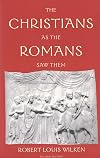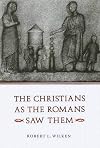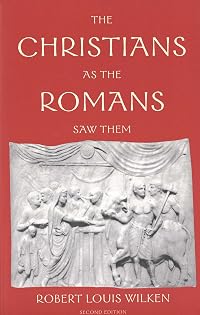
The Christians as the Romans Saw Them
by Robert Louis Wilken
On This Page
Description
This book, which includes a new preface by the author, offers an engrossing portrayal of the early years of the Christian movement from the perspective of the Romans."A fascinating . . . account of early Christian thought. . . . Readable and exciting."-Robert McAfee Brown, New York Times Book Review"Should fascinate any reader with an interest in the history of human thought."-Phoebe-Lou Adams, Atlantic Monthly"The pioneering study in English of Roman impressions of Christians during the show more first four centuries A.D."-E. Glenn Hinson, Christian Century"This gracefully written study . . . draws upon well-known sources-both pagan and Christian-to provide the general reader with an illuminating account . . . [of how] Christianity appeared to the Romans before it became the established religion of the empire."-Merle Rubin, Christian Science Monitor show lessTags
Recommendations









Member Reviews
An interesting and very informative perspective of early Christianity as seen through the eyes of various Roman/pagans from the second, third and fourth centuries, AD. From the earliest perspectives (brief correspondence from Pliny the younger to the Emperor Trajan) to the later well-developed critical arguments (by Celsus, Porphyry and the last pagan Emperor Julian) each viewpoint was fascinating.
I would have rated this book higher but for the author's unimaginative, dry writing style.
I would have rated this book higher but for the author's unimaginative, dry writing style.
A well-written account of Roman arguments against Christianity from the 2nd century to the 4th. It's not a history of Roman attitudes in general but a literary analysis of the works of Pliny, Galen, Celsus, Porphyry and Julian which touch upon christianity. Sadly (but not surprisingly) the story is built on fragmentary evidence since none of the original works survived to the present day. Compared to other books that I've read on ancient greek and roman literature this one is quite lively and it also says more about the social context of this literature than most other books manage to do.
Fascinating interplay between who the Romans really were (versus how we think of them today, mostly likely thanks to church history) and how they viewed the Christians. I loved reading about Pliny the Younger and having a context in which to put him, along with the other critics. It raised a lot of questions for me regarding my understanding of Christ and the early church, but is definitely worth the discomfort.
Naturally, there are very few books which can leave you feeling that you know less than you did before you started, yet this book left me profoundly frustrated at the thinness of the material delivered, compared to the immensity and significance of the subject. The best portions of of the book attempted to reconstruct the micro-sociology of early Christian groups in terms of the immense network and clubs and friendly societies which were active in Roman life. Maybe it''s just me, but I was a little startled to infer a subtle but continuous sense that the Author -- a sometime Professor at Notre Dame -- felt that the pagan Romans weren't entirely mistaken in mistrusting, and even persecuting the early followers of Jesus. I can take this show more from a genius like GIbbon, but Wilken fails to convince, if indeed I am at-all right in my inference. show less
Mr. Wilken does a fantastic job in his use of source materials in writing the reaction of Greeks & Romans to the rise of Christianity. Obviously the Greeks & Romans were unhappy that Christianity was exploding among slaves & women & they would soon react with violence & murder. Their attempts only served to enhance & spread Christianity which the author presents quite well here. Much of the source material he uses may be new to the reader since these are known only to the scholars who seek them. This is a good read to familiarize one self with little known opponents who hated & despised Christianity & wrote vitriolic rants against it. Amazingly, those who responded actually recorded & preserved those writings in their show more works show less
I really enjoyed this book, not for what it told me about Christianity, but for what I learned about Romans and Roman religion.
It's interesting.Wilken is partial to the arguments of the Roman and Greek pagans, as He readily admits. He says that he wanted to "present them sympathetically within the framework of the ideas that existed before the emergence of Christianity," and he does. It is clear that Wilken to modern higher and form criticisms associated with more liberal types of theology.
Yet the book is worth the effort.Wilken enlightens you to many of the views, prejudices and cultural concerns of the pagan intellectuals as they confronted the early Christians. I would give it 2½ stars.
Yet the book is worth the effort.Wilken enlightens you to many of the views, prejudices and cultural concerns of the pagan intellectuals as they confronted the early Christians. I would give it 2½ stars.
Members
- Recently Added By
Author Information

26+ Works 3,061 Members
Robert Louis Wilken is William R. Kenan Professor of the History of Christianity Emeritus, University of Virginia. He is the author of many books, including The Christians as the Romans Saw Them, published by Yale University Press.
Some Editions
Series
Belongs to Publisher Series
Studi biblici [Paideia] (155)
Common Knowledge
- Original publication date
- 1984
- People/Characters
- Pliny the Younger; Galen; Celsus, 2nd century; Porphyry; Julian the Apostate
- Important places
- Roman Empire
- Important events
- Rise of Christianity
- Dedication
- To Dan and Mary--
And to summer on Schoodic Lake - First words
- How did Christianity appear to men and women of the Roman Empire?
- Last words
- (Click to show. Warning: May contain spoilers.)The distinctive traits of the new religion and the tenacity of Christian apologists in defending their faith opened up new horizons for Greco-Roman culture and breathed new life into the spiritual and intellectual traditions of the ancient world.
- Publisher's editor
- Folsom, Barbara
- Blurbers
- Meeks, Wayne
Classifications
- Genres
- Religion & Spirituality, Nonfiction, History, General Nonfiction
- DDC/MDS
- 270.1 — Religion History of Christianity History, geographic treatment, biography of Christianity Apostolic; Nativity to Constantine
- LCC
- BL2756 .W54 — Philosophy, Psychology and Religion Religions. Mythology. Rationalism Religions. Mythology. Rationalism Rationalism
- BISAC
Statistics
- Members
- 932
- Popularity
- 28,570
- Reviews
- 11
- Rating
- (3.76)
- Languages
- English, Italian
- Media
- Paper, Ebook
- ISBNs
- 5
- ASINs
- 7