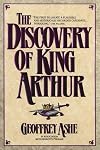
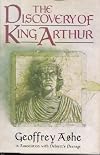
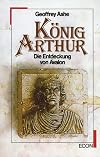
The Discovery of King Arthur
by Geoffrey Ashe
On This Page
Description
Ashe offers convincing proof that Arthur not only existed, but was more like the Arthur of legend than historians ever suspected.Tags
Recommendations
















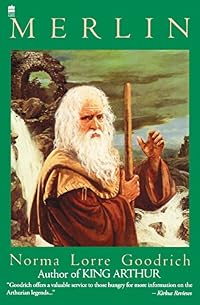







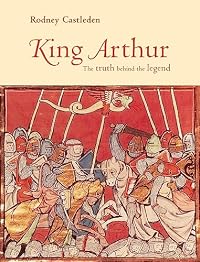










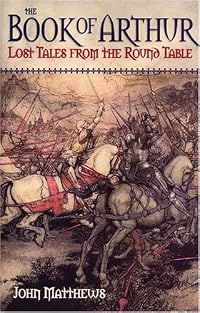

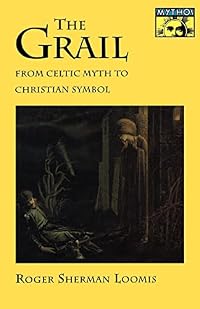



Member Recommendations
Member Reviews
The question of the reality of King Arthur has been answered in various ways and Geoffrey Ashe gives his answer in “The Discovery of King Arthur”. One of the most preeminent Arthurian scholars in the world, Ashe’s thesis brought the possibility of a real Arthur to the public by guiding them through the layers of myth and legend.
Ashe begins his presentation by establishing how the Arthur we have come to know in was first widely distributed, through Geoffrey of Monmouth’s “Histories of the Kings of Britain”. Ashe begins dissecting Geoffrey’s account through the lens of various sources during the supposed time of Arthur’s career as well as giving context to the nature of medieval literary work thus gleaming clues to the show more real events that Geoffrey based his writing on. Ashe’s analysis of several sources from Roman Gaul, sources from Britain closer to Arthur’s time, and history of the last Western Roman Empire together with clues from Geoffrey’s histories help Ashe narrow in on the individual who was the starting point of the Arthur mythos, the Briton High King named Riothamus.
After naming this candidate whose career inspired the Arthur legend, Ashe then details how over the centuries to Geoffrey of Monmouth and afterwards the embellished and fantasies were created about an individual who seemingly revived Roman Briton’s fortunes and was seen on the Continent as someone to help restore the civilization—as the Roman was viewed. Yet, while this information is intriguing in seeing how the mythos was created and expanded Ashe’s somewhat dry writing style makes the last half of the book somewhat less of an engaging read as compared to the first half when Ashe “discovers” the man behind the legend.
This is my first time reading this book in almost 20 years and frankly this book is not how I remember it, frankly I remembered the information Ashe put in the first half of the book in making his case and willing forgot the second half of the book when he discussed the legend building. This can be put down to Ashe converting a scholarly paper into a book for mass consumption, which is telling as it would be expected that the writing style would be more lively for book for public consumption while a more scholarly work would have a different tone. But that doesn’t mean this is not an overall good book, it is but it does have some drawbacks that potential readers should be aware of before cracking it open. show less
Ashe begins his presentation by establishing how the Arthur we have come to know in was first widely distributed, through Geoffrey of Monmouth’s “Histories of the Kings of Britain”. Ashe begins dissecting Geoffrey’s account through the lens of various sources during the supposed time of Arthur’s career as well as giving context to the nature of medieval literary work thus gleaming clues to the show more real events that Geoffrey based his writing on. Ashe’s analysis of several sources from Roman Gaul, sources from Britain closer to Arthur’s time, and history of the last Western Roman Empire together with clues from Geoffrey’s histories help Ashe narrow in on the individual who was the starting point of the Arthur mythos, the Briton High King named Riothamus.
After naming this candidate whose career inspired the Arthur legend, Ashe then details how over the centuries to Geoffrey of Monmouth and afterwards the embellished and fantasies were created about an individual who seemingly revived Roman Briton’s fortunes and was seen on the Continent as someone to help restore the civilization—as the Roman was viewed. Yet, while this information is intriguing in seeing how the mythos was created and expanded Ashe’s somewhat dry writing style makes the last half of the book somewhat less of an engaging read as compared to the first half when Ashe “discovers” the man behind the legend.
This is my first time reading this book in almost 20 years and frankly this book is not how I remember it, frankly I remembered the information Ashe put in the first half of the book in making his case and willing forgot the second half of the book when he discussed the legend building. This can be put down to Ashe converting a scholarly paper into a book for mass consumption, which is telling as it would be expected that the writing style would be more lively for book for public consumption while a more scholarly work would have a different tone. But that doesn’t mean this is not an overall good book, it is but it does have some drawbacks that potential readers should be aware of before cracking it open. show less
If you are serious in your search for the actual historical Arthur, this book is for you. Otherwise, don’t bother, as it does involve dedicated focus to read, and can be somewhat tedious. This is due, no doubt, to the fact that Ashe is handling primary source material spanning many centuries, and presenting us with the relevant details in a relatively small tome. Quite an undertaking, and one which he handles quite masterfully. To observe Ashe’s thought processes as he fits pieces together is gratifying, and his wry sense of humor is enjoyable (esp. when he pokes fun at the “Arthur-as-god” camp). Definitely worthwhile.
A book of controversy, that has engaged the less fiercely British Arthurians. I know of a book about Arthur's origin that places him in North Wales, and another that places his origin in the Scottish Lowlands. Mr. Ashe has started with the few references to interactions between the British Isles and Gaul in the dying days of the Roman empire. From this, he elaborates that Arthur was modelled on the British chieftain to whom Sidonius Apollinaris wrote a letter, Ricomathis. I think he was Uther Pendragon, but more investigation is required. An interesting read.
The third part was a bit much for me but overall I enjoyed the read.
This book is for people like me who want to know the man behind the myth. Ashe provides a plausible candidate for the basis of the King Arthur legend.
Geoffrey Ashe takes us into a world of medieval Europe in search for King Arthur. Did he exist or is he nothing but a myth? His journey leads to a most intersting outcome.
Members
- Recently Added By
Author Information

41+ Works 3,235 Members
Geoffrey Ashe was born in London. A graduate of the universities of British Columbia and Cambridge, he has a varied background in literary and journalistic work, lecturing, and industrial administration.
Common Knowledge
- Canonical title
- The Discovery of King Arthur
- Original publication date
- 1985
- People/Characters
- King Arthur; Ambrosius Aurelianus
- Important places
- England, UK; Wales, UK; Scotland, UK
Classifications
- Genres
- History, Nonfiction, General Nonfiction, Biography & Memoir
- DDC/MDS
- 942.014 — History & geography History of Europe England and Wales England Anglo-Saxon B.C. 55 - A.D. 1066
- LCC
- DA152.5 .A7 .A793 — History of Europe, Asia, Africa and Oceania Great Britain History of Great Britain England History By period Early and medieval to 1485 Celts. Romans. Saxons. Danes. Normans
- BISAC
Statistics
- Members
- 792
- Popularity
- 34,905
- Reviews
- 8
- Rating
- (3.72)
- Languages
- English, Estonian, German
- Media
- Paper, Ebook
- ISBNs
- 8
- ASINs
- 11