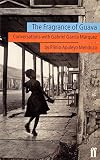
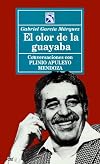
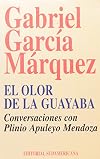
The Fragrance of Guava
by Gabriel Garcia Marquez, Plinio Apuleyo Mendoza
On This Page
Description
In these conversations with a friend and contemporary the Nobel prize-winning Colombian novelist speaks movingly, revealingly and unaffectedly about his family background, his early travels and struggles as a writer, his literary antecedents and his personal artistic concerns. Guided by Mendoza, M#65533;rquez reveals - as transfigured in his work by the power of language - the heat and colour of the Spanish Caribbean, the mythological world of its inhabitants, the exotic mentality of its show more leaders. show lessTags
Recommendations











Member Reviews
35. The Fragrance of Guava : Conversations with Gabriel Garcia Márquez by Plinio Apuleyo Mendoza
published: 1982
format: 118 Page little paperback
acquired: March
read: Jun 14-18
rating: 4
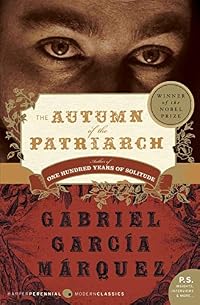
Márquez won the Nobel Prize in 1982, but this interview took place before that. Márquez was a different person before and after [One Hundred Years of Solitude] (published 1967). Before he was world-traveling journalist from coastal Columbia who went through starving stretches where he was unemployed (including once when his publisher was shut down), had written numerous wonderful stories and four full books, none of which had sold more than a 1000 copies. He wrote at night after work, all night, and was constantly searching out connections and feedback show more about his writing, openly sharing passages with close writer friends. Afterward, fame entered and Márquez responded by becoming extremely private, focusing on his family and developing a writing routine he never broke - 9am to 3pm everyday. When he finished [Autumn of the Patriarch] early one day, he struggled with how to fill his time until 3:00.
Mendoza fills in a nice role as a writer who knew him in his younger hungry days, and has remained close to him, and, based on this book, is an elegant writer himself. This is a short book, stretched out to over a hundred pages by photos and line spacings. Márquez is both interesting and reticent, and Mendoza needs to pull things out of him. He comes across as very closely connected to Caribbean culture, as one obsessed with solitude (of course), and who claims his most personal and autobiographical (and technically best) work is the really disturbing [Autumn of the Patriarch], a book about the complete corruption of power which took almost 20 years to write. In the end he as little to nothing to say about his most famous work. He seems to have very mixed feeling about both the book and the impact it had on his life.
"I believe writers are always alone, like shipwrecked sailors in the middle of the ocean."
...
"I've never really been interested in any idea which can't stand many years of neglect."
2018
https://www.librarything.com/topic/288371#6511026 show less
published: 1982
format: 118 Page little paperback
acquired: March
read: Jun 14-18
rating: 4
Márquez won the Nobel Prize in 1982, but this interview took place before that. Márquez was a different person before and after [One Hundred Years of Solitude] (published 1967). Before he was world-traveling journalist from coastal Columbia who went through starving stretches where he was unemployed (including once when his publisher was shut down), had written numerous wonderful stories and four full books, none of which had sold more than a 1000 copies. He wrote at night after work, all night, and was constantly searching out connections and feedback show more about his writing, openly sharing passages with close writer friends. Afterward, fame entered and Márquez responded by becoming extremely private, focusing on his family and developing a writing routine he never broke - 9am to 3pm everyday. When he finished [Autumn of the Patriarch] early one day, he struggled with how to fill his time until 3:00.
Mendoza fills in a nice role as a writer who knew him in his younger hungry days, and has remained close to him, and, based on this book, is an elegant writer himself. This is a short book, stretched out to over a hundred pages by photos and line spacings. Márquez is both interesting and reticent, and Mendoza needs to pull things out of him. He comes across as very closely connected to Caribbean culture, as one obsessed with solitude (of course), and who claims his most personal and autobiographical (and technically best) work is the really disturbing [Autumn of the Patriarch], a book about the complete corruption of power which took almost 20 years to write. In the end he as little to nothing to say about his most famous work. He seems to have very mixed feeling about both the book and the impact it had on his life.
"I believe writers are always alone, like shipwrecked sailors in the middle of the ocean."
...
"I've never really been interested in any idea which can't stand many years of neglect."
2018
https://www.librarything.com/topic/288371#6511026 show less
Garc?a Marquez, Gabriel. The Fragrance of Guava: Plinio Apuleyo Mendoza in Conversation with Gabriel GarcM. Verso, London, 1983.
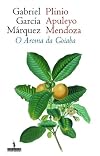
Se formalmente "O Aroma da Goiaba" é uma longa conversa do escritor e jornalista Plinio Apuleyo Mendoza com o seu velho amigo Gabriel García Márquez - o que dá a este ocasião para desfiar com vivacidade as suas lembranças, juízos, opiniões e convicções - o seu conteúdo vai para além disso: em "O Aroma da Goiaba" bem podem encontrar-se as chaves de um processo, criador e criativo de singular riqueza.
Pela mão de Plinio Apuleyo Mendonza, García Marquez revela o mundo que a sua obra reflecte até o transfigurar com a magia da palavra: o calor e o cheiro do caribe, o universo mítico dos seus povoadores, a estranha mentalidade dos seus homens célebres e caudilhos.
Uma obra na qual o compromisso com a emoção e o compromisso show more com a razão dão as mãos para oferecer a mais sugestiva aproximação a um grande criador que, de tão complexo, pode permitir-se o luxo de ser claro. show less
Pela mão de Plinio Apuleyo Mendonza, García Marquez revela o mundo que a sua obra reflecte até o transfigurar com a magia da palavra: o calor e o cheiro do caribe, o universo mítico dos seus povoadores, a estranha mentalidade dos seus homens célebres e caudilhos.
Uma obra na qual o compromisso com a emoção e o compromisso show more com a razão dão as mãos para oferecer a mais sugestiva aproximação a um grande criador que, de tão complexo, pode permitir-se o luxo de ser claro. show less
Nov 8, 2020Portuguese (Portugal)
Gabriel García-Márquez nos descubre en sus conversaciones con Plinio Apuleyo Mendoza -amigo desde la juventud- lo que piensa de la literatura, la fama, la política, el poder, las mujeres... nos habla de su amistad con Fidel Castro, Omar Torrijos y François Mitterrand, y de su compromiso en la defensa de los derechos humanos.
Jan 9, 2023Spanish
Ratings
Members
- Recently Added By
Author Information

381+ Works 146,763 Members
Gabriel García Márquez was born in Aracataca, Colombia on March 6, 1927. After studying law and journalism at the National University of Colombia in Bogota, he became a journalist. In 1965, he left journalism, to devote himself to writing. His works included Leaf Storm, No One Writes to the Colonel, The Evil Hour, One Hundred Years of Solitude, show more Love in the Time of Cholera, The Autumn of the Patriarch, Chronicle of a Death Foretold, The General in His Labyrinth, Clandestine in Chile, and the memoir Living to Tell the Tale. He won the Nobel Prize for Literature in 1982. He died on April 17, 2014 at the age of 87. (Bowker Author Biography) show less
4+ Works 292 Members
All Editions
Some Editions
Common Knowledge
- Canonical title
- The Fragrance of Guava
- Original title
- El olor de la guayaba: Conversaciones con Plinio Apuleyo Mendoza
- Alternate titles
- The Fragrance of the Guava
- Quotations*
- Ich habe sie mit der Zeit so gut kennengelernt, dass ich schon nicht mehr die leiseste Vorstellung davon habe, wie sie in Wirklichkeit ist. (über seine Frau Mercedes, S. 26)
*Some information comes from Common Knowledge in other languages. Click "Edit" for more information.
Classifications
- Genres
- Fiction and Literature, Biography & Memoir
- DDC/MDS
- 863 — Literature & rhetoric Spanish, Portuguese, Galician literatures Spanish fiction
- LCC
- PQ8180.17 .A73 .Z47 — Language and Literature French, Italian, Spanish and Portuguese literatures Spanish literature Provincial, local, colonial, etc. Spanish America
Statistics
- Members
- 288
- Popularity
- 111,235
- Reviews
- 5
- Rating
- (4.00)
- Languages
- 23 — Arabic, Chinese, simplified, Danish, Dutch, English, Finnish, French, Georgian, German, Irish, Hungarian, Italian, Japanese, Norwegian, Farsi/Persian, Polish, Portuguese (Brazil), Portuguese (Portugal), Romanian, Croatian, Spanish, Swedish, Turkish
- Media
- Paper, Ebook
- ISBNs
- 31
- ASINs
- 5