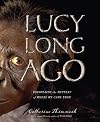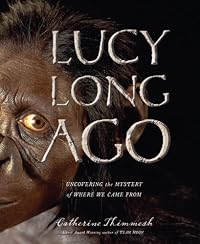
Lucy long ago
by Catherine Thimmesh
On This Page
Description
This story of scientific sleuthing invites readers to wonder what our ancestors were like and recounts the discovery of the remains of Lucy, the world's most famous hominid.Tags
Recommendations







Member Reviews
An elegant, well-illustrated book about the discovery of "Lucy", the first Australopithecus Afarensis to be dug up. Discusses the significance of the fossil, and how it unseated a linear interpretation of hominid evolution. Good discussion of argon-potassium dating of surrounding rock strata, although there is no math. Many photographs of a reconstructed specimen, and some nice comparisons of different skeletons. Modern humans look so flimsy!
This was a very interesting nonfiction about how the discovery of Lucy required scientists to rethink the human family tree. Instead of being a linear progression, they realized the family tree was more like a bush, with some offshoots here and there that are difficult to explain. Lucy was a hominid (a bipedal primate mammal), but her brain size was small. Most other bipedals had larger brains, but Lucy was a mystery. Her discovery and the findings of other hominids shook up the scientific world, and still no one knows for sure how the human family “bush” should look.
The book tells of how Donald Johansen happened to find that fateful elbow sticking up out of the dirt in Ethiopia in 1974. It goes into detail with great photographs show more about how they made replicas of the fossilized bones and pieced them together. The explanation of how they dated the bones was well explained, and kids would find that the science in this book is accessible and made infinitely more interesting with the pictures and graphs along the way. It includes a good glossary, too. The best part was how scientists made an educated guess about what Lucy would have looked like. A paleo-artist constructed a life-size sculpture of Lucy that kids will love. I thought this book was great.
Personally, I love reading nonfiction for kids because it gives me just enough of this topic. If I were to research this topic, I would find tons of scholarly journals and monstrously boring books for adult scholars. I would quickly lose interest in the topic and probably not even bother. Kids’ nonfiction makes the topics fun, interesting, and informative. They are usually pretty well written, too, written to grab your attention and hold it. The photographs and drawings make the different facts come alive. This one was a real joy to read. show less
The book tells of how Donald Johansen happened to find that fateful elbow sticking up out of the dirt in Ethiopia in 1974. It goes into detail with great photographs show more about how they made replicas of the fossilized bones and pieced them together. The explanation of how they dated the bones was well explained, and kids would find that the science in this book is accessible and made infinitely more interesting with the pictures and graphs along the way. It includes a good glossary, too. The best part was how scientists made an educated guess about what Lucy would have looked like. A paleo-artist constructed a life-size sculpture of Lucy that kids will love. I thought this book was great.
Personally, I love reading nonfiction for kids because it gives me just enough of this topic. If I were to research this topic, I would find tons of scholarly journals and monstrously boring books for adult scholars. I would quickly lose interest in the topic and probably not even bother. Kids’ nonfiction makes the topics fun, interesting, and informative. They are usually pretty well written, too, written to grab your attention and hold it. The photographs and drawings make the different facts come alive. This one was a real joy to read. show less
Lucy Long Ago is the scientific non-fiction account of when scientists uncovered the fossils of “Lucy”, a prehistoric species. Lucy was a new type of species that shared many characteristics of both chimpanzee and human. Evidence proved that she lived in trees, but also walked upright like modern humans, despite her small brain. Lucy was a new type of hominid that extended the human family tree. Her discovery was a big step in archaeology findings.
This book can be used to teach students about archaeology and the scientific method. Students could do many activities using fossils, such as making a fossil imprint, digging for fossils outside and then examining their findings, and comparing human skeletons to chimpanzee skeletons and show more then using pictures of Lucy’s fossils to make comparisons to both. I think this book is appropriate to use for middle school students 5th to 8th grade.
I did enjoy this book. It was fascinating to see Lucy’s skeleton and how alike it was to both chimpanzee and human. It was also interesting to see the life size model of Lucy that was constructed. Students would benefit from this book because it is scientific non-fiction. Students get the benefit of reading an informational text to align with Common Core standards, while also learning scientific information as well. This book would be an asset in the classroom. It is also relatively short so too much time would not be used reading it. It also contains sections where the author explains things, such as the scientific method, how to make a hypothesis, and how fossils are preserved to expand student knowledge. show less
This book can be used to teach students about archaeology and the scientific method. Students could do many activities using fossils, such as making a fossil imprint, digging for fossils outside and then examining their findings, and comparing human skeletons to chimpanzee skeletons and show more then using pictures of Lucy’s fossils to make comparisons to both. I think this book is appropriate to use for middle school students 5th to 8th grade.
I did enjoy this book. It was fascinating to see Lucy’s skeleton and how alike it was to both chimpanzee and human. It was also interesting to see the life size model of Lucy that was constructed. Students would benefit from this book because it is scientific non-fiction. Students get the benefit of reading an informational text to align with Common Core standards, while also learning scientific information as well. This book would be an asset in the classroom. It is also relatively short so too much time would not be used reading it. It also contains sections where the author explains things, such as the scientific method, how to make a hypothesis, and how fossils are preserved to expand student knowledge. show less
In clear, concise text, Catherine Thimmesh gives us the story of Lucy, an ancient hominid that may be an ancestor or relation to modern humans. The discovery of Lucy, the oldest most complete hominid skeleton that's been found so far, majorly changed the way scientists pictured the human 'family tree'. Thimmesh presents a sophisticated subject in an accessible way. Photos and illustrations add to the text and sidebars explain many of the ways that anthropologists study ancient bones to reveal how these creatures may be related to humans.
Excellent nonfiction. Highly recommended.
Full review on my blog: http://abbylibrarian.blogspot.com/2009/03/book-review-lucy-long-ago.html
Excellent nonfiction. Highly recommended.
Full review on my blog: http://abbylibrarian.blogspot.com/2009/03/book-review-lucy-long-ago.html
Picked it up from the library late this afternoon. Read it during dinner (a treat while J's on work travel) and for part one of snack and stories. It was absolutely fascinating, both for Z and me. Thanks, Horn Book editors.
The origins of homo sapiens. Stunning!!!
Ratings
Members
- Recently Added By
Lists

A Child's Book Tour of East Africa ::: Ethiopia, Kenya, Sudan, Uganda
68 works; 4 members
Author Information

12 Works 2,593 Members
Some Editions
Awards and Honors
Awards
Common Knowledge
- Canonical title
- Lucy long ago
- Original publication date
- 2009
- People/Characters
- Lucy (Prehistoric hominid)
- Important places
- Ethiopia
- Dedication
- For Jim Ryan, whose green pen and 36Cs and 17Bs cause me much misery in high school -- and helped me become a better writer in the process. Teachers make a difference. And I thank you.
- First words
- Long ago, it lived . . . even before it had a name.
- Last words
- (Click to show. Warning: May contain spoilers.)Because somewhere deep in the past, near the beginning, lived Lucy.
Classifications
Statistics
- Members
- 107
- Popularity
- 302,086
- Reviews
- 6
- Rating
- (4.32)
- Languages
- English
- Media
- Paper
- ISBNs
- 2
- ASINs
- 1