
Wampeters, Foma & Granfalloons
by Kurt Vonnegut
On This Page
Description
Reviews, essays and speeches on the phenomena of this and other ages.Tags
Recommendations


















Member Reviews
In an interview with Playboy that appears at the end of this book, Vonnegut claims that he's "so unlike my books or my reputation." He also claims, earlier in the same interview, "You understand, of course, that everything I say is horseshit."
The interesting thing is that this book creates such a clear picture of Vonnegut as an artist, a thinker, and a person, and that it does so in a manner that is so consistent with his fiction that the contradiction above must be somewhere between a joke and a non sequitur. The many short missives, essays, and speeches reprinted here, which take up the first 235 pages, are wonderful pieces of the mind of Vonnegut, though they tend to run together if you read them in any sort of rhythm.
That all show more changes with the last 52 pages, a lengthy interview with Playboy that answers nearly every question you might have about the man at that time. His thoughts on fame, writing, depression, lonesomeness, politics, and the state of America are not too far off from the way things work today, and his prescience in seeing those issues (even if they have not yet been resolved) is incredible.
Not every piece in this text is a winner, but the closing interview is among the most introspective work Vonnegut has done and alone makes this book worth the read. show less
The interesting thing is that this book creates such a clear picture of Vonnegut as an artist, a thinker, and a person, and that it does so in a manner that is so consistent with his fiction that the contradiction above must be somewhere between a joke and a non sequitur. The many short missives, essays, and speeches reprinted here, which take up the first 235 pages, are wonderful pieces of the mind of Vonnegut, though they tend to run together if you read them in any sort of rhythm.
That all show more changes with the last 52 pages, a lengthy interview with Playboy that answers nearly every question you might have about the man at that time. His thoughts on fame, writing, depression, lonesomeness, politics, and the state of America are not too far off from the way things work today, and his prescience in seeing those issues (even if they have not yet been resolved) is incredible.
Not every piece in this text is a winner, but the closing interview is among the most introspective work Vonnegut has done and alone makes this book worth the read. show less
This was a nice little assortment of non-fiction pieces by Kurt Vonnegut. It touched on a lot of different themes and the range of the pieces varied in intensity and magnitude. Overall, I was impressed by this. Previously, I had read Fates Worse Than Death and this turned me on to Vonnegut's non-fiction. I have read a lot of Vonnegut's fiction and this is a nice little supplement to it.
Although the contributions are somewhat uneven, this is a better collection that Fates Worse Than Death. A somewhat uncritical essay on Madame Blavatsky. A good essay on the over valuation of Hermann Hesse. A moving essay on the Biafran war; it makes me want to learn more about that conflict and the people who tried to make a nation.
This book was interesting, in that it was a collection of opinions from one of my favorite writers. However, it was also really uninteresting due to the fact that it was mostly nonfiction, and didn't have as much of Vonnegut's signature wit and randomness. Reading some of his opinions before reading his next book was a fun experience, however, in that I got to see the ideas develop from a mental fetus to a full born novel.
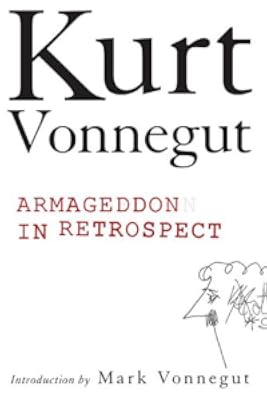
All in all, this is better than Armageddon in retrospect, because the author was alive to have input.
Read it if you've read everything else and are sad there's nothing left.
All in all, this is better than Armageddon in retrospect, because the author was alive to have input.
Read it if you've read everything else and are sad there's nothing left.
Although this book is unmistakably Vonnegut, you can find everything in it why we love the Master, somehow I understand why it wasn't translated into Hungarian until now. Of course it's a must for fans but try not to read this first from him.
Good Lord we need this man back, now more than ever. Stupid Pall Malls. Terrific collection of essays, speeches and interviews. Biafra: A People Betrayed will break your heart.
A selection of magazine pieces. They are not particularly interesting as thought, but there are some interesting turns of phrase.
Members
- Recently Added By
Lists

Amusing Book Titles
146 works; 39 members

Books Read in 2023
5,638 works; 145 members
Author Information

291+ Works 201,432 Members
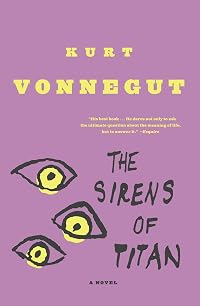
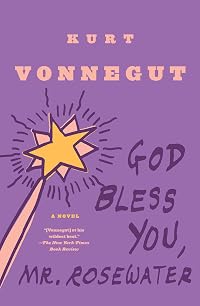
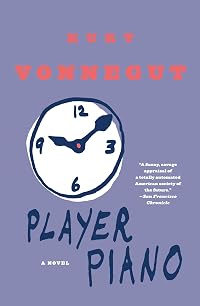
The appeal of Kurt Vonnegut, especially to bright younger readers of the past few decades, may be attributed partly to the fact that he is one of the few writers who have successfully straddled the imaginary line between science-fiction/fantasy and "real literature." He was born in Indianapolis and attended Cornell University, but his college show more education was interrupted by World War II. Captured during the Battle of the Bulge and imprisoned in Dresden, he received a Purple Heart for what he calls a "ludicrously negligible wound." After the war he returned to Cornell and then earned his M.A. at the University of Chicago.He worked as a police reporter and in public relations before placing several short stories in the popular magazines and beginning his career as a novelist. His first novel, Player Piano (1952), is a highly credible account of a future mechanistic society in which people count for little and machines for much. The Sirens of Titan (1959), is the story of a playboy whisked off to Mars and outer space in order to learn some humbling lessons about Earth's modest function in the total scheme of things. Mother Night (1962) satirizes the Nazi mentality in its narrative about an American writer who broadcasts propaganda in Germany during the war as an Allied agent. Cat's Cradle (1963) makes use of some of Vonnegut's experiences in General Electric laboratories in its story about the discovery of a special kind of ice that destroys the world. God Bless You, Mr. Rosewater (1965) satirizes a benevolent foundation set up to foster the salvation of the world through love, an endeavor with, of course, disastrous results. Slaughterhouse-Five; or The Children's Crusade (1969) is the book that marked a turning point in Vonnegut's career. Based on his experiences in Dresden, it is the story of another Vonnegut surrogate named Billy Pilgrim who travels back and forth in time and becomes a kind of modern-day Everyman. The novel was something of a cult book during the Vietnam era for its antiwar sentiments. Breakfast of Champions (1973), the story of a Pontiac dealer who goes crazy after reading a science fiction novel by "Kilgore Trout," received generally unfavorable reviews but was a commercial success. Slapstick (1976), dedicated to the memory of Laurel and Hardy, is the somewhat wacky memoir of a 100-year-old ex-president who thinks he can solve society's problems by giving everyone a new middle name. In addition to his fiction, Vonnegut has published nonfiction on social problems and other topics, some of which is collected in Wampeters, Foma and Granfalloons (1974). He died from head injuries sustained in a fall on April 11, 2007. (Bowker Author Biography) show less
Work Relationships
Common Knowledge
- Original title
- Wampeters, Foma & Granfalloons (Opinions) (Opinions)
- Original publication date
- 1974-05
- Dedication
- For Jill Who Cronkled Me
- First words
- Dear Reader: The tile of this book is composed of three words from my novel Cat's Cradle. (Preface)
- Last words
- (Click to show. Warning: May contain spoilers.)I know this much: After I'm gone, I don't want my children to have to say about me what I have to say about my father: "He made wonderful jokes, but he was such an unhappy man."
- Original language
- English
Classifications
Statistics
- Members
- 2,312
- Popularity
- 8,599
- Reviews
- 10
- Rating
- (3.67)
- Languages
- 8 — Chinese, Dutch, English, Hungarian, Italian, Polish, Spanish, Turkish
- Media
- Paper, Audiobook, Ebook
- ISBNs
- 27
- ASINs
- 36