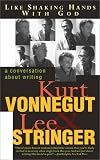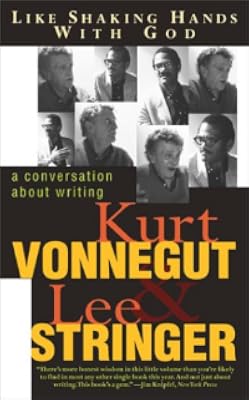
Like Shaking Hands With God: A Conversation About Writing
by Kurt Vonnegut
On This Page
Description
Like Shaking Hands with God details a collaborative journey on the art of writing undertaken by two distinguished writers separated by age, race, upbringing, and education, but sharing common goals and aspirations. Rarely have two writers spoken so candidly about the intersection where the lives they live meet the art they practice. That these two writers happen to be Kurt Vonnegut and Lee Stringer makes this a historic and joyous occasion. The setting was a bookstore in New York City, the show more date Thursday, October 1, 1998. Before a crowd of several hundred, Vonnegut and Stringer took up the challenge of writing books that would make a difference and the concomitant challenge of living from day to day. As Vonnegut said afterward, ""It was a magical evening."" A book for anyone interested in why the simple act of writing things down can be more important than the amount of memory in our computers. show lessTags
Recommendations









Member Reviews
Writing Wizards’ Wisdom
A review of “Like shaking hands with God”, Kurt Vonnegut and Lee Stringer – a conversation about writing¹
Preamble
Is writing a craft, a calling – a curse? According to Vonnegut and Stringer, more a conversation and a conviction. What kind of conversation and what kinds of convictions? That’s what the book is about.
Summary
This booklet (70 odd pages) contains the transcript of two public conversations between Vonnegut and Stringer moderated by Ross Klavan. The audience were in a bookstore in New York, 1998. In the course of their conversation we learn a great deal about the approach to writing by men from different sides of the tracks. Considerably different in age, cultural background and life show more experiences, their chemistry is palpable through the page. If you want writing inspiration, spend some time in their company.
Body of the Book
There is a lack of pretentiousness from the authors as they talk about writing, although Kurt does a little grandstanding. I suspect that’s his nature. Comes across in his writing – tough, hard-edged and economical. The writer as someone growing through writing is a thread. From page 29, “I have said about the practice of the arts that practising any art – be it painting, music, dance, literature, or whatever – is not a way to make money or become famous. It’s a way to make your soul grow. So you should do it anyway.”
About motivation in writing they point out that, “writing comes out of the questions… Trying to find an answer.… It’s not something I already know and I’m feeding down to them. I am making the trip with them.” (p54) That’s my best kind of reading experience – one where we’re sharing in what the author has learned and is learning. Hence it is a conversation, “someone said to me once, write what you want to write. But to me it’s a conversation: you have to be talking to somebody.” (p42)
In answer to the question, is writing a form of public speaking? Kurt answered: “Partly. It’s about how you hold an audience. Because they can leave.” (p60) These assertions give confidence to any aspiring writer. Can you hold a conversation? Then you can write. Can you speak? Then you can write.
Conclusion
The book highlights the significance of authenticity. The story must be yours. I find agreement with Lee’s observation about writing being a conversation with your audience.These are subtler and deeper waters of conversation-making, rather than shallow declarations of conviction.
Kurt seems to be less concerned about conversation, and more interested in writing about whatever captures his ire or excitement. He makes sense in emphasising that writing for its own sake is not the point. It must come from a place of conviction.
Both men are driven to write, based on experiences and events that spark their indignation or inspire their soul. “Like shaking hands with God” is a fascinating insight into the minds and motivations of two extraordinary writers. I recommend it to anyone interested in finding, maintaining or reigniting their writing fire.
Malcolm Cox
14 October 2016
¹ Seven Stories Press, 2010, New York show less
A review of “Like shaking hands with God”, Kurt Vonnegut and Lee Stringer – a conversation about writing¹
Preamble
Is writing a craft, a calling – a curse? According to Vonnegut and Stringer, more a conversation and a conviction. What kind of conversation and what kinds of convictions? That’s what the book is about.
Summary
This booklet (70 odd pages) contains the transcript of two public conversations between Vonnegut and Stringer moderated by Ross Klavan. The audience were in a bookstore in New York, 1998. In the course of their conversation we learn a great deal about the approach to writing by men from different sides of the tracks. Considerably different in age, cultural background and life show more experiences, their chemistry is palpable through the page. If you want writing inspiration, spend some time in their company.
Body of the Book
There is a lack of pretentiousness from the authors as they talk about writing, although Kurt does a little grandstanding. I suspect that’s his nature. Comes across in his writing – tough, hard-edged and economical. The writer as someone growing through writing is a thread. From page 29, “I have said about the practice of the arts that practising any art – be it painting, music, dance, literature, or whatever – is not a way to make money or become famous. It’s a way to make your soul grow. So you should do it anyway.”
About motivation in writing they point out that, “writing comes out of the questions… Trying to find an answer.… It’s not something I already know and I’m feeding down to them. I am making the trip with them.” (p54) That’s my best kind of reading experience – one where we’re sharing in what the author has learned and is learning. Hence it is a conversation, “someone said to me once, write what you want to write. But to me it’s a conversation: you have to be talking to somebody.” (p42)
In answer to the question, is writing a form of public speaking? Kurt answered: “Partly. It’s about how you hold an audience. Because they can leave.” (p60) These assertions give confidence to any aspiring writer. Can you hold a conversation? Then you can write. Can you speak? Then you can write.
Conclusion
The book highlights the significance of authenticity. The story must be yours. I find agreement with Lee’s observation about writing being a conversation with your audience.These are subtler and deeper waters of conversation-making, rather than shallow declarations of conviction.
Kurt seems to be less concerned about conversation, and more interested in writing about whatever captures his ire or excitement. He makes sense in emphasising that writing for its own sake is not the point. It must come from a place of conviction.
Both men are driven to write, based on experiences and events that spark their indignation or inspire their soul. “Like shaking hands with God” is a fascinating insight into the minds and motivations of two extraordinary writers. I recommend it to anyone interested in finding, maintaining or reigniting their writing fire.
Malcolm Cox
14 October 2016
¹ Seven Stories Press, 2010, New York show less
While this isn't really a Vonnegut text, per se, it shows two very interesting sides to the man that you don't see through his fiction.
Firstly, you see very humble deference to another author, the first time I can remember that Vonnegut actively points out another writer that he admires. What you learn from this humility, however, is that he values most every writer as a member of the sacred community of artists.
But, far more interestingly, you also see a darker, and arguably more passionate, Vonnegut, the Vonnegut that sincerely suggests that Lee Stringer actually need not write another book, no matter how much the man may feel he must.
So sure, there's the usual fond and fascinating connections between life and writing found here, but show more there's far more interesting things to be found out about the man who says notably less here. Good stuff. show less
Firstly, you see very humble deference to another author, the first time I can remember that Vonnegut actively points out another writer that he admires. What you learn from this humility, however, is that he values most every writer as a member of the sacred community of artists.
But, far more interestingly, you also see a darker, and arguably more passionate, Vonnegut, the Vonnegut that sincerely suggests that Lee Stringer actually need not write another book, no matter how much the man may feel he must.
So sure, there's the usual fond and fascinating connections between life and writing found here, but show more there's far more interesting things to be found out about the man who says notably less here. Good stuff. show less
This small, slim volume is a transcription of two public-performance conversations between much-loved perennial bestselling author Kurt Vonnegut and Lee Stringer, author of bestselling Grand Central Winter. I have two favorite Vonnegutisms from these conversations. The first is "practicing any art . . . is not a way to make money or become famous. It's a way to make your soul grow." And second, "music is the proof of the existence of God." Oh, what the hell. I'll throw in another one. He quotes from his book Timequake: "We are here on Earth to fart around. Don't let anybody tell you any different!"
Lee Stringer was living on the streets of New York and strung out on cocaine when he began writing. Thanks to a successful stint in a show more drug-treatment program, he was clean when he wrote Grand Central Winter: Stories from the Street, which became a bestseller. It is a memoir of his years on the streets. That Stringer is a writer of rare talent seems to be unanimous among critics, readers, and other writers. Vonnegut wrote the foreword to Stringer's book, which is most likely why he joined Stringer for the conversations that comprise this text.
Reviews of Stringer's book frequently mention that he is not writing social commentary or a plea for the homeless, but rather it is a memoir of a turning point in one man's life. He never writes about "the homeless," his reviewers write, but about the individuals he knew during his years on the street.
Struggling writers hungry for any morsel of advice from someone who's "made it" will find a word or two of encouragement. Or if you are a Vonnegut collector, no doubt you'd be happy to have this little book on your shelf. Otherwise, why not pick up Grand Central Winter instead and find out why Vonnegut says that Stringer is a better writer than he is. show less
Lee Stringer was living on the streets of New York and strung out on cocaine when he began writing. Thanks to a successful stint in a show more drug-treatment program, he was clean when he wrote Grand Central Winter: Stories from the Street, which became a bestseller. It is a memoir of his years on the streets. That Stringer is a writer of rare talent seems to be unanimous among critics, readers, and other writers. Vonnegut wrote the foreword to Stringer's book, which is most likely why he joined Stringer for the conversations that comprise this text.
Reviews of Stringer's book frequently mention that he is not writing social commentary or a plea for the homeless, but rather it is a memoir of a turning point in one man's life. He never writes about "the homeless," his reviewers write, but about the individuals he knew during his years on the street.
Struggling writers hungry for any morsel of advice from someone who's "made it" will find a word or two of encouragement. Or if you are a Vonnegut collector, no doubt you'd be happy to have this little book on your shelf. Otherwise, why not pick up Grand Central Winter instead and find out why Vonnegut says that Stringer is a better writer than he is. show less
This collection of two moderated conversations between Lee Stringer and Kurt Vonnegut is a rare and entertaining hour's read. The two authors discuss writing style, inspiration and subject matter. The longer conversation is peppered with passages from Vonnegut's Timequake and Stringer's Grand Central Winter. If you are fan of either author or just an avid reader, I would recommend this collection.
An excellent commentary on the craft of writing and the experience of writing as a whole from two great writers. Their insights delve deep into the realities that writers face and what it means to be one.
Ratings
Members
- Recently Added By
Author Information

290+ Works 200,908 Members
The appeal of Kurt Vonnegut, especially to bright younger readers of the past few decades, may be attributed partly to the fact that he is one of the few writers who have successfully straddled the imaginary line between science-fiction/fantasy and "real literature." He was born in Indianapolis and attended Cornell University, but his college show more education was interrupted by World War II. Captured during the Battle of the Bulge and imprisoned in Dresden, he received a Purple Heart for what he calls a "ludicrously negligible wound." After the war he returned to Cornell and then earned his M.A. at the University of Chicago.He worked as a police reporter and in public relations before placing several short stories in the popular magazines and beginning his career as a novelist. His first novel, Player Piano (1952), is a highly credible account of a future mechanistic society in which people count for little and machines for much. The Sirens of Titan (1959), is the story of a playboy whisked off to Mars and outer space in order to learn some humbling lessons about Earth's modest function in the total scheme of things. Mother Night (1962) satirizes the Nazi mentality in its narrative about an American writer who broadcasts propaganda in Germany during the war as an Allied agent. Cat's Cradle (1963) makes use of some of Vonnegut's experiences in General Electric laboratories in its story about the discovery of a special kind of ice that destroys the world. God Bless You, Mr. Rosewater (1965) satirizes a benevolent foundation set up to foster the salvation of the world through love, an endeavor with, of course, disastrous results. Slaughterhouse-Five; or The Children's Crusade (1969) is the book that marked a turning point in Vonnegut's career. Based on his experiences in Dresden, it is the story of another Vonnegut surrogate named Billy Pilgrim who travels back and forth in time and becomes a kind of modern-day Everyman. The novel was something of a cult book during the Vietnam era for its antiwar sentiments. Breakfast of Champions (1973), the story of a Pontiac dealer who goes crazy after reading a science fiction novel by "Kilgore Trout," received generally unfavorable reviews but was a commercial success. Slapstick (1976), dedicated to the memory of Laurel and Hardy, is the somewhat wacky memoir of a 100-year-old ex-president who thinks he can solve society's problems by giving everyone a new middle name. In addition to his fiction, Vonnegut has published nonfiction on social problems and other topics, some of which is collected in Wampeters, Foma and Granfalloons (1974). He died from head injuries sustained in a fall on April 11, 2007. (Bowker Author Biography) show less
Common Knowledge
- Original publication date
- 1999
- People/Characters
- Kurt Vonnegut; Lee Stringer
Classifications
Statistics
- Members
- 286
- Popularity
- 112,263
- Reviews
- 5
- Rating
- (3.61)
- Languages
- English, Italian
- Media
- Paper, Ebook
- ISBNs
- 6
- ASINs
- 3