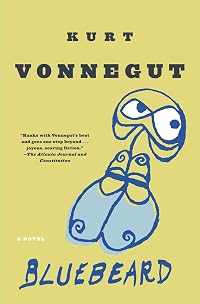
Bluebeard
by Kurt Vonnegut
On This Page
Description
"Broad humor and bitter irony collide in this fictional autobiography of Rabo Karabekian, who, at age seventy-one, wants to be left alone on his Long Island estate with the secret he has locked inside his potato barn. But then a voluptuous young widow badgers Rabo into telling his life story--and Vonnegut in turn tells us the plain, heart-hammering truth about man's careless fancy to create or destroy what he loves"--Cover.Tags
Recommendations





Member Recommendations
Member Reviews
Rabo Karabekian, Armenian-American widower, World War II veteran and failed Abstract Expressionist painter but successful art collector, seems to be enjoying feeling sorry for himself in his retirement on the coast of Long Island, until the bouncy widow Circe Berman (secretly a popular romantic novelist) turns up to insert herself into his household and persuade him to write a memoir. But he has a secret locked up in the potato barn…
Vonnegut has fun poking an ironic stick into the orthodoxies of fine art and literature with the assurance of a writer who has reached an age when he doesn’t need to worry too much about whose toes he treads on any more (if he ever did, that is). But he’s also teasing out a surprisingly optimistic show more message about the way even the most cynical and passionless hack has a moment somewhere in his life that is big enough to push him into producing real art. show less
Vonnegut has fun poking an ironic stick into the orthodoxies of fine art and literature with the assurance of a writer who has reached an age when he doesn’t need to worry too much about whose toes he treads on any more (if he ever did, that is). But he’s also teasing out a surprisingly optimistic show more message about the way even the most cynical and passionless hack has a moment somewhere in his life that is big enough to push him into producing real art. show less
The Basics
Rabo Karabekian is an artist aging alone in a big house full of modern art. Then one day he finds Circe Berman, a young widow, on his private beach. She urges him to write an autobiography about his life, invites herself to live in his house, and starts asking questions about the locked potato barn on his property. Herein, Rabo unravels his life story and eventually comes to face that barn himself.
My Thoughts
Vonnegut doesn’t write bad books. I’ve come to believe that wholeheartedly. I do think sometimes he writes books that aren’t for everyone though, and while I enjoyed this book, there were things that left me wishing for better.
Let me start with Circe Berman. While this wasn’t really a trope when it was written, she show more smacks of Manic Pixie Dream Girl. She sweeps into Rabo’s life to change it for the better while struggling to be a character herself. It wasn’t until the end that I felt she had really become something besides a catalyst for Rabo, but even that felt weak. Not to mention that when Rabo’s irritation with her built, so did mine, so I struggled to both understand and like her. It didn’t break the book for me, but it was a hurdle.
I also think, and this is my problem more than it is Vonnegut’s, that this book wasn’t strange enough. For someone that’s really known for delivering oddities with a smirk, this didn’t have much of that at all. That’s not to say it wasn’t odd in its way, but the oddness was still within the walls of contemporary literature. I adjusted to it and enjoyed the book, but I think this is a sign of the sort of reputation Vonnegut made for himself as a writer of the wonderfully weird and how hard it was for him to break out.
That said, it was still a wonderful book with all that Vonnegut charm. Vonnegut attempts here to chart his way through the waters of modern art, to talk equally about what someone could see in it and what people may be incapable of seeing in it, and much of that is insightful and hilarious. He talks about war in that way that is unique entirely to him. He tells Rabo’s story the way a man facing his past might: in anecdotes, turning to look at memories only when he is prepared for them, and it works.
I always feel personally rewarded when I read Vonnegut, and this was no exception.
Final Rating
4/5 show less
Rabo Karabekian is an artist aging alone in a big house full of modern art. Then one day he finds Circe Berman, a young widow, on his private beach. She urges him to write an autobiography about his life, invites herself to live in his house, and starts asking questions about the locked potato barn on his property. Herein, Rabo unravels his life story and eventually comes to face that barn himself.
My Thoughts
Vonnegut doesn’t write bad books. I’ve come to believe that wholeheartedly. I do think sometimes he writes books that aren’t for everyone though, and while I enjoyed this book, there were things that left me wishing for better.
Let me start with Circe Berman. While this wasn’t really a trope when it was written, she show more smacks of Manic Pixie Dream Girl. She sweeps into Rabo’s life to change it for the better while struggling to be a character herself. It wasn’t until the end that I felt she had really become something besides a catalyst for Rabo, but even that felt weak. Not to mention that when Rabo’s irritation with her built, so did mine, so I struggled to both understand and like her. It didn’t break the book for me, but it was a hurdle.
I also think, and this is my problem more than it is Vonnegut’s, that this book wasn’t strange enough. For someone that’s really known for delivering oddities with a smirk, this didn’t have much of that at all. That’s not to say it wasn’t odd in its way, but the oddness was still within the walls of contemporary literature. I adjusted to it and enjoyed the book, but I think this is a sign of the sort of reputation Vonnegut made for himself as a writer of the wonderfully weird and how hard it was for him to break out.
That said, it was still a wonderful book with all that Vonnegut charm. Vonnegut attempts here to chart his way through the waters of modern art, to talk equally about what someone could see in it and what people may be incapable of seeing in it, and much of that is insightful and hilarious. He talks about war in that way that is unique entirely to him. He tells Rabo’s story the way a man facing his past might: in anecdotes, turning to look at memories only when he is prepared for them, and it works.
I always feel personally rewarded when I read Vonnegut, and this was no exception.
Final Rating
4/5 show less
This is Vonnegut, so it’s quirky, knowing, silly, intelligent, funny, mysterious (what IS in the potato barn?) and anti-war – amongst many other things. It's conversational, and broken into very short chunks, but don't be deceived into thinking it's lightweight.
It claims to be the autobiography of Rabo Karabekian, an Armenian-American WW2 veteran who became a major figure in Abstract Expressionism, after an apprenticeship with realist illustrator, Dan Gregory. It reads more as a memoir, interspersed with “Bulletin from the present” sections which cover the eventful months he wrote it. The backstory is relatively straight; the present day, more comical. (All the main characters are fictitious, but a few real names are dropped, show more such as Jackson Pollock.)
It’s the 1980s, Rabo is in his 70s, and is living alone in a huge house in the Hamptons. He no longer paints, but is wealthy from his art collection and from property he inherited on the death of his second wife, Edith. He’s not actually alone, as his cook lives in, with her daughter, and his writer friend, Paul Slazenger, practically lives there. But he wants to be alone, or thinks he does – until it looks as if it’s going to happen (his mother thought “the most pervasive American disease was loneliness”). Then the widow Circe Berman turns up, and everything changes.
Image: abstract expressionist picture by Willem de Kooning, The Visit 1966–7. (Source.)
The Meaning and Value of Art
“How can you tell a good painting from a bad one? All you have to do… is look at a million paintings, and they you can never be mistaken.”
Should paintings – and their titles – communicate? (If not, what’s the point?) This is a recurring question, with a variety of answers. Old, lonely, and guarding his Abstract Expressionist paintings, Rabo says that they “are about absolutely nothing but themselves”, and lack of passion and message in his works was why he was rejected by art school. When Circe first sees his abstract works, she declares “you hate facts like poison”. And yet Rabo CAN draw – very well; the fact he doesn’t is “because it’s just too fucking easy.”
In contrast, Dan Gregory’s works are hyper-realistic, and Rabo describes them as “truthful about material things, but they lied about time” because Dan was “a taxidermist… [of] great moments”. One of the first things he taught Rabo was the importance of the phrase “The Emperor has no clothes”. It’s for the reader to decide which art that applies to.
There is a visceral thrill: “I discovered something as powerful and irresponsible as shooting up with heroin: if I start laying on just one colour of paint to a huge canvas, I could make the whole world drop away”. But it doesn’t work like that for everyone: of one artist, “I would look into his eyes and there wasn’t anybody home any more”, and he says similar about someone else.
Inflated art prices (and exploitative venture capitalists and investment bankers) are lampooned, especially by the fact that “My paintings, thanks to unforeseen chemical reactions… all destroyed themselves”, including ones that sold for $20,000. Sateen Dura-Luxe proved to be anything but durable. In contrast, his teenage works were made with the best possible materials, given to him from the stores of a successful artist.
Writing is another art form central to the narrative: Rabo is now writing; his friends Circe Berman and Paul Slazenger are also writers, of varying success, and the letters of Dan Gregory’s PA, Marilee, are crucial to the story. The secret is “to write for just one person”. How you decide who that is, is unclear.
Circe Berman
The widow Berman is a wonderful comic creation; I’d love to meet her, though hate to share a home with her. Her opening line on meeting Rabo is “Tell me how your parents died”, because “hello” means “don’t talk about anything important”. It’s also symptomatic of her pathological inquisitiveness (“the most ferocious enemy of privacy I ever knew”). His father died alone in a cinema, and she immediately asks “What was the movie?” – shades of Graham Greene’s short story, A Shocking Incident.
Her chutzpah is breath-taking – the way she storms into Rabo’s life and takes control of him, his house, his time and those around him. He is staggered, outraged… and compliant: “’Who is she to reward and punish me, and what the hell is this: a nursery school or a prison camp?’ I don’t asker that, because she might take away all my privileges.”
Bluebeard and What's in the Potato Barn
I read this book because I wanted to read another Vonnegut, and I was intrigued to see to what extent the title reflected the traditional story of Bluebeard (see my review of Angela Carter's version HERE), or even its echoes in Jane Eyre (see my review HERE).
It’s a gentle nod, but it helps if you’re aware of the original: In the grounds, Rabo has a potato barn that used to be his studio. It is now locked up, and its contents secret: “I am Bluebeard, and my studio is my forbidden chamber”, but “there are no bodies in my barn”.
Much of the book is an elaborate tease as to what’s in there, why, and whether the reader will ever find out. In contrast to his allegedly message-less paintings, Rabo says that the barn contains “the emptiest and yet the fullest of human messages”.
There are other forbidden places: Dan Gregory’s is the Museum Of Modern Art, Paul Slazenger’s is his Theory of Revolution, currently in his head, and Circe Berman must have something, but I don’t know what or where.
War, Death, and Resurrection
The main character is an injured veteran who came to the US as a child refugee from another war. It’s not a ranting pacifist book, and Rabo himself has fond memories of the army, but Vonnegut’s anti-war opinions shine through, especially at the end. Sometimes this is poignant: Rabo is utterly repulsed by the scarring around his missing eye, and always wears a patch. Sometimes it is more satirical: WW2 was promoted to Americans on promises of “a final war between good and evil, so that nothing would do but that it be followed by miracles, Instant coffee was one. DDT was another. It was going to kill all the bugs, and almost did. Nuclear energy was going to make electricity so cheap that it might not even be metered… Antibiotics would defeat all diseases. Lazarus would never die: How was that for a scheme to make the Son of God obsolete?”
In fact, it’s Rabo who is Lazarus. Circe explicitly says so when he complains about her intrusion into and control of him, “I brought you back to life… You’re my Lazarus”, and his beloved second wife, Edith, had had a similar effect.
As a youth, Rabo assumed society had evolved so that people would no longer be fooled by the apparent romance of war, but as an old man, he observes “you can buy a machine gun with a plastic bayonet for your little kid”.
The Inimitable Dan Gregory (Refrain)
The central third of the book feels as much like a biography of Dan Gregory as of Rabo.
Where Slaughterhouse Five has the recurring phrase “so it goes”, in this, it’s a series of superlatives about Dan Gregory: “Nobody could [do x] like Dan Gregory”. His achievements include: “draw cheap, mail-order clothes”, “paint grime”, “counterfeit rust and rust-stained oak”, “counterfeit plant diseases”, “counterfeit more accents from stage, screen and radio”, “counterfeit images in dusty mirrors”, “paint black people”, “put more of the excitement of a single moment into the eyes of stuffed animals”.
Quotes
• “Never trust a survivor… until you find out what he did to stay alive.”
• “Perfectly beautiful cowboy boots… dazzling jewelry for manly feet.”
• “She had life. I had accumulated anecdotes.”
• Old canvases “Purged of every trace of Sateen Dura-Luxe, and restretched and reprimed… dazzling white in their restored virginity.”
• “They are a negation of art! They aren’t just neutral. They are black holes from which no intelligence or skill can ever escape. Worse than that, they suck up the dignity, the self-respect, of anybody unfortunate enough to have to look at them.” (What Rabo thinks of Circe’s choice of pictures.)
Suggested by Rand, as being in a similar vein to Vonnegut's excellent Galapogos (see my review HERE). show less
It claims to be the autobiography of Rabo Karabekian, an Armenian-American WW2 veteran who became a major figure in Abstract Expressionism, after an apprenticeship with realist illustrator, Dan Gregory. It reads more as a memoir, interspersed with “Bulletin from the present” sections which cover the eventful months he wrote it. The backstory is relatively straight; the present day, more comical. (All the main characters are fictitious, but a few real names are dropped, show more such as Jackson Pollock.)
It’s the 1980s, Rabo is in his 70s, and is living alone in a huge house in the Hamptons. He no longer paints, but is wealthy from his art collection and from property he inherited on the death of his second wife, Edith. He’s not actually alone, as his cook lives in, with her daughter, and his writer friend, Paul Slazenger, practically lives there. But he wants to be alone, or thinks he does – until it looks as if it’s going to happen (his mother thought “the most pervasive American disease was loneliness”). Then the widow Circe Berman turns up, and everything changes.
Image: abstract expressionist picture by Willem de Kooning, The Visit 1966–7. (Source.)
The Meaning and Value of Art
“How can you tell a good painting from a bad one? All you have to do… is look at a million paintings, and they you can never be mistaken.”
Should paintings – and their titles – communicate? (If not, what’s the point?) This is a recurring question, with a variety of answers. Old, lonely, and guarding his Abstract Expressionist paintings, Rabo says that they “are about absolutely nothing but themselves”, and lack of passion and message in his works was why he was rejected by art school. When Circe first sees his abstract works, she declares “you hate facts like poison”. And yet Rabo CAN draw – very well; the fact he doesn’t is “because it’s just too fucking easy.”
In contrast, Dan Gregory’s works are hyper-realistic, and Rabo describes them as “truthful about material things, but they lied about time” because Dan was “a taxidermist… [of] great moments”. One of the first things he taught Rabo was the importance of the phrase “The Emperor has no clothes”. It’s for the reader to decide which art that applies to.
There is a visceral thrill: “I discovered something as powerful and irresponsible as shooting up with heroin: if I start laying on just one colour of paint to a huge canvas, I could make the whole world drop away”. But it doesn’t work like that for everyone: of one artist, “I would look into his eyes and there wasn’t anybody home any more”, and he says similar about someone else.
Inflated art prices (and exploitative venture capitalists and investment bankers) are lampooned, especially by the fact that “My paintings, thanks to unforeseen chemical reactions… all destroyed themselves”, including ones that sold for $20,000. Sateen Dura-Luxe proved to be anything but durable. In contrast, his teenage works were made with the best possible materials, given to him from the stores of a successful artist.
Writing is another art form central to the narrative: Rabo is now writing; his friends Circe Berman and Paul Slazenger are also writers, of varying success, and the letters of Dan Gregory’s PA, Marilee, are crucial to the story. The secret is “to write for just one person”. How you decide who that is, is unclear.
Circe Berman
The widow Berman is a wonderful comic creation; I’d love to meet her, though hate to share a home with her. Her opening line on meeting Rabo is “Tell me how your parents died”, because “hello” means “don’t talk about anything important”. It’s also symptomatic of her pathological inquisitiveness (“the most ferocious enemy of privacy I ever knew”). His father died alone in a cinema, and she immediately asks “What was the movie?” – shades of Graham Greene’s short story, A Shocking Incident.
Her chutzpah is breath-taking – the way she storms into Rabo’s life and takes control of him, his house, his time and those around him. He is staggered, outraged… and compliant: “’Who is she to reward and punish me, and what the hell is this: a nursery school or a prison camp?’ I don’t asker that, because she might take away all my privileges.”
Bluebeard and What's in the Potato Barn
I read this book because I wanted to read another Vonnegut, and I was intrigued to see to what extent the title reflected the traditional story of Bluebeard (see my review of Angela Carter's version HERE), or even its echoes in Jane Eyre (see my review HERE).
It’s a gentle nod, but it helps if you’re aware of the original: In the grounds, Rabo has a potato barn that used to be his studio. It is now locked up, and its contents secret: “I am Bluebeard, and my studio is my forbidden chamber”, but “there are no bodies in my barn”.
Much of the book is an elaborate tease as to what’s in there, why, and whether the reader will ever find out. In contrast to his allegedly message-less paintings, Rabo says that the barn contains “the emptiest and yet the fullest of human messages”.
There are other forbidden places: Dan Gregory’s is the Museum Of Modern Art, Paul Slazenger’s is his Theory of Revolution, currently in his head, and Circe Berman must have something, but I don’t know what or where.
War, Death, and Resurrection
The main character is an injured veteran who came to the US as a child refugee from another war. It’s not a ranting pacifist book, and Rabo himself has fond memories of the army, but Vonnegut’s anti-war opinions shine through, especially at the end. Sometimes this is poignant: Rabo is utterly repulsed by the scarring around his missing eye, and always wears a patch. Sometimes it is more satirical: WW2 was promoted to Americans on promises of “a final war between good and evil, so that nothing would do but that it be followed by miracles, Instant coffee was one. DDT was another. It was going to kill all the bugs, and almost did. Nuclear energy was going to make electricity so cheap that it might not even be metered… Antibiotics would defeat all diseases. Lazarus would never die: How was that for a scheme to make the Son of God obsolete?”
In fact, it’s Rabo who is Lazarus. Circe explicitly says so when he complains about her intrusion into and control of him, “I brought you back to life… You’re my Lazarus”, and his beloved second wife, Edith, had had a similar effect.
As a youth, Rabo assumed society had evolved so that people would no longer be fooled by the apparent romance of war, but as an old man, he observes “you can buy a machine gun with a plastic bayonet for your little kid”.
The Inimitable Dan Gregory (Refrain)
The central third of the book feels as much like a biography of Dan Gregory as of Rabo.
Where Slaughterhouse Five has the recurring phrase “so it goes”, in this, it’s a series of superlatives about Dan Gregory: “Nobody could [do x] like Dan Gregory”. His achievements include: “draw cheap, mail-order clothes”, “paint grime”, “counterfeit rust and rust-stained oak”, “counterfeit plant diseases”, “counterfeit more accents from stage, screen and radio”, “counterfeit images in dusty mirrors”, “paint black people”, “put more of the excitement of a single moment into the eyes of stuffed animals”.
Quotes
• “Never trust a survivor… until you find out what he did to stay alive.”
• “Perfectly beautiful cowboy boots… dazzling jewelry for manly feet.”
• “She had life. I had accumulated anecdotes.”
• Old canvases “Purged of every trace of Sateen Dura-Luxe, and restretched and reprimed… dazzling white in their restored virginity.”
• “They are a negation of art! They aren’t just neutral. They are black holes from which no intelligence or skill can ever escape. Worse than that, they suck up the dignity, the self-respect, of anybody unfortunate enough to have to look at them.” (What Rabo thinks of Circe’s choice of pictures.)
Suggested by Rand, as being in a similar vein to Vonnegut's excellent Galapogos (see my review HERE). show less
Bluebeard is full of all the stuff I love about Kurt Vonnegut: wit, empathy, humor, fascinating characters. I also happen to love the conceit of a fictional autobiography, and this one is done so well—Rabo Karabekian is thoughtfully drawn, his history believable and his Sateen Dura-Luxe catastrophe perfectly tragicomic. I also love Circe Berman, who we get to know only obliquely but who is wonderfully headstrong and funny.
There's a lacuna at the center of this story, and it's glaring, and as I got closer to the end I wondered if it would be addressed: Rabo's time in the war. He mentions how he began his service, what his mission was, and we get one or two very brief anecdotes—but no time is spent exploring what he actually did. I show more think that's intentional, and once I noticed it wouldn't be touched upon at all, I thought it was a smart choice, especially considering the reveal of what our Bluebeard is hiding.
It'll be hard to surpass The Sirens of Titan for me, but I've loved each of the three Vonnegut novels I've read so far and will continue to make my way through his oeuvre! show less
There's a lacuna at the center of this story, and it's glaring, and as I got closer to the end I wondered if it would be addressed: Rabo's time in the war. He mentions how he began his service, what his mission was, and we get one or two very brief anecdotes—but no time is spent exploring what he actually did. I show more think that's intentional, and once I noticed it wouldn't be touched upon at all, I thought it was a smart choice, especially considering the reveal of what our Bluebeard is hiding.
It'll be hard to surpass The Sirens of Titan for me, but I've loved each of the three Vonnegut novels I've read so far and will continue to make my way through his oeuvre! show less
Bluebeard is structured as the autobiography of the Armenian, one-eyed painter, Rabo Karabekian. You may remember him from his cameo in Breakfast of Champions, although he's a lot older in Bluebeard. It's a clever idea to take this minor character and then spin out an entire backstory- and what a life! This book deals with his Armenian genocide survivor parents, apprenticeship with a famous, but mean painter, being a soldier in World War II, two marriages, and his involvement in the Abstract Expressionist art movement. It also functions as a journal for his present life, which has been turned upside down by a pushy pill-popping widow named Circe Birman. There's even a mystery pushing the plot forward, as Rabo refers to a secret he is show more keeping in his potato barn that he does not want shown until after his death. I've read this book before, but I completely forgot what was in the barn so I was still curious. Based on the title Bluebeard you might expect it to be his dead wives, but you just have to wait and find out…
Rabo writes in a voice remarkably similar to Kurt Vonnegut's and he also writes in the same broken up style, but I can forgive it since I like Vonnegut's style so much. Like Vonnegut, he's also a world weary, cynical, curmudgeonly old guy, but still sees the beauty in people. He believes humans are made of meat and souls and it is our meat which makes us do terrible things. But if you can look past it, there is a beautiful soul in everyone.
I thought for the first time in a Vonnegut novel that there were some strong female characters. Circe Birman is kind of crazy, but her opening line "Tell me how your parents died" is amazing. Her dynamic with Paul Slazinger was also funny, as he'd patronize her without knowing she was a bestselling author. Marilee is also interesting. I like how going to MOMA with Rabo was more offensive to her husband than sleeping with him would be. She takes a turn to feminism following WWII, which I guess is kind of before "feminism" was a thing. Rabo expects a booty call when they reunite in Italy, but instead she teaches him about how cruel and dangerous men can be. It's nice to see a woman who before couldn't understand Nora in 'A Doll's House' get her independence.
This novel also deals a lot with art. It makes fun at how ridiculously expensive some modern art is by having Rabo's expensive paintings completely disintegrate and peel off the canvas. His legacy is reduced to failure, unlike his buddy Jackson Pollack. It also explores technical skill and how it's not enough to make a great painting. Rabo rejects his excellent drawing skills because he feels it's too easy and turns to the Abstract Expressionist style. You'd think throwing paint around would be easier, but apparently not! The painting in the potato barn uses his excellent technical skill but combines it with emotional subject matter. The massive painting depicts the valley Rabo was released to with thousands of other prisoners in World War II. What makes the painting incredible is the detailed backstory that Rabo has given to each person. It's amazing to think that each person in a crowd is not only a beam of awareness, but also a complicated individual. I wish this painting existed, but I guess it probably couldn't live up to how everyone can imagine it in their heads. It also makes you think of what everyone is hiding in their own metaphorical potato barns. It's like everyone has all these great talents but we keep them hidden because we're afraid of people's reactions. This novel was a really enjoyable reading experience and I consider it to be one of Kurt Vonnegut's best. show less
Rabo writes in a voice remarkably similar to Kurt Vonnegut's and he also writes in the same broken up style, but I can forgive it since I like Vonnegut's style so much. Like Vonnegut, he's also a world weary, cynical, curmudgeonly old guy, but still sees the beauty in people. He believes humans are made of meat and souls and it is our meat which makes us do terrible things. But if you can look past it, there is a beautiful soul in everyone.
I thought for the first time in a Vonnegut novel that there were some strong female characters. Circe Birman is kind of crazy, but her opening line "Tell me how your parents died" is amazing. Her dynamic with Paul Slazinger was also funny, as he'd patronize her without knowing she was a bestselling author. Marilee is also interesting. I like how going to MOMA with Rabo was more offensive to her husband than sleeping with him would be. She takes a turn to feminism following WWII, which I guess is kind of before "feminism" was a thing. Rabo expects a booty call when they reunite in Italy, but instead she teaches him about how cruel and dangerous men can be. It's nice to see a woman who before couldn't understand Nora in 'A Doll's House' get her independence.
This novel also deals a lot with art. It makes fun at how ridiculously expensive some modern art is by having Rabo's expensive paintings completely disintegrate and peel off the canvas. His legacy is reduced to failure, unlike his buddy Jackson Pollack. It also explores technical skill and how it's not enough to make a great painting. Rabo rejects his excellent drawing skills because he feels it's too easy and turns to the Abstract Expressionist style. You'd think throwing paint around would be easier, but apparently not!
Kurt Vonnegut is a sublime craftsman, whose days both as a soldier and news reporter honed his empathy and literary skills so that he has been able to write books that work on many levels, reaching many people with grand success; all the while flying the flag for peace and goodwill so as to encourage us all to treat each other and this beautiful planet we happen to live on, with love. His self deprecating characters are portals to all the craziness and tomfoolery in the world, beautifully accentuated by sharp, satirical, ironic wit.
This particular tale is suffused with themes I imagine particularly relevant to Vonnegut's own life - it almost feels like this is somewhat semi-autobiographical too - (writing, art, war, living in the late show more bloom of life). It tells the tale of a One-eyed Armenian called Rabo Karabekian who is a retired and ridiculed abstract expressionist painter and soldier who now lives in relative hermitdom, whilst writing an autobiography in his late years. His memoirs are permeated with happenings of his present day life too, which serve to create a tale of his life from both ends, as it were.
Having studied art, the abstract expressionist strand endeared me ever further to another strong work by one of my favourite authors. Not only does he do the whole art shebang justice - mixing it into the plot like jesso into oil paint (see what I did there?) he crafts another story of immense pathos. Well worth the read for wise words about life and how to live it better, all wrapped up in the life and story of an eyepatch-wearing, melancholy, reflective soul. show less
This particular tale is suffused with themes I imagine particularly relevant to Vonnegut's own life - it almost feels like this is somewhat semi-autobiographical too - (writing, art, war, living in the late show more bloom of life). It tells the tale of a One-eyed Armenian called Rabo Karabekian who is a retired and ridiculed abstract expressionist painter and soldier who now lives in relative hermitdom, whilst writing an autobiography in his late years. His memoirs are permeated with happenings of his present day life too, which serve to create a tale of his life from both ends, as it were.
Having studied art, the abstract expressionist strand endeared me ever further to another strong work by one of my favourite authors. Not only does he do the whole art shebang justice - mixing it into the plot like jesso into oil paint (see what I did there?) he crafts another story of immense pathos. Well worth the read for wise words about life and how to live it better, all wrapped up in the life and story of an eyepatch-wearing, melancholy, reflective soul. show less
This is probably my favorite Vonnegut novel. It is his most mainstream, the one that most closely follows the traditional model. But I think it's also Vonnegut at his most powerful, because it's Vonnegut at his most hopeful.
Bluebeard is about an artist named Rabo Karabekian's whose life, like his art, has completely fallen apart. The novel functions as his memoir, which he doesn't want to write. But as the novel progresses, Rabo discovers that he has more to say. He make a form of peace with his past, and he takes a step forward in a way Vonnegut's characters rarely do.
Bluebeard is about an artist named Rabo Karabekian's whose life, like his art, has completely fallen apart. The novel functions as his memoir, which he doesn't want to write. But as the novel progresses, Rabo discovers that he has more to say. He make a form of peace with his past, and he takes a step forward in a way Vonnegut's characters rarely do.
Members
- Recently Added By
Published Reviews
ThingScore 100
There may be greater noevelists than Vonnegut, but there can be a few, if any, with as much good humour and generorisy. His long-standing affection for his fellow science-fiction writers, a clan still beyond the pale of polite society - 'I love you crazy sons of bitches,' he told them in 'God Bless You, Mr Rosewater' - now extends to the whole human race, whose members also sit well below the show more salt but, in Vonnegut's eyes, display the same innocence, feckless enthusiasms and general tendency to trip over the furniture. show less
added by Diabolical_DrZ
Lists

Novels Published in 1987
81 works; 19 members

1980s
356 works; 23 members

Blue Pyramid 1,276 Best Books of All Time
1,248 works; 32 members

A Rainbow of Books: Colors in the Title
570 works; 24 members

Books That Changed Our Perspective
423 works; 168 members

naturallogg's 2025 in Books
50 works; 1 member
Author Information

294+ Works 201,676 Members
The appeal of Kurt Vonnegut, especially to bright younger readers of the past few decades, may be attributed partly to the fact that he is one of the few writers who have successfully straddled the imaginary line between science-fiction/fantasy and "real literature." He was born in Indianapolis and attended Cornell University, but his college show more education was interrupted by World War II. Captured during the Battle of the Bulge and imprisoned in Dresden, he received a Purple Heart for what he calls a "ludicrously negligible wound." After the war he returned to Cornell and then earned his M.A. at the University of Chicago.He worked as a police reporter and in public relations before placing several short stories in the popular magazines and beginning his career as a novelist. His first novel, Player Piano (1952), is a highly credible account of a future mechanistic society in which people count for little and machines for much. The Sirens of Titan (1959), is the story of a playboy whisked off to Mars and outer space in order to learn some humbling lessons about Earth's modest function in the total scheme of things. Mother Night (1962) satirizes the Nazi mentality in its narrative about an American writer who broadcasts propaganda in Germany during the war as an Allied agent. Cat's Cradle (1963) makes use of some of Vonnegut's experiences in General Electric laboratories in its story about the discovery of a special kind of ice that destroys the world. God Bless You, Mr. Rosewater (1965) satirizes a benevolent foundation set up to foster the salvation of the world through love, an endeavor with, of course, disastrous results. Slaughterhouse-Five; or The Children's Crusade (1969) is the book that marked a turning point in Vonnegut's career. Based on his experiences in Dresden, it is the story of another Vonnegut surrogate named Billy Pilgrim who travels back and forth in time and becomes a kind of modern-day Everyman. The novel was something of a cult book during the Vietnam era for its antiwar sentiments. Breakfast of Champions (1973), the story of a Pontiac dealer who goes crazy after reading a science fiction novel by "Kilgore Trout," received generally unfavorable reviews but was a commercial success. Slapstick (1976), dedicated to the memory of Laurel and Hardy, is the somewhat wacky memoir of a 100-year-old ex-president who thinks he can solve society's problems by giving everyone a new middle name. In addition to his fiction, Vonnegut has published nonfiction on social problems and other topics, some of which is collected in Wampeters, Foma and Granfalloons (1974). He died from head injuries sustained in a fall on April 11, 2007. (Bowker Author Biography) show less
Some Editions
Awards and Honors
Distinctions
Notable Lists
Series
Belongs to Publisher Series
ハヤカワ文庫 SF (1205)
Keltainen kirjasto (221)
Work Relationships
Is contained in
Common Knowledge
- Canonical title
- Bluebeard
- Original title
- Bluebeard
- Original publication date
- 1987-10-02
- Related movies
- Bluebeard (pre-production | IMDb)
- First words
- Having written "The End" to this story my life, I find it prudent to scamper back here to before the beginning, to my front door, so to speak, and to make this apology to arriving guests: "I promised you an autobiography, but... (show all) something went wrong in the kitchen."
- Quotations
- "If anybody has discovered what life is all about,“ Father might say, "it is too late. I am no longer interested."
- Last words
- (Click to show. Warning: May contain spoilers.)Oh, happy Rabo Karabekian.
- Original language
- English
Classifications
Statistics
- Members
- 5,037
- Popularity
- 2,776
- Reviews
- 46
- Rating
- (3.90)
- Languages
- 17 — Dutch, English, Estonian, Finnish, French, German, Greek, Hungarian, Italian, Japanese, Norwegian (Bokmål), Polish, Portuguese, Russian, Spanish, Swedish, Turkish
- Media
- Paper, Audiobook, Ebook
- ISBNs
- 56
- ASINs
- 31