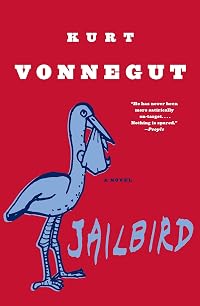
Jailbird
by Kurt Vonnegut
On This Page
Description
This wry tale follows bumbling bureaucrat Walter F. Starbuck from Harvard to the Nixon White House to the penitentiary as Watergate's least known co-conspirator.Tags
Recommendations







Member Reviews
Vonnegut shines in this novel, as he explores cold war America and its attitudes towards various things such as Communism, the Watergate scandal, and international conglomerates.
Some of Vonnegut's defining features come out in this. Namely, from the Vonnegut I have read, his main characters are not always the most likeable characters, and their attitudes towards love, death, sex, and money are not sympathetic. Vonnegut is a natural humanist, and explores the human condition interestingly with Jailbird's Walter Starbuck.
Another thing that Vonnegut does well is his jumping between time seamlessly. While not as aggressive as Slaughterhouse-Five, this work still does jump around, from Walter Starbuck's time at Harvard, to his marriage, and show more his time in prison, Vonnegut connects settings and times very well. He does this by using continuity of language and attitude throughout, so that he simply has to tell the readers where in the timeline they are, and they can jump right in.
I'm a historian, at least in study, and this is a very nice, relatively accurate telling in my opinion. Loved the tenacity with which Vonnegut goes about dissecting post WW2 America, and love that he does through the eyes of a former communist turned Vice President of a sector of an international conglomerate. show less
Some of Vonnegut's defining features come out in this. Namely, from the Vonnegut I have read, his main characters are not always the most likeable characters, and their attitudes towards love, death, sex, and money are not sympathetic. Vonnegut is a natural humanist, and explores the human condition interestingly with Jailbird's Walter Starbuck.
Another thing that Vonnegut does well is his jumping between time seamlessly. While not as aggressive as Slaughterhouse-Five, this work still does jump around, from Walter Starbuck's time at Harvard, to his marriage, and show more his time in prison, Vonnegut connects settings and times very well. He does this by using continuity of language and attitude throughout, so that he simply has to tell the readers where in the timeline they are, and they can jump right in.
I'm a historian, at least in study, and this is a very nice, relatively accurate telling in my opinion. Loved the tenacity with which Vonnegut goes about dissecting post WW2 America, and love that he does through the eyes of a former communist turned Vice President of a sector of an international conglomerate. show less
My 4th perfect score i've given to a book & guess what!
This is my 3rd Vonnegut book of those 4 (the only other book, Zealot, is nonfiction, meaning that all 3 fiction books i've given perfect scores are Vonnegut: this, SH5 & The sirens of titan).
As I said to Joe when recommending & trying to explain this book, any explanation of this story is like unfolding a beautiful origami swan into a crumpled piece of paper and pointing at the random creases saying "Thisss was where the eye was! and this crimp right here was a wing tip".
The way this interlaces history & far right political views (or as Vonnegut says "common sense") with a fractured Vonnegutian narrative + his beautiful, human-first approach to life and everything. An approach I show more always feel i can learn more from each time I read him & one i admire so dearly!
God bless you, Mr. Vonnegut (or Pearls before Swine)! show less
This is my 3rd Vonnegut book of those 4 (the only other book, Zealot, is nonfiction, meaning that all 3 fiction books i've given perfect scores are Vonnegut: this, SH5 & The sirens of titan).
As I said to Joe when recommending & trying to explain this book, any explanation of this story is like unfolding a beautiful origami swan into a crumpled piece of paper and pointing at the random creases saying "Thisss was where the eye was! and this crimp right here was a wing tip".
The way this interlaces history & far right political views (or as Vonnegut says "common sense") with a fractured Vonnegutian narrative + his beautiful, human-first approach to life and everything. An approach I show more always feel i can learn more from each time I read him & one i admire so dearly!
God bless you, Mr. Vonnegut (or Pearls before Swine)! show less
Damn, I love Vonnegut! This is (I think) considered a lesser work, and still I found it to be profoundly enjoyable. Sacco & Vanzetti; Watergate; homelessness; all rolled up in Vonnegut's style of storytelling.
Here's just one of the passages that bowled me over:
So I did sit down, and everywhere I looked I saw customers of every description being received with love. To the waitress everybody was "honeybunch" and "darling" and "dear." It was like an emergency ward after a great catastrophe. It did not matter what race or class the victims belonged to. They were all given the same miracle drug, which was coffee. The catastrophe in this case, of course, was that the sun had come up again.
As Vonnegut might say (and does, in this novel, as an show more echo of "So it goes"): Strong stuff. show less
Here's just one of the passages that bowled me over:
So I did sit down, and everywhere I looked I saw customers of every description being received with love. To the waitress everybody was "honeybunch" and "darling" and "dear." It was like an emergency ward after a great catastrophe. It did not matter what race or class the victims belonged to. They were all given the same miracle drug, which was coffee. The catastrophe in this case, of course, was that the sun had come up again.
As Vonnegut might say (and does, in this novel, as an show more echo of "So it goes"): Strong stuff. show less
Jailbird begins as a story about a man who has been jailed for having a very insignificant part in the Watergate scandal. Because of this, he is housed in a jail for white collar criminals near Atlanta, Georgia. The story traces his past beginning with his childhood as the son of two servants for the wealthy McCone family and continues on to tell about his life as a Harvard student and role in the HUAC hearings among other things.
I found the book to be characteristic of Vonnegut in that it is filled with his trademark wit and dark humor. The reader wants to root for the protagonist to find some sort of fulfillment in life in a world that Vonnegut portrays as being very silly and senseless. Through humorous portrayals of the US show more government and corporations, Vonnegut provides a scathing mockery of the US economic system and how inhuman we all become within it.
I liked this book even though I doubt that Vonnegut and I would agree on a lot of things politically. Regardless of how you feel about the American version of the capitalist system, you have to admit that at many times Vonnegut does point out some of the absurdities of it. Likewise, as I previously mentioned, he does write in such a way as to make you want to root for the protagonist and hope that he gets some sort of justice in his life even though, after comparisons are frequently made to Sacco and Vanzetti, that this isn't likely to happen for him. show less
I found the book to be characteristic of Vonnegut in that it is filled with his trademark wit and dark humor. The reader wants to root for the protagonist to find some sort of fulfillment in life in a world that Vonnegut portrays as being very silly and senseless. Through humorous portrayals of the US show more government and corporations, Vonnegut provides a scathing mockery of the US economic system and how inhuman we all become within it.
I liked this book even though I doubt that Vonnegut and I would agree on a lot of things politically. Regardless of how you feel about the American version of the capitalist system, you have to admit that at many times Vonnegut does point out some of the absurdities of it. Likewise, as I previously mentioned, he does write in such a way as to make you want to root for the protagonist and hope that he gets some sort of justice in his life even though, after comparisons are frequently made to Sacco and Vanzetti, that this isn't likely to happen for him. show less
It's not shocking that in Palm Sunday, the "autobiographical collage" Vonnegut compiled/wrote immediately after publishing Jailbird, he grades this book as an A.
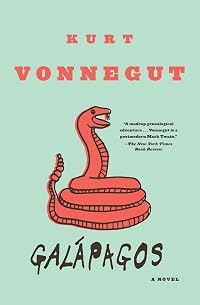
While this one came first, Jailbird shares a great deal in common with 1985's Galápagos -- specifically, that both novels take place over the course of one very star-crossed day (with numerous forwards- and backwards-looking references, of course), and that both deal with the nastiness of human nature in a surprisingly endearing way. Here, we have Walter F. Starbuck, who epitomizes the good man who was in the wrong place at the wrong time throughout his life, who begins the novel leaving prison after serving his sentence for his involvement in Watergate and ends it about to show more return to prison for concealing a will.
In between, we meet a huge amount of horrible people, and some good ones too, all of whom have contributed to Walter's downfall. Despite it all, he's still a good man (a Vonnegutian man, no doubt), and the novel is saved from potential jadedness by the devil-may-care sweetness of its main character. Still, that such awfulness happens to such a good man is troublesome, and by the end, that's the entire point.
Human horridness never looked so good. show less
While this one came first, Jailbird shares a great deal in common with 1985's Galápagos -- specifically, that both novels take place over the course of one very star-crossed day (with numerous forwards- and backwards-looking references, of course), and that both deal with the nastiness of human nature in a surprisingly endearing way. Here, we have Walter F. Starbuck, who epitomizes the good man who was in the wrong place at the wrong time throughout his life, who begins the novel leaving prison after serving his sentence for his involvement in Watergate and ends it about to show more return to prison for concealing a will.
In between, we meet a huge amount of horrible people, and some good ones too, all of whom have contributed to Walter's downfall. Despite it all, he's still a good man (a Vonnegutian man, no doubt), and the novel is saved from potential jadedness by the devil-may-care sweetness of its main character. Still, that such awfulness happens to such a good man is troublesome, and by the end, that's the entire point.
Human horridness never looked so good. show less
I began reading this book just after finishing Anna Karenina and I am glad I did. It was essentially everything Anna Karenina was not (in a good way).
The prose was classic Vonnegut, light, fast paced and strangely hilarious. I look at Vonnegut as many look upon their grandfathers. There are the same corny jokes you've come to expect and despite their corniness you can't help but laugh and be pleased with them.
Jailbird was particularly interesting and at the same time confusing for me. The tale gets wrapped up in just as many historical events as it does fictional and there is also the mention and inclusion of many notable figures from the past 100 or so years.
In the end it doesn't matter where fact and fiction cross or where they show more diverge. The book was fun and seemingly lighthearted and like Vonnegut always does he make some serious points.
Here is a quote, that given our current economic crisis seems perfect:
"The economy is a thoughtless weather system-- and nothing more. Some joke on the people, to give them such a thing."
I think we are slowly realizing that we are the butt of this joke show less
The prose was classic Vonnegut, light, fast paced and strangely hilarious. I look at Vonnegut as many look upon their grandfathers. There are the same corny jokes you've come to expect and despite their corniness you can't help but laugh and be pleased with them.
Jailbird was particularly interesting and at the same time confusing for me. The tale gets wrapped up in just as many historical events as it does fictional and there is also the mention and inclusion of many notable figures from the past 100 or so years.
In the end it doesn't matter where fact and fiction cross or where they show more diverge. The book was fun and seemingly lighthearted and like Vonnegut always does he make some serious points.
Here is a quote, that given our current economic crisis seems perfect:
"The economy is a thoughtless weather system-- and nothing more. Some joke on the people, to give them such a thing."
I think we are slowly realizing that we are the butt of this joke show less
It strikes me, not for the first time whilst reading Vonnegut that writers can be divided into two camps. The ones who have to work to include that smart-arse-clever line/sentence/phrase they jotted down somewhere, sometime and really really need to get in. Who was it who said that the more you like something you've written down, the more likely it is that you should take it out? And the ones who, even if what they say hits you with a jolt - and Vonnegut's lines often do that - they nonetheless fit in. They aren't forced, they naturally belong just there where the reader sets upon them. There is a hilarious Kilgore Trout story about Einstein trying to get into heaven in Jailbird. He goes through an audit first and then:
Rest here: show more target="_top">http://alittleteaalittlechat.wordpress.com/2014/09/01/jailbird-by-kurt-vonnegut/ show less
Rest here: show more target="_top">http://alittleteaalittlechat.wordpress.com/2014/09/01/jailbird-by-kurt-vonnegut/ show less
Members
- Recently Added By
Published Reviews
Jailbird is KV's surrealistic yet stunningly pertinent
account of the part he played, under the alias of Walter F. Starbuck, as the least significant—and hitherto entirely unknown—conspirator in the villainies of Watergate. No, it isn't. It's a love-affair with language and ideas.
account of the part he played, under the alias of Walter F. Starbuck, as the least significant—and hitherto entirely unknown—conspirator in the villainies of Watergate. No, it isn't. It's a love-affair with language and ideas.
added by KayCliff
Lists

20th Century Literature
1,161 works; 55 members

Books Read in 2017
4,249 works; 130 members

Publisher's Weekly Bestsellers - Part II - 1940 - 1979
355 works; 5 members

Books Read in 2020
4,379 works; 124 members

Read
293 works; 4 members

Blue Pyramid 1,276 Best Books of All Time
1,248 works; 32 members

Animals in the Title
498 works; 11 members

The Torchlight List
95 works; 1 member

Unread books
1,063 works; 86 members
Author Information

291+ Works 201,110 Members
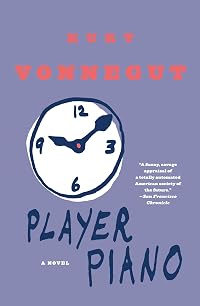
The appeal of Kurt Vonnegut, especially to bright younger readers of the past few decades, may be attributed partly to the fact that he is one of the few writers who have successfully straddled the imaginary line between science-fiction/fantasy and "real literature." He was born in Indianapolis and attended Cornell University, but his college show more education was interrupted by World War II. Captured during the Battle of the Bulge and imprisoned in Dresden, he received a Purple Heart for what he calls a "ludicrously negligible wound." After the war he returned to Cornell and then earned his M.A. at the University of Chicago.He worked as a police reporter and in public relations before placing several short stories in the popular magazines and beginning his career as a novelist. His first novel, Player Piano (1952), is a highly credible account of a future mechanistic society in which people count for little and machines for much. The Sirens of Titan (1959), is the story of a playboy whisked off to Mars and outer space in order to learn some humbling lessons about Earth's modest function in the total scheme of things. Mother Night (1962) satirizes the Nazi mentality in its narrative about an American writer who broadcasts propaganda in Germany during the war as an Allied agent. Cat's Cradle (1963) makes use of some of Vonnegut's experiences in General Electric laboratories in its story about the discovery of a special kind of ice that destroys the world. God Bless You, Mr. Rosewater (1965) satirizes a benevolent foundation set up to foster the salvation of the world through love, an endeavor with, of course, disastrous results. Slaughterhouse-Five; or The Children's Crusade (1969) is the book that marked a turning point in Vonnegut's career. Based on his experiences in Dresden, it is the story of another Vonnegut surrogate named Billy Pilgrim who travels back and forth in time and becomes a kind of modern-day Everyman. The novel was something of a cult book during the Vietnam era for its antiwar sentiments. Breakfast of Champions (1973), the story of a Pontiac dealer who goes crazy after reading a science fiction novel by "Kilgore Trout," received generally unfavorable reviews but was a commercial success. Slapstick (1976), dedicated to the memory of Laurel and Hardy, is the somewhat wacky memoir of a 100-year-old ex-president who thinks he can solve society's problems by giving everyone a new middle name. In addition to his fiction, Vonnegut has published nonfiction on social problems and other topics, some of which is collected in Wampeters, Foma and Granfalloons (1974). He died from head injuries sustained in a fall on April 11, 2007. (Bowker Author Biography) show less
Some Editions
Awards and Honors
Series
Belongs to Publisher Series
Work Relationships
Common Knowledge
- Canonical title*
- Galgenvogel
- Original title
- Jailbird
- Original publication date
- 1979
- People/Characters
- Walter F. Starbuck; Kilgore Trout; Ferdinando Nicola Sacco; Bartolomeo Vanzetti
- Dedication
- For Benjamin D. Hitz, Close friend of my youth, Best man at my wedding. Ben, you used to tell me about Wonderful books you had just read, And then I would imagine that I Had read them, too. You read nothing but the best, B... (show all)en, While I studied chemistry. Long time no see.
- First words
- Yes -- Kilgore Trout is back again. (Prologue)
Life goes on, yes -- and a fool and his self-respect are soon parted. - Last words
- (Click to show. Warning: May contain spoilers.)Goodbye.
- Blurbers
- Irving, John; Diehl, William
- Original language
- English
*Some information comes from Common Knowledge in other languages. Click "Edit" for more information.
Classifications
Statistics
- Members
- 4,603
- Popularity
- 3,146
- Reviews
- 27
- Rating
- (3.72)
- Languages
- 19 — Czech, Danish, Dutch, English, Estonian, Finnish, French, German, Hungarian, Italian, Japanese, Norwegian (Bokmål), Polish, Portuguese, Romanian, Spanish, Swedish, Turkish, Ukrainian
- Media
- Paper, Audiobook, Ebook
- ISBNs
- 57
- ASINs
- 30