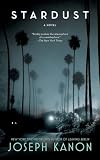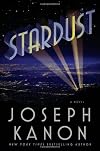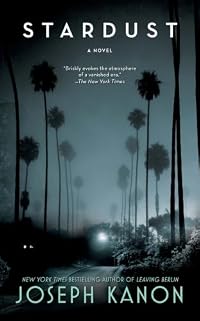
Stardust
by Joseph Kanon
On This Page
Description
Having returned from war-torn Europe in 1945 and discovered the mysterious death of his brother, Daniel, Ben Collier delves into the seedy world of the movie business to discover the truth behind Daniel's death.Tags
Recommendations



















Member Reviews
Ben Collier, on leave from the Army, is back stateside to see his brother, Daniel, who has attempted suicide. On the down-low, Ben is also tasked with finding a Hollywood studio to partner with in producing a film using footage of the concentration camps. He comes from a film family and he knows the industry, the people, but in California nobody is interested in Nazis, they're too preoccupied with the Red Threat. As Ben learns more than he wants to of studio politics, communism and rag journalism, it becomes most important to solve the mystery of his brother's trouble and to stay out of trouble himself.
I have such a book hangover from this one. Kanon is never going to work for you if you need to know the color of the starlet's gown, show more the name of her lippie color or the brand of her heels. You're going to have to fill all that in using your imagination. But Kanon is excellent at telling you what she whispered in the leading man's ear as she exited the car and that's so juicy it's worth the effort. He does so much with dialogue, particularly in a one-on-one scene. I noticed a page or two that was completely dialogue with no tags, no description, no scenery - just rapid fire back-and-forth - because the pace of the scene needed that.
The dynamic between Ben and Liesl, Daniel's wife, just broke my heart. Family stuff is so hard. The studio politics were interesting to me but to be honest, I zoned on the Communist bits. If you're interested in Hollywood studios during the 40s, or in Kanon's work, I recommend it to you. show less
I have such a book hangover from this one. Kanon is never going to work for you if you need to know the color of the starlet's gown, show more the name of her lippie color or the brand of her heels. You're going to have to fill all that in using your imagination. But Kanon is excellent at telling you what she whispered in the leading man's ear as she exited the car and that's so juicy it's worth the effort. He does so much with dialogue, particularly in a one-on-one scene. I noticed a page or two that was completely dialogue with no tags, no description, no scenery - just rapid fire back-and-forth - because the pace of the scene needed that.
The dynamic between Ben and Liesl, Daniel's wife, just broke my heart. Family stuff is so hard. The studio politics were interesting to me but to be honest, I zoned on the Communist bits. If you're interested in Hollywood studios during the 40s, or in Kanon's work, I recommend it to you. show less
Joseph Kanon's Stardust is a delicious crime drama wrapped in the pure American mink coat of late 1940s Hollywood. While both the film and period terminology are excessively specific, making it a slightly difficult read for anyone unfamiliar with the backlots (or anyone trying to keep track of the real, historical figures and those of Kanon's imagining), the structure is a classic with a twist.
Our protagonist Ben Collier doesn't have too many layers and his drives seem pretty basic, but he's a cool head in a very hot place and time. Ironically, his army composure and quickness of mind keep him above many of the Hollywood snares, keeping (as it were) stardust from getting into his eyes. While investigating his estranged brother's death, show more Collier enlists the help of everyone from the head of the studio he's working for, to the local German community (rife with Communists and ex-Communists), to a sneaky columnist, to the FBI.
But some of Collier's best help comes in the form of the most developed of Kanon's characters, Bunny Jenkins - gay former-child-star, now assistant to studio head Sol Lasner. For Bunny, the industry and the studio are everything, and wherever a problem may arise to obstruct that beautiful truth--be it an ugly dress or Joseph McCarthy's witch-hunting predecessor--Bunny has a fix for it. Fortunately for Collier, Bunny ends up on his side.
Though it took me a while to get through, I did like this book. I only wish that I might have been more versed in the time period before I took it up.
Lauren Cartelli
www.theliterarygothamite.com show less
Our protagonist Ben Collier doesn't have too many layers and his drives seem pretty basic, but he's a cool head in a very hot place and time. Ironically, his army composure and quickness of mind keep him above many of the Hollywood snares, keeping (as it were) stardust from getting into his eyes. While investigating his estranged brother's death, show more Collier enlists the help of everyone from the head of the studio he's working for, to the local German community (rife with Communists and ex-Communists), to a sneaky columnist, to the FBI.
But some of Collier's best help comes in the form of the most developed of Kanon's characters, Bunny Jenkins - gay former-child-star, now assistant to studio head Sol Lasner. For Bunny, the industry and the studio are everything, and wherever a problem may arise to obstruct that beautiful truth--be it an ugly dress or Joseph McCarthy's witch-hunting predecessor--Bunny has a fix for it. Fortunately for Collier, Bunny ends up on his side.
Though it took me a while to get through, I did like this book. I only wish that I might have been more versed in the time period before I took it up.
Lauren Cartelli
www.theliterarygothamite.com show less
If a novel can be written in crisp black and white images, with a disillusioned young hero (imagine here a sleepy-eyed young Robert Mitchum), and a cast of tragic, yet stock, characters, Joseph Kannon’s 'Stardust' hits its mark. Kannon’s homage to the film noir both rings with authenticity and provides a compelling read.
Ben Collier returns from post-war Germany to discover that his brother Danny has inexplicitly committed suicide, leaving behind a widow, the luscious and lethal Liesel. Why did Danny fall to his death? Did he jump? Was he pushed? Why does no one other than Ben seem to care?
'Stardust' is a character study, recounting the lives of those displaced by Hitler who will never feel secure again. Should they return to show more Germany? And to which Germany, East or West? It is a romance, as Danny and Liesel are strongly drawn to each other (I found it impossible not to see Mitchum and Hedy Lamar facing each other through hazy cigarette smoke). And it is a commentary on American history as the antics of Joseph McCarthy and his followers threaten the German refugees and Hollywood propaganda machine.
'Stardust' is a well-written novel; read the book, don’t wait for the movie. Mitchum and his sardonic voice are long gone. show less
Ben Collier returns from post-war Germany to discover that his brother Danny has inexplicitly committed suicide, leaving behind a widow, the luscious and lethal Liesel. Why did Danny fall to his death? Did he jump? Was he pushed? Why does no one other than Ben seem to care?
'Stardust' is a character study, recounting the lives of those displaced by Hitler who will never feel secure again. Should they return to show more Germany? And to which Germany, East or West? It is a romance, as Danny and Liesel are strongly drawn to each other (I found it impossible not to see Mitchum and Hedy Lamar facing each other through hazy cigarette smoke). And it is a commentary on American history as the antics of Joseph McCarthy and his followers threaten the German refugees and Hollywood propaganda machine.
'Stardust' is a well-written novel; read the book, don’t wait for the movie. Mitchum and his sardonic voice are long gone. show less
Yet another engrossing novel from Joseph Kanon. Set in late 1945 in Hollywood, much of the depth of the story is marked by the contrast between reality and the dreams and façade of the movie industry. The novel centres on Ben Collier, a soldier who has just returned from Europe and has seen the horrors of the concentration camps. He is shocked by the mysterious death of his brother and is determined to understand the reasons for his death. His investigations reveal fresh perspectives on his father and brother. These discoveries complicate his feelings for them and are mixed into the studio politics, apparent anti-Jewish feeling and the early beginnings of the Cold War and a McCarthy-style investigation into communist influence in the show more film industry that is taking place.
A well crafted book with twists, turns and revelations to keep you guessing right up to the last page. show less
A well crafted book with twists, turns and revelations to keep you guessing right up to the last page. show less
This is a very well written mystery story, set in Hollywood just after World War 2. Ben is still in the Army making a documentary about the Nazi death camps. When his brother falls from a building and suffers a fatal injury in California, he travels across the country by train to try to get there before he dies. On the train, he meets and befriends a big-shot movie studio head, who offers him space and support at his studio to complete work on the documentary. His brother dies soon after he arrives in California, and although it is officially reported as an accident, this was fixed by the studio to cover up an apparent suicide. Ben does not accept either explanation, and sets out to investigate his brothers death, and prove that he was show more murdered. This takes place amid the usual Hollywood intrigue, a community of German emigrés and the start of the Red scare, with an opportunistic Congressman set to eliminate any Communists and their sympathizers from the film industry.
I found the book to be extremely well written for the genre, although I was frequently fighting to make sense of conversation that is written in incomplete sentences and with indirect meaning. But, the book still held my interest and the plot was well constructed. I would recommend the book to anyone who likes an intelligent mystery. show less
I found the book to be extremely well written for the genre, although I was frequently fighting to make sense of conversation that is written in incomplete sentences and with indirect meaning. But, the book still held my interest and the plot was well constructed. I would recommend the book to anyone who likes an intelligent mystery. show less
Like many other commenters, I really enjoyed the postwar Hollywood setting and the zippy dialogue. But also like many other commenters, I found it hard to navigate the huge cast of similarly named characters, and the subplots were out of control. It did occur to me that both of those things could have been done in homage to The Maltese Falcon, which I've always thought had similar problems (an unwieldy, labyrinthine plot and a lot of characters who seem largely unnecessary to the story). I kept reading, but mainly for the setting; I actually figured out the Big Reveal as soon as it happened.
OTOH, I think this would make a GREAT movie with some of the excess plotting trimmed away (again, like The Maltese Falcon... I think; I last saw show more the movie in 1982, and don't remember it very well). show less
OTOH, I think this would make a GREAT movie with some of the excess plotting trimmed away (again, like The Maltese Falcon... I think; I last saw show more the movie in 1982, and don't remember it very well). show less
The entire time I was reading this I felt as if I was watching a black and white film noir. Ben Collier arrives in Hollywood to work on a film for the US Army and to try to piece together what happened to his brother Danny, who supposedly jumped off of the balcony at his rented apartment. Everyone thinks it's a suicide except Ben, and he aims to prove it. But the further he gets into his investigations, the more he realizes that maybe he didn't know his brother very well at all. As he delves into his brother's death, he becomes caught up in some pretty nasty business, none the least of which is a zealous congressman who's trying to sort out who's red and who's not, and eventually Ben comes to realize that there are others who wish he'd show more just let things lie.
Kanon has succeeded in evoking the post World War II Hollywood era very well. The big studios are in their heydays, movie stars are making their way to the top, and underneath the glamor lies the seamy underbelly of Los Angeles. However, I found parts of this book quite tedious with a few scenes that probably could have been omitted to make the story much tighter and to make it flow a lot better. Many of the characters came off as flat with no personality and this also detracted from my enjoyment of this novel.
I would recommend it to people interested in the time period, and to those interested in McCarthy-type politics and how they affected people in Hollywood. Overall -- a good read, but rather long and often confusing. show less
Kanon has succeeded in evoking the post World War II Hollywood era very well. The big studios are in their heydays, movie stars are making their way to the top, and underneath the glamor lies the seamy underbelly of Los Angeles. However, I found parts of this book quite tedious with a few scenes that probably could have been omitted to make the story much tighter and to make it flow a lot better. Many of the characters came off as flat with no personality and this also detracted from my enjoyment of this novel.
I would recommend it to people interested in the time period, and to those interested in McCarthy-type politics and how they affected people in Hollywood. Overall -- a good read, but rather long and often confusing. show less
Members
- Recently Added By
Lists

Same Title
115 works; 3 members
Author Information

14+ Works 6,742 Members
Joseph Kanon began his career in publishing while an undergraduate at Harvard, reading manuscripts for The Atlantic Monthly. Kanon traveled to England for graduate school, then returned to the United States to work as a book review editor and writer for the Saturday Review. Rising through the ranks of the publishing world, he eventually became show more president and CEO of E.P. Dutton, and then executive vice president of Houghton Mifflin's Trade and Reference Division. Kanon is the author of Los Alamos (1997), an authentic fictional recreation of the waning days of World War II during which the murder of one of the Manhattan Project's security officers occurs. The Prodigal Spy was published in late 1998. His novel, Leaving Berlin, is a 2015 New York Times bestseller. (Bowker Author Biography) show less
Awards and Honors
Common Knowledge
- Canonical title
- Stardust
- Original publication date
- 2009
Classifications
- Genres
- Fiction and Literature, General Fiction, Historical Fiction, Mystery
- DDC/MDS
- 813.54 — Literature & rhetoric American literature in English American fiction in English 1900-1999 1945-1999
- LCC
- PS3561 .A476 .S73 — Language and Literature American literature American literature Individual authors 1961-
- BISAC
Statistics
- Members
- 306
- Popularity
- 104,878
- Reviews
- 14
- Rating
- (3.38)
- Languages
- English
- Media
- Paper, Audiobook, Ebook
- ISBNs
- 18
- ASINs
- 3