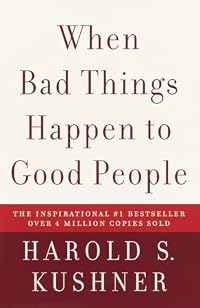
When Bad Things Happen to Good People
by Harold S. Kushner
On This Page
Description
The #1 bestselling inspirational classic from the nationally known spiritual leader; a source of solace and hope for over 4 million readers.When Harold Kushner’s three-year-old son was diagnosed with a degenerative disease that meant the boy would only live until his early teens, he was faced with one of life’s most difficult questions: Why, God? Years later, Rabbi Kushner wrote this straightforward, elegant contemplation of the doubts and fears that arise when tragedy strikes. In show more these pages, Kushner shares his wisdom as a rabbi, a parent, a reader, and a human being. Often imitated but never superseded, When Bad Things Happen to Good People is a classic that offers clear thinking and consolation in times of sorrow. show less
Tags
Recommendations






















Member Recommendations

2wonderY Kushner's book just commiserates, Yancey offers a more uplifting message. He has studied pain and sorrow and tries to make sense of it.
Member Reviews
It took me a while to get to this book; I was so immersed in grief that reading about grief seemed pointless. Now that I've gotten to it, I realize that I came to Kushner's conclusion on my own, and his wisdom wouldn't have been misplaced during any of the terrifically rotten last few years.
I'm not a theist, but I have grown up in a predominantly Judeo-Christian culture, and people tend to reach out to that when attempting to comfort the bereaved, and often come up with the same extremely un-comforting platitude that "things happen for a reason." Ugh. Kushner lays out a very intelligent argument about three things that everyone would like to believe:
1. God is all-powerful and causes everything that happens in the world. Nothing happens show more without his willing it.
2. God is just and fair, and stands for people getting what they deserve, so that the good prosper and the wicked are punished.
3. I am a good person.
When the subject of (3) suffers loss, people often throw him under the bus so that they can preserve the other two beliefs. But perhaps the more comforting (and maybe the more theologically sound) conclusion to draw is that 2 and 3 are true, but not 1.
Kushner talks about the power of a religious community to comfort, not by preventing grief and loss, but by affirming life and community in spite of it. This book is rightly part of the canon of western wisdom on how to live. show less
I'm not a theist, but I have grown up in a predominantly Judeo-Christian culture, and people tend to reach out to that when attempting to comfort the bereaved, and often come up with the same extremely un-comforting platitude that "things happen for a reason." Ugh. Kushner lays out a very intelligent argument about three things that everyone would like to believe:
1. God is all-powerful and causes everything that happens in the world. Nothing happens show more without his willing it.
2. God is just and fair, and stands for people getting what they deserve, so that the good prosper and the wicked are punished.
3. I am a good person.
When the subject of (3) suffers loss, people often throw him under the bus so that they can preserve the other two beliefs. But perhaps the more comforting (and maybe the more theologically sound) conclusion to draw is that 2 and 3 are true, but not 1.
Kushner talks about the power of a religious community to comfort, not by preventing grief and loss, but by affirming life and community in spite of it. This book is rightly part of the canon of western wisdom on how to live. show less
Harold Kushner comes across in this book as a really humane man. He was a young rabbi when his son was born with the aging disease: progeria. He had to reconcile his beliefs about God with what was happening to his son, who died of the disease at age 14. I sympathize with him greatly. Nevertheless, this book left me more convinced that if there is a god, he is uncaring and cruel. Not what the author's goal was, I'm sure.
Kushner does an excellent job of shooting down the usual justifications given for tragedies such as: it's all part of God's plan, God loved him/her so much he wanted him nearer to him, etc. His defense of God is that tragedies are not judgements, not part of "bigger" plan, but rather God made us human in a world ruled show more by laws of physics -- which means he can't bend those rules for individual people, that what God brings to us during tragedies is comfort, a gathering of people around us. Frankly, I found this completely uncomforting myself. I want a God who can do miracles -- but then why should we need miracles to begin with--if God is loving and all-powerful? All we can do, according to Kushner, is accept that tragedies happen and there is no why or wherefore, it is all random. Just as I thought. show less
Kushner does an excellent job of shooting down the usual justifications given for tragedies such as: it's all part of God's plan, God loved him/her so much he wanted him nearer to him, etc. His defense of God is that tragedies are not judgements, not part of "bigger" plan, but rather God made us human in a world ruled show more by laws of physics -- which means he can't bend those rules for individual people, that what God brings to us during tragedies is comfort, a gathering of people around us. Frankly, I found this completely uncomforting myself. I want a God who can do miracles -- but then why should we need miracles to begin with--if God is loving and all-powerful? All we can do, according to Kushner, is accept that tragedies happen and there is no why or wherefore, it is all random. Just as I thought. show less
I'm not sure what God is, but I know what God isn't: the "Sky Daddy" found in most churches. Life is often difficult and unfair, and sh*t happens. I reject the idea that God causes or allows bad things to happen, that its all part of His big plan that we couldn't possibly understand, and that "everything happens for a reason". Kushner's God is one I might be able to believe in
I read this in preparation for discussion with my small group. What struck me was how theologically shrunken of a God Kushner leaves us with, and how little he relies on scripture to get himself through his own suffering. It also impressed on me the extent to which Jesus addresses so many of the biggest questions of the bible, including one most pertinent to this book: "what does a God who suffers look like?" Kushner can't imagine one, and that's the saddest thing of all. I look forward to discussing it with an Orthodox Jew who can offer a more robust scriptural answer to the questions Kushner raises, all while staying in the Tanach.
This is a lovely tribute to and meditation on grief, with some profound thoughts. He often gets down to the core of our discomfort with the mental and emotional process of grief. Though I disagree with some minor points, I love the layers and nuances in his text.
After finishing Endo's A Life of Jesus, I turned to the book I picked up yesterday afternoon, this popular book on suffering and God. As great as it felt to read two books in one day, Kushner's book was so light that it wasn't a big feat. This rabbi's work was wrought out of his suffering over a son who died at 14 from a rare rapid aging disorder. Since it's written out of grief rather than scholarly acumen, it carries an extra punch.
Kusher's premise is that suffering is not caused by God. He looks at Job and his pastoral experience and finds many of the pat answers unsatisfactory: "it's your fault you're suffering," "God is punishing you," "It serves a purpose or helps you grow," "It is a test of faith," "the virtuous always prosper in show more the long run," "You only see it as suffering because you are deluded," and "We can't know God's plan" (aka "God works in mysterious ways"). None of these sit right with Kushner, and none are useful pastorally when he is comforting peoples' grief. Rather suffering is caused by human action, the chaos and interdependent situations of the universe, and the natural laws that do not care about human suffering. God loves us and empathizes with the suffering, but is not able to stop all of it. It is up to us to do God's work in stopping suffering.
Wait, what? But the Bible is full of God stopping suffering. Miracles happen in the Bible. The Lord takes the Israelites' side in a battle and they win despite outrageous odds. God, through Moses, parts the Sea of Reeds and brings water from the rock and manna from the sky. Yet Kushner, who has a Ph.D. in Bible, doesn't address any of this. Miracles, he says, are unlikely coincidences of natural events, which we should be thankful for but not credit to God. While this follows from his theory of the universe's dealings as random, it doesn't sit well even with his Jewish Biblical tradition.
As one of my professors put it, the problem of evil leads to the meanie God (powerful enough to stop suffering but not all-loving) or the weenie God (all-loving but not powerful enough). Kushner adopts the weenie God. The weenie God is in the Bible. Think of the God who had a rough time wrestling Leviathan in Job. But the Psalms echo the almighty power of God time and time again. Kushner doesn't discuss this. God is only an emotional consolation, a psychology, but not an ontological reality who acts in the world. Ultimately, his blind spot is what does him in. I can't accept his metaphysics without throwing out huge parts of the Bible.
That said, Kushner has some very, very good pastoral advice. How often we tell wounded people tired cliches that amount to blamingthe victim or telling them they are wrong to be grieved! Job didn't need answers that were theologically correct as much as he needed empathy, compassion, and a receptive ear. Kushner's book has transformed the way I interact with people who suffer. And since it succeed in its goal as a pastoral help, I shouldn't knock its facile philosophy too much. Just take it with a grain of salt. show less
Kusher's premise is that suffering is not caused by God. He looks at Job and his pastoral experience and finds many of the pat answers unsatisfactory: "it's your fault you're suffering," "God is punishing you," "It serves a purpose or helps you grow," "It is a test of faith," "the virtuous always prosper in show more the long run," "You only see it as suffering because you are deluded," and "We can't know God's plan" (aka "God works in mysterious ways"). None of these sit right with Kushner, and none are useful pastorally when he is comforting peoples' grief. Rather suffering is caused by human action, the chaos and interdependent situations of the universe, and the natural laws that do not care about human suffering. God loves us and empathizes with the suffering, but is not able to stop all of it. It is up to us to do God's work in stopping suffering.
Wait, what? But the Bible is full of God stopping suffering. Miracles happen in the Bible. The Lord takes the Israelites' side in a battle and they win despite outrageous odds. God, through Moses, parts the Sea of Reeds and brings water from the rock and manna from the sky. Yet Kushner, who has a Ph.D. in Bible, doesn't address any of this. Miracles, he says, are unlikely coincidences of natural events, which we should be thankful for but not credit to God. While this follows from his theory of the universe's dealings as random, it doesn't sit well even with his Jewish Biblical tradition.
As one of my professors put it, the problem of evil leads to the meanie God (powerful enough to stop suffering but not all-loving) or the weenie God (all-loving but not powerful enough). Kushner adopts the weenie God. The weenie God is in the Bible. Think of the God who had a rough time wrestling Leviathan in Job. But the Psalms echo the almighty power of God time and time again. Kushner doesn't discuss this. God is only an emotional consolation, a psychology, but not an ontological reality who acts in the world. Ultimately, his blind spot is what does him in. I can't accept his metaphysics without throwing out huge parts of the Bible.
That said, Kushner has some very, very good pastoral advice. How often we tell wounded people tired cliches that amount to blamingthe victim or telling them they are wrong to be grieved! Job didn't need answers that were theologically correct as much as he needed empathy, compassion, and a receptive ear. Kushner's book has transformed the way I interact with people who suffer. And since it succeed in its goal as a pastoral help, I shouldn't knock its facile philosophy too much. Just take it with a grain of salt. show less
Harold S. Kushner's When Bad Things Happen to Good People isn't what I expected in the slightest and explained its plight in a way that felt pessimistic, dated, and mildly insensitive while still showcasing the value of community and healthy relationships whether it be within your respective religious groups, family, or friends.
The book details the internal struggle within Harold S. Kushner after the death of his fourteen year old son Aaron but the book strays from divulging too much of his personal experience with the loss of his son and instead delves into how grief plays a role in your relationship with God. Kushner goes into great detail in his internal struggle with the grief of himself and his congregation, his relationship with show more God as a Rabbi, and how he chooses to grow from the experience but while doing so he states his personal revelations as fact and although there’s a lot of good to takeaway from this title when dealing with grief there’s very harmful advice within it.
The book was written in 1981 and touches on psychology, particularly depression, in a way that doesn’t reflect today's findings and understandings of the illness. Several points of the book have extremely dated information and viewpoints that can be harmful to the grieving person of today so it’s important to keep that in mind when reading When Bad Things Happen To Good People but the insight that Harold S. Kushner has on the grieving person in terms of their relationship with God and the coming together of people is extremely valuable and universal regardless of the reader's religious affiliation. show less
The book details the internal struggle within Harold S. Kushner after the death of his fourteen year old son Aaron but the book strays from divulging too much of his personal experience with the loss of his son and instead delves into how grief plays a role in your relationship with God. Kushner goes into great detail in his internal struggle with the grief of himself and his congregation, his relationship with show more God as a Rabbi, and how he chooses to grow from the experience but while doing so he states his personal revelations as fact and although there’s a lot of good to takeaway from this title when dealing with grief there’s very harmful advice within it.
The book was written in 1981 and touches on psychology, particularly depression, in a way that doesn’t reflect today's findings and understandings of the illness. Several points of the book have extremely dated information and viewpoints that can be harmful to the grieving person of today so it’s important to keep that in mind when reading When Bad Things Happen To Good People but the insight that Harold S. Kushner has on the grieving person in terms of their relationship with God and the coming together of people is extremely valuable and universal regardless of the reader's religious affiliation. show less
Members
- Recently Added By
Lists

Books for helping to cope with serious illness/dying
19 works; 2 members

Blue Pyramid 1,276 Best Books of All Time
1,248 works; 32 members

Books Read in 2018
4,360 works; 110 members
Author Information

32+ Works 9,738 Members
Harold Kushner has been a rabbi for more than thirty years. His bestselling books have helped millions of people find in faith a source of help for coping with life's problems
Awards and Honors
Distinctions
Series
Belongs to Publisher Series
Common Knowledge
- Canonical title
- When Bad Things Happen to Good People
- Original title
- When Bad Things Happen to Good People
- Original publication date
- 1981
- People/Characters
- Harold S. Kushner
- Epigraph
- And David said: While the child was yet alive, I fasted and wept, for I said, Who knows whether the Lord will be gracious to me and the child will live. But now that he is dead, why should I fast? Can I bring him back again? ... (show all)I shall go to him, but he will not return to me. (II Samuel 12:22-23)
- Dedication
- In Memory of Aaron Zev Kushner
1963-1977 - First words
- There is only one question which really matters: why do bad things happen to good people?
- Last words
- (Click to show. Warning: May contain spoilers.)Yesterday seems less painful, and I am not afraid of tomorrow.
Classifications
Statistics
- Members
- 3,661
- Popularity
- 4,395
- Reviews
- 34
- Rating
- (3.93)
- Languages
- 9 — Czech, Dutch, English, German, Italian, Japanese, Portuguese, Spanish, Swedish
- Media
- Paper, Audiobook, Ebook
- ISBNs
- 56
- UPCs
- 4
- ASINs
- 27