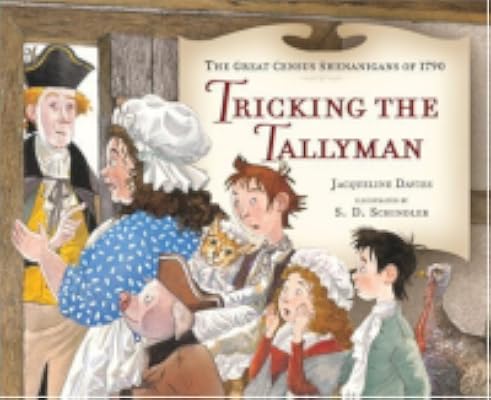
Tricking the Tallyman
by Jacqueline Davies
On This Page
Description
In 1790, the suspicious residents of a small Vermont town try to trick the man who has been sent to count their population for the first United States Census.Tags
Recommendations






Member Reviews
Phineas Bump was "heartsick, saddle-sore, and down on his luck." One of 650 marshals dispatched by the federal government in 1790, in order to tally the population for the first national census, Phineas hadn't seen wife and home in many months, and was running out of supplies. But "Count them I must, and count them I will," he tells himself. Unfortunately, the people of Tunbridge, Vermont - led by Mrs. Samuel Pepper and her clever son, Boston - have no intention of making his task any easier...
An amusing story based on historical fact, Tricking the Tallyman introduces young children to an aspect of American history and government - the census - that they may never otherwise have considered. It also highlights the fact that the issues of show more political representation and taxation are intimately connected in our democracy. I can't say that S.D. Schindler's illustrations were to my taste, which surprised me, as I love the work he did for Ursula K. Le Guin's Catwings series; and I have to wonder, as the Horn Book reviewer noted, why Davies chose to set her tale in Vermont, which didn't have a census until 1791; but overall this was an engaging tale that highlights an interesting footnote to history. show less
An amusing story based on historical fact, Tricking the Tallyman introduces young children to an aspect of American history and government - the census - that they may never otherwise have considered. It also highlights the fact that the issues of show more political representation and taxation are intimately connected in our democracy. I can't say that S.D. Schindler's illustrations were to my taste, which surprised me, as I love the work he did for Ursula K. Le Guin's Catwings series; and I have to wonder, as the Horn Book reviewer noted, why Davies chose to set her tale in Vermont, which didn't have a census until 1791; but overall this was an engaging tale that highlights an interesting footnote to history. show less
Phineas Bump and his traveling adventures through the small Vermont town of Tunbridge turn through the events of the first great U.S. census of 1790 as the government sought the ambitious task of counting everyone. How could this have been done? Without computers, calculators, and modern technology? well in this piece of historical fiction, the cunning and determined Phineas Bump exhumes all his options as he meets an unruly mother and her children, all determined that the Tally Man is of not good intent. In the end you learn a urgent piece of history, that to this day census taking is big business and important to our civil society and structure of government. It is very well written and young students will be enthralled by all of its show more innuendo. show less
Tricking the Tallyman is a cute story with the moral that tells children to always be honest. It is set right around the time that the US constitution was instated. There is a man going from town to town on horseback tallying how many people there are in each town. There are rumors that go around as for why he has to count people. The townspeople get together to trick him into thinking there are more, less, and then finally the correct amount of people i the town. It is important that this book is set during this time because it leads to the reader understanding of why tricking the tallyman was so important. They were unaware of whether or not this was a good or bad thing for their town because the Constitution was just set into place. show more They were unaware of how this number of people would affect them.
The book is written in a playful style. There are times when the reader will giggle because of the attitudes of the characters. I enjoy that at the end of the book, we see that it is always best to tell the truth. Was it predictable? Yes, but it is still a great message for children of all ages. show less
The book is written in a playful style. There are times when the reader will giggle because of the attitudes of the characters. I enjoy that at the end of the book, we see that it is always best to tell the truth. Was it predictable? Yes, but it is still a great message for children of all ages. show less
Tricking the Tallyman takes place in 1790, the year of the first U.S. census. Phineas Bump is sent to the town of Tunbridge, Vermont to tally the people who live there. The Pepper family does not want to be counted for fear that the government will ask their town to pay more taxes and send more soldiers to war. They decide to trick the tallyman into miscounting their town's population. This book is both funny and informative. It teaches the history of the census in a lighthearted way and explains why it is important. I appreciate that in the author's note Davies explains that people were counted differently based on age, race, and gender.
If you want to introduce the census in a fun clever way this is the book for you. The book is about a town that doesn't want the census to count them so they come up with ways to trick him. The story and illustration pull you in, will they trick the tallyman? Must have for any social studies teacher.
It was a light hearted story showing the fears Colonial Americans had about being counted by the government. Townspeople trick the census taker twice before finally giving him the correct population. Very cute and had my two oldest children curious about what a census is and what it does.
Tricking the Tallyman is about a man that comes to a small town in the 1790 13 colonies. This town believes that the man is here to count people, in order to raise taxes. One family come up with a plan for the Tallyman to count only 1 person in the town. The next day the family hears that the tally is for representation in government, and so the family tricks the Tallyman into counting a huge town number. On the third day the family hears that the tally is for both taxes and government representation. They ask the Tallyman to count again, and this time he receives the town's true count.
This book shows how taxes and representation were both real concerns to the colonists at this time. The author, however, was able to convey this in a show more relaxed and fun way for children to understand. I think younger students would go to read this story due to its fun story line, and then would receive a small history lesson without even trying. This would also be a good story to pair with a US history or early revolution lesson. show less
This book shows how taxes and representation were both real concerns to the colonists at this time. The author, however, was able to convey this in a show more relaxed and fun way for children to understand. I think younger students would go to read this story due to its fun story line, and then would receive a small history lesson without even trying. This would also be a good story to pair with a US history or early revolution lesson. show less
Members
- Recently Added By
Lists

American Revolution
7 works; 1 member
Author Information

26 Works 9,051 Members
All Editions
Awards and Honors
Awards
Classifications
Statistics
- Members
- 182
- Popularity
- 180,271
- Reviews
- 13
- Rating
- (4.02)
- Languages
- English
- Media
- Paper, Ebook
- ISBNs
- 7
- ASINs
- 3