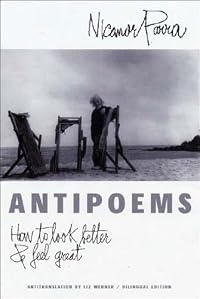
Antipoems: How to Look Better & Feel Great
by Nicanor Parra
On This Page
Description
"Of the fifty-eight pieces in Antipoems, the first twenty-three are taken from Parra's 1985 collection, Hojas de Parra ("Vine Leaves" or "Leaves of Parra"), two others appeared in his Paginas en Blanco ("Blank Pages," 2001), while the rest come straight out of his notebooks and have never been collected before, either in Spanish or English. The book itself is divided into two sections, "Antipoems" (im)proper and a selection of Parra's most recent incarnation of the antipoem, the hand-drawn show more images of his "Visual Artefactos."" "Born in 1914 in the southern city of Chillan, Parra spent many years as a teacher of mathematics and a professor of physics. As his antitranslator Liz Werner explains in her introduction, Parra's scientific training infuses his work. "Viewed through the lens of antimatter," she writes, "antipoetry mirrors poetry, not as its adversary but as its perfect complement ... it is as opposite, complete, and interdependent as the shape left behind in the fabric where the garment has been cut out.""--Jacket. show lessTags
Recommendations







Member Reviews
This is the short note I made about this book back in 2005 when I read it:
>>This poet is both subversive and fun. It's guys like this that basically piss off right wing conservatives, to put it mildly (haha!). Seriously though, Nicanor Parra is a well known Chilean poet known for his humor and unconventional verse. So, what is antipoetry? Well, simply put it is the opposite of poetry, and yet it is not quite as easy as that. Antipoetry can be understood from the concept of antimatter. In her introduction to the book, Werner writes that "viewed through the lens of antimatter, antipoetry mirrors poetry, not as its adversary but as its complement; it is not by nature negative, but negative where poetry is positive, and vice versa; it is show more as opposite, complete, and interdependent as the shape left behind in the fabric where the garment has been cut out" (x).
I think that is a great way to look at it, as a complement, and in the case of Parra's work, as a playful poetry. Read why the poet thinks he should be awarded the Nobel Prize for Reading, what's the problem with philosophy (who does the dishes), and admire some visual artefactos (yes, he draws as well). The book is fun to read and reread. For the squeamish, there are some words (yes, he says "shit" and other chosen words of "color"), but nothing a reader can't handle. He addresses life, politics, math, philosophy, women, humor, etc. As an interesting touch, for bilingual readers, do look at the translation, or rather antitranslation. She was encouraged by Parra to use more cultural equivalents rather than literal translations. The results are some interesting and subtle differences between the poems and the translations, creating something new, maybe subversive, well worth it if you pay attention. Overall, this book is very highly recommended. show less
>>This poet is both subversive and fun. It's guys like this that basically piss off right wing conservatives, to put it mildly (haha!). Seriously though, Nicanor Parra is a well known Chilean poet known for his humor and unconventional verse. So, what is antipoetry? Well, simply put it is the opposite of poetry, and yet it is not quite as easy as that. Antipoetry can be understood from the concept of antimatter. In her introduction to the book, Werner writes that "viewed through the lens of antimatter, antipoetry mirrors poetry, not as its adversary but as its complement; it is not by nature negative, but negative where poetry is positive, and vice versa; it is show more as opposite, complete, and interdependent as the shape left behind in the fabric where the garment has been cut out" (x).
I think that is a great way to look at it, as a complement, and in the case of Parra's work, as a playful poetry. Read why the poet thinks he should be awarded the Nobel Prize for Reading, what's the problem with philosophy (who does the dishes), and admire some visual artefactos (yes, he draws as well). The book is fun to read and reread. For the squeamish, there are some words (yes, he says "shit" and other chosen words of "color"), but nothing a reader can't handle. He addresses life, politics, math, philosophy, women, humor, etc. As an interesting touch, for bilingual readers, do look at the translation, or rather antitranslation. She was encouraged by Parra to use more cultural equivalents rather than literal translations. The results are some interesting and subtle differences between the poems and the translations, creating something new, maybe subversive, well worth it if you pay attention. Overall, this book is very highly recommended. show less
This one is going to be more like a fan letter than a review. I can't say that I'm any kind of expert of all the components that go into making a poem what is supposed to be. In this respect maybe this is why the anti-poet Nicanor Parra is probably my most favorite of all. What can I say? I have always loved irreverence and when it sometimes comes with social or political commentary it's even better. Parra is the most irreverent of them all. He pulls no punches. He's willing to throw barbs and jabs at everybody--to explore all sanctimony--to call attention to all unproven beliefs and even into his 90's he is still going strong--is still vital--is still relevant. I named our new cat after his Chimbarango so that should say enough about show more my admiration for his work. Anyway many thanks to his translator Liz Werner who traveled to Chile and tracked him down so that we could have this work. show less
Ratings
Members
- Recently Added By
Author Information

70+ Works 722 Members
Nicanor Segundo Parra Sandoval was born in San Fabián de Alico, Chile on September 15, 1914. He received degrees in mathematics and physics from the University of Chile in 1938. He later studied mechanics at Brown University in Providence, Rhode Island and cosmology at the University of Oxford in England. He taught theoretical physics at the show more University of Chile for decades. He was a poet who pioneered the literary movement that became known as anti-poetry. He published his first book, Singer Without a Name, in 1937. His other books include Poems and Antipoems, Emergency Poems, Artifacts, and The Sermons and Teachings of the Christ of Elqui. In 1963, he spent six months in the Soviet Union translating the work of several Soviet poets into Spanish. He received Chile's National Literary Prize in 1969 and the Cervantes Prize in 2011. He died on January 23, 2018 at the age of 103. (Bowker Author Biography) show less
Series
Belongs to Publisher Series
New Directions Paperbook (994)
Classifications
- Genres
- Poetry, Fiction and Literature
- DDC/MDS
- 861.62 — Literature & rhetoric Spanish Literature Spanish poetry 20th Century 1900-1945
- LCC
- PQ8097 .P322 .A26 — Language and Literature French, Italian, Spanish and Portuguese literatures Spanish literature Provincial, local, colonial, etc. Spanish America
- BISAC
Statistics
- Members
- 134
- Popularity
- 243,168
- Reviews
- 2
- Rating
- (3.87)
- Languages
- English, Spanish
- Media
- Paper
- ISBNs
- 1
- ASINs
- 1