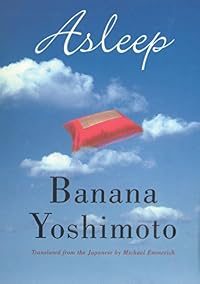
Asleep
by Banana Yoshimoto
On This Page
Description
Banana Yoshimoto has a magical ability to animate the lives of her young characters, and here she spins the stories of three women, all bewitched into a spiritual sleep. One, mourning a lost lover, finds herself sleepwalking at night. Another, who has embarked on a relationship with a man whose wife is in a coma, finds herself suddenly unable to stay awake. A third finds her sleep haunted by another woman whom she was once pitted against in a love triangle. Sly and mystical as a ghost story, show more with a touch of Kafkaesque surrealism, Asleep is an enchanting book from one of the best writers in contemporary international fiction. show lessTags
Recommendations


















Member Reviews
An eerie yet familiar ethereal quality infuses the three stories of Banana Yoshimoto’s Asleep. The first-person narrator of each is a border person, existing on the cusp between wakefulness and sleep, life and death, periodically crossing over and crossing back.
In “Night and Night’s Travelers” the death of Yoshihiro, the brother of the narrator, transfixes the lives of his sister, Shibami, his girlfriend at the time of his death, Mari, and the young American exchange student, Sarah, with whom he earlier fallen in love and later abandoned. Mari cannot sleep. Sarah cannot let go. Both have enduring mementos of their relationship with Yoshihiro. It is left to Shibami to serve as their medium, between each other and with the spirit show more of Yoshihiro.
In “Love Songs”, two women vying for the same man form a relationship so intense, yet unspoken, that it might be love. The death of the older woman, Haru, cements the bond somehow. The younger woman begins taking on some of Haru’s characteristics and is even visited by what she believes is Haru’s spirit. Her purposeful confrontation with the spirit is the necessary next step in her own transformation and broader understanding of love in its many forms.
Death also troubles “Asleep,” with the suicide of the former flat-mate of the narrator, Terako. Her death and the transitional state between life and death of the wife of the Terako’s boyfriend, trapped in a permanent coma, begin to sap the life force of Terako. She visibly loses her will to live, embracing exhaustion and sleeping for increasing numbers of hours, so deeply that she cannot even hear a telephone ring. Again, a visitation from the spirit realm triggers Terako’s rescue.
The themes of death, loss of will, and love permeate these stories. Tone is more important than action. Anxiety, perhaps about the transition to adulthood (most of the characters seem to exist in a state of perpetual late adolescence), dominates. Age or cultural distance may be a barrier to embracing the objects of Yoshimoto’s concern, but her writing itself is well worth reading. show less
In “Night and Night’s Travelers” the death of Yoshihiro, the brother of the narrator, transfixes the lives of his sister, Shibami, his girlfriend at the time of his death, Mari, and the young American exchange student, Sarah, with whom he earlier fallen in love and later abandoned. Mari cannot sleep. Sarah cannot let go. Both have enduring mementos of their relationship with Yoshihiro. It is left to Shibami to serve as their medium, between each other and with the spirit show more of Yoshihiro.
In “Love Songs”, two women vying for the same man form a relationship so intense, yet unspoken, that it might be love. The death of the older woman, Haru, cements the bond somehow. The younger woman begins taking on some of Haru’s characteristics and is even visited by what she believes is Haru’s spirit. Her purposeful confrontation with the spirit is the necessary next step in her own transformation and broader understanding of love in its many forms.
Death also troubles “Asleep,” with the suicide of the former flat-mate of the narrator, Terako. Her death and the transitional state between life and death of the wife of the Terako’s boyfriend, trapped in a permanent coma, begin to sap the life force of Terako. She visibly loses her will to live, embracing exhaustion and sleeping for increasing numbers of hours, so deeply that she cannot even hear a telephone ring. Again, a visitation from the spirit realm triggers Terako’s rescue.
The themes of death, loss of will, and love permeate these stories. Tone is more important than action. Anxiety, perhaps about the transition to adulthood (most of the characters seem to exist in a state of perpetual late adolescence), dominates. Age or cultural distance may be a barrier to embracing the objects of Yoshimoto’s concern, but her writing itself is well worth reading. show less
I loved this! Gorgeous prose, simple yet haunting. It's amazing to me that modern Japanese culture still has such strong ties to the spirit world. I loved these depictions of people drifting in and out of reality, fighting their addictions and demons.
Asleep is a collection of three short novellas, all of which focus on some aspect of death and also a sleeping, either literal or psychic, born of trauma.
"Night and Night's Travelers" is a tale of the literal death of one and the resulting temporary emotional death of another. The narrator is Shibami and she tells the story of her "vibrantly charismatic" brother Yoshihiro and her dreamy cousin Mari. Yoshihiro and Mari are not only cousins, but lovers. After Yoshihiro's death, Mari withdraws and enters a year of dreamlike fog and sleepwalking.
"Love Songs" tells of the haunting of one woman by another. Fumi has found herself at the end of an affair and drinking to excess. She often hears a "soothing voice singing." This voice belongs to show more Haru, a dead woman with whom Fumi once shared her ex-lover. Fumi is drawn to this voice from the beyond and, through consultation with a midget psychic, is able to meet with Haru. In life, the two women were in a relationship of bitter resentment and jealousy, yet in this meeting of life and afterlife they find peace and friendship.
"Asleep" is the story of Terako who shares the deep sleep of her lover's comatose wife. Mr. Iwanaga has an unusual effect on women ... he puts them to sleep. His wife is in a coma and his lover, Terako, becomes increasingly sleepy. As Terako separates herself from Mr. Iwanaga and creates her own life, she finds a new energy.
Supernatural occurrences seem natural throughout the stories in Asleep. The language is sparse, creating silences and the stories lack any attempt to draw the reader in emotionally. Yoshimoto's writing style reminded me of minimalist Japanese decor. The setting is sparse, but what is there is beautiful. The writing often seems like a prose version of haiku:
"Late at night the trees in my garden seemed to shine.
Awash in light from the street, the quiet glittering green of the
leaves and the deep brown of the trunk seemed startlingly vivid."
Those looking for an exciting read will not find it in Asleep. What the reader will find is a quiet and beautiful collection of stories that take the vicissitudes of life in stride. show less
"Night and Night's Travelers" is a tale of the literal death of one and the resulting temporary emotional death of another. The narrator is Shibami and she tells the story of her "vibrantly charismatic" brother Yoshihiro and her dreamy cousin Mari. Yoshihiro and Mari are not only cousins, but lovers. After Yoshihiro's death, Mari withdraws and enters a year of dreamlike fog and sleepwalking.
"Love Songs" tells of the haunting of one woman by another. Fumi has found herself at the end of an affair and drinking to excess. She often hears a "soothing voice singing." This voice belongs to show more Haru, a dead woman with whom Fumi once shared her ex-lover. Fumi is drawn to this voice from the beyond and, through consultation with a midget psychic, is able to meet with Haru. In life, the two women were in a relationship of bitter resentment and jealousy, yet in this meeting of life and afterlife they find peace and friendship.
"Asleep" is the story of Terako who shares the deep sleep of her lover's comatose wife. Mr. Iwanaga has an unusual effect on women ... he puts them to sleep. His wife is in a coma and his lover, Terako, becomes increasingly sleepy. As Terako separates herself from Mr. Iwanaga and creates her own life, she finds a new energy.
Supernatural occurrences seem natural throughout the stories in Asleep. The language is sparse, creating silences and the stories lack any attempt to draw the reader in emotionally. Yoshimoto's writing style reminded me of minimalist Japanese decor. The setting is sparse, but what is there is beautiful. The writing often seems like a prose version of haiku:
"Late at night the trees in my garden seemed to shine.
Awash in light from the street, the quiet glittering green of the
leaves and the deep brown of the trunk seemed startlingly vivid."
Those looking for an exciting read will not find it in Asleep. What the reader will find is a quiet and beautiful collection of stories that take the vicissitudes of life in stride. show less
Uhm, I actually don’t know where to start. Or rather, it’s hard to find the exact words to describe Asleep, but I’ve never been so sad while reading a book. It never fails whenever I read a Yoshimoto Banana novel — the words and narration are so simple, but it captures everything, and the weight of the words and the emotions are heavier than they appear. It’s a good thing I was reading this in between at work otherwise I could’ve bawled my eyes out, haha. It was that sad.
The only thing I’d understood right now from the very beginning was that even love was supported by loneliness. That neither one of us could haul ourselves up out of the deadly numbness we felt when we lay together, so silent, in darkness so isolating it show more seemed to shine. (Asleep, p.114)
I like how this novel portrayed love, sadness, isolation and loneliness without trying so hard. The writing seems effortless, and yet all the necessary emotions were there. It’s the kind of heaviness that you don’t mind carrying along; the kind of sadness that lingers in your heart. It tastes bitter and sweet on your lips. Kind of like that.
I love this book, even though it squeezed my heart as I read through it. show less
The only thing I’d understood right now from the very beginning was that even love was supported by loneliness. That neither one of us could haul ourselves up out of the deadly numbness we felt when we lay together, so silent, in darkness so isolating it show more seemed to shine. (Asleep, p.114)
I like how this novel portrayed love, sadness, isolation and loneliness without trying so hard. The writing seems effortless, and yet all the necessary emotions were there. It’s the kind of heaviness that you don’t mind carrying along; the kind of sadness that lingers in your heart. It tastes bitter and sweet on your lips. Kind of like that.
I love this book, even though it squeezed my heart as I read through it. show less
http://pixxiefishbooks.blogspot.com/2...
OK, I admit it. I initially bought this book because I kept seeing it in the deeply-discounted Bargain Books section every time I went to Chapters (which is probably more often than I should go). And I think 'Banana Yoshimoto' is one of the coolest names an author could ever wish to have. So I bought it.
I have since learned that Yoshimoto is in fact one of Japan's better-known contemporary writers. And Asleep is in fact a lovely book. It's a bit strange. As a translation, and from Japanese no less, where the pace of story-telling can be different from what readers are used to (at least readers like me, who perhaps overdose on Canadian literature now and again (though reviewing my book list of show more books read-to-date, I seem to be expanding those horizons this year)), the book feels slightly magical and other-worldly (though again, if you've ever been to Japan, that assessment isn't too far off the mark). In a way, speaking of Can-lit, Yoshimoto reminds me of Alice Munro (at least in the earlier days before I realized I was confusing Munro's books because they all dealt with women in unusual or awkward situations).
Asleep actually is three novellas about three very different women who have strange spiritual connections to sleep and all that it entails. And here I unashamedly steal from the jacket dust-cover: 'One, mourning for a lost lover, finds herself sleepwalking at night. Another, who has embarked on a relationship with a man whose wife is in a coma, finds herself suddenly unable to stay awake. A third finds her sleep haunted by another woman whom she was once pitted against in a love triangle.' There is a dreamy quality to the book itself - you could almost be reading some form of long poem. I took my time with this book, not wanting to spoil its sometimes near-perfect balance, but often was compelled to read 'just a few more pages' to see what would happen next.
Yoshimoto has written a few other books which have been translated from the Japanese; of these, I think Kitchen will be the next one I search out (even if it isn't available on discount. show less
OK, I admit it. I initially bought this book because I kept seeing it in the deeply-discounted Bargain Books section every time I went to Chapters (which is probably more often than I should go). And I think 'Banana Yoshimoto' is one of the coolest names an author could ever wish to have. So I bought it.
I have since learned that Yoshimoto is in fact one of Japan's better-known contemporary writers. And Asleep is in fact a lovely book. It's a bit strange. As a translation, and from Japanese no less, where the pace of story-telling can be different from what readers are used to (at least readers like me, who perhaps overdose on Canadian literature now and again (though reviewing my book list of show more books read-to-date, I seem to be expanding those horizons this year)), the book feels slightly magical and other-worldly (though again, if you've ever been to Japan, that assessment isn't too far off the mark). In a way, speaking of Can-lit, Yoshimoto reminds me of Alice Munro (at least in the earlier days before I realized I was confusing Munro's books because they all dealt with women in unusual or awkward situations).
Asleep actually is three novellas about three very different women who have strange spiritual connections to sleep and all that it entails. And here I unashamedly steal from the jacket dust-cover: 'One, mourning for a lost lover, finds herself sleepwalking at night. Another, who has embarked on a relationship with a man whose wife is in a coma, finds herself suddenly unable to stay awake. A third finds her sleep haunted by another woman whom she was once pitted against in a love triangle.' There is a dreamy quality to the book itself - you could almost be reading some form of long poem. I took my time with this book, not wanting to spoil its sometimes near-perfect balance, but often was compelled to read 'just a few more pages' to see what would happen next.
Yoshimoto has written a few other books which have been translated from the Japanese; of these, I think Kitchen will be the next one I search out (even if it isn't available on discount. show less
It was Ms. Yoshimoto who got me enamored with the Japanese writing with her book Amrita. Since then, I have been more and more inclined towards picking up books from Ishiguro, Murakami, and even Junichiro.
Ms. Yoshimoto has a very definitive way of delving into the other world and seam the real with the surreal in a complimentary fashion.
In Asleep, she brings forth the story of three women, who have to fight different battles with their sleep - sleep-walking, hanuted sleep and an inability to wakeup. Though the author does not pay much attention to detailing out a character, she somehow masterly deals with abstractions, to the point where I an almost identify with the ethereal yearning and restlessness.
Simply impressive.
Ms. Yoshimoto has a very definitive way of delving into the other world and seam the real with the surreal in a complimentary fashion.
In Asleep, she brings forth the story of three women, who have to fight different battles with their sleep - sleep-walking, hanuted sleep and an inability to wakeup. Though the author does not pay much attention to detailing out a character, she somehow masterly deals with abstractions, to the point where I an almost identify with the ethereal yearning and restlessness.
Simply impressive.
Asleep by Banana Yoshimoto is a collection of three short stories focusing on the transitory nature of life and nostalgia from one of Japan's most famous modern writers. Each story is tinged with loss, death, and sleep and how one, while shunning the ordinariness of the world, comes to terms with that. Of the three stories ("Night and Night's Travellers", "Long Songs", and "Asleep"), my favourite was the first one, which could have been extended just a little more.
All three stories do not really end but just stop, which when read in succession can be wearisome. However, Yoshimoto has portrayed beautifully the pathos of everyday life and its fleetingness, central to Japanese aesthetics, both of which are contained within these stories. show more Each is enjoyable. show less
All three stories do not really end but just stop, which when read in succession can be wearisome. However, Yoshimoto has portrayed beautifully the pathos of everyday life and its fleetingness, central to Japanese aesthetics, both of which are contained within these stories. show more Each is enjoyable. show less
Members
- Recently Added By
Lists

Japanese Literature
230 works; 38 members
Author Information

97+ Works 15,920 Members
Banana Yoshimoto, 1964 - Novelist Banana Yoshimoto was born Mahoko Yoshimoto on July 24, 1964 in Tokyo, Japan. She is the daughter of poet and commentator Yoshimoto Ryumei, who had an impact on the radical student movement of the late 1960's. She attended Tokyo's Nihon University, where she studied creative writing and won a faculty award for her show more 1987 graduation novel "Moonlight Shadow." While working as a waitress, she took moments out of her day to write a novel and, at the age of 24, the result was "Kitchen" (1988), which is the story of a lonely woman who moves her bed into the kitchen, finding comfort in the humming of the refrigerator. She also wrote "Pineapple Pudding" and "Fruit Basket," which were both bestsellers. Her novel "Lizard" was dedicated to the memory of the late rocker Kurt Cobain and the novel "Long Night of Marika/Bali Dream Diary" (1996) was considered a flop. (Bowker Author Biography) show less
Some Editions
Series
Belongs to Publisher Series
Common Knowledge
- Canonical title
- Asleep
- Original title
- 白河夜船; Shirakawa Yofune
- Original publication date
- 1989
- People/Characters
- Yoshihiro; Shibami; Mari; Mizuo; Haru; Terako (show all 8); Mr. Iwanaga; Shiori
- First words
- Dear Sarah,
It was spring when we went to see my brother off. - Quotations
- I'd noticed this for the first time just recently, after I'd started drinking more heavily. Each time I looked out on that scenery with drunken eyes I'd be overwhelmed by the unbelievable purity of those colors, and I'd star... (show all)t feeling as if nothing really mattered, like I wouldn't really care at all even if I were to lose everything I had.
This wasn't resignation, or desperation. It was a much more natural form of acceptance, a feeling that arose from a sweep of emotion that was quiet and cool and crystal-clear.
Somewhere within the borders of that day I left behind the healthy young woman I'd been, and came on without her. Nothing had change, not really, and yet before the day was over we found ourselves being dragged into the flow... (show all) of some gigantic, dark, irresistible fate: the two of us together.
And since our house was much too big for a child to stay in all by herself, I made it my policy just to hold my breath and count to three and hurl myself headlong into sleep. The thoughts that twirled through my head when I ... (show all)turned out the bedroom lights and lay there gazing up at the dark ceiling were always so deliciously sweet and full of loneliness that I hated them. I didn't want to start liking that loneliness, so before I knew it I'd be asleep. - Last words
- (Click to show. Warning: May contain spoilers.)We felt a strange fondness for the tiny bursts of fire that we glimpsed from time to time off to the side of the skyscraper, and we kept our arms locked tightly together ans we stood there, fantastically excited, waiting fo the next round of fireworks to explode.
- Original language
- Japanese
Classifications
- Genres
- Fiction and Literature, General Fiction
- DDC/MDS
- 895.635 — Literature & rhetoric Literatures of other languages Literatures of East and Southeast Asia Japanese Japanese fiction 1945–2000
- LCC
- PL865 .O7138 .S5413 — Language and Literature Languages and literatures of Eastern Asia, Africa, Oceania Languages of Eastern Asia, Africa, Oceania Japanese language and literature Japanese literature Individual authors and works
- BISAC
Statistics
- Members
- 1,389
- Popularity
- 16,957
- Reviews
- 24
- Rating
- (3.56)
- Languages
- 8 — English, German, Greek, Hungarian, Italian, Japanese, Russian, Spanish
- Media
- Paper, Audiobook, Ebook
- ISBNs
- 26
- ASINs
- 9