Pharaoh's Boat
by David L. Weitzman
On This Page
Description
This book describes the building of Egyptian pharaoh Cheops's funeral boat.Tags
Recommendations



















Member Reviews
Worst Ikea order ever. More than 1,000 pieces and delivered over 4,500 years late.
But who knew pharaoh's were DIY boatwrights? ("Oh no, I'm dead. Better start building a boat. Now where did I leave the instructions?")
Proof that history is fun and archeology demands the world's most patient puzzlers.
But who knew pharaoh's were DIY boatwrights? ("Oh no, I'm dead. Better start building a boat. Now where did I leave the instructions?")
Proof that history is fun and archeology demands the world's most patient puzzlers.
Beautifully illustrated, this book teaches about ancient Egyptian culture through the story of one ship's creation and rediscovery. Can be read to a class of young children, or used individually as a part of a unit on ancient Egyptian culture. No citations or references are offered so it may not be a good book to use alone, but its vivid pictures and well written story make it a worthwhile read in conjunction with other works. I may use this story to give my students an example of how they can write their own stories incorporating real historical information.
For the young reader who has approached you asking for a book about Ancient Egypt and heiroglyphics, Pharaoh's Boat is an unusual find. Author/illustrtor David Weitzman claims to have had the same fascination as a child, and has written a compelling informational text that wholistically involves the reader with a fascinating story, using beautifully detailed narrative illustrations and diagrams, and mysterious heiroglyphic designs in varied colorful patterns. With simple language, the chronicle details the ancient construction and burial of the death ships of Cheops, and then centuries later the discovery of one of them by Egyptologist Kamel el Mallakh, and the meticulous restoration of the vessel by Ahmed Youssef Moustafa. The large show more landscape format of the book, which extends folded pages at one point to double the panorama, gives a spaciousness for illustrated diagrams and text to complement each other and deepen the understanding of the reader. This is not an introduction to ancient Egypt, but would be of interest to readers who already have some background knowledge of the culture and seek to know more. It is unique in its connection of this particular ancient event to personal stories of modern archeologists. Highly recommended for large collections, optional purchase for those not needing works on this topic. show less
Pharaoh's Boat is an excellent example of how a teacher can show students how the past connects to the present, how techniques used 4500 years ago are still being used today. David L. Weitzman, although just an amateur expert on Ancient Egypt, did extensive research in order to write the story of how Pharaoh Cheops's burial ship was built. He used the findings of Egyptologist Hag Ahmed Youssef Moustafa to describe how the Ancient Egyptians built their burial ships. Moustafa found the remains of Cheops's ship and then painstakingly pieced the boat's rotten pieces back together. Through this process he discovered that shipbuilders in Egypt now use similar techniques when it comes to building the hull; techniques used in ancient times show more survive through to today. Although this is just one small aspect of Ancient Egyptian life, this book could segue students into understanding how the Nile River shaped life in ancient times. I also appreciate that the illustrations throughout the book are reminiscent of Egyptian hieroglyphics. By staying true to the historical background throughout the illustrations with images of tools and and the like, Weitzman is able to show children several sides of Ancient Egyptian life. show less
For the young reader who has approached you asking for a book about Ancient Egypt and heiroglyphics, Pharaoh's Boat is an unusual find. Author/illustrtor David Weitzman claims to have had the same fascination as a child, and has written a compelling informational text that wholistically involves the reader with a fascinating story, using beautifully detailed narrative illustrations and diagrams, and mysterious heiroglyphic designs in varied colorful patterns. With simple language, the chronicle details the ancient construction and burial of the death ships of Cheops, and then centuries later the discovery of one of them by Egyptologist Kamel el Mallakh, and the meticulous restoration of the vessel by Ahmed Youssef Moustafa. The large show more landscape format of the book, which extends folded pages at one point to double the panorama, gives a spaciousness for illustrated diagrams and text to complement each other and deepen the understanding of the reader. This is not an introduction to ancient Egypt, but would be of interest to readers who already have some background knowledge of the culture and seek to know more. It is unique in its connection of this particular ancient event to personal stories of modern archeologists. Highly recommended for large collections, optional purchase for those not needing works on this topic. ( ) show less
This book follows an Egyptologists quest in recreating a great Egyptian ship. The author describes Egyptian history related to shipbuilding and religious and cultural beliefs. The illustrations are done in the style of hieroglyphics and technical drawings show tools of the trade and how different parts of the ship were built and put together. They will indeed lend to the readers understanding of the long, intensive process. The book is captivating and the subject matter is awe-inspiring.
Weitzman, D. (2009). Pharaoh's Boat. Boston: Houghton Mifflin Books for Children.
Appetizer: The pharaoh Cheops had died and must be properly sent into the afterlife to the sun god, Re. Weitzman shares the process that the Ancient Egyptians went through to prepare Cheops's boat. Contrasting this, Weitzman also shares how the space where the ancient Egyptians stored the boats was discovered in the 1950s and how Ahmed Youssef Moustafa worked to restore the boat.
Wietzman is very thorough, showing each step of the boat building process, the tools used and the reasons why the boats were designed the way they were.
I liked how he showed the parallels of the Egyptian workers building the boat and how Moustafa and his staff reconstructed it. I do show more wish that these scenes had been shown back and forth instead of telling one story and then the later one. I think it would have been more powerful to go back and forth for regularly (Although, there is one page where Moustafa works on one end and an Ancient Egyptian worker does his thing on the other side).
While thorough, I have to admit, I kinda-sorta lost interest in reading the text as it went on. While part of my problem was how text-heavy this picturebook was, my main issue was the fact that the story didn't follow any specific or well-developed character.
Instead, the narrative consisted of "The shipbuilders did this...Then the shipbuilders did that...." And although important, Moustafa wasn't really a character that children will relate to immediately. I did, however, like that there were foldout pages and a lot of direct quotes by Moustafa (That guy was eloquent!).
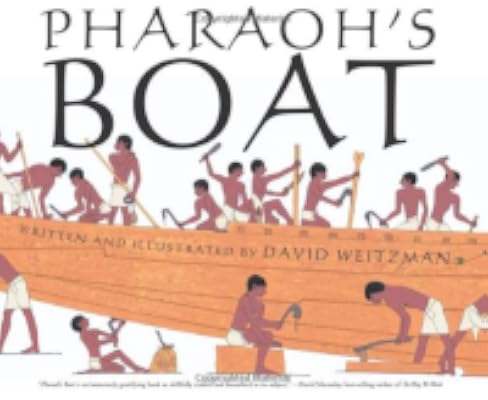
The illustrations are striking, because they're done in the style of the Egyptian hieroglyphs. There's also a clear distinction to those that were done to represent the 1950s (and on) when Moustafa was doing his work.
Dinner Conversation:
"In 1954, workmen began clearing away tongs of windblown sand and rubble that had piled up against the south face of the Great Pyramid at Giza. As they dug, there suddenly appeared an old stone boundary wall. Strange. They weren't expecting to find a wall here."
"The ancient shipwrights fashioned huge, sleek ships from the trunks and branches with a few simple bronze tools."
"Cheops would soon be making his last journey in the world, from his palace at Thebes down the Nile to his pyramid tomb at Giza, where his boats would be waiting for him."
"Ahmed Youssef Moustafa, chief of the Restoration Department of the Egyptian Antiquities Service, was chosen to direct the recovery, preservation and reconstruction of the huge ancient ship--an almost impossible task that no one had ever undertaken before."
To Go with the Meal:
This book can trigger deeper discussions of Ancient Egyptian culture, religion, geography, the flow of the Nile, and the work of archaeologists and restorationists. The book can also trigger a fair number of research projects--whether into subjects like Egyptian archaeology, mummification, religion or the process of different types of boat construction.
A teacher could also focus on the way the past is still alive and influencing the present.
This is a good book to honestly show the work of Archaeologists without, you know, mummies coming alive and interrupting them.
Tasty Rating: !!! show less
Appetizer: The pharaoh Cheops had died and must be properly sent into the afterlife to the sun god, Re. Weitzman shares the process that the Ancient Egyptians went through to prepare Cheops's boat. Contrasting this, Weitzman also shares how the space where the ancient Egyptians stored the boats was discovered in the 1950s and how Ahmed Youssef Moustafa worked to restore the boat.
Wietzman is very thorough, showing each step of the boat building process, the tools used and the reasons why the boats were designed the way they were.
I liked how he showed the parallels of the Egyptian workers building the boat and how Moustafa and his staff reconstructed it. I do show more wish that these scenes had been shown back and forth instead of telling one story and then the later one. I think it would have been more powerful to go back and forth for regularly (Although, there is one page where Moustafa works on one end and an Ancient Egyptian worker does his thing on the other side).
While thorough, I have to admit, I kinda-sorta lost interest in reading the text as it went on. While part of my problem was how text-heavy this picturebook was, my main issue was the fact that the story didn't follow any specific or well-developed character.
Instead, the narrative consisted of "The shipbuilders did this...Then the shipbuilders did that...." And although important, Moustafa wasn't really a character that children will relate to immediately. I did, however, like that there were foldout pages and a lot of direct quotes by Moustafa (That guy was eloquent!).
The illustrations are striking, because they're done in the style of the Egyptian hieroglyphs. There's also a clear distinction to those that were done to represent the 1950s (and on) when Moustafa was doing his work.
Dinner Conversation:
"In 1954, workmen began clearing away tongs of windblown sand and rubble that had piled up against the south face of the Great Pyramid at Giza. As they dug, there suddenly appeared an old stone boundary wall. Strange. They weren't expecting to find a wall here."
"The ancient shipwrights fashioned huge, sleek ships from the trunks and branches with a few simple bronze tools."
"Cheops would soon be making his last journey in the world, from his palace at Thebes down the Nile to his pyramid tomb at Giza, where his boats would be waiting for him."
"Ahmed Youssef Moustafa, chief of the Restoration Department of the Egyptian Antiquities Service, was chosen to direct the recovery, preservation and reconstruction of the huge ancient ship--an almost impossible task that no one had ever undertaken before."
To Go with the Meal:
This book can trigger deeper discussions of Ancient Egyptian culture, religion, geography, the flow of the Nile, and the work of archaeologists and restorationists. The book can also trigger a fair number of research projects--whether into subjects like Egyptian archaeology, mummification, religion or the process of different types of boat construction.
A teacher could also focus on the way the past is still alive and influencing the present.
This is a good book to honestly show the work of Archaeologists without, you know, mummies coming alive and interrupting them.
Tasty Rating: !!! show less
Members
- Recently Added By
Lists

A Child's Book Tour of Egypt
27 works; 2 members
Author Information
23 Works 1,351 Members
David Weitzman lives in Covelo, California. He was awarded a medal at the Leipzig International Book Design Exhibition for his book Superpower
Awards and Honors
Awards
Distinctions
Common Knowledge
- Original publication date
- 2009
- People/Characters
- Cheops (Khufu); Khufu (Cheops); Ahmed Youssef Moustafa
- Important places
- Egypt
- First words
- The pharaoh, Cheops, is dead, the people lament.
- Last words
- (Click to show. Warning: May contain spoilers.)During the final assembly the posts slid, like the finger of a glove, over the tapered ends of the hull.
- Blurbers
- Macaulay, David
- Original language
- English
Classifications
Statistics
- Members
- 363
- Popularity
- 86,496
- Reviews
- 20
- Rating
- (3.56)
- Languages
- English, French
- Media
- Paper, Ebook
- ISBNs
- 7
- ASINs
- 2