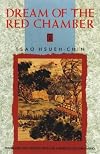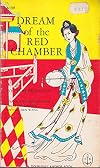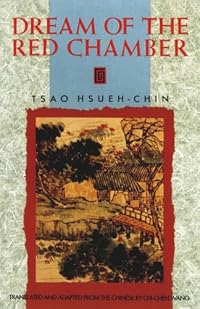
Dream of the Red Chamber [Abridged]
by Tsao Hsueh-Chin
On This Page
Description
The Dream of the Red Chamber is believed to be semi-autobiographical, mirroring the rise and decline of author Cao Xueqin's own family and, by extension, of the Qing dynasty. As the author details in the first chapter, it is intended to be a memorial to the women he knew in his youth: friends, relatives and servants. The novel is remarkable not only for its huge cast of characters and psychological scope, but also for its precise and detailed observation of the life and social structures show more typical of 18th-century Chinese society. It contains within its pages a sampling of all of the major modes and genres of the Chinese literary tradition. show lessTags
Recommendations









Member Reviews
A very great work, but chatty and personal in all its greatness. Full of wonderful small stories and sharply observed social turns. Jane Austen in China, somehow joined at the hip with Chekhov. The story of the farm woman who had all her life lived in fear of falling into poverty and losing the farm, now a beggar on the street, speaking about what a relief it was not to fear it any more. Not minimizing the misery, but able to seize on the relief of life in the present moment . . . there's a full-blooded gutsiness to this book. It acknowledges what kinds of creatures we are, we humans, the whole damn range.
I generally deplore abridged editions, excerpts, and extracts, but I have to confess to enjoying Chi-Chen Wang's abridgement of Dream of the Red Chamber thoroughly. Not having read the (unfinished) original (least of all in Chinese) I can't discuss what must be missing from this version; what is here, however, hangs together well, at least for readers comfortable with the episodic and the (even in this shortened version) sprawling, qualities that, I expect, characterize the unabridged original as well. And the abridgement has done what any good one must do: it's made me eager to plunge into David Hawkes's five-volume unabridged translation.
A good introduction to the novel. I was first introduced to this version via a World Lit class at the University of North Carolina--Wilmington. It had such a deep effect on me that I re-read it several times and eventually read the five volume version numerous times. I would say that the five-volume translation has become probably my favorite of all-time, perhaps, next to [b:Brave New World|5129|Brave New World|Aldous Huxley|http://photo.goodreads.com/books/1327865608s/5129.jpg|3204877]. It has all the genius of the Romantic-era novels of manners, e.g. [b:Pride and Prejudice|1885|Pride and Prejudice|Jane Austen|http://photo.goodreads.com/books/1320399351s/1885.jpg|3060926] set against a background of Taoism, Confucianism, Zen, and other show more types of Buddhism. It also touches on traditional Chinese medicine. I can't recommend this novel enough. The only reason I don't give this five stars is because you really must read the whole translation. show less
A good introduction to the novel. I was first introduced to this version via a World Lit class at the University of North Carolina--Wilmington. It had such a deep effect on me that I re-read it several times and eventually read the five volume version numerous times. I would say that the five-volume translation has become probably my favorite of all-time, perhaps, next to [b:Brave New World|5129|Brave New World|Aldous Huxley|http://photo.goodreads.com/books/1327865608s/5129.jpg|3204877]. It has all the genius of the Romantic-era novels of manners, e.g. [b:Pride and Prejudice|1885|Pride and Prejudice|Jane Austen|http://photo.goodreads.com/books/1320399351s/1885.jpg|3060926] set against a background of Taoism, Confucianism, Zen, and other show more types of Buddhism. It also touches on traditional Chinese medicine. I can't recommend this novel enough. The only reason I don't give this five stars is because you really must read the whole translation. show less
The Dream of the Red Chamber gives the reader a glimpse into an 18th Century Chinese aristocratic family. There are several stories that play at the same time and twist and turn around one another. The book reminded me of an Orchid. Each story was a different blossom, distinct but part of a greater whole. The stem of the orchid represents the largest story, the one that ties all the others together. That overriding story is of the forgotten block not used in the building of heaven that desires to go down to existence, the red dust, and know what it means to be human.
It is this theme of being human that plays again and again throughout the book. While we see the adults and their power plays, the bulk of the book is focused around the show more adolescent segment of the family. Rich, poor, happiness and sorrow are all parts of existence. Our lives are partially controlled by fate and partially controlled by our own decisions. We have a purpose in life, and that is to honor our families by our actions and achievements. It is not until the very end of the book that the main character understands that purpose and fulfils his destiny.
There is not a simple main story line to follow which leaves many readers wondering what the book is all about. By concentrating on the intricacies of the story the reader will be drawn in and will anticipate the dramas that make up the characters lives. I found it difficult to keep track of the individual characters because of the use of traditional Chinese names and because each character is referred to by several names during the book. If I were to read it again I would have a pad of paper to write down names and relationships. Even not having done that I felt I gained a great deal out of reading the story. show less
It is this theme of being human that plays again and again throughout the book. While we see the adults and their power plays, the bulk of the book is focused around the show more adolescent segment of the family. Rich, poor, happiness and sorrow are all parts of existence. Our lives are partially controlled by fate and partially controlled by our own decisions. We have a purpose in life, and that is to honor our families by our actions and achievements. It is not until the very end of the book that the main character understands that purpose and fulfils his destiny.
There is not a simple main story line to follow which leaves many readers wondering what the book is all about. By concentrating on the intricacies of the story the reader will be drawn in and will anticipate the dramas that make up the characters lives. I found it difficult to keep track of the individual characters because of the use of traditional Chinese names and because each character is referred to by several names during the book. If I were to read it again I would have a pad of paper to write down names and relationships. Even not having done that I felt I gained a great deal out of reading the story. show less
According to Benét’s Reader’s Encyclopedia, Dream of the Red Chamber is “written with great psychological insight and is unique among Chinese novels for the depth and subtlety of its characterization.” Perhaps this translation, or the process of abridgement, has obscured these virtues. A major problem I found in reading was that the translation makes it nearly impossible to keep track of the characters. Names in a completely foreign language are difficult in any case, but frequent switches from names to titles which can switch depending on who is addressing whom, i.e. a man is father to one character, grandfather to another and uncle to another make the task more difficult. The male characters are named in Chinese, the women show more are sometimes named in Chinese, sometimes in translations such as Black Jade. There may be class or age significance here, but it is not clear.
The main character, Pao-yu, is merely a boy growing into adolescence, but I felt little insight into his motivations. He is the petted grandchild of the Matriarch of an aristocratic Chinese family. Surrounded by female servants he whiles away his time writing poetry, attending parties, admiring the gardens, etc. Does he neglect his studies, essential for advancement within Chinese Imperial government, out of laziness, rebellion, indifference? We never really know. Nor do we understand why the adults of the family exert little in the way of long term discipline. At one point his father threatens to beat him to death for concealing an actor attached to the Emperor’s household. Yet no one seems inclined to remove the numerous distractions that encourage his aimless lifestyle.
Admittedly the culture described may seem too different from that of the West to elicite a sympathetic engagement. However it is no more foreign than the court society of Japan described in Tale of the Genji, which, in my opinion displays the depth of characterization ascribed to Dream of the Red Chamber. I forced myself to finish this book, but would not seek out another like it.
For longer review see ritasreviewsandruminations.blogspot.com/ show less
The main character, Pao-yu, is merely a boy growing into adolescence, but I felt little insight into his motivations. He is the petted grandchild of the Matriarch of an aristocratic Chinese family. Surrounded by female servants he whiles away his time writing poetry, attending parties, admiring the gardens, etc. Does he neglect his studies, essential for advancement within Chinese Imperial government, out of laziness, rebellion, indifference? We never really know. Nor do we understand why the adults of the family exert little in the way of long term discipline. At one point his father threatens to beat him to death for concealing an actor attached to the Emperor’s household. Yet no one seems inclined to remove the numerous distractions that encourage his aimless lifestyle.
Admittedly the culture described may seem too different from that of the West to elicite a sympathetic engagement. However it is no more foreign than the court society of Japan described in Tale of the Genji, which, in my opinion displays the depth of characterization ascribed to Dream of the Red Chamber. I forced myself to finish this book, but would not seek out another like it.
For longer review see ritasreviewsandruminations.blogspot.com/ show less
Like a historical record, the novel vividly portraits forgotten customs as well as enduring intrigues of a wealthy but declining aristocratic family in the Qing dynasty, detailing sumptuous delicacies, colorful cotton-padded jackets, and the luxurious chambers’ wooden stools, chamber pots, woven screens and bedside heaters. To turn the pages of Dream of the Red Chamber is to relive the decaying luxury of a lost time.
Members
- Recently Added By
Lists

1964 College Preparatory Reading List
202 works; 8 members
Author Information

102+ Works 5,383 Members
Some Editions
Series
Belongs to Publisher Series
Common Knowledge
- Canonical title
- Dream of the Red Chamber [Abridged]
- Original title
- Dream of the Red Chamber - 紅樓夢
- Original publication date
- 1929
- People/Characters
- Baoyu; Daiyu; Baochai
- Important places
- China
- Related movies
- Xin hong lou meng (1978 | IMDb)
- First words
- When the Goddess Nugua undertook to repair the Dome of Heaven, she fashioned at the Great Mythical Mountain under the Nonesuch Bluff 36,501 pieces of stone, each 120 feet high and 240 feet around. (Part 1 - Chapter One)
- Last words
- (Click to show. Warning: May contain spoilers.)But that is not fate's way; Lotus died in childbirth within a year of the marriage.
- Disambiguation notice
- This is and abridged version of the complete work variously known as A Dream of Red Mansions , The Dream of the Red Chamber, or The Story of the Stone, by Cao Xueqin (also known as Tsao Hsueh-chin) and Ka... (show all)o Ngo (also known as Kao Hgo, or Gao E). Please distinguish it from the complete work, any other abridged versions, or any portions. Thank you.
Classifications
- Genres
- Fiction and Literature, General Fiction
- DDC/MDS
- 895.1348 — Literature & rhetoric Asian Literature Literatures of East and Southeast Asia Chinese Chinese fiction Song, Yuan, Ming, Qing dynasties 960–1912 Qing dynasty 1644–1912
- LCC
- PL2727 .S2 .A28 — Language and Literature Languages and literatures of Eastern Asia, Africa, Oceania Languages of Eastern Asia, Africa, Oceania Chinese language and literature Chinese literature Individual authors and works
- BISAC
Statistics
- Members
- 933
- Popularity
- 28,404
- Reviews
- 11
- Rating
- (3.75)
- Languages
- Chinese, English, German, Greek
- Media
- Paper, Ebook
- ISBNs
- 31
- ASINs
- 13