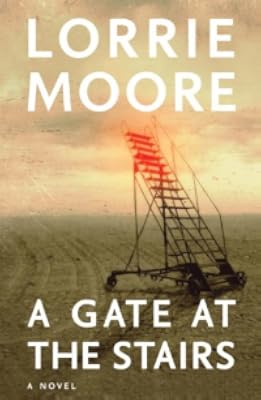
A Gate at the Stairs
by Lorrie Moore
On This Page
Description
"...As the United States begins gearing up for war in the Middle East, twenty-year-old Tassie Keltjin, the Midwestern daughter of a gentleman hill farmer--his 'Keltjin potatoes' are justifiably famous--has come to a university town as a college student, her brain on fire with Chaucer, Sylvia Plath, Simone de Beauvoir. Between semesters, she takes a job as a part-time nanny. The family she works for seems both mysterious and glamorous to her, and although Tassie had once found children show more boring, she comes to care for, and to protect, their newly adopted little girl as her own. As the year unfolds and she is drawn deeper into each of these lives, her own life back home becomes ever more alien to her: her parents are frailer; her brother, aimless and lost in high school, contemplates joining the military. Tassie finds herself becoming more and more the stranger she felt herself to be, and as life and love unravel dramatically, even shockingly, she is forever changed..."--dust cover flap. show lessTags
Recommendations

Member Recommendations
jwrudn If you like Lorrie Moore and short stories.
Member Reviews
I didn't expect to like this as much as I did. In that way that impressions form about writers when one has never read them but only heard about them, I expected Moore to have a sort of postmodern whiny narrative voice. But, on the whole, I found the voice here to be much more engaging and compassionate and wise and genuinely funny. I have some hesitations and criticisms, but I will probably read more Moore...
A Gate at the Stairs is narrated by a Midwestern farmer's daughter and begins the year she gets a job as a babysitter for an older couple who are about to adopt. Tassie is in college, rooming with a girl who has disappeared into her boyfriend's life, leaving Tassie alone and a little lonely and willing to fill her life with the family she babysits for and to fall for the friendly Brazilian guy in her Sufism class. Lorrie Moore can write. Which means what happens in the book is almost beside the point, what with all the words being put into the right places. She's skilled at creating atmosphere, at heading off into short diversions that circle back into the story later on and at capturing the feeling of being caught between trying to show more appear as experienced and prepared as possible while really not knowing what to do. Set at the beginning of the war in Afghanistan, there's a feeling of uncertainty, of suspicion of the people around you and of a divided country going to war.
This book defies easy summarization, with its divergences and multiple threads of plot. Tassie's a naive, but intelligent observer, and takes her time with the story she's telling, which, being the story of a period of time in her life, is less straight-forward and plot-driven, than it is meandering and, like memory, hurrying through some experiences while slowing down to peer at other events in detail. show less
This book defies easy summarization, with its divergences and multiple threads of plot. Tassie's a naive, but intelligent observer, and takes her time with the story she's telling, which, being the story of a period of time in her life, is less straight-forward and plot-driven, than it is meandering and, like memory, hurrying through some experiences while slowing down to peer at other events in detail. show less
That the university town of Troy is described as “the Athens of the Midwest” ought to be a signal that a conflicted tragedy on a Homeric scale is about to unfold. And that’s mostly true, although the “Homer” is more Simpson than Greek. Tragedy abounds—from the songbirds caught off guard by winter’s full force in the opening paragraph, to child abandonment, infanticide (sort of), fratricide (sort of), roommate-icide (sort of), racism, paternalism, terrorism, and people who quote Nietzsche. In the face of so much tragedy, Moore offers us Tassie Keltjin, intrepid baby-sitter, kilt clad bassist, and bard. When Tassie expresses doubt that the stars and the planets have anything to do with our lives down here, her roommate, show more Murph, succinctly replies, “How could they not?” They’re both right: the gods have no interest in us, yet we find ourselves buffeted and banged about by random chance, coincidence, and gruesome reality.
Fortunately, Tassie, her family, and her close friends have uncanny wit and revel in verbal gamesmanship. Because there is no making sense of things. Life just doesn’t make sense. And so you’ve got to laugh.
Lorrie Moore packs a wealth of observation, and disappointment, into this burbling novel. Sometimes it feels so full, you’ll think it will spill its bounds. Yet, she manages to keep it and Tassie on course through the worst of everything, even a metaphoric visit to Hades, to renewed hope and the return to the life of learning, and Starbucks. Be prepared to be surprised, confounded, appalled, and amused. Highly recommended. show less
Fortunately, Tassie, her family, and her close friends have uncanny wit and revel in verbal gamesmanship. Because there is no making sense of things. Life just doesn’t make sense. And so you’ve got to laugh.
Lorrie Moore packs a wealth of observation, and disappointment, into this burbling novel. Sometimes it feels so full, you’ll think it will spill its bounds. Yet, she manages to keep it and Tassie on course through the worst of everything, even a metaphoric visit to Hades, to renewed hope and the return to the life of learning, and Starbucks. Be prepared to be surprised, confounded, appalled, and amused. Highly recommended. show less
Call me old fashioned, but I do like at least a little conflict with my plot! Any middle school student would quickly spot this for what it really is: not a narrative at all, but just one (over) long descriptive essay. Guess I should have suspected something was amiss when, at page 100, story still hadn't advanced beyond exposition. But I kept reading, expecting something eventually to happen: for a conflict to emerge, or a theme to assert itself, or a character to arise from the morass of words and make themselves heard. Alas, I was wrong. Reading this was like going to the theater expecting a play but getting, instead, 2 hours of prop people arranging scenery.
If someone generated a word cloud of the text, suspect "like" and "as" show more would dominate. Moore drowns her reader in similes, metaphors, and imagery - nothing, from clouds to toilet paper, escapes without at least a paragraph's worth of description, typically accompanied by 1-2 peripherally-related anecdotes, an attempt at wit, and perhaps a forced literary allusion or two. Some of the similes are deft and lovely; others are forced and actually painful to read. (As when she compares a dead body to a salad - cringe-inducing!) And yet, whenever the opportunity arises for her first person narrator, Tassie, to describe her feelings/opinions/reflections, suddenly the descriptive flood goes dry. Neither Tassie nor anyone else in this story changes, thinks, reflects, questions, changes, or grows in any way ... the characters and their day-to-day existences seem merely intended to provide a trellis linking endless descriptive set-pieces.
This felt less like a fully fleshed-out novel than some ambitious author's writing workshop "descriptive essay" homework. I'll give Moore a "A" for language/imagery (though I'm tempted to dock the grade because she went *way* over the recommended page limit), but as a work of literature that provokes the reader to empathize, reflect, reason or grow, this merits a "D", tops. show less
If someone generated a word cloud of the text, suspect "like" and "as" show more would dominate. Moore drowns her reader in similes, metaphors, and imagery - nothing, from clouds to toilet paper, escapes without at least a paragraph's worth of description, typically accompanied by 1-2 peripherally-related anecdotes, an attempt at wit, and perhaps a forced literary allusion or two. Some of the similes are deft and lovely; others are forced and actually painful to read. (As when she compares a dead body to a salad - cringe-inducing!) And yet, whenever the opportunity arises for her first person narrator, Tassie, to describe her feelings/opinions/reflections, suddenly the descriptive flood goes dry. Neither Tassie nor anyone else in this story changes, thinks, reflects, questions, changes, or grows in any way ... the characters and their day-to-day existences seem merely intended to provide a trellis linking endless descriptive set-pieces.
This felt less like a fully fleshed-out novel than some ambitious author's writing workshop "descriptive essay" homework. I'll give Moore a "A" for language/imagery (though I'm tempted to dock the grade because she went *way* over the recommended page limit), but as a work of literature that provokes the reader to empathize, reflect, reason or grow, this merits a "D", tops. show less
I must admit, I’ve never been unduly fond of the whole rites-of-passage, coming-of-age genre. To my mind – due perhaps to one or two bad past experiences – it suggests nothing so much as overwrought prose and supposed daring providing a fig leaf of modesty barely large enough to cover underlying weak plotting, poor characterisation and over-the-top angst penned by authors who don’t seem to have realised that having feelings does not in itself make you special or interesting, but just human. I picked up A Gate at the Stairs with some trepidation, then: this was, after all, as the cover informed me, a story about a twenty-year-old student seeking to escape a provincial background in an oh-so-liberal university town, being stripped show more of her innocence and illusions in the process, and, well, growing up a bit. But – would you believe it? – Lorrie Moore has, apart from anything else, just reminded me that preconceptions are a bad, bad thing. A Gate at the Stairs is not just good, it’s really quite brilliant.
It has its faults, certainly. The writing drags sometimes, and the overuse of exclamation marks (always! everywhere!) can get annoying. The jokes don’t always work very well, the characters felt a little flat to me, and some of the plot developments (especially one involving a boyfriend who is not all he seems) are creaky. Still, Moore takes you right to the heart of everything she writes about, whether it’s the American Midwest, romantic love or bereavement. Part of this is due to her almost psychic grasp of the correct word or phrase to nail her intended meaning precisely. Indeed, if language alone excites you, you’ll love this book. A (very) few examples:
“A scalding boldness gripped Amber’s face, then a kind of guilt, then drifty blankness, like songs off a jukebox list, flipped through unchosen.”
“She was like a stickleback fish caught inland as the glacier retreated and the rivers – the only access to the sea – disappeared. She would have to make do, in this landlocked lake of love.”
“Edward’s middle-aged face turned slightly, tensed with an adolescent’s wordless hate.”
“The gothic knell of a wedding bell, the hangman’s rope grown straight out of the chest then looped like tasseling around the tables. Rat teeth raking the cake. Beauty could not love you back.”
When you weigh the book’s flaws against language like that, it seems churlish to complain too much about them. Besides, I defy anyone to tell me that a book containing the sentence “Did he not have the speed-dating of fruit flies to chaperone?” does not justify its existence by virtue of that alone. show less
It has its faults, certainly. The writing drags sometimes, and the overuse of exclamation marks (always! everywhere!) can get annoying. The jokes don’t always work very well, the characters felt a little flat to me, and some of the plot developments (especially one involving a boyfriend who is not all he seems) are creaky. Still, Moore takes you right to the heart of everything she writes about, whether it’s the American Midwest, romantic love or bereavement. Part of this is due to her almost psychic grasp of the correct word or phrase to nail her intended meaning precisely. Indeed, if language alone excites you, you’ll love this book. A (very) few examples:
“A scalding boldness gripped Amber’s face, then a kind of guilt, then drifty blankness, like songs off a jukebox list, flipped through unchosen.”
“She was like a stickleback fish caught inland as the glacier retreated and the rivers – the only access to the sea – disappeared. She would have to make do, in this landlocked lake of love.”
“Edward’s middle-aged face turned slightly, tensed with an adolescent’s wordless hate.”
“The gothic knell of a wedding bell, the hangman’s rope grown straight out of the chest then looped like tasseling around the tables. Rat teeth raking the cake. Beauty could not love you back.”
When you weigh the book’s flaws against language like that, it seems churlish to complain too much about them. Besides, I defy anyone to tell me that a book containing the sentence “Did he not have the speed-dating of fruit flies to chaperone?” does not justify its existence by virtue of that alone. show less
Tassie Keltjin is a 20 year old student at a major university in Troy, a moderately sized and liberal Midwestern city, who answers an ad placed by a couple who seeks to adopt a child. She is the half Jewish daughter of farmers in a small town, somewhat naïve and quirky, and is entranced by her employers, an owner of a French restaurant who is also half Jewish and even quirkier than Tassie, and her husband, a biomedical researcher who is not associated with the university. The couple adopt a biracial child who soon becomes the focus of a relatively benign racial attack by a local youth, which triggers a response by those in the community that are horrified that such a thing could take place in Troy, "the Athens of the Midwest".
Tassie show more continues her studies and her job as a part-time nanny for the child, falls in love with a mysterious student, and engages with her troubled family and even more troubled roommate. At the same time the adoptive couple faces their own issues, especially a past incident that comes to light after the adoption is approved.
I found A Gate at the Stairs to be a frustrating, maddening, and intensely distasteful novel, as Moore attempted to do too much with it ,and its characters, especially the adoptive couple, were either despicable, overly quirky, or inscrutable. Was this supposed to be a novel about post-9/11 America? One about racism, or multiculturalism, or the contrast between the rural towns and university cities in the Midwest? Maybe it's supposed to be a coming of age novel? A love story, perhaps? It was ultimately none of these things, as it handled these topics in a most superficial and demeaning manner. Avoid this book like the plague. show less
Tassie show more continues her studies and her job as a part-time nanny for the child, falls in love with a mysterious student, and engages with her troubled family and even more troubled roommate. At the same time the adoptive couple faces their own issues, especially a past incident that comes to light after the adoption is approved.
I found A Gate at the Stairs to be a frustrating, maddening, and intensely distasteful novel, as Moore attempted to do too much with it ,and its characters, especially the adoptive couple, were either despicable, overly quirky, or inscrutable. Was this supposed to be a novel about post-9/11 America? One about racism, or multiculturalism, or the contrast between the rural towns and university cities in the Midwest? Maybe it's supposed to be a coming of age novel? A love story, perhaps? It was ultimately none of these things, as it handled these topics in a most superficial and demeaning manner. Avoid this book like the plague. show less
There's certainly a lot of pain and injustice in this book, but I'm glad to have read it. Moore has a unique writing voice and a kind of "old soul" wisdom ensconced in her story about the world of young women in the modern age. If you're looking for some sort of feel good story or thriller then keep moving. But if you can stomach the gut punches, this is a novel well worth the discomfort.
Members
- Recently Added By
Published Reviews
ThingScore 79
As the drifts of perfectly turned moments mount up about the reader's shoulders, along with a corresponding paucity of dramatic incident, forward motion becomes increasingly difficult. Moore is a great writer, but you wish that every once in a while, she would settle for just being good.
added by Shortride
Moore has performed a brilliant feat. She has retained the shining, fluid, and, yes, funny surface of her earlier work. But she has also given us a narrator who attempts to peer through the shimmering veil of language to the truth behind.
added by Shortride
What Moore crafts is so like life that to condemn Tassie for the ways in which she fails and falls short as a person would demand that we examine such behavior in ourselves. Thank goodness this book is funny, otherwise, it would be nearly unbearable.
added by Shortride
Lists

1001 Books You Must Read Before You Die
1,448 works; 1,134 members

Favourite Women's Prize for Fiction, Orange & Bailey's Prize contenders
132 works; 52 members

Pen/Faulkner Winners and Finalists
178 works; 9 members

Maybe This Year? Books to Look Forward To
412 works; 9 members

Llibres que he llegit el 2022
32 works; 1 member

Secret Histories
28 works; 8 members

To Read
617 works; 7 members
Author Information

32+ Works 13,136 Members
Lorrie Moore was born Marie Lorena Moore on January 13, 1957 in Glen Falls, New York. She was nicknamed Lorrie by her parents. She attended St. Lawrence University and won Seventeen magazine's fiction contest. After graduation, she moved to Manhattan and worked as a paralegal for two years. In 1980 she enrolled in Cornell University's M.F.A. show more program. After graduation from Cornell she was encouraged by a teacher to contact an agent who sold her collection, Self-Help, which was composed of stories from her master's thesis. Lorrie Moore writes about failing relationships and terminal illness. She is the Delmore Schwartz Professor in the Humanities at the University of Wisconsin-Madison where she teaches creative writing. She has also taught at Cornell University. She has written a children's book entitled The Forgotten Helper. She won the 1998 O. Henry Award for her short story People Like That They Are the Only People Here. In 1999 she was given the Irish Times International Fiction Prize for Birds of America. She was elected to the American Academy of Arts and Letters in 2006 and in 2010 her novel A Gate at the stairs was a finalist for the Pen/Faulkner Award for fiction. (Bowker Author Biography) show less
Some Editions
Awards and Honors
Awards
Distinctions
Series
Belongs to Publisher Series
Common Knowledge
- Canonical title
- A Gate at the Stairs
- Original publication date
- 2009
- People/Characters
- Tassie Keltjin; Sarah Brinks-Thornwood (Susan); Edward Thornwood (John); Emmie (Mary Emma); Robert Keltjin; Renaldo
- Important places
- Troy ('The Athens of the Midwest')
- Epigraph
- "As for living, we shall have our servants do that for us."
--VILLIERS DE L'ISLE-ADAM, Axel
"Suzuki!"
Madama Butterfly
"All seats provide equal viewing of the universe."
--MUSEUM GUIDE, HA... (show all)YDEN PLANETARIUM - Dedication
- This book is for Victoria Wilson and Melanie Jackson.
- First words
- The cold came late that fall and the songbirds were caught off guard.
- Quotations
- If he had loved me, or even if he’d just have said so, I would have died of happiness. But it didn’t happen. So I didn’t die of happiness. Words for a tombstone: SHE DIDN’T DIE OF HAPPINESS.
This was love, I supposed, and eventually I would come to know it. Someday it would choose me and I would come to understand its spell, for long stretches and short, two times, maybe three, and then quite probably it would ch... (show all)oose me never again. - Last words
- (Click to show. Warning: May contain spoilers.)That much I learned in college.
- Blurbers
- Lethem, Jonathan; Doyle, Roddy; Kennedy, Douglas; Dyer, Geoff; Kakutani, Michiko; Showalter, Elaine (show all 8); Harrison, Sophie; Alter, Alexandra
- Original language
- English
Classifications
Statistics
- Members
- 2,708
- Popularity
- 6,841
- Reviews
- 167
- Rating
- (3.35)
- Languages
- 9 — Catalan, English, French, German, Greek, Italian, Norwegian (Bokmål), Portuguese, Spanish
- Media
- Paper, Audiobook, Ebook
- ISBNs
- 43
- UPCs
- 1
- ASINs
- 17