On This Page
Description
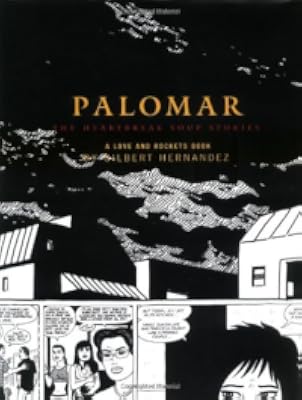
Reprints every "Palomar" comic written and drawn by Gilbert Hernandez between 1982 and 2003, tracing the lives of the residents of the mythical Latin American village from the arrival of Luba, the guiding material spirit of Palomar, to her departure twenty years later.Tags
Recommendations


























Member Recommendations

Member Reviews
(Reprinted from the Chicago Center for Literature and Photography [cclapcenter.com]. I am the original author of this essay, as well as the owner of CCLaP; it is not being reprinted here illegally.)
Regular readers know that I make my way through graphic novels on a pretty regular basis, usually only ten or twenty pages at a time while in bed at night; and hey, what should just happen to pop up at my neighborhood library the other day than the collected "Palomar" stories from legendary '80s and '90s comic Love And Rockets, only a handful of which I'd ever sat down and read from cover to cover before. (Or, actually I cheated a little -- the book I came across randomly was merely volume one of a brand-new paperback collection by its show more publisher Fantagraphics, being offered as a cheaper and more mobile version than the all-in-one coffeetable-sized hardback collection they put out in 2003; when I discovered that the Chicago Public Library has not yet acquired volume two of this new paperback series, I simply checked out the larger hardback version, and finished up the stories that way.) For those who don't know, the original Love And Rockets consisted of several different persistent storylines, each of which was run by a different member of the multi-sibling Hernandez family, who as a group originally created and funded this historically ultra-important title from the dawn of alt-comics; the "Palomar" stories (named after the town where they take place, also known as the "Heartbreak Soup" stories after the very first tale in the series) was the one maintained by brother Gilbert, an expansive look at a fictional village somewhere on the west coast of Central America, and all the remarkable things that happen there from roughly the 1950s to 1980s (and sometimes both before and beyond).
And indeed, the entire series as a whole is still a remarkable read, just as sharp and entertaining as when the stories first started appearing nearly thirty years ago; because by concentrating on the long-term fates of dozens of Palomar's citizens, as they mature over a dense 600 pages from childhood to middle-age (or from middle-age to death in the case of the main characters' parents, or from birth to puberty in the case of their kids), combined with a healthy dose of magical realism (inspired by the Latino-American artist's obsession with Gabriel Garcia Marquez), Hernandez turns in a saga much more timeless than his '80s contemporaries, ultimately a story about family that now holds up much better than the instantly dated punk-rock tropes of, say, peer Alan Moore from the same period. (For example, just try reading Moore's early-'80s V For Vendetta anymore without its naive anarchist political posturing making you want to burst into unintended laughter on a regular basis.) It's this original attention to classic detail that makes the Palomar stories still so enjoyable, and what has kept Love And Rockets still so well-known and influential even decades later, when so many of the other roughly-done black-and-white comic-book experiments from the period have by now fallen into near-total obscurity.
Out of 10: 9.4 show less
Regular readers know that I make my way through graphic novels on a pretty regular basis, usually only ten or twenty pages at a time while in bed at night; and hey, what should just happen to pop up at my neighborhood library the other day than the collected "Palomar" stories from legendary '80s and '90s comic Love And Rockets, only a handful of which I'd ever sat down and read from cover to cover before. (Or, actually I cheated a little -- the book I came across randomly was merely volume one of a brand-new paperback collection by its show more publisher Fantagraphics, being offered as a cheaper and more mobile version than the all-in-one coffeetable-sized hardback collection they put out in 2003; when I discovered that the Chicago Public Library has not yet acquired volume two of this new paperback series, I simply checked out the larger hardback version, and finished up the stories that way.) For those who don't know, the original Love And Rockets consisted of several different persistent storylines, each of which was run by a different member of the multi-sibling Hernandez family, who as a group originally created and funded this historically ultra-important title from the dawn of alt-comics; the "Palomar" stories (named after the town where they take place, also known as the "Heartbreak Soup" stories after the very first tale in the series) was the one maintained by brother Gilbert, an expansive look at a fictional village somewhere on the west coast of Central America, and all the remarkable things that happen there from roughly the 1950s to 1980s (and sometimes both before and beyond).
And indeed, the entire series as a whole is still a remarkable read, just as sharp and entertaining as when the stories first started appearing nearly thirty years ago; because by concentrating on the long-term fates of dozens of Palomar's citizens, as they mature over a dense 600 pages from childhood to middle-age (or from middle-age to death in the case of the main characters' parents, or from birth to puberty in the case of their kids), combined with a healthy dose of magical realism (inspired by the Latino-American artist's obsession with Gabriel Garcia Marquez), Hernandez turns in a saga much more timeless than his '80s contemporaries, ultimately a story about family that now holds up much better than the instantly dated punk-rock tropes of, say, peer Alan Moore from the same period. (For example, just try reading Moore's early-'80s V For Vendetta anymore without its naive anarchist political posturing making you want to burst into unintended laughter on a regular basis.) It's this original attention to classic detail that makes the Palomar stories still so enjoyable, and what has kept Love And Rockets still so well-known and influential even decades later, when so many of the other roughly-done black-and-white comic-book experiments from the period have by now fallen into near-total obscurity.
Out of 10: 9.4 show less
Palomar is a small town of a few hundred people somewhere in Central America. Our story is a sprawling tale, starting with one midwife, Chelo, destined to have no children of her own and surrounding those she's helped bring into the world, those she's protected, those she's befriended and known. Like all stories, there are those bits to satiate you at the beginning, a bit of background on this that or the other and some nips of whatnot, but then there's the thing that really gets everything rolling. In Palomar, that thing is Luba. Luba's arrival is the beginning of everything - it sparks our boys into manhood, girls pay attention to their new powers of womanhood, Chelo has competition as a banadora, the sheriff pushes his corrupt nature show more too far, there is death, betrayal and murder...and this is all within the first 50 pages of the 500 that will cover 20 years in the life of Palomar.
Palomar is a sprawling soap opera disguised as the great novel. Within every dramatic twist, new romance or damaged relationship, there's true humanity. These are not story lines that converge just to get one character from point A to point B back to point A in dramatic fashion. These are characters that go down paths that they cannot return from unchanged. show less
Palomar is a sprawling soap opera disguised as the great novel. Within every dramatic twist, new romance or damaged relationship, there's true humanity. These are not story lines that converge just to get one character from point A to point B back to point A in dramatic fashion. These are characters that go down paths that they cannot return from unchanged. show less
I first read Love and Rockets back in the '80s, but only sporadically. This collection is funny, touching, disturbing, heartbreaking, and always entertaining.
Engross yourself in the intricate trials and tribulations of a mythical Central American townspeople who share in your foibles.
Ratings
Members
- Recently Added By
Lists

Magic Realism
371 works; 52 members

Books
85 works; 1 member
Author Information

284+ Works 7,504 Members
Awards and Honors
Notable Lists
Series

Common Knowledge
- Canonical title
- Palomar: The Heartbreak Soup Stories
- Original publication date
- 2003-07
- People/Characters
- Chelo; Luba [Love and Rockets]; Jesus Angel; Vicente; Israel Diaz; Satch (Sakahftewa) (show all 29); Pipo; Carmen; Gato; Gordo Martinez; Lucia; Ofelia; Maricela; Toco; Heraclio; Soledad Marquez; Archie Ruiz; Doralis; Casamira; Guadalupe; Demona; Sergio; Tonantzin; Babosa; Howard Miller; Khamo; Diana; Sergio; Aurora Diaz
- Important places
- Palomar, Central America; San Fideo, Central America
- First words
- As well as giving baths for a living in those days, Chelo was also a midwife. She can tell you stories.
- Last words
- (Click to show. Warning: May contain spoilers.)Oh...Oh, thank you. But I've got to get going, really. My girlfriends are waiting for me in the car.
Classifications
- Genre
- Graphic Novels & Comics
- DDC/MDS
- 741.5973 — Arts & recreation Drawing & decorative arts Drawing Comic books, graphic novels, fotonovelas, cartoons, caricatures, comic strips History, geographic treatment, biography North American United States (General)
- LCC
- PN6727 .H477 .P36 — Language and Literature Literature (General) Literature (General) Collections of general literature Comic books, strips, etc.
- BISAC
Statistics
- Members
- 319
- Popularity
- 100,509
- Reviews
- 4
- Rating
- (4.50)
- Languages
- English, French, Spanish, Swedish
- Media
- Paper
- ISBNs
- 5