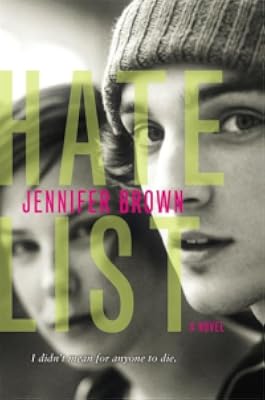
Hate List
by Jennifer Brown
On This Page
Description
Sixteen-year-old Valerie, whose boyfriend Nick committed a school shooting at the end of their junior year, struggles to cope with integrating herself back into high school life, unsure herself whether she was a hero or a villain.Tags
Recommendations










Member Recommendations
Member Reviews
It's only been one semester since Valerie's boyfriend, Nick, murdered several students at their high school before turning the gun on himself. Although she was not involved in the shooting - she didn't even know Nick was going to do it - she's been held to some degree responsible. After all, Valerie was the one who created the Hate List, and it seems that Nick was picking off people who were included upon it. But Valerie was the one to stop the shooting from escalating - saving one student, and getting shot in the leg herself in the process. Is she a hero, or is she responsible? How can she live with this?
Hate List is a fascinating book. The subject matter, as the synopsis shows, is incredibly dark. Jennifer Brown captures the voice of show more an eighteen year old outcast rather well, and more, the questioning nature of the rest of the town. The way the book is structured, newspaper clippings giving a biography of each of the students shot scattered in front of most of the chapters, serves to drive the gravity of the situation home.
The book reminded me in a lot of ways of the film/play Bang, Bang, You're Dead. While not taking the perspective of the shooter, it does take the perspective of someone more sympathetic to what causes people to go to such extremes. Nick cannot be truly vindicated for what he did, but at the same time the way he was treated is also inexcusable. Hate is a part of life, but it isn't all there is to life. I defy anyone to get through this book and not cry at the last few scenes. show less
Hate List is a fascinating book. The subject matter, as the synopsis shows, is incredibly dark. Jennifer Brown captures the voice of show more an eighteen year old outcast rather well, and more, the questioning nature of the rest of the town. The way the book is structured, newspaper clippings giving a biography of each of the students shot scattered in front of most of the chapters, serves to drive the gravity of the situation home.
The book reminded me in a lot of ways of the film/play Bang, Bang, You're Dead. While not taking the perspective of the shooter, it does take the perspective of someone more sympathetic to what causes people to go to such extremes. Nick cannot be truly vindicated for what he did, but at the same time the way he was treated is also inexcusable. Hate is a part of life, but it isn't all there is to life. I defy anyone to get through this book and not cry at the last few scenes. show less
Are you ready for some serious reading? Because that's what you'll get with Hate List.
Brown, J. (2009). Hate List. New York: Little, Brown and Company.
408 pages.
Appetizer: Valerie Leftman was shot in the leg during a school shooting. She'd been diving at the shooter at the time, but witness couldn't tell if she was actually trying to protect another girl, stop the shooter, or protect him.
The shooter was her boyfriend, Nick. They were each other's bright spots in their lives. And they vented their frustration with the school bullies by writing a hate list of the people and things that upset them.
While Nick kills himself, Valerie survives the school shooting. She has to come to terms with what her boyfriend, the person she relied upon show more most, has done and she must return to school to face the other survivors, most of whom think Valerie is at least partially responsible for the shootings.
The first part of the book is structured with chapters that go back and forth between the day of the shooting and Valerie's first day back to school months later.
The rest of the book deals with the aftermath of the shooting, from the time Valerie wakes up in the hospital and is suspected of having a role in the shooting, to being admitted for psychiatric observation, to looking over some newspaper articles and seeing how the media tended to portray the shootings with biases, to learning to express herself with art, to her meetings with her psychiatrist, to mourning, to finding she doesn't have to go through this alone or run away from her problems and finally to her graduation day.
Intense.
As I was reading through the book, I almost didn't want to write a blog post, since my reactions to this book tended to be on a very personal level.
First off, like everyone else my age, I was in high school when the Columbine shootings occurred. I remember very vividly watching the news reports in class as the reporters arrived on the scene and having one of my more idiotic teachers inform us that Columbine closely reflected the demographics of our own school. So, what happened there could happen HERE. A great thing to tell fourteen and fifteen-year-olds. Just awesome.
I remember having extensive discussions about how, if there were a shooting, which teacher we would run to for protection (Answer: Thor, the aptly nicknamed math teacher).
I remember how a boy who used to wear a long black coat stopped wearing it after the shootings.
I also remember that I stopped adding to my own Burn List that I'd kept in my mind.
In the book, Valerie comes under scrutiny and suspicion from other students after it is publicized on many television shows and in newspaper that her Hate List of her difficulties with her school work, bullies and parents. It's the list that Nick and her grew to share, was what guided Nick when he wandered the commons area of the school looking for people to shoot.
My list was never as concrete as Valerie's in the book. Mainly my mental list consisted of people like "that one guy, who cut off my mom while driving, that one time." (I'd added him to the list at my mom's urging.)
Having this list provided me with comfort, a way of organizing all the things that had been upsetting me. But I 100% nothing/nobody on my burn list would ever end up actually burned.
WAIT! That's a lie. I'm lying to you. There was that one time I burned a few photos of me and an ex at a dance over the sink, with a glass of water nearby. (Safety first!) But that was, like, in senior year. And it didn't help much.
My personal experiences and the content of Hate List book raised a lot of questions for me about warning signs and the way school shooters are publicly viewed. Jennifer Brown does an amazing job of showing Valerie's confusion over Nick's actions--what she always thought were their inside jokes and fantasies about death he took very seriously. Brown does a great job of showing both Valerie and Nick as a complicated characters. When the media and police misunderstood her, I couldn't help but feel outraged for Valerie. How can these people be so mean to each other?!
Likewise, a few of Nick's interactions with Valerie that occurred early in their relationship made me write an "aww, cute" once or twice in the margins. And then I'd have to remind myself, "Wait! This guy is going to be a killer."
Plus, as I was going through this book, I was also reading a book on children's folklore that included these examples of how kids adjust songs like The Battle Hymn of the Republic:
"Mine eyes have seen the glory of the burning of the school
We have tortured every teacher, we have broken every rule
He have planned to hang the principal, we boarded up the school
Our troops go marching on.
Glory, glory hallelujah, teacher hit me with a ruler
I met her at the door with a loaded 44
And she ain't my teacher no more--
I wonder whyyyyyyy."
Supposedly, versions of children's versions of The Battle Hymn of the Republic have become more violent over the decades as our culture has changed, since "I bopped her on the bean" probably wouldn't have the shock value using a loaded 44 would. Sigh.
I don't remember singing any of the folkloric version of the Battle Hymn of the Republic, but one of my professors did (and in fact, she sang it for us...she went with the slightly less violent version).
I do, however, remember singing some modified version of this Barney song:
"I hate you, you hate me,
Let's hang Barney from a tree.
With a shotgun, boom, right in the head,
Now the purple thing is dead."
To be honest, I only remember singing the first line. I feel like I sang some other version that wasn't in the children's folklore handbook.
So, basically, I was left with questions about how our culture could contribute to a mindset that could cause a shooting, but also contemplating how people need safe ways to express their frustration and anger.
I wasn't left feeling that Hate List gave me any answers to these questions. But I still appreciate that it raised the questions and provided such a complex view of the aftereffects of a school shooting.
But the majority of this book isn't about the shooting. It's about moving beyond the trauma and dealing with the problems that contributed to Valerie's situation. And despite one quirky character that was a little too quirky for me to believe to be real *cough* Bea *cough*, Valerie's experience feels real. (Although, I wasn't too crazy about the last page. I wanted her to do something else after graduation)
Dinner Conversation:
"The scene in the Garvin High School cafeteria, known as the Commons, is being described as "grim" by investigators who are working to identify the victims of a shooting spree that erupted Friday morning" (p. 3).
"After I ignored the third snooze alarm, my mom started pounding on my door, trying to get me out of bed. Just like any other morning. Only this morning was just any other morning. This was the morning I was supposed to pick myself up and get on with my life" (p. 6).
"And then one day I was having a really crappy day and all I wanted to do was get back at everyone who was making it that way. So I got this idea that I would write down all their names in a notebook, like the notebook was some kind of paper voodoo doll or something. I think I had this feeling that just writing down their names in the book would prove that they were assholes and that I was the victim" (pp. 133-134).
"A tear slipped down my cheek and, not for the first time, I ached for Nick to hold me.
"It's just that I feel like such a bad person because even now sometimes I find myself still wishing he was just in jail so I'd get to see him again," I said. Suddenly I was struck with that memory again, Nick holding me down by my wrists on his bedroom floor, telling me we could be winners. Of him leaning in to kiss me. I sat on the couch, feeling more alone than ever before. Feeling colder that I'd ever imagined possible. Feeling like, of all the horror of what happened, this was the worst of it. This was the worst because, even after everything that had been done, I still missed Nick" (p. 207).
Tasty Rating: !!!! show less
Brown, J. (2009). Hate List. New York: Little, Brown and Company.
408 pages.
Appetizer: Valerie Leftman was shot in the leg during a school shooting. She'd been diving at the shooter at the time, but witness couldn't tell if she was actually trying to protect another girl, stop the shooter, or protect him.
The shooter was her boyfriend, Nick. They were each other's bright spots in their lives. And they vented their frustration with the school bullies by writing a hate list of the people and things that upset them.
While Nick kills himself, Valerie survives the school shooting. She has to come to terms with what her boyfriend, the person she relied upon show more most, has done and she must return to school to face the other survivors, most of whom think Valerie is at least partially responsible for the shootings.
The first part of the book is structured with chapters that go back and forth between the day of the shooting and Valerie's first day back to school months later.
The rest of the book deals with the aftermath of the shooting, from the time Valerie wakes up in the hospital and is suspected of having a role in the shooting, to being admitted for psychiatric observation, to looking over some newspaper articles and seeing how the media tended to portray the shootings with biases, to learning to express herself with art, to her meetings with her psychiatrist, to mourning, to finding she doesn't have to go through this alone or run away from her problems and finally to her graduation day.
Intense.
As I was reading through the book, I almost didn't want to write a blog post, since my reactions to this book tended to be on a very personal level.
First off, like everyone else my age, I was in high school when the Columbine shootings occurred. I remember very vividly watching the news reports in class as the reporters arrived on the scene and having one of my more idiotic teachers inform us that Columbine closely reflected the demographics of our own school. So, what happened there could happen HERE. A great thing to tell fourteen and fifteen-year-olds. Just awesome.
I remember having extensive discussions about how, if there were a shooting, which teacher we would run to for protection (Answer: Thor, the aptly nicknamed math teacher).
I remember how a boy who used to wear a long black coat stopped wearing it after the shootings.
I also remember that I stopped adding to my own Burn List that I'd kept in my mind.
In the book, Valerie comes under scrutiny and suspicion from other students after it is publicized on many television shows and in newspaper that her Hate List of her difficulties with her school work, bullies and parents. It's the list that Nick and her grew to share, was what guided Nick when he wandered the commons area of the school looking for people to shoot.
My list was never as concrete as Valerie's in the book. Mainly my mental list consisted of people like "that one guy, who cut off my mom while driving, that one time." (I'd added him to the list at my mom's urging.)
Having this list provided me with comfort, a way of organizing all the things that had been upsetting me. But I 100% nothing/nobody on my burn list would ever end up actually burned.
WAIT! That's a lie. I'm lying to you. There was that one time I burned a few photos of me and an ex at a dance over the sink, with a glass of water nearby. (Safety first!) But that was, like, in senior year. And it didn't help much.
My personal experiences and the content of Hate List book raised a lot of questions for me about warning signs and the way school shooters are publicly viewed. Jennifer Brown does an amazing job of showing Valerie's confusion over Nick's actions--what she always thought were their inside jokes and fantasies about death he took very seriously. Brown does a great job of showing both Valerie and Nick as a complicated characters. When the media and police misunderstood her, I couldn't help but feel outraged for Valerie. How can these people be so mean to each other?!
Likewise, a few of Nick's interactions with Valerie that occurred early in their relationship made me write an "aww, cute" once or twice in the margins. And then I'd have to remind myself, "Wait! This guy is going to be a killer."
Plus, as I was going through this book, I was also reading a book on children's folklore that included these examples of how kids adjust songs like The Battle Hymn of the Republic:
"Mine eyes have seen the glory of the burning of the school
We have tortured every teacher, we have broken every rule
He have planned to hang the principal, we boarded up the school
Our troops go marching on.
Glory, glory hallelujah, teacher hit me with a ruler
I met her at the door with a loaded 44
And she ain't my teacher no more--
I wonder whyyyyyyy."
Supposedly, versions of children's versions of The Battle Hymn of the Republic have become more violent over the decades as our culture has changed, since "I bopped her on the bean" probably wouldn't have the shock value using a loaded 44 would. Sigh.
I don't remember singing any of the folkloric version of the Battle Hymn of the Republic, but one of my professors did (and in fact, she sang it for us...she went with the slightly less violent version).
I do, however, remember singing some modified version of this Barney song:
"I hate you, you hate me,
Let's hang Barney from a tree.
With a shotgun, boom, right in the head,
Now the purple thing is dead."
To be honest, I only remember singing the first line. I feel like I sang some other version that wasn't in the children's folklore handbook.
So, basically, I was left with questions about how our culture could contribute to a mindset that could cause a shooting, but also contemplating how people need safe ways to express their frustration and anger.
I wasn't left feeling that Hate List gave me any answers to these questions. But I still appreciate that it raised the questions and provided such a complex view of the aftereffects of a school shooting.
But the majority of this book isn't about the shooting. It's about moving beyond the trauma and dealing with the problems that contributed to Valerie's situation. And despite one quirky character that was a little too quirky for me to believe to be real *cough* Bea *cough*, Valerie's experience feels real. (Although, I wasn't too crazy about the last page. I wanted her to do something else after graduation)
Dinner Conversation:
"The scene in the Garvin High School cafeteria, known as the Commons, is being described as "grim" by investigators who are working to identify the victims of a shooting spree that erupted Friday morning" (p. 3).
"After I ignored the third snooze alarm, my mom started pounding on my door, trying to get me out of bed. Just like any other morning. Only this morning was just any other morning. This was the morning I was supposed to pick myself up and get on with my life" (p. 6).
"And then one day I was having a really crappy day and all I wanted to do was get back at everyone who was making it that way. So I got this idea that I would write down all their names in a notebook, like the notebook was some kind of paper voodoo doll or something. I think I had this feeling that just writing down their names in the book would prove that they were assholes and that I was the victim" (pp. 133-134).
"A tear slipped down my cheek and, not for the first time, I ached for Nick to hold me.
"It's just that I feel like such a bad person because even now sometimes I find myself still wishing he was just in jail so I'd get to see him again," I said. Suddenly I was struck with that memory again, Nick holding me down by my wrists on his bedroom floor, telling me we could be winners. Of him leaning in to kiss me. I sat on the couch, feeling more alone than ever before. Feeling colder that I'd ever imagined possible. Feeling like, of all the horror of what happened, this was the worst of it. This was the worst because, even after everything that had been done, I still missed Nick" (p. 207).
Tasty Rating: !!!! show less
CW: Described school shooting, suicide and suicide attempts, dealing with the loss of loved ones, depression, guilt, dealing with shooting injuries, bullying, unhealthy family relationships, extra- martial affair, unsupportive father.
This book is about quite a challenging topic. Obviously it’s hard to comment on whether this was ‘enjoyable’ given that it was about a school shooting, so instead I will say it was a really engaging book. The writing was such that I felt connected to Val and everything that she went through prior to and after the shooting. Her struggle to make sense of her feelings of grief and guilt, and her continued love for the person who committed such a heinous act felt so believable and raw. I didn’t feel show more moved to tears. It was more that I felt exhausted with the weight of her feelings and the feelings of those around her pressing down on me throughout the novel. One of the themes that underpinned the story was ‘Are monsters born or made?’ His act was indeed a monstrous one but the novel tries to humanise him somewhat to illustrate that some people eventually reach a snapping point. Obviously his horrendous actions are not excused in this novel. The book merely attempts to show that the shooter was, to a certain extent, also a victim. I think there will be quite varied responses to the author taking this stance.
Please read the content warnings as this has the potential to be upsetting. show less
This book is about quite a challenging topic. Obviously it’s hard to comment on whether this was ‘enjoyable’ given that it was about a school shooting, so instead I will say it was a really engaging book. The writing was such that I felt connected to Val and everything that she went through prior to and after the shooting. Her struggle to make sense of her feelings of grief and guilt, and her continued love for the person who committed such a heinous act felt so believable and raw. I didn’t feel show more moved to tears. It was more that I felt exhausted with the weight of her feelings and the feelings of those around her pressing down on me throughout the novel. One of the themes that underpinned the story was ‘Are monsters born or made?’ His act was indeed a monstrous one but the novel tries to humanise him somewhat to illustrate that some people eventually reach a snapping point. Obviously his horrendous actions are not excused in this novel. The book merely attempts to show that the shooter was, to a certain extent, also a victim. I think there will be quite varied responses to the author taking this stance.
Please read the content warnings as this has the potential to be upsetting. show less
After closing the pages of this book, I couldn't stop thinking about it. My mind kept wandering back to Val and everything that she had been through. It's like this book opens up a part of you that is emotionally dormant, until you start to read. Hate List is by far one of the toughest books I've read this year, and yet I was completely invested in every single minute of it. All I can really say is, oh my goodness.
I think what really blew me away was that this particular book is from the point of view of Val. She isn't the shooter, she isn't necessarily a victim (although she is in a way), but instead she's even more than that. Val is the girlfriend, the confidant, the accessory (as people so blindingly label her) to the shooter. show more Watching things unfold through her eyes was heartbreaking. I'll admit that at first I was slightly frustrated with her. I couldn't seem to understand how she missed so many signs. However Jennifer Brown writes in a way that shows the reader different points of view, and I soon found that I was only seeing what was there because I was being allowed to. Does that make sense at all? Putting myself in Val's shoes, I can see why she missed those early signs.
What was truly heartbreaking though, were the relationships that were crushed in the wake of event. The two people in Val's life who should have been there for her, her parents, were so angry and almost heartless. As a reader, I saw a girl who had no one to really lean on. A girl who was struggling with something bigger than herself without any aid whatsoever. Let's put it this way my dear readers. If you are going to read this book, get a box of tissues. You might also want something to punch, because wow did parts of this make me angry. The writing on the pages is so emotional, so deep, that Hate List will cause you anger, sorrow, and the feeling of utter hopelessness all in one page.
School shootings are a tough subject to handle, but Jennifer Brown does it with the utmost grace and understanding. I got to see the emotions that rolled through each of the characters. I saw the bullying that went on and felt for those who were so fed up, so helpless, that they didn't know where to find an outlet. I walked with Val, as it happened, and sobbed for her. It was intense, it was amazing, it was so beautifully written. Jennifer Brown's Hate List is well worth your time. I'm not sure what else I can write to convince you of that. You'll need to experience it yourself to understand what I really mean. show less
I think what really blew me away was that this particular book is from the point of view of Val. She isn't the shooter, she isn't necessarily a victim (although she is in a way), but instead she's even more than that. Val is the girlfriend, the confidant, the accessory (as people so blindingly label her) to the shooter. show more Watching things unfold through her eyes was heartbreaking. I'll admit that at first I was slightly frustrated with her. I couldn't seem to understand how she missed so many signs. However Jennifer Brown writes in a way that shows the reader different points of view, and I soon found that I was only seeing what was there because I was being allowed to. Does that make sense at all? Putting myself in Val's shoes, I can see why she missed those early signs.
What was truly heartbreaking though, were the relationships that were crushed in the wake of event. The two people in Val's life who should have been there for her, her parents, were so angry and almost heartless. As a reader, I saw a girl who had no one to really lean on. A girl who was struggling with something bigger than herself without any aid whatsoever. Let's put it this way my dear readers. If you are going to read this book, get a box of tissues. You might also want something to punch, because wow did parts of this make me angry. The writing on the pages is so emotional, so deep, that Hate List will cause you anger, sorrow, and the feeling of utter hopelessness all in one page.
School shootings are a tough subject to handle, but Jennifer Brown does it with the utmost grace and understanding. I got to see the emotions that rolled through each of the characters. I saw the bullying that went on and felt for those who were so fed up, so helpless, that they didn't know where to find an outlet. I walked with Val, as it happened, and sobbed for her. It was intense, it was amazing, it was so beautifully written. Jennifer Brown's Hate List is well worth your time. I'm not sure what else I can write to convince you of that. You'll need to experience it yourself to understand what I really mean. show less
I started this book on a whim because I’d seen it on other blogs before and I couldn’t decide among the INSANE amount of books I’ve gotten over the last couple months which book to read. So I randomly just scrolled through my kindle and put my finger on a book and lo and behold it was Hate List. I could not have made a more perfect decision though. This book surpassed my highest expectations. It shot straight to the top of my 2011 favorite reads.
The Good: There are so many things going right with this book that my mind is scrambled right now. From the opening lines of the book, “The scene in the Garvin High School cafeteria, known as the Commons, is being described as “grim” by investigators who are working to identify the show more victims of a shooting spree that erupted Friday morning" to the very end, this book not only captured my attention, but it had me by the throat, demanding that each page be read with intense fury. I guess I should start with the writing. Hate List is not only well-written but it is extremely addictive writing. Brown seamlessly moves from past to present, character to character without blinking an eye and it all works so well. You don’t know you’re 200 pages in until you look at the clock and realize you’ve been reading for a couple hours. That’s how much this book consumes you. So great writing? Check. Let’s move on to some of the issues brought up in this book. School Shooting. Love. High School. Bullying. Parental divorce and fighting. Poverty. This book touches on all those topics but the thing is…it goes SO much deeper than that. Our main character, Valerie is the girlfriend of a school shooter. What’s even worse is that the people he chose to shoot are people he AND Valerie put on a “hate list.” This novel goes deeper than that surface topic though and delves into the fact that just because something awful and disturbing has been done by Valerie’s boyfriend…she still loves him. Love doesn’t just stop immediately after something like that. It takes time. But what do you think the rest of the world would want her to do? Hate him? Yes…they do want that. Society expects that of her. Even Valerie expects that of herself. But that is not life! It’s not love. This book explores that difficulty of navigating between what society/life/Valerie expects out of her and than the reality of the matter. Another deeper issue this book brings up is the expectations of parental love. I’ve been told my entire life that no matter what, my parents will love me. No matter what. But what if I were to be involved with someone that shot 16 people? Would they still love me unconditionally? This is the question Valerie grapples with. Really, she is innocent as far as the shooting goes, but both of her parents don’t see it that way. She may not have physically shot those people, but it was her words, her relationship and her involvement with Nick that implicate her in the shooting as well. This is an incredibly difficult thing to have to deal with. Valerie is not only trying to recover from the ordeal and deal with her own guilty conscious but than to have your parents knowingly act like it was your fault is an awful feeling. The best example I can give is when Valerie’s dad is talking to her,
“No,” he said, without facing me. “Maybe it makes me a bad parent, but I don’t know if I can forgive you. No matter what the police found, you were involved in that shooting, Valerie. You wrote those names on that list. You wrote my name on that list. You had a good life here. You may not have pulled the trigger, but you helped cause the tragedy.”
And on the flip side of things…how would it feel to be the parent? How COULD you look at your kid, knowing they were in love with someone who killed so many people? Would I be able to forgive my child for that? Would you?
Another great issue that was brought up is something that I think is so remnant of teenage relationships. It’s this whole attitude of being so wrapped up in love, lust and feelings that you sort of just agree with the things the other person says. Whether its because you want them to trust you, like you, respect you or just have a feeling of camaraderie, sometimes it’s the “pretending” that ends up getting you more in trouble. For example, Nick talked about death and revenge a lot and when he’d ask Valerie questions she would either nod in agreement or say something neutral that would lead Nick to believe she understood what he meant and agreed with him, even if that’s not what Valerie truly thought. Brown completely nails this whole phenomenon with a couple of lines that come from Valerie, “Who was I kidding? I never even really belonged with Nick. Because I totally betrayed him, made him think I believed what he believed, made him think I would be on his side no matter what, even if he killed people.” This is exactly the issue, teens are so vulnerable and impressionable at the high school age and especially during new and powerful relationships. They are so willing to give themselves entirely to someone and they end up losing themselves before it’s too late to realize what’s going on. These issues are exactly why reading this book turned out to be such a huge experience for me. Instead of focusing JUST on the topical issues, Brown goes deeper and pushes the envelope to make people REALLY think about these things, make them question even their own moral beliefs. I love that this book is realistic and the school and the popular kids aren’t all hunky-dory after the shooting happens, because that is not real life when that happens. Speaking from experience of witnessing a school tragedy, people do not change all that much. Most of them keep on acting bratty, selfish and downright mean. But that’s not to say that no one changes, because sometimes they do. The girl that Valerie chooses to save in this book is completely altered by the experience and she really does change, but it’s not like a 180 change and suddenly she’s sugar sweet, it’s a gradual, grown-up change and it’s done so well that by the end of the book, you can’t help but adore the girl who was once such a witch to Valerie. I also loved watching Valerie’s growth from the beginning of the novel to the end. She grows so much as she navigates all the emotions she’s feeling and I appreciate that Brown allows her to be both the victim and the perpetrator at certain points. I also appreciate that Brown makes Valerie stand up for herself at certain times because really, it’s not fair the way she is treated and it would have been really annoying and unrealistic if she let Valerie play the victim the whole way through and let her blame herself entirely. It would have felt like a sob story a little bit. But watching Valerie get angry, shout and stand up for herself was wonderful and refreshing. Really there are probably lots of other things I could talk about in relationship to this novel, but I think I’ve rambled on enough and you get the hint that I really freaking loved this book. I finished it and literally ten minutes later bought the book for my sister who started reading it Christmas morning and ended up finishing it that night with the same feelings I had about the book.
I would recommend this book to anyone of any age. It may be a book that is set centrally around a teenage/high school character but the themes, topics and issues that are discussed are certainly more than that. I think so many types of readers would enjoy this book and find something extremely important to take away from it. I give it an A+!! show less
The Good: There are so many things going right with this book that my mind is scrambled right now. From the opening lines of the book, “The scene in the Garvin High School cafeteria, known as the Commons, is being described as “grim” by investigators who are working to identify the show more victims of a shooting spree that erupted Friday morning" to the very end, this book not only captured my attention, but it had me by the throat, demanding that each page be read with intense fury. I guess I should start with the writing. Hate List is not only well-written but it is extremely addictive writing. Brown seamlessly moves from past to present, character to character without blinking an eye and it all works so well. You don’t know you’re 200 pages in until you look at the clock and realize you’ve been reading for a couple hours. That’s how much this book consumes you. So great writing? Check. Let’s move on to some of the issues brought up in this book. School Shooting. Love. High School. Bullying. Parental divorce and fighting. Poverty. This book touches on all those topics but the thing is…it goes SO much deeper than that. Our main character, Valerie is the girlfriend of a school shooter. What’s even worse is that the people he chose to shoot are people he AND Valerie put on a “hate list.” This novel goes deeper than that surface topic though and delves into the fact that just because something awful and disturbing has been done by Valerie’s boyfriend…she still loves him. Love doesn’t just stop immediately after something like that. It takes time. But what do you think the rest of the world would want her to do? Hate him? Yes…they do want that. Society expects that of her. Even Valerie expects that of herself. But that is not life! It’s not love. This book explores that difficulty of navigating between what society/life/Valerie expects out of her and than the reality of the matter. Another deeper issue this book brings up is the expectations of parental love. I’ve been told my entire life that no matter what, my parents will love me. No matter what. But what if I were to be involved with someone that shot 16 people? Would they still love me unconditionally? This is the question Valerie grapples with. Really, she is innocent as far as the shooting goes, but both of her parents don’t see it that way. She may not have physically shot those people, but it was her words, her relationship and her involvement with Nick that implicate her in the shooting as well. This is an incredibly difficult thing to have to deal with. Valerie is not only trying to recover from the ordeal and deal with her own guilty conscious but than to have your parents knowingly act like it was your fault is an awful feeling. The best example I can give is when Valerie’s dad is talking to her,
“No,” he said, without facing me. “Maybe it makes me a bad parent, but I don’t know if I can forgive you. No matter what the police found, you were involved in that shooting, Valerie. You wrote those names on that list. You wrote my name on that list. You had a good life here. You may not have pulled the trigger, but you helped cause the tragedy.”
And on the flip side of things…how would it feel to be the parent? How COULD you look at your kid, knowing they were in love with someone who killed so many people? Would I be able to forgive my child for that? Would you?
Another great issue that was brought up is something that I think is so remnant of teenage relationships. It’s this whole attitude of being so wrapped up in love, lust and feelings that you sort of just agree with the things the other person says. Whether its because you want them to trust you, like you, respect you or just have a feeling of camaraderie, sometimes it’s the “pretending” that ends up getting you more in trouble. For example, Nick talked about death and revenge a lot and when he’d ask Valerie questions she would either nod in agreement or say something neutral that would lead Nick to believe she understood what he meant and agreed with him, even if that’s not what Valerie truly thought. Brown completely nails this whole phenomenon with a couple of lines that come from Valerie, “Who was I kidding? I never even really belonged with Nick. Because I totally betrayed him, made him think I believed what he believed, made him think I would be on his side no matter what, even if he killed people.” This is exactly the issue, teens are so vulnerable and impressionable at the high school age and especially during new and powerful relationships. They are so willing to give themselves entirely to someone and they end up losing themselves before it’s too late to realize what’s going on. These issues are exactly why reading this book turned out to be such a huge experience for me. Instead of focusing JUST on the topical issues, Brown goes deeper and pushes the envelope to make people REALLY think about these things, make them question even their own moral beliefs. I love that this book is realistic and the school and the popular kids aren’t all hunky-dory after the shooting happens, because that is not real life when that happens. Speaking from experience of witnessing a school tragedy, people do not change all that much. Most of them keep on acting bratty, selfish and downright mean. But that’s not to say that no one changes, because sometimes they do. The girl that Valerie chooses to save in this book is completely altered by the experience and she really does change, but it’s not like a 180 change and suddenly she’s sugar sweet, it’s a gradual, grown-up change and it’s done so well that by the end of the book, you can’t help but adore the girl who was once such a witch to Valerie. I also loved watching Valerie’s growth from the beginning of the novel to the end. She grows so much as she navigates all the emotions she’s feeling and I appreciate that Brown allows her to be both the victim and the perpetrator at certain points. I also appreciate that Brown makes Valerie stand up for herself at certain times because really, it’s not fair the way she is treated and it would have been really annoying and unrealistic if she let Valerie play the victim the whole way through and let her blame herself entirely. It would have felt like a sob story a little bit. But watching Valerie get angry, shout and stand up for herself was wonderful and refreshing. Really there are probably lots of other things I could talk about in relationship to this novel, but I think I’ve rambled on enough and you get the hint that I really freaking loved this book. I finished it and literally ten minutes later bought the book for my sister who started reading it Christmas morning and ended up finishing it that night with the same feelings I had about the book.
I would recommend this book to anyone of any age. It may be a book that is set centrally around a teenage/high school character but the themes, topics and issues that are discussed are certainly more than that. I think so many types of readers would enjoy this book and find something extremely important to take away from it. I give it an A+!! show less
"We don't always have to be the losers, Valerie. They may want to make us feel that way, but we're not. Sometimes we get to win, too." ~ Nick
This is one of THE hardest books I've ever read.
I'm the mother of 2. I have an oldest child in highschool.
The threat and terror of a school shooting is my worst nightmare. Something so out of control and so unfathomable, that I can't even wrap my mind around it.
When there are school shootings - and sometimes it feels like they are daily - I can't handle it. It's too much for me.
This book, too, was almost too much for me. If I hadn't been reading it with friends and had the ability to vent something of these things (and have a fun discussion about law - because THOSE things I like to talk about!), show more I never would have finished this.
It was just so gut-wrenching and awful. I felt so bad for Valerie - but her struggle was so foreign to me. And as much as I wanted to hug her and feel so bad for her - I was held back from fully having sympathy for her.
Because I'm not her mother. I love her mother for being the best mother she could be with the situatin she was handed. And I kind of hate her dad for being a jerk.
But I really struggled with feeling bad for Valerie. I wanted to hate her. I wanted to hate her as much as I hated Nick. But she was just a kid, too. And it seems so unfair to hate her - she was a victim too.
It's what makes this book good - that struggle to like who is supposed to be the good guys even tho they did bad things. And the struggle to define who the bad guys were. Because the bullies were AWFUL. And the shooters, did they turn into bullies too? Gah, it's just all....too much. show less
This is one of THE hardest books I've ever read.
I'm the mother of 2. I have an oldest child in highschool.
The threat and terror of a school shooting is my worst nightmare. Something so out of control and so unfathomable, that I can't even wrap my mind around it.
When there are school shootings - and sometimes it feels like they are daily - I can't handle it. It's too much for me.
This book, too, was almost too much for me. If I hadn't been reading it with friends and had the ability to vent something of these things (and have a fun discussion about law - because THOSE things I like to talk about!), show more I never would have finished this.
It was just so gut-wrenching and awful. I felt so bad for Valerie - but her struggle was so foreign to me. And as much as I wanted to hug her and feel so bad for her - I was held back from fully having sympathy for her.
Because I'm not her mother. I love her mother for being the best mother she could be with the situatin she was handed. And I kind of hate her dad for being a jerk.
But I really struggled with feeling bad for Valerie. I wanted to hate her. I wanted to hate her as much as I hated Nick. But she was just a kid, too. And it seems so unfair to hate her - she was a victim too.
It's what makes this book good - that struggle to like who is supposed to be the good guys even tho they did bad things. And the struggle to define who the bad guys were. Because the bullies were AWFUL. And the shooters, did they turn into bullies too? Gah, it's just all....too much. show less
Actual Rating: 4.25
Oh man, if I could describe this book in one word, it would be thought-provoking.
How many times have you wished for someone to die, or to feel the pain that you were feeling?
How many times have you been consumed with hatred or disgust or pain that you just wanted to end it - not only for yourself, but for everyone else too?
For me, too many times.
Jennifer Brown's Hate List is about the aftermath of a school shooting. Valerie, the main character, struggles with accepting herself and being accepted by those in society as the girlfriend of the perpetrator (Nick), who not only shot up their enemies, but shot himself as well.
Valerie is something of an antihero - she helped create a list of victims (although she didn't know show more what it would become), but on the other hand, she also stopped the shooting by jumping in front of a potential victim, resulting in Nick's immediate suicide.
So what is she? An accomplice or a savior?
It is this part of her identity that she now struggles with - she is torn between guilt and innocence, and it is this same distinction that others are too quick to make.
As Valerie's identity is blurred, her family falls apart, along with the lives of those around her.
Hate List follows Valerie (and everyone she knows) as they try to come to terms with this tragedy and move on with their lives.
The writing is so powerful.
As someone who not only holds grudges but also has a pretty volatile temper, Jennifer Brown's Hate List hit me on a very personal level, where I not only connected with Valerie, but also with Nick and Jessica and Duce and everyone in between.
This book raises a lot of questions as well, especially concerning issues of gun control, mental health, and bullying - but it focuses more on the last two, putting into the spotlight concerns such as:
What is the breaking point? How do you control the difference between feeling anger and acting on it?
And when it is bullying that drives someone to do something like this, who receives the blame?
After reading this book, I would say: a little bit of everyone.
People are so used to seeing school shooters as two-dimensional, flat criminals or evil masterminds, but what Brown does is turn Nick into someone who is so layered and multifaceted so that readers don't only as Nick the shooter, but also as Nick the victim, Nick the boyfriend, and Nick the best friend.
It is hard to imagine that they are not all cruel and heartless killers, but it's true - maybe they're just people who have been in pain for too long.
But what doesn't change is that what they do hurts everyone - this book is a powerful reminder that these things happen, and that these things are real.
School Shootings, misrepresentations in media, bullying - Brown touches up on so many issues in real life and she does it in an absolutely touching and captivating way.
Oh, but one more thing. The parents in this are absolutely a w f u l. They are distrustful, unsupportive, selfish, you name it - and although it's true that sometimes my dislike of characters is what ruins a book for me, this time it was different. It was because of the way Valerie was frustrated and hurt because of those characters that allowed me to relate to this and connect with this book on a personal level.
All in all, I'd say that this was a heartbreakingly real book about a girl's journey to accepting herself and dealing with her own guilt and anger. But thats not all this book is - it's a story about everyone's path to understanding, and most of all, the difference between controlling your pain or letting it control you. show less
Oh man, if I could describe this book in one word, it would be thought-provoking.
How many times have you wished for someone to die, or to feel the pain that you were feeling?
How many times have you been consumed with hatred or disgust or pain that you just wanted to end it - not only for yourself, but for everyone else too?
For me, too many times.
Jennifer Brown's Hate List is about the aftermath of a school shooting. Valerie, the main character, struggles with accepting herself and being accepted by those in society as the girlfriend of the perpetrator (Nick), who not only shot up their enemies, but shot himself as well.
Valerie is something of an antihero - she helped create a list of victims (although she didn't know show more what it would become), but on the other hand, she also stopped the shooting by jumping in front of a potential victim, resulting in Nick's immediate suicide.
So what is she? An accomplice or a savior?
It is this part of her identity that she now struggles with - she is torn between guilt and innocence, and it is this same distinction that others are too quick to make.
As Valerie's identity is blurred, her family falls apart, along with the lives of those around her.
Hate List follows Valerie (and everyone she knows) as they try to come to terms with this tragedy and move on with their lives.
The writing is so powerful.
As someone who not only holds grudges but also has a pretty volatile temper, Jennifer Brown's Hate List hit me on a very personal level, where I not only connected with Valerie, but also with Nick and Jessica and Duce and everyone in between.
This book raises a lot of questions as well, especially concerning issues of gun control, mental health, and bullying - but it focuses more on the last two, putting into the spotlight concerns such as:
What is the breaking point? How do you control the difference between feeling anger and acting on it?
And when it is bullying that drives someone to do something like this, who receives the blame?
After reading this book, I would say: a little bit of everyone.
People are so used to seeing school shooters as two-dimensional, flat criminals or evil masterminds, but what Brown does is turn Nick into someone who is so layered and multifaceted so that readers don't only as Nick the shooter, but also as Nick the victim, Nick the boyfriend, and Nick the best friend.
It is hard to imagine that they are not all cruel and heartless killers, but it's true - maybe they're just people who have been in pain for too long.
But what doesn't change is that what they do hurts everyone - this book is a powerful reminder that these things happen, and that these things are real.
School Shootings, misrepresentations in media, bullying - Brown touches up on so many issues in real life and she does it in an absolutely touching and captivating way.
Oh, but one more thing. The parents in this are absolutely a w f u l. They are distrustful, unsupportive, selfish, you name it - and although it's true that sometimes my dislike of characters is what ruins a book for me, this time it was different. It was because of the way Valerie was frustrated and hurt because of those characters that allowed me to relate to this and connect with this book on a personal level.
All in all, I'd say that this was a heartbreakingly real book about a girl's journey to accepting herself and dealing with her own guilt and anger. But thats not all this book is - it's a story about everyone's path to understanding, and most of all, the difference between controlling your pain or letting it control you. show less
Members
- Recently Added By
Lists

Main Character is aged 10-19
361 works; 6 members

Books set in high school
89 works; 7 members

Books Read in 2015
3,299 works; 126 members

Literature About Suicide
24 works; 4 members

Bullies
44 works; 2 members
Author Information

15+ Works 4,109 Members
Some Editions
Awards and Honors
Awards
Distinctions
Common Knowledge
- Canonical title*
- Hate list
- Original title
- Hate List
- Original publication date
- 2009-09-01
- People/Characters
- Valerie Leftman; Nick Levil; Mason Markum; Jane Keller; Jessica Campbell; Dr Rex Hieler (show all 12); Frankie Leftman; Christie Bruter; Ginny Baker; Jenny Leftman; Stacey Brinks; Duce Barnes
- Important places
- Garvin High School
- Important events
- School Shooting 5 months before start of book
- Epigraph
- We'll show the world they were wrong
And teach them all to sing along
--Nickelback - Dedication
- For Scott
- First words
- [From the Garvin County Sun-Tribune,
May 3, 2008, Reporter Angela Dash]
The scene in the Garvin High School cafeteria, known as the Commons, is being described as "grim" by investigators who are working to identify... (show all) the victims of a shoot spree that erupted Friday morning. - Blurbers
- Giles, Gail; Jones, Patrick
*Some information comes from Common Knowledge in other languages. Click "Edit" for more information.
Classifications
Statistics
- Members
- 2,441
- Popularity
- 7,978
- Reviews
- 110
- Rating
- (4.01)
- Languages
- 5 — Dutch, English, French, German, Portuguese (Portugal)
- Media
- Paper, Audiobook, Ebook
- ISBNs
- 30
- ASINs
- 9