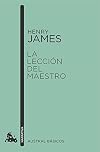
The Lesson of the Master
by Henry James
On This Page
Description
"Exemplifying Henry James's famous belief that ""Art makes life,"" The Lesson of the Master is a piercing study of the life that art makes. When the tale's protagonist a gifted young writer meets and befriends a famous author he has long idolized, he is both repelled by and attracted to the artist's great secret- the emotional costs of a life dedicated to art. With extraordinary psychological insight and devastating wit, the novella asks the question of whether art is, ultimately, demeaning show more or ennobling for the artist, while capturing the ambiguities of a life devoted to art, and the choices artists must make. The expatriate James knew these choice well by the time he published the novella in the Universal Review in 1888, and the work reveals him at the height of his powers." show lessTags
Recommendations















Member Reviews
This was my introduction to Henry James and certainly the beginning of a long relationship. The balance of ornate prose, confident narrative structure, and lovely empathy for his characters makes this one of the best pieces of fiction I have ever read. The plot is important, and it drives the work from beginning to end but what is so extraordinary is that it hinges of the reader's empathy to convey its point. On the surface, it could be told as a vaguely mean story about a young man duped, but compounded with James' grace the story lifts off into a serious meditation on the power discourse underlying celebrity, pedagogy, and the creation of art under capitalist conditions. There is so much to say about this expert piece of fiction (and show more so much of it lofty) yet the experience of reading was as thrilling as ever.
I highly, highly, HIGHLY recommend this to anyone, especially if you haven't read anything by Henry James. I'm utterly floored. show less
I highly, highly, HIGHLY recommend this to anyone, especially if you haven't read anything by Henry James. I'm utterly floored. show less
This was my introduction to Henry James and certainly the beginning of a long relationship. The balance of ornate prose, confident narrative structure, and lovely empathy for his characters makes this one of the best pieces of fiction I have ever read. The plot is important, and it drives the work from beginning to end but what is so extraordinary is that it hinges of the reader's empathy to convey its point. On the surface, it could be told as a vaguely mean story about a young man duped, but compounded with James' grace the story lifts off into a serious meditation on the power discourse underlying celebrity, pedagogy, and the creation of art under capitalist conditions. There is so much to say about this expert piece of fiction (and show more so much of it lofty) yet the experience of reading was as thrilling as ever.
I highly, highly, HIGHLY recommend this to anyone, especially if you haven't read anything by Henry James. I'm utterly floored. show less
I highly, highly, HIGHLY recommend this to anyone, especially if you haven't read anything by Henry James. I'm utterly floored. show less
A very Henry James kind of story, though I stayed convinced of a different hidden motivation until there was no chance of it. Perhaps this could be best summed up as "Don't Meet Your Hero." Young writer Paul meets his idol, who tries to convince him of the best way to be an artist. Does he mean it or is it all a con? In the best way of Henry James, it is all blissfully obscure.
This short novel charmed me. A nice change of pace. It's sensibilities are quite dated but what should one expect for 1888? What it has to say about writers and their creations is probably timeless. James likes to use twenty words where two might do but I suppose that is part of the charm. I think the older author (The Master) really plays a trick on the younger author in the story, but perhaps his advice was sincere to some extent. The younger author was naïve and too much into hero worship to realize he was being played. I think that is all I need to say.
"So, MFA class, what did you think of this?"
"Well, I don't like how he starts it. I mean, we don't really get to know Paul Overt very much, right, and those first few sentences are just so confusing. I mean, who is this guy? Why should I care about him?"
"This strikes me as a bit, I don't know, it's kind of sexist. Like, why can't you have Miss Fancourt take control of her own destiny, because she seems right now like she's just waiting for someone to propose to her."
"You shouldn't write about writers, I think."
"Also, it's like, the lesson of the master seems to be that women get in the way of artistic genius. Is it meant to be homoerotic? I just can't relate to someone who doesn't care about sex. But then, it's also kind of sexist, as show more if women are just getting in the way of good writing. Unless good writing is a metaphor for gay sex? Is that what you're after?"
And so on; I've had bad experiences with MFA fiction over the last couple of weeks, and this is a glorious breath of pre-Hemingwayan competence, subtlety, and ambiguity. Also, great length for an afternoon's read.
And since I am not Henry James, I should say the lesson of the master really is completely ambiguous. Those who favor a simplistic interpretation of it are interpreting themselves, not the text. show less
"Well, I don't like how he starts it. I mean, we don't really get to know Paul Overt very much, right, and those first few sentences are just so confusing. I mean, who is this guy? Why should I care about him?"
"This strikes me as a bit, I don't know, it's kind of sexist. Like, why can't you have Miss Fancourt take control of her own destiny, because she seems right now like she's just waiting for someone to propose to her."
"You shouldn't write about writers, I think."
"Also, it's like, the lesson of the master seems to be that women get in the way of artistic genius. Is it meant to be homoerotic? I just can't relate to someone who doesn't care about sex. But then, it's also kind of sexist, as show more if women are just getting in the way of good writing. Unless good writing is a metaphor for gay sex? Is that what you're after?"
And so on; I've had bad experiences with MFA fiction over the last couple of weeks, and this is a glorious breath of pre-Hemingwayan competence, subtlety, and ambiguity. Also, great length for an afternoon's read.
And since I am not Henry James, I should say the lesson of the master really is completely ambiguous. Those who favor a simplistic interpretation of it are interpreting themselves, not the text. show less
Despite fumbling over some of the more antiquated narrative devices, I found myself immediately invested in the plight of James's protagonist. And at the end of the novella I wondered what the true lesson was, which speaks the elegant rendering of these characters and the routes of the psychological quandaries of the artist.
A young writer, Paul Overt, befriends St. George, a famous master whose later work, while popular, is less artistically strong. Enmeshed in their social dance are St. George’s wife, who it becomes apparent directs the master’s artistic and business life, and Marian Fancourt, a young intellectual beauty who captures Paul’s heart. Revolving around themes of marriage and its effects on the artistic life (anyone care to guess?), The Lesson is a dense, rich novella full of twists and turns. There is a bit of humor here. Particuarlly St. George’s response to Paul’s question of whether the artist is a man - ”I mostly think not.”
What the master wishes for the student: “The sense of having done the best – the sense which is the show more real life of the artist and the absence of which is his death, of having drawn from his intellectual instrument the finest music that nature had hidden in it, of having played it as it should be played.” show less
What the master wishes for the student: “The sense of having done the best – the sense which is the show more real life of the artist and the absence of which is his death, of having drawn from his intellectual instrument the finest music that nature had hidden in it, of having played it as it should be played.” show less
Members
- Recently Added By
Author Information

1,061+ Works 87,953 Members
Awards and Honors
Notable Lists
Series
Belongs to Publisher Series
Work Relationships
Is contained in
Common Knowledge
- Canonical title
- The Lesson of the Master
- First words
- He had been told the ladies were at church, but this was corrected by what he saw from the top of the steps - they descended from a great height in two arms, with a circular sweep of the most charming effect - at the threshol... (show all)d of the door which, from the long bright gallery, overlooked the immense lawn.
- Last words
- (Click to show. Warning: May contain spoilers.)I may say for him, however, that if this event were to occur he would really be the very first to appreciate it: which is perhaps a proof that the Master was essentially right and that Nature had dedicated him to intellectual, not to personal passion.
- Original language
- English
Classifications
Statistics
- Members
- 331
- Popularity
- 95,595
- Reviews
- 10
- Rating
- (3.61)
- Languages
- 5 — English, Italian, Spanish, Swedish, Turkish
- Media
- Paper, Audiobook, Ebook
- ISBNs
- 49
- ASINs
- 10