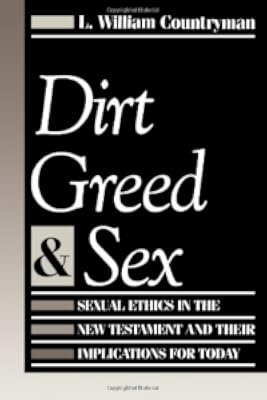
Dirt, Greed, and Sex: Sexual Ethics in the New Testament and Their Implications for Today
by L. William Countryman
On This Page
Description
This revised edition, of the 1988 text, includes updated text and notes throughout, taking advantage of recent studies of sexual ethics and, where appropriate, criticizing them. A new chapter engages the presumed "ethic of creation" that has become a major theme among more conservative thinkers and writers in biblical ethics. A concluding chapter on sex is thoroughly rewritten and offers a positive statement of a New Testament sexual ethic.Tags
Recommendations




Member Reviews
This book really helped me make plausible sense of some of the bits of the New Testament which otherwise can be such an obstruction to us - at least to some of us, who for one reason or another are not deemed to measure up. The thoughtful and textually careful exploration of the framework in which inherited purity rules are rendered meaningless by the implications of the nascent Christian faith is something which doesn't lose its pertinence.
This was a required text for an Episcopalian training
course I went through. I profoundly disgreed wuith the argument that the sexual laws of the OT were part of the purity laws which were scrapped in the NT. However, I thouight Countryman did a more honest job of arguing his position than some modern scholars.
course I went through. I profoundly disgreed wuith the argument that the sexual laws of the OT were part of the purity laws which were scrapped in the NT. However, I thouight Countryman did a more honest job of arguing his position than some modern scholars.
This is a book about sexual ethics. And it begins by asking, "What is this 'dirt' of which it is spoken?" The ancient Israelite purity code placed the male "at the center and was interested in other beings (women) only as they impinged on him." [34] He re-examines the Holiness Code of scripture -- noting that at the heart of it is the "cardinal sin of greed". The secondary part was a purity ethic--avoiding "dirtiness" or impurity.
The author seeks to present a "faithful reading of the pertinent biblical texts, even if that should at times prove uncongenial to one or another group today...". [x] The author admits to a conviction that "Hellenistic philosophy contributed not principles but only details to New Testament sexual ethics." [3] show more In light of interpreters inability to agree, "it is necessary to read scripture anew" -- fresh and careful reading, here offered by Countryman. [1]
Biblically, women are both unclean and contagious. For example, at Mount Sinai, "the people" are to consecrate themselves for the great epiphany and are told not to "go near a woman" (Exod. 19:10-15). [29]
Outside of the very short and ambiguous Holiness code for priests, there is "no condemnation of homosexual acts as such in the Torah". [33]
Countryman underlines the idea/fact that the early Church was indifferent about "dirty"-- choosing to accept all--ALL--of the oppressed, rich and poor, leprous or priestly, during the Golden Age of Rome. [142ff] However, by the 4th century, Christian writers became obsessed with piety and purity. For example, Jerome, who was moved to translate the Scriptures from Greek [Septuagint] to Latin (vulgate). [142] Pietism and revivalism contributed to the propagation of a Purity Code, which is not in the Tanach or Gospels. [142]
Countryman agrees that writers of Scripture framed Sexual Ethics in terms of Purity and Property. [237]. However, he shows how the teachings of the ancient prophets and Jesus was unsystematic in form, and devoted to metanoia, "transformation" of the spirit. [238] Proverbs 5:15-23 is cited as an example where it warns the reader of the wiles of a loose woman, comparing the joy of infatuation with a wife to wasting resources on a courtesan. [165] Countryman notes that the reproof was not for the courtesan, but for the wastrel who visits her. "The modern moralism which attacks the independent female prostitute and says little against those who patronize her is a world removed from the Scriptures of Israel." [166; author acknowledges the condemnation of widows who become prostitutes in the post-prophetic biblical period shown by the Sibylline Oracles 3.43]
Countryman cites historians (Pomeroy, Veyne) for the fact that for a time, "Gentile society was more tolerant of prostitution", often involved with slavery or competing religions. [166] On the Greco-Roman side, the idea of marriage was increasingly spoken of in terms of "friendship". [167, fn 37] Significantly, in the late first and second centuries, medical notions backed by Stoic philosophy, began to discourage intercourse. In the patriarchal world, widows and orphans, who had no connection with a patriarch, were necessarily marginal to the society. This is that Countryman means by speaking of Jesus as revolutionary. His preaching expressly undermined the autonomy of the family and redefined the ownership of sexuality, subordinating all human goods to the reign of God. [167] show less
The author seeks to present a "faithful reading of the pertinent biblical texts, even if that should at times prove uncongenial to one or another group today...". [x] The author admits to a conviction that "Hellenistic philosophy contributed not principles but only details to New Testament sexual ethics." [3] show more In light of interpreters inability to agree, "it is necessary to read scripture anew" -- fresh and careful reading, here offered by Countryman. [1]
Biblically, women are both unclean and contagious. For example, at Mount Sinai, "the people" are to consecrate themselves for the great epiphany and are told not to "go near a woman" (Exod. 19:10-15). [29]
Outside of the very short and ambiguous Holiness code for priests, there is "no condemnation of homosexual acts as such in the Torah". [33]
Countryman underlines the idea/fact that the early Church was indifferent about "dirty"-- choosing to accept all--ALL--of the oppressed, rich and poor, leprous or priestly, during the Golden Age of Rome. [142ff] However, by the 4th century, Christian writers became obsessed with piety and purity. For example, Jerome, who was moved to translate the Scriptures from Greek [Septuagint] to Latin (vulgate). [142] Pietism and revivalism contributed to the propagation of a Purity Code, which is not in the Tanach or Gospels. [142]
Countryman agrees that writers of Scripture framed Sexual Ethics in terms of Purity and Property. [237]. However, he shows how the teachings of the ancient prophets and Jesus was unsystematic in form, and devoted to metanoia, "transformation" of the spirit. [238] Proverbs 5:15-23 is cited as an example where it warns the reader of the wiles of a loose woman, comparing the joy of infatuation with a wife to wasting resources on a courtesan. [165] Countryman notes that the reproof was not for the courtesan, but for the wastrel who visits her. "The modern moralism which attacks the independent female prostitute and says little against those who patronize her is a world removed from the Scriptures of Israel." [166; author acknowledges the condemnation of widows who become prostitutes in the post-prophetic biblical period shown by the Sibylline Oracles 3.43]
Countryman cites historians (Pomeroy, Veyne) for the fact that for a time, "Gentile society was more tolerant of prostitution", often involved with slavery or competing religions. [166] On the Greco-Roman side, the idea of marriage was increasingly spoken of in terms of "friendship". [167, fn 37] Significantly, in the late first and second centuries, medical notions backed by Stoic philosophy, began to discourage intercourse. In the patriarchal world, widows and orphans, who had no connection with a patriarch, were necessarily marginal to the society. This is that Countryman means by speaking of Jesus as revolutionary. His preaching expressly undermined the autonomy of the family and redefined the ownership of sexuality, subordinating all human goods to the reign of God. [167] show less
L. William Countryman laid out an alternative Christian view of sexual ethics that contrasts the fundamentalist ethic commonly perceiver as the Christian sex ethic of today in his book Dirt, Greed, and Sex: Sexual Ethics in the New Testament and their Implications for Today. Countryman used an exegetical reading of Biblical passages on sex, historical scholarship, and rational thought to arrive at his conclusion that the sexual ethics of Christianity should be accepting of non-traditional men and women while not condoning or approving rampant sexuality of any persuasion. The denominations he disagreed with were even named, though not until late in the book.
One need not be a Christian to appreciate his scholarship, but Countryman is show more clear that his intended audience is Christian. While agreement with Countryman’s theology is not necessary to appreciate his scholarship, his arguments are framed within Christian thought and supported by ample biblical readings. The biblical passages cited by Countryman are vital to his argument as the more liberal sexual morality which he uses to condemn certain denominations. While the book is 267 pages in length, Countryman spent the first 236 pages in scholastic discussion of the context of Christian and Jewish sexual ethics from both the Old and New Testaments.
Old Testament purity preceded Net Testament purity. Property ethics were explained in the same pattern. Old Testament then New Testament ethics were explained in this manner to give context for the early Christian ethics since Christianity was originally a sect within Judaism. Understanding the early Christian views is impossible without first understanding the Jewish views out of which grew the Christian views. Understanding what the church fathers’ views were and why they held those views is vital to Countryman’s arguments about Christian sexual ethics in contemporary society.
Countryman’s explanation of both Testaments’ sexual ethics ties the ethics to purity and property. For the first section, Dirt, the purity codes of the Old and New Testament were explored, beginning with the question of “What is Purity?” Matter out of place in regards to humans is the functional definition of dirt used by Countryman. While differing cultures decide which matter is out of place, all agree that the boundaries are the body, particularly the orifices. American purity codes also required exploration as Countryman found them powerful yet incoherently fragmented due to purity rules being taught early then the teaching is forgotten and the rules regarded as “self-evident.”
While Jews under Hellenic rule adopted some degree of Hellenic ways it is clear the Jews held themselves apart from their neighbors. That Torah was law both for the religion of and people of Israel. There was no distinction between their national and religious identity. The purity codes were incorporated into the Torah around 587 BCE, possibly as a result of the Babylonian exile. Two purity codes were identified by Countryman, the first in Leviticus 11-16 and the second, Holiness Code in Leviticus 17-26. Differentiation between the codes is by the Holiness Code stressing differentiation while the other code also gives methods for purification.
A scholastic explanation for much of the biblical codes includes pointing out differing translations. Countryman interprets bestiality as “confusion” rather than perversion because it attempts to mix two different “perfections,” animal and man. Likewise, homosexuality violates Levitical purity by the receptive man taking on female traits by being penetrated and was punishable by death under the Holiness Code. While Countryman mentioned prohibitions against male homosexuality, he observed in a footnote that the Bible is silent on the matter of female homosexuality.
Adultery was a case of a property violation that was assimilated into the purity code. One man’s property (the wife) was taken by another, rendering any future children suspect and of uncertain origin. The capacity to bear children that had been “consecrated” to one man was violated by another. A man could only commit adultery if the woman he bedded was married to another man. A slave woman’s virginity also was a matter of property. If she was betrothed to another and her master raped her, the master would owe her betrothed a sum of money.
“The purity code of the written code had no great interest in intention. Purity and impurity were simply facts: Play with mud and you will get dirty.” First century Judaism and its various sects were discussed between Countryman’s discussions of the Old and New Testaments’ purity codes. The four sects mentioned by him are the Pharisees, Essenes, Sadducees, and the “Fourth Philosophy.” All but the Fourth Philosophy received discussion.
Consensus regarding purity within the New Testament is not present. The first position Countryman examined was Acts and the decision to admit gentiles into the church. The Gospels were examined, with such notions as the purity of all foods, the purity of sex if it lacks harmful intent, and Jesus’ attack on the Pharisees for concern over outer purity rather than inner purity. Paul is the focus of much exposition with the conclusion that sexual purity was a spiritual purity.
Property codes receive the same treatment by Countryman. Ancient Hebrew views of property held that the wife was her husband’s property. Such property views were extended to daughters, concubines, and slaves. In the vein of property, adultery is a violation of only the husband’s property rights over the wife. An important property code change within the New Testament is that the wife has authority over her husband’s body just as the husband has authority over his wife’s body.
Countryman’s intended audience was Christians who may or may not have the scholastic or exegetical background. For them he spent a majority of the book explaining the context of biblical purity and property notions. His scholarship includes the likes of Walter Burkert, a Greek historian and one footnotes offers an alternative interpretation of Paul’s writings. The Book of Jude’s exegesis included text non canonical, 1 Enoch, due to the author of Jude viewing it as such.
Countryman concluded with a statement that his book should act as a beginning to new discussions on Christian sexual ethics. He ends with six principles to guide Christians in their decisions on sexual ethics as well:
1. Membership in the Christian community is in no way limited by purity codes.
2. Christians must respect the sexual property of others and practice detachment from their own.
3. Where in late antiquity, sexual property belonged to the family through the agency of the male householder, in our own era it belongs to the individual.
4. The gospel can discern no inequality between men and women as they stand before God’s grace.
5. Marriage creates a union of flesh, normally indissoluble except by death.
6. The Christian’s sexual life and property are always subordinate to the reign of God.
Some groups within Christianity were named by Countryman as having un-Christian sexual ethics, Roman Catholics, Southern Baptists, Evangelicals, Pentecostals, and Charismatics for differing reasons.
Through scholarship, exegesis, and reason, Countryman argues for a more open, liberal understanding of sexual ethics. Additionally, he advocated one not blindly accepting one’s church’s sexual ethics. While one may not agree with his overall premise of the spiritual truth of the Christian faith, one can find little fault in how Countryman uses Christian text to argue for his sexual ethics. show less
One need not be a Christian to appreciate his scholarship, but Countryman is show more clear that his intended audience is Christian. While agreement with Countryman’s theology is not necessary to appreciate his scholarship, his arguments are framed within Christian thought and supported by ample biblical readings. The biblical passages cited by Countryman are vital to his argument as the more liberal sexual morality which he uses to condemn certain denominations. While the book is 267 pages in length, Countryman spent the first 236 pages in scholastic discussion of the context of Christian and Jewish sexual ethics from both the Old and New Testaments.
Old Testament purity preceded Net Testament purity. Property ethics were explained in the same pattern. Old Testament then New Testament ethics were explained in this manner to give context for the early Christian ethics since Christianity was originally a sect within Judaism. Understanding the early Christian views is impossible without first understanding the Jewish views out of which grew the Christian views. Understanding what the church fathers’ views were and why they held those views is vital to Countryman’s arguments about Christian sexual ethics in contemporary society.
Countryman’s explanation of both Testaments’ sexual ethics ties the ethics to purity and property. For the first section, Dirt, the purity codes of the Old and New Testament were explored, beginning with the question of “What is Purity?” Matter out of place in regards to humans is the functional definition of dirt used by Countryman. While differing cultures decide which matter is out of place, all agree that the boundaries are the body, particularly the orifices. American purity codes also required exploration as Countryman found them powerful yet incoherently fragmented due to purity rules being taught early then the teaching is forgotten and the rules regarded as “self-evident.”
While Jews under Hellenic rule adopted some degree of Hellenic ways it is clear the Jews held themselves apart from their neighbors. That Torah was law both for the religion of and people of Israel. There was no distinction between their national and religious identity. The purity codes were incorporated into the Torah around 587 BCE, possibly as a result of the Babylonian exile. Two purity codes were identified by Countryman, the first in Leviticus 11-16 and the second, Holiness Code in Leviticus 17-26. Differentiation between the codes is by the Holiness Code stressing differentiation while the other code also gives methods for purification.
A scholastic explanation for much of the biblical codes includes pointing out differing translations. Countryman interprets bestiality as “confusion” rather than perversion because it attempts to mix two different “perfections,” animal and man. Likewise, homosexuality violates Levitical purity by the receptive man taking on female traits by being penetrated and was punishable by death under the Holiness Code. While Countryman mentioned prohibitions against male homosexuality, he observed in a footnote that the Bible is silent on the matter of female homosexuality.
Adultery was a case of a property violation that was assimilated into the purity code. One man’s property (the wife) was taken by another, rendering any future children suspect and of uncertain origin. The capacity to bear children that had been “consecrated” to one man was violated by another. A man could only commit adultery if the woman he bedded was married to another man. A slave woman’s virginity also was a matter of property. If she was betrothed to another and her master raped her, the master would owe her betrothed a sum of money.
“The purity code of the written code had no great interest in intention. Purity and impurity were simply facts: Play with mud and you will get dirty.” First century Judaism and its various sects were discussed between Countryman’s discussions of the Old and New Testaments’ purity codes. The four sects mentioned by him are the Pharisees, Essenes, Sadducees, and the “Fourth Philosophy.” All but the Fourth Philosophy received discussion.
Consensus regarding purity within the New Testament is not present. The first position Countryman examined was Acts and the decision to admit gentiles into the church. The Gospels were examined, with such notions as the purity of all foods, the purity of sex if it lacks harmful intent, and Jesus’ attack on the Pharisees for concern over outer purity rather than inner purity. Paul is the focus of much exposition with the conclusion that sexual purity was a spiritual purity.
Property codes receive the same treatment by Countryman. Ancient Hebrew views of property held that the wife was her husband’s property. Such property views were extended to daughters, concubines, and slaves. In the vein of property, adultery is a violation of only the husband’s property rights over the wife. An important property code change within the New Testament is that the wife has authority over her husband’s body just as the husband has authority over his wife’s body.
Countryman’s intended audience was Christians who may or may not have the scholastic or exegetical background. For them he spent a majority of the book explaining the context of biblical purity and property notions. His scholarship includes the likes of Walter Burkert, a Greek historian and one footnotes offers an alternative interpretation of Paul’s writings. The Book of Jude’s exegesis included text non canonical, 1 Enoch, due to the author of Jude viewing it as such.
Countryman concluded with a statement that his book should act as a beginning to new discussions on Christian sexual ethics. He ends with six principles to guide Christians in their decisions on sexual ethics as well:
1. Membership in the Christian community is in no way limited by purity codes.
2. Christians must respect the sexual property of others and practice detachment from their own.
3. Where in late antiquity, sexual property belonged to the family through the agency of the male householder, in our own era it belongs to the individual.
4. The gospel can discern no inequality between men and women as they stand before God’s grace.
5. Marriage creates a union of flesh, normally indissoluble except by death.
6. The Christian’s sexual life and property are always subordinate to the reign of God.
Some groups within Christianity were named by Countryman as having un-Christian sexual ethics, Roman Catholics, Southern Baptists, Evangelicals, Pentecostals, and Charismatics for differing reasons.
Through scholarship, exegesis, and reason, Countryman argues for a more open, liberal understanding of sexual ethics. Additionally, he advocated one not blindly accepting one’s church’s sexual ethics. While one may not agree with his overall premise of the spiritual truth of the Christian faith, one can find little fault in how Countryman uses Christian text to argue for his sexual ethics. show less
Ratings
Members
- Recently Added By
Author Information
23+ Works 1,281 Members
L. William Countryman is professor emeritus of New Testament at the Church Divinity School of the Pacific, Berkeley, California. He is the author of several books in biblical studies and spirituality, including the most recent Lovesongs Reproaches: Passionate Conversations with God in 2010 and Calling on the Spirit in Unsettling Times in 2011-both show more by Morehouse Publishing. show less
Common Knowledge
- Blurbers
- Stone, Howard; Borsch, Frederick H.; Hunt, George N.
Classifications
- Genres
- Religion & Spirituality, Nonfiction, General Nonfiction, History
- DDC/MDS
- 241.6609015 — Religion Christian practice & observance Christian ethics Christian ethics not otherwise covered Christian sexual ethics
- LCC
- BS2545 .S36 .C68 — Philosophy, Psychology and Religion The Bible The Bible New Testament Works about the New Testament
- BISAC
Statistics
- Members
- 264
- Popularity
- 123,282
- Reviews
- 4
- Rating
- (4.00)
- Languages
- English
- Media
- Paper, Ebook
- ISBNs
- 9
- ASINs
- 6