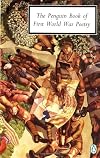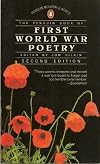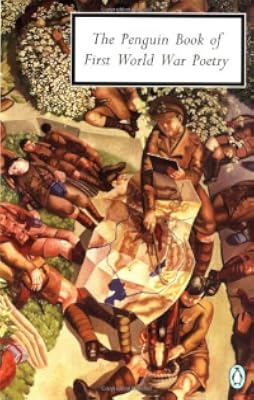
The Penguin Book of First World War Poetry
by Jon Silkin (Editor)
On This Page
Description
A selection of poetry written during World War I. In the introduction Jon Silkin traces the changing mood of the poets - from patriotism through anger and compassion to an active desire for social change. The book includes work by Sassoon, Owen, Blunden, Rosenberg, Hardy and Lawrence.Tags
Recommendations



















Member Reviews
I'm not technically "finished", but I don't know why I ever expected myself to pick this up and read it through like a novel. In this second edition (a third edition, finished in 2007, is available as well), George Walter has supplied the hits (Brooke, McCrae, Owens), as well as expanding on his favourites (Edward Thomas, Blunden, Rosenberg), while not forgetting to include those voices who had been forgot hitherto (Ungaretti, a host of women, etc.).
The collection is sobering, powerful, and breathtaking in its variation. War is awful, who'd've thought? While not a comparison, when I struggled with PTSD and the emotional fallout of it, I often struggled to articulate the blinding pain I constantly felt, even in a medium like poetry. show more These poets who could capture that feeling in their work naturally feel very close to me then, and while I'll never produce like them, I appreciate the small, shared understanding of no understanding at all. I fell particular in love with some of the poets only represented by a poem or two, and has inspired me to look at them further, as any anthology is wont to do.
Unfortunately, I've been reading on-and-off a library copy the past three months, but I recommend buying this or the newer edition if interested. Walter's introduction was equal-parts stuffy and hilarious, probably owing to his stuffiness. I couldn’t understand it by the midpoint and it seems to have been written to a more expert audience versed in the philosophies of poetry, of which I am not a part of. Definetly a must-peruse for those interested in WWI though. You can't read this through like any old book: the emotional intensity, to be truly experienced, leaves one chewing on a few pages for days. show less
The collection is sobering, powerful, and breathtaking in its variation. War is awful, who'd've thought? While not a comparison, when I struggled with PTSD and the emotional fallout of it, I often struggled to articulate the blinding pain I constantly felt, even in a medium like poetry. show more These poets who could capture that feeling in their work naturally feel very close to me then, and while I'll never produce like them, I appreciate the small, shared understanding of no understanding at all. I fell particular in love with some of the poets only represented by a poem or two, and has inspired me to look at them further, as any anthology is wont to do.
Unfortunately, I've been reading on-and-off a library copy the past three months, but I recommend buying this or the newer edition if interested. Walter's introduction was equal-parts stuffy and hilarious, probably owing to his stuffiness. I couldn’t understand it by the midpoint and it seems to have been written to a more expert audience versed in the philosophies of poetry, of which I am not a part of. Definetly a must-peruse for those interested in WWI though. You can't read this through like any old book: the emotional intensity, to be truly experienced, leaves one chewing on a few pages for days. show less
BTW the Introduction by Jon Silkin is excellent. It’s not just a couple of pages, it’s almost a third of the book (77 pages in a book of 282 pages, though that includes the indexes and the bibliography.) He talks about the issue of evaluating the war poets for their explicit ideas, even if we disagree (as to militarism, patriotism, pacifism and so on) and his schema consists of two parts:
•… an arrangement, or progression, of poets according to a developing consciousness, in relation to the war and the ‘good’ of society as a whole
•…an attempt to group poets in terms of sensibility and language.
He places the war poets in context with the preceding Romantic poets, and he identifies four stages of consciousness:
•… a show more passive reflection of, or conduit for, the prevailing patriot ideas, and the cant that’s contingent on most social abstract impulsions.
•…’the role of the angry prophet’, protesting against the war through the recreation of physical horror, through anger and satire, and through sardonic distancing.
•…’compassion’ – with strength of feeling
•…’an active desire for change, a change that will re-align the elements of human society in such a way as to make it more creative and fruitful.
This is a very good collection, thoughtfully arranged and inclusive of both sides of the conflict.
To see the rest of my review please visit https://anzlitlovers.com/2018/04/25/the-penguin-book-of-first-world-war-poetry-e... show less
•… an arrangement, or progression, of poets according to a developing consciousness, in relation to the war and the ‘good’ of society as a whole
•…an attempt to group poets in terms of sensibility and language.
He places the war poets in context with the preceding Romantic poets, and he identifies four stages of consciousness:
•… a show more passive reflection of, or conduit for, the prevailing patriot ideas, and the cant that’s contingent on most social abstract impulsions.
•…’the role of the angry prophet’, protesting against the war through the recreation of physical horror, through anger and satire, and through sardonic distancing.
•…’compassion’ – with strength of feeling
•…’an active desire for change, a change that will re-align the elements of human society in such a way as to make it more creative and fruitful.
This is a very good collection, thoughtfully arranged and inclusive of both sides of the conflict.
To see the rest of my review please visit https://anzlitlovers.com/2018/04/25/the-penguin-book-of-first-world-war-poetry-e... show less
My experience with poetry anthologies is limited as an adult reader. Given my pleasant experience with this volume, that is likely to change. Over the last few years while browsing poetry sections I have discovered that this anthology is near ubiquitous. I feel grateful I finally approached it. I would be curious about corresponding verse from Turkey and the Balkans.
I discovered a few new poets I’ll approach again and my estimations of Sassoon, Owen and Blunden were undoubtedly confirmed.
I discovered a few new poets I’ll approach again and my estimations of Sassoon, Owen and Blunden were undoubtedly confirmed.
Some very dark and haunting poetry that encapsulates the WW1 experience. More illuminating that any other work on WW1 I have read/seen yet. Amazing.
The Penguin Book of First World War Poetry (Second edition) edited by Jon Silkin and David McDuff is a collection of poetry from and about the WWI. Silkin and McDuff increased the number of poems in translation included in the collection. There are poems translated from German, French, Italian, Russian, and Hebrew, and Silkin was a poet himself. As expressed in the not at the beginning, “For some, war was moral athletics; others looked forward to the experience of war as a ‘vacation from life’ — a vacation from a society disjoined by class and constrained by the rigid structures of labour.” (page 12)
Read the full review: http://savvyverseandwit.com/2012/11/the-penguin-book-of-first-world-war-poetry-s...
Read the full review: http://savvyverseandwit.com/2012/11/the-penguin-book-of-first-world-war-poetry-s...
"
The Soldier’s Death
By Anne, Countess of Winchilsea (1660–1720)
TRAIL all your pikes, dispirit every drum,
March in a slow procession from afar,
Ye silent, ye dejected men of war!
Be still the hautboys, and the flute be dumb!
Display no more, in vain, the lofty banner;
For see! where on the bier before ye lies
The pale, the fall’n, the untimely sacrifice
To your mistaken shrine, to your false idol Honour. "
The Soldier’s Death
By Anne, Countess of Winchilsea (1660–1720)
TRAIL all your pikes, dispirit every drum,
March in a slow procession from afar,
Ye silent, ye dejected men of war!
Be still the hautboys, and the flute be dumb!
Display no more, in vain, the lofty banner;
For see! where on the bier before ye lies
The pale, the fall’n, the untimely sacrifice
To your mistaken shrine, to your false idol Honour. "
Early works – for young kids
Members
- Recently Added By
Lists

You Couldn't Pay Me to Read That (Take 2)
203 works; 86 members

Reading List: Books for Insomniacs
17 works; 4 members

University literature
145 works; 5 members

Literary Works Read in College
316 works; 15 members
Author Information

Series
Belongs to Publisher Series
Common Knowledge
- Canonical title
- The Penguin Book of First World War Poetry
- Original publication date
- 1979
- Important events
- World War I (1914 | 1918)
- Epigraph
- Reconciliation
Word over all, beautiful as the sky,
Beautiful that war and all its deeds of carnage must in time be utterly lost,
That the hands of the sisters Death and Night incessantly
softly wash again, an... (show all)d ever again, this soil'd world;
For my enemy is dead, a man divine as myself is dead,
I look where he lies white-faced and still in the coffin - I draw near,
Bend down and touch lightly with my lips the white face in the coffin.
--From Drum Taps, Walt Whitman - First words
- Introduction: Even compassion must now be circumspect, for if it doesn't try to do away with, or limit, the war that causes the suffering, it's indulgent.
That night your great guns, unawares,
Shook all our coffins as we lay,
And broke the chancel window-squares,
We thought it was the Judgment-day
And sat upright. - Last words
- (Click to show. Warning: May contain spoilers.)Oh that I could shrink the surface of the World,
So that suddenly I might find you standing at my side! - Disambiguation notice
- This is the Jon Silkin selection. Please do not combine with the George Walter selection.
Classifications
- Genres
- Poetry, Fiction and Literature
- DDC/MDS
- 808.819358 — Literature & rhetoric Literature, rhetoric & criticism Rhetoric and collections of literary texts from more than two literatures Literature Collections Collections of poetry Thematic anthologies
- LCC
- PN6110 .W28 .P46 — Language and Literature Literature (General) Literature (General) Collections of general literature German Poetry
- BISAC
Statistics
- Members
- 712
- Popularity
- 39,960
- Reviews
- 7
- Rating
- (4.07)
- Languages
- English
- Media
- Paper
- ISBNs
- 7
- ASINs
- 7