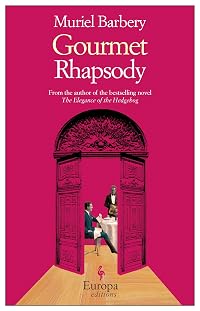
The Gourmet
by Muriel Barbery
On This Page
Description
A great food critic who can make or destroy the reputation of a chef with a stroke of his pen, Pierre Arthens faces his imminent death by trying to recall the one perfect flavor he sampled in his youth, a flavor that he believes forms the ultimate truth of his life.Tags
Recommendations


























Member Reviews
Precedente di sei anni il più noto "L'eleganza del riccio" e ambientato nello stesso palazzo parigino, questo "Estasi culinarie" è stato ripubblicato in Italia con questo titolo dopo il successo del bestseller. Le differenze tra le due opere sono marcate, tanto che questo potrebbe deludere chi ha amato "Il riccio": manca sicuramente la drammaticità delle vicende, come anche sono assenti le interazioni profonde tra i vari personaggi. Eppure "Estasi culinarie" non mi è affatto dispiaciuto, pur nella sua stasi che ricorda il teatro greco, con unità di tempo, di luogo e di azione, e nel suo svolgimento sulla scia dei ricordi più che delle azioni. Un letto di morte, una sentenza inappellabile che condanna il noto critico culinario show more Monsieur Arthens a poche ore e che porta inevitabilmente a un bilancio della sua vita da parte propria e di chi l'ha conosciuto. Sentenze dolorose, talvolta inappellabili, accomunate da una tragica incomprensione. Da un lato lui, la superstar della gastronomia, incarnazione del nicciano concetto di Superuomo, incapace di vedere gli altri come qualcosa di diverso da satelliti dipendenti da lui. Le uniche emozioni vere le prova a tavola, dove la sua esperienza si trasforma ai limiti della sinestesia, in un crogiolo di sensazioni che coinvolgono contemporaneamente i cinque sensi. E un sesto senso meriterebbe di essere creato appositamente, ovvero quello stuzzicato dalle parole scritte che così abilmente portano il lettore a provare le stesse sensazioni preziose e raffinate che evoca Arthens. Non è solo la classica "acquolina in bocca" a sopraggiungere, ma si va ben oltre - ed "estasi" diventa un termine davvero azzeccato. Dall'altro lato, ecco una sfilata di personaggi che hanno avuto la (s)fortuna di incrociare la propria strada con quella di Arthens: moglie, figli, nipoti, semplici conoscenti - ognuno ha una parola per il moribondo, non sempre colma della clemenza che viene riservata a chi se ne sta andando. Anzi, talvolta il livore sembra aumentare all'idea dell'inevitabile, come se anche in questa ultima tappa il critico volesse dimostrare la propria superiorità sul mondo. In comune con "Il riccio", "Estasi" ha le solitudini dei suoi personaggi: ma mentre nel primo avviene una sublimazione tramite un contatto, un'amicizia spesso assurda e inspiegabile, qui l'isolamento è totale. Non c'è comunicazione, non c'è reciprocità, non c'è scontro: solo una serie di unità che si osservano come pesci rossi che nuotano ciascuno nella propria boccia. Eppure la catarsi arriva, insolita e curiosa, proprio grazie a quel sapore misterioso che Arthens rincorre lungo la scia dei ricordi - quello che vorrebbe risentire un'ultima volta prima della fine ma che, ironia del caso, proprio non riesce a riportare alla mente. È questo lo spunto che dà il via al romanzo, una curiosità, quel "ce l'ho sulla punta della lingua" capace di portare alla follia se non si riesce a trovarne la definizione corretta. In queste scorribande nel gusto, si ritrovano spunti interessanti sul perché e sul come della cucina - quella buona, non perché sana o particolarmente gustosa, ma perché tramite di un messaggio che per essere recepito necessita di tutti i cinque sensi. Quella cucina delle nonne che oggi, a suon di fast food, abbiamo dimenticato; quella che dà un ruolo magico alla donna di casa, tramite di sentimenti e sensazioni, punto di equilibrio discreto e fermo. Vien davvero voglia di riprendere a cucinare come si deve, mettendoci di più ma facendolo con più gusto, per riscoprire sensazioni dimenticate nella fretta; vien voglia di spegnere la tv e di gustare in silenzio le pietanze, riprendendo un contatto familiare che rischia di perdersi. show less
Although translated one year after The Elegance of the Hedgehog, this is actually Muriel's first book and was published in French 6 years before. And that's why i read it first.
I'm in two frames of mind about this book, my first one is that it's an incredibly well written descriptive narrative that i thoroughly enjoyed, especially being a life long foody myself, to the point i found myself happily picking it up at every spare minute to read some more. However, my other frame of mind comes from my utter contempt for people who look at food as a medium for art when the best part of i billion people don't get enough calories every day while many many more get absolutely no choice what to eat and very rarely have access to a full show more range of essential nutrients. At the same time, over 1 billion other people in the privileged developed world gorge themselves on highly processed foods to an obesity epidemic (creating an obscene amount of waste while doing so). A system of food preparation, presentation, advertising and marketing that caters for nothing but a ridiculous conception of what good food is. This system being pushed wholesale through advertising and television cookery programs: Master Chef being a prime example.
Good food is as it comes from the ground with the most minimal processing, just enough processing to maximise the digestion of the nutrients, and each meal should aim to be completely nutritionally balanced. Instead we have these so called master chefs, critics and their sycophants parading food on television that bears no resemblance to reality, is nutritionally corrupt in the extreme and does nothing but titillate people's mouths and give them a spike of neurotransmitters that they fallaciously perceive as delicious while fuelling a pandemic of obesity and chronic diseases, causing years of suffering before sending them all to an early grave.
So yeah, i loved the writing and enjoyed reading it, but i really hated the main protagonist's attitude to food, life and everything: the only thing he didn't treat with utter contempt was his own gluttony and i was quite pleased when he died without the choux pastry he wanted so much.
Anyways, i'm certainly looking forward to reading The Elegance of the Hedgehog. show less
I'm in two frames of mind about this book, my first one is that it's an incredibly well written descriptive narrative that i thoroughly enjoyed, especially being a life long foody myself, to the point i found myself happily picking it up at every spare minute to read some more. However, my other frame of mind comes from my utter contempt for people who look at food as a medium for art when the best part of i billion people don't get enough calories every day while many many more get absolutely no choice what to eat and very rarely have access to a full show more range of essential nutrients. At the same time, over 1 billion other people in the privileged developed world gorge themselves on highly processed foods to an obesity epidemic (creating an obscene amount of waste while doing so). A system of food preparation, presentation, advertising and marketing that caters for nothing but a ridiculous conception of what good food is. This system being pushed wholesale through advertising and television cookery programs: Master Chef being a prime example.
Good food is as it comes from the ground with the most minimal processing, just enough processing to maximise the digestion of the nutrients, and each meal should aim to be completely nutritionally balanced. Instead we have these so called master chefs, critics and their sycophants parading food on television that bears no resemblance to reality, is nutritionally corrupt in the extreme and does nothing but titillate people's mouths and give them a spike of neurotransmitters that they fallaciously perceive as delicious while fuelling a pandemic of obesity and chronic diseases, causing years of suffering before sending them all to an early grave.
So yeah, i loved the writing and enjoyed reading it, but i really hated the main protagonist's attitude to food, life and everything: the only thing he didn't treat with utter contempt was his own gluttony and i was quite pleased when he died without the choux pastry he wanted so much.
Anyways, i'm certainly looking forward to reading The Elegance of the Hedgehog. show less
Pierre Arthens, the famous food critic from Barbery’s second novel, The Elegance of the Hedgehog, is very close to death. He remains in his bed throughout Gourmet Rhapsody. His family is little comfort, as he has been of little comfort to them in his life. Arthens doesn’t love his children. “I have never loved them, and I feel no remorse on that account.” He ignores his wife, Anna, but she loves the “charmer with insane, miraculous talent ; a prince, a lord constantly hunting outside his own walls.” As one of his mistresses says: “No doubt about it, he was a regular bastard.”
Arthen’s only wish in his last hours is one last taste of a food he can’t quite name, a “lost flavor,” “the buried flavor that I cannot show more find.” Although his love of food stems from his grandmother’s cooking, “under the influence of her expert hands, the most banal substances were transformed into miracles of faith,” all of his passion was directed to the sensation and taste of food, none was left for his family.
Chapters alternate between Arthens remembering past meals, tastes, and cooks from his life; and his family, mistresses and employees offering their opinions on Arthens and his impending death.
As with Hedgehog, the translation by Alison Anderson is sublime. The writing about food is lyrical. “The raw tomato, devoured in the garden when freshly picked, is a horn of abundance of simple sensations, a radiating rush in one’s mouth that brings with it every pleasure.” A rare whiskey has “such formidable aggressiveness, such a muscular, abrupt explosion, dry and fruity at the same time.” Sashimi is “neither matter nor water,” “a fragment of the cosmos within reach of one’s heart.” show less
Arthen’s only wish in his last hours is one last taste of a food he can’t quite name, a “lost flavor,” “the buried flavor that I cannot show more find.” Although his love of food stems from his grandmother’s cooking, “under the influence of her expert hands, the most banal substances were transformed into miracles of faith,” all of his passion was directed to the sensation and taste of food, none was left for his family.
Chapters alternate between Arthens remembering past meals, tastes, and cooks from his life; and his family, mistresses and employees offering their opinions on Arthens and his impending death.
As with Hedgehog, the translation by Alison Anderson is sublime. The writing about food is lyrical. “The raw tomato, devoured in the garden when freshly picked, is a horn of abundance of simple sensations, a radiating rush in one’s mouth that brings with it every pleasure.” A rare whiskey has “such formidable aggressiveness, such a muscular, abrupt explosion, dry and fruity at the same time.” Sashimi is “neither matter nor water,” “a fragment of the cosmos within reach of one’s heart.” show less
Sumptuous language (in French) but not much substance. A not-so-nice celebrity food and restaurant critic lies on his death bed, searching for an illusive taste experience from the past. In his search, he combs through various episodes and relationships from his life that might reveal the hidden treasure. Such memories are interwoven with views of the dying man from the perspective of everyone from the concierge to a statue of Venus in his study. Of course, passing by way of all the affected and disaffected members of his family and entourage (including the pets). In the moments just before death, when the man finally recalls the gourmandise that he has been yearning for, the pay-off for the reader is negligible. Addendum: the other show more members of my French book group appreciated this novel quite a bit more than I did, so much so that I'm tempted to revise my opinion and award the book another star. [After rereading the novel for a class, I'm awarding it one more star, based on an even greater appreciation of the language. My estimation of the novel as novel, however, remains the same. If the point of the novel is that it's the simple joys that make life meaningful or that one can only make sense of one' s life if one returns to childhood to rediscover what really mattered then, then the book's message is simply a cliche. I prefer to see the book's intentions as ironic. Yes, the dying food critic finally remembers the "savour" that he has been searching his memory for and it turns out to be that of supermarket chouquettes, an industrial pastry. It is quite "juste" that what he rediscovers as his purest joy turns out to be something artificial, of little value, in keeping with his failure to love and to value his wife, children, lovers, etc or to make good use of his talents. His joys, in essence, have always been artificial or misguided ones. He dies as he has lived. So his god turns out to be a chouqette. So what? I don't see any redemption in this. I think the author has been poking sharp fun at the academic and literary establishment all along. Of course, I could be dead wrong. Perhaps her aims were serious ones, in which case, she succeeded in expressing cliches in very sumptuous language. Bravo for the language, but I'd rather the irony, the poke in the eye.:] show less
“I am going to die and there is a flavor that has been teasing my taste buds and my heart and I simply cannot recall it.”
So mourns renowned (and reviled) French food critic Pierre Arthens, who’s on his literal deathbed and desperate for a final taste of a food that he can’t recall except to know that it changed his life. He proceeds into a series of ruminations that take him back through his most important food experiences -- and in the process reveal his arrogance and unlikeability -- each memory alternating with ultra-short, eulogy-like reminiscences by more than a dozen of his relatives, acquaintances, and pet :)
The narrative structure brings to mind the numerous points of view in Anita Shreve’s Testimony, although this show more narrative does not benefit from the forward movement of an underlying story as Shreve's did. Indeed, it took me days to finish this short novella, and I learned to not put it aside when I was in Monsieur Arthens’ point of view because I’d delay picking it up again. Thankfully, the other narrators add a lively, interesting and sympathetic balance. In the end, I’m happy to have persevered and finished, because in the final pages Monsieur Arthens’ food descriptions finally move from intellectual to sensual, prompting me to compile tasting goals of my own.
(Note: This novella was first published in 2000, before Barbery's The Elegance of the Hedgehog; it's been translated and published in the US in 2009, following the success of Hedgehog.) show less
So mourns renowned (and reviled) French food critic Pierre Arthens, who’s on his literal deathbed and desperate for a final taste of a food that he can’t recall except to know that it changed his life. He proceeds into a series of ruminations that take him back through his most important food experiences -- and in the process reveal his arrogance and unlikeability -- each memory alternating with ultra-short, eulogy-like reminiscences by more than a dozen of his relatives, acquaintances, and pet :)
The narrative structure brings to mind the numerous points of view in Anita Shreve’s Testimony, although this show more narrative does not benefit from the forward movement of an underlying story as Shreve's did. Indeed, it took me days to finish this short novella, and I learned to not put it aside when I was in Monsieur Arthens’ point of view because I’d delay picking it up again. Thankfully, the other narrators add a lively, interesting and sympathetic balance. In the end, I’m happy to have persevered and finished, because in the final pages Monsieur Arthens’ food descriptions finally move from intellectual to sensual, prompting me to compile tasting goals of my own.
(Note: This novella was first published in 2000, before Barbery's The Elegance of the Hedgehog; it's been translated and published in the US in 2009, following the success of Hedgehog.) show less
I know this is my pre-teen, Nancy-Drew-loving self that is saying this, but I will say it anyway: I hope Muriel Barbery writes a book about EVERY SINGLE PERSON at 17 Rue de Grenelle. I loved _The Elegance of the Hedgehog_, and was enchanted to find this new novel by Barbery. This one which concerns Pierre Arthens, who makes one supremely unpleasant visit to the heroine of _Hedgehog_ before dying and leaving his flat vacant. Let me say upfront: He is unpleasant in this one too. But this time we spend a few days in his mind and memory, and it is distressing, but fascinating too.
Pierre is a food critic - THE premier food critic of France - and his memories and longings are couched in the same lush, sensuous prose that he has used to show more describe food in his long career. But as the novel proceeds, the reader comes to see that Pierre's undoubted verbal skills have been used not to reveal the truth, but to hide it; his words create exquisite cages that confine, conceal, and perhaps ultimately smother the simple truth at the core.
Hm, pretty fancy words I'm using there. I don't want to be nasty Pierre Arthens, so I will just say: I liked this idea. And I liked the way Barbery never had to state it, because her characters acted it out for her. Skillful. I like that. And the marvelous descriptions of foods both complex and simple were quite mouthwatering. show less
Pierre is a food critic - THE premier food critic of France - and his memories and longings are couched in the same lush, sensuous prose that he has used to show more describe food in his long career. But as the novel proceeds, the reader comes to see that Pierre's undoubted verbal skills have been used not to reveal the truth, but to hide it; his words create exquisite cages that confine, conceal, and perhaps ultimately smother the simple truth at the core.
Hm, pretty fancy words I'm using there. I don't want to be nasty Pierre Arthens, so I will just say: I liked this idea. And I liked the way Barbery never had to state it, because her characters acted it out for her. Skillful. I like that. And the marvelous descriptions of foods both complex and simple were quite mouthwatering. show less
Where I got the book: from The Book Depository.
After my tear-soaked, ecstatic reaction to The Elegance of the Hedgehog, I was eager to read Une Gourmandise (I had it in its original French) or Gourmet Rhapsody if you're reading the translation. It's Barbery's first novel (Elegance is the second and last to date, the first to be published) and deals with the same apartment building in Paris. This time it's about the penthouse tenant, the food critic Pierre Arthens, who is dying and searching through his memories for an elusive taste he feels compelled to recall before he dies.
As Arthens shuffles through a number of memorable occasions in which food has played an important part, he reveals the essence of himself; his appreciation of the show more simplicity and honesty of authentic meals and authentic lives, but also his cruelty toward his wife and children who fail to understand who he really is. Without ever having it explicitly laid out, you get the impression that he hates his own success for pulling him ever farther away from what he sees as his real self, and hates the Parisian trappings of success; hence he has nothing but coldness and contempt for those around him, who are all given their own voices as they wait--some eagerly--for him to die.
As others have pointed out, the great artist who's a failure as a human being is nothing new. But Barbery's language is luminous, and if this book doesn't have nearly as much punch and pathos as Elegance, it also doesn't have nearly as much of the philosophizing that some readers find hard to stomach (pun intended). I'd give it a 3.5 for being a short, elegant read. show less
After my tear-soaked, ecstatic reaction to The Elegance of the Hedgehog, I was eager to read Une Gourmandise (I had it in its original French) or Gourmet Rhapsody if you're reading the translation. It's Barbery's first novel (Elegance is the second and last to date, the first to be published) and deals with the same apartment building in Paris. This time it's about the penthouse tenant, the food critic Pierre Arthens, who is dying and searching through his memories for an elusive taste he feels compelled to recall before he dies.
As Arthens shuffles through a number of memorable occasions in which food has played an important part, he reveals the essence of himself; his appreciation of the show more simplicity and honesty of authentic meals and authentic lives, but also his cruelty toward his wife and children who fail to understand who he really is. Without ever having it explicitly laid out, you get the impression that he hates his own success for pulling him ever farther away from what he sees as his real self, and hates the Parisian trappings of success; hence he has nothing but coldness and contempt for those around him, who are all given their own voices as they wait--some eagerly--for him to die.
As others have pointed out, the great artist who's a failure as a human being is nothing new. But Barbery's language is luminous, and if this book doesn't have nearly as much punch and pathos as Elegance, it also doesn't have nearly as much of the philosophizing that some readers find hard to stomach (pun intended). I'd give it a 3.5 for being a short, elegant read. show less
Members
- Recently Added By
Published Reviews
ThingScore 75
At her florid best, Barbery captures the arousal inflamed by good food (and good food writing) almost as well as Julia Child, who inspired countless readers with her recipes and epiphanic mouthful of sole meunière. While reading can’t replace the joy of biting into a juicy tomato, Barbery cooks up a decent substitute.
added by Shortride
Lists

Books Read in 2014
2,343 works; 89 members

Authors from France
23 works; 2 members

Llibres que he llegit el 2009
35 works; 1 member

Books translated from Romance Languages into English
102 works; 7 members

A Smorgasbord of Culinary Fiction
221 works; 94 members

Best of World Literature
431 works; 51 members
Author Information

14 Works 15,330 Members
Writer and philosophy professor Muriel Barbery was born in Casablanca, Morocco on May 28, 1969 and raised in France. She attended the École Normale Supérieure de Fontenay-Saint-Cloud from 1990 to 1993 and then taught philosophy at the Université de Bourgogne, in a lycée, and at the Saint-Lô IUFM. Barbery has published the bestselling novels show more L'Élégance du hérisson (The Elegance of the Hedgehog) and Une Gourmandise (Gourmet Rhapsody). She will be at the Adelaide Writer's Week for the 2016 festival. (Bowker Author Biography) show less
Some Editions
Awards and Honors
Series
Belongs to Publisher Series
Common Knowledge
- Canonical title
- The Gourmet
- Original title
- Une gourmandise
- Alternate titles
- Gourmet Rhapsody [US]
- Original publication date
- 2000
- People/Characters
- Pierre Arthens
- Important places
- Paris, France; Casablanca, Morocco; Rabat, Morocco; Tangier, Morocco; France; England, UK
- Dedication
- To Stephane, without whom....
- First words
- When I took possession of the table, it was as supreme monarch.
- Last words
- (Click to show. Warning: May contain spoilers.)In the name of the father, the son, and the chouquette, amen. I die.
- Blurbers
- Dirda, Michael
- Original language
- French
Classifications
Statistics
- Members
- 1,402
- Popularity
- 16,806
- Reviews
- 81
- Rating
- (3.14)
- Languages
- 15 — Catalan, Czech, Dutch, English, Finnish, French, German, Hungarian, Italian, Norwegian (Bokmål), Portuguese, Russian, Spanish, Swedish, Turkish
- Media
- Paper, Audiobook, Ebook
- ISBNs
- 57
- ASINs
- 10
