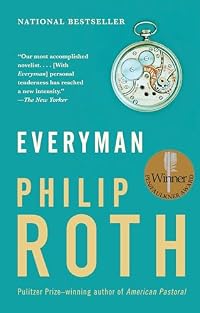
Everyman
by Philip Roth
On This Page
Description
Philip Roth's new novel is a candidly intimate yet universal story of loss, regret, and stoicism. The best-selling author of The Plot Against America now turns his attention from "one family's harrowing encounter with history" (New York Times) to one man's lifelong skirmish with mortality. The fate of Roth's everyman is traced from his first shocking confrontation with death on the idyllic beaches of his childhood summers, through the family trials and professional achievements of his show more vigorous adulthood, and into his old age, when he is rended by observing the deterioration of his contemporaries and stalked by his own physical woes. A successful commercial artist with a New York ad agency, he is the father of two sons from a first marriage who despise him and a daughter from a second marriage who adores him. He is the beloved brother of a good man whose physical well-being comes to arouse his bitter envy, and he is the lonely ex-husband of three very different women with whom he's made a mess of marriage. In the end he is a man who has become what he does not want to be. The terrain of this powerful novel -- Roth's twenty-seventh book and the fifth to be published in the twenty-first century -- is the human body. Its subject is the common experience that terrifies us all. Everyman takes its title from an anonymous fifteenth-century allegorical play, a classic of early English drama, whose theme is the summoning of the living to death. show lessTags
Recommendations









Member Recommendations
Member Reviews
Based on a number of nearly unanimous reviews, I began this book with a few expectations.
I expected the protagonist to be a self-obsessed emotional vampire; Roth's characters are often needy and broken, cyclically building up their lives, tearing them down, and wounding anyone foolish enough to mistake their emotional pawing for genuine love. The author met that expectation with room to spare.
But I also expected to have my heart broken. Most reviewers mention that this is a truly depressing book. It does indeed catalog the horrors of aging. You will not be spared any of the details. Illness and time do conspire to mentally and physically break down the protagonist, his friends, and his lovers. However, I didn't feel any of the loss I show more felt when reading Roth's The Dying Animal.
Here's what I think went wrong. Roth shovels the Everyman's life to you in great big heaps of unbalanced dirt. You learn everything there is to know about his transgressions and his pettiness. You follow every surgery he's had the pleasure to endure from childhood to the grave. But for some reason, you're spared all the best moments of his life. All the joy comes to you through the filter of a bitter old self-loathing man.
I'm going to do Roth the kindness of assuming Everyman was intentionally written to be so one-sided. Still, I don't feel at all depressed -- I'm indifferent. I never cared for the guy and the specifics of his life really do not apply to my own or the lives of those I love. The novel sounds one melancholy note and it's flat. show less
I expected the protagonist to be a self-obsessed emotional vampire; Roth's characters are often needy and broken, cyclically building up their lives, tearing them down, and wounding anyone foolish enough to mistake their emotional pawing for genuine love. The author met that expectation with room to spare.
But I also expected to have my heart broken. Most reviewers mention that this is a truly depressing book. It does indeed catalog the horrors of aging. You will not be spared any of the details. Illness and time do conspire to mentally and physically break down the protagonist, his friends, and his lovers. However, I didn't feel any of the loss I show more felt when reading Roth's The Dying Animal.
Here's what I think went wrong. Roth shovels the Everyman's life to you in great big heaps of unbalanced dirt. You learn everything there is to know about his transgressions and his pettiness. You follow every surgery he's had the pleasure to endure from childhood to the grave. But for some reason, you're spared all the best moments of his life. All the joy comes to you through the filter of a bitter old self-loathing man.
I'm going to do Roth the kindness of assuming Everyman was intentionally written to be so one-sided. Still, I don't feel at all depressed -- I'm indifferent. I never cared for the guy and the specifics of his life really do not apply to my own or the lives of those I love. The novel sounds one melancholy note and it's flat. show less
Phil, Me and Everyman -
I was at an 'in-between-books' impasse for a couple days, then picked up a book I'd found at a library sale last summer. The book is EVERYMAN, Philip Roth's 27th book, published in 2006. It's a grim little tome, with a black dust jacket, the one-word title framed by a thin red-line square, the author's name writ large in white block letters, and a black and white photo of a stern-faced Roth, arms crossed, on the back cover.
I only vaguely remember reading the original EVERYMAN - a 15th century morality play - or some version of it back in graduate school. Its Christian theme of life and death and a final accounting of ones deeds in life to determine whether one deserves salvation - heaven - or not seems an odd show more thing for Philip Roth to be writing about. I mean, he is Jewish, after all, and, judging from his writing, he puts little stock in any kind of an afterlife. So I was not surprised to find this story a pretty dark one. The unnamed protagonist - Everyman, I presume - is retired to the Jersey shore from a successful career in advertising. He has been a philanderer and hedonist, married and divorced three times, and now, at 71, finds himself alone and in declining health, having survived numerous heart surgeries, with six stents inserted, as well as a defibrillator, and faces more of the same on the immediate horizon. His two sons from the first marriage have little to do with him. His daughter, from the second, is devoted to him, but, divorced with young twins, has problems of her own.
Everyman, alone and sometimes agitated and afraid, reflects back on his life, summing up his many mistakes. He wonders how he's ended up this way, and how it's all gone by so quickly, still mourning the loss of his beloved parents, as well as his own youth and virility.
I don't know if EVERYMAN was a bestseller, but I strongly suspect it would not have been a popular choice for book club discussions among the elderly. It's just too damn dark, too starkly honest about the winding down of life, too sad. But I love the writing of Philip Roth. I'm frustrated too that I've not managed to keep up with his prodigious output. (I felt the same way about Updike's stuff.) The first Roth book I read was PORTNOY'S COMPLAINT, which, at 25, I found howlingly funny. My first year of teaching, I even used it in a literature class, and this was in a pretty conservative, solidly blue-collar sort of community. What was I thinking? I still wonder, over forty years later, how it was that I was never summoned to the Department Chair's office over a complaint from an outraged parent. Nope. Never happened. But I do remember it was kinda hard to get a good class discussion going about Alex Portnoy.
After PORTNOY I went on to read several of Roth's other early books. One of them, LETTING GO, remains a special favorite. Of his later books, I loved AMERICAN PASTORAL and THE HUMAN STAIN.
But this book, EVERYMAN, despite its dark theme, touched me with its truths. I nodded in agreement when I read the following passage, about a trip Everyman makes to the beach community where he spent summers with his parents and brother. He has lost interest in his painting and doesn't know what to do with his time.
"... it was still his beach and at the center of the circles in which his mind revolved when he remembered the best of boyhood. But how much time could a man spend remembering the best of boyhood? What about enjoying the best of old age? Or was the best of old age just that - the longing for the best of boyhood ...[?]"
An interesting question, no? Indeed, I spent five of the most enjoyable years of my own retirement doing that very thing - remembering, and not just my boyhood, but my whole life. And writing it all down, or trying to. Four memoirs in six years, and now nothing for the past five. And I wonder. What's next? Do I have more to write of my own life? Or do I keep on doing only this: writing about other people's books? It's a question I ponder on an almost daily basis, as I continue to read and read and read some more.
Yes, I could relate to Everyman. At a particularly low point near the end, he has just visited his second wife, who has had a crippling stroke; then he made some difficult phone calls to friends who were terminally ill and to the wife of his former boss, newly widowed. And then, "what he wanted to do ... [was] to revive his own esprit by phoning and talking to his mother and father."
His parents by this time are both long dead, of course, but I understood that urge, that 'want.' I've had it myself.
I understood too the sadness of Everyman at no longer possessing "the productive man's male allure." And I nodded sadly yet again at his realization of what was probably left for him -
"But now it appeared that like any number of the elderly, he was in the process of becoming less and less and would have to see his aimless days through to the end as no more than what he was - the aimless days and uncertain nights and the impotently putting up with the physical deterioration and the terminal sadness and the waiting and the waiting for nothing. This is how it works out, he thought, this is what you could not know."
Yes, EVERYMAN is a pretty unrelentingly sad sort of book, full of grim, unwelcome truths about how things really often do turn out. If there really is a final reckoning, as the 15th century EVERYMAN play suggests, then Roth's Everyman would undoubtedly "have some 'splainin' to do" as Ricky Ricardo might say. But Philip Roth? Yeah, I know he's had a couple of wives, and all the scholars and experts say a lot of his work is highly autobiographical. But even so, I think I would LIKE this guy. I think it would be great to sit with him over a coffee and talk about things - about books and writers and writing, and, and well, about life in general.
Roth was featured in a PBS special last year, and, if I remember correctly, he may have said he's done writing. That he is retiring. It's not something you hear very often from writers. Mostly they just keep on writing until, well, until they die. Updike did. A couple friends of mine, Curtis Harnack and Ed Hannibal, did. But then I remember that another author, mystery writer Lawrence Block, recently announced his retirement too. So what the hell, if Philip Roth wants to retire, then he should. But I hope he enjoys it more than his own poor Everyman did. I just wonder what he'll DO, ya know?
So, anyway, if you should happen to read this, Phil, and you're bored, call me, okay? We could meet at McDonald's and get our senior coffees, and we could talk books. Seriously. show less
I was at an 'in-between-books' impasse for a couple days, then picked up a book I'd found at a library sale last summer. The book is EVERYMAN, Philip Roth's 27th book, published in 2006. It's a grim little tome, with a black dust jacket, the one-word title framed by a thin red-line square, the author's name writ large in white block letters, and a black and white photo of a stern-faced Roth, arms crossed, on the back cover.
I only vaguely remember reading the original EVERYMAN - a 15th century morality play - or some version of it back in graduate school. Its Christian theme of life and death and a final accounting of ones deeds in life to determine whether one deserves salvation - heaven - or not seems an odd show more thing for Philip Roth to be writing about. I mean, he is Jewish, after all, and, judging from his writing, he puts little stock in any kind of an afterlife. So I was not surprised to find this story a pretty dark one. The unnamed protagonist - Everyman, I presume - is retired to the Jersey shore from a successful career in advertising. He has been a philanderer and hedonist, married and divorced three times, and now, at 71, finds himself alone and in declining health, having survived numerous heart surgeries, with six stents inserted, as well as a defibrillator, and faces more of the same on the immediate horizon. His two sons from the first marriage have little to do with him. His daughter, from the second, is devoted to him, but, divorced with young twins, has problems of her own.
Everyman, alone and sometimes agitated and afraid, reflects back on his life, summing up his many mistakes. He wonders how he's ended up this way, and how it's all gone by so quickly, still mourning the loss of his beloved parents, as well as his own youth and virility.
I don't know if EVERYMAN was a bestseller, but I strongly suspect it would not have been a popular choice for book club discussions among the elderly. It's just too damn dark, too starkly honest about the winding down of life, too sad. But I love the writing of Philip Roth. I'm frustrated too that I've not managed to keep up with his prodigious output. (I felt the same way about Updike's stuff.) The first Roth book I read was PORTNOY'S COMPLAINT, which, at 25, I found howlingly funny. My first year of teaching, I even used it in a literature class, and this was in a pretty conservative, solidly blue-collar sort of community. What was I thinking? I still wonder, over forty years later, how it was that I was never summoned to the Department Chair's office over a complaint from an outraged parent. Nope. Never happened. But I do remember it was kinda hard to get a good class discussion going about Alex Portnoy.
After PORTNOY I went on to read several of Roth's other early books. One of them, LETTING GO, remains a special favorite. Of his later books, I loved AMERICAN PASTORAL and THE HUMAN STAIN.
But this book, EVERYMAN, despite its dark theme, touched me with its truths. I nodded in agreement when I read the following passage, about a trip Everyman makes to the beach community where he spent summers with his parents and brother. He has lost interest in his painting and doesn't know what to do with his time.
"... it was still his beach and at the center of the circles in which his mind revolved when he remembered the best of boyhood. But how much time could a man spend remembering the best of boyhood? What about enjoying the best of old age? Or was the best of old age just that - the longing for the best of boyhood ...[?]"
An interesting question, no? Indeed, I spent five of the most enjoyable years of my own retirement doing that very thing - remembering, and not just my boyhood, but my whole life. And writing it all down, or trying to. Four memoirs in six years, and now nothing for the past five. And I wonder. What's next? Do I have more to write of my own life? Or do I keep on doing only this: writing about other people's books? It's a question I ponder on an almost daily basis, as I continue to read and read and read some more.
Yes, I could relate to Everyman. At a particularly low point near the end, he has just visited his second wife, who has had a crippling stroke; then he made some difficult phone calls to friends who were terminally ill and to the wife of his former boss, newly widowed. And then, "what he wanted to do ... [was] to revive his own esprit by phoning and talking to his mother and father."
His parents by this time are both long dead, of course, but I understood that urge, that 'want.' I've had it myself.
I understood too the sadness of Everyman at no longer possessing "the productive man's male allure." And I nodded sadly yet again at his realization of what was probably left for him -
"But now it appeared that like any number of the elderly, he was in the process of becoming less and less and would have to see his aimless days through to the end as no more than what he was - the aimless days and uncertain nights and the impotently putting up with the physical deterioration and the terminal sadness and the waiting and the waiting for nothing. This is how it works out, he thought, this is what you could not know."
Yes, EVERYMAN is a pretty unrelentingly sad sort of book, full of grim, unwelcome truths about how things really often do turn out. If there really is a final reckoning, as the 15th century EVERYMAN play suggests, then Roth's Everyman would undoubtedly "have some 'splainin' to do" as Ricky Ricardo might say. But Philip Roth? Yeah, I know he's had a couple of wives, and all the scholars and experts say a lot of his work is highly autobiographical. But even so, I think I would LIKE this guy. I think it would be great to sit with him over a coffee and talk about things - about books and writers and writing, and, and well, about life in general.
Roth was featured in a PBS special last year, and, if I remember correctly, he may have said he's done writing. That he is retiring. It's not something you hear very often from writers. Mostly they just keep on writing until, well, until they die. Updike did. A couple friends of mine, Curtis Harnack and Ed Hannibal, did. But then I remember that another author, mystery writer Lawrence Block, recently announced his retirement too. So what the hell, if Philip Roth wants to retire, then he should. But I hope he enjoys it more than his own poor Everyman did. I just wonder what he'll DO, ya know?
So, anyway, if you should happen to read this, Phil, and you're bored, call me, okay? We could meet at McDonald's and get our senior coffees, and we could talk books. Seriously. show less
Innanzi tutto, questo libro ha colpito fortemente la mia ipocondria. Ad ogni nuova operazione del protagonista, che ha sempre vissuto una vita sana, fatto sport, eccetera, io lo trovavo sempre più difficile da sopportare. Perché sentivo troppo mie tutte le sue sensazioni, dalla più banale paura all’assurdo odio per i sani. Per non parlare poi del pensiero della morte, e del modo in cui prende il protagonista. Onestamente parlando, mi ha fatto male questo libro. A lettura ultimata non sapevo se alzargli o abbassargli il voto per questo motivo, visto che mi ha depresso, o meglio, ha fomentato le mie paure, ma proprio per questo mi ha coinvolto come non mai. Alla fine quindi ho deciso di aumentarglielo il voto, perché a distanza di show more alcuni giorni sento ancora forte l'impressione che ha prodotto in me, e non smetto di pensarci. In più, quando ripenso al titolo lo trovo ancora più geniale. Everyman’s Jewelry Store (la gioielleria di tutti) è il nome del negozio del padre del protagonista ma, leggo nel risvolto di copertina, Everyman è anche il titolo di un anonimo dramma del Quattrocento inglese che ha come tema la chiamata di tutti gli uomini alla morte. Personalmente, ignorando questo particolare che ho letto solo dopo, io avevo inteso quell’”everyman” come “questa è la storia di ogni uomo”, come a dire di qualunque uomo, ma anche di un uomo qualunque. Magari anche la mia.
http://www.naufragio.it/iltempodileggere/16781
First of all, this book has greatly affected my hypochondria. For each new surgery of the protagonist, who has always lived a healthy lifestyle, doing sports, etc., I found it increasingly difficult to bear. Because I felt all his sensations as they was so like mine, from the most trivial fear to the absurd hate for the healthy ones. Not to mention the thought of death, and the way it takes the protagonist. Honestly speaking, I this book hurt me. After I read it I did not know if I should lower or raise his rating because of this reason: I surely was depressed, or rather, it has fueled my fears, but just because of this I was extremely involved. So eventually I decided to increase the vote, because after a few days I still feel the strong impression that this book produced in me, and I can not stop thinking about it. In addition, when I think back to the title I find it even more brilliant. "Everyman's Jewelry Store" is the name of the shop of the protagonist's father, but I read on the the cover flap that Everyman is also the title of an anonymous fififteenth-century English play whose eponymous protagonist is "called" by death. Personally, 'cause I read that only after I finished the book, I had thought at "everyman" as "this is the story of every man," like saying of any man, but also an ordinary man. Maybe even mine. show less
http://www.naufragio.it/iltempodileggere/16781
First of all, this book has greatly affected my hypochondria. For each new surgery of the protagonist, who has always lived a healthy lifestyle, doing sports, etc., I found it increasingly difficult to bear. Because I felt all his sensations as they was so like mine, from the most trivial fear to the absurd hate for the healthy ones. Not to mention the thought of death, and the way it takes the protagonist. Honestly speaking, I this book hurt me. After I read it I did not know if I should lower or raise his rating because of this reason: I surely was depressed, or rather, it has fueled my fears, but just because of this I was extremely involved. So eventually I decided to increase the vote, because after a few days I still feel the strong impression that this book produced in me, and I can not stop thinking about it. In addition, when I think back to the title I find it even more brilliant. "Everyman's Jewelry Store" is the name of the shop of the protagonist's father, but I read on the the cover flap that Everyman is also the title of an anonymous fififteenth-century English play whose eponymous protagonist is "called" by death. Personally, 'cause I read that only after I finished the book, I had thought at "everyman" as "this is the story of every man," like saying of any man, but also an ordinary man. Maybe even mine. show less
"No hocus locus about death and God or obsolete fantasies of heaven for him. There were only our bodies born to live and die on terms decided by the bodies that had lived and died before us."
This short novel begins with the funeral of "Everyman," our unnamed main character, and then proceeds to relate his life story as fleshed out and structured around a skeleton of his various encounters with death or mortality. (Hmm, reminds me of Maggie Farrell's I am I am I am). As a young boy he witnessed a drowned soldier/sailor who had washed up on shore, and shortly after when he was hospitalized for a hernia operation, his roommate, another young boy, died mysteriously in the night---"memorable enough that he was in the hospital that young, but show more even more memorable that he had registered a death." Thereafter, through-out he life he was haunted by health problems, and concurrently thoughts of death. In contrast, his older brother remained the picture of health into old age, while his own body was constantly betraying him.
I had stopped reading Roth when I became bored with his (male) characters constant obsessions with sex and female bodies. This "meditation on mortality," as it has been described, has less of that than in many of his earlier books, although Everyman does go through three marriages, each to a successively younger woman, and in his late sixties is still hitting on a 20-something jogger younger than his daughter. But on the whole, I "enjoyed," if that's the correct word, this story about how one man dealt with facing death.
Recommended
4 stars
First line: "Around the grave in the rundown cemetery were a few of his former advertising colleagues from New York who recalled his energy and originality and told his daughter, Nancy, what a pleasure it had been to work with him."
Last line: "He was no more, freed from being, entering into nowhere without even knowing it. Just as he had feared from the start. show less
This short novel begins with the funeral of "Everyman," our unnamed main character, and then proceeds to relate his life story as fleshed out and structured around a skeleton of his various encounters with death or mortality. (Hmm, reminds me of Maggie Farrell's I am I am I am). As a young boy he witnessed a drowned soldier/sailor who had washed up on shore, and shortly after when he was hospitalized for a hernia operation, his roommate, another young boy, died mysteriously in the night---"memorable enough that he was in the hospital that young, but show more even more memorable that he had registered a death." Thereafter, through-out he life he was haunted by health problems, and concurrently thoughts of death. In contrast, his older brother remained the picture of health into old age, while his own body was constantly betraying him.
I had stopped reading Roth when I became bored with his (male) characters constant obsessions with sex and female bodies. This "meditation on mortality," as it has been described, has less of that than in many of his earlier books, although Everyman does go through three marriages, each to a successively younger woman, and in his late sixties is still hitting on a 20-something jogger younger than his daughter. But on the whole, I "enjoyed," if that's the correct word, this story about how one man dealt with facing death.
Recommended
4 stars
First line: "Around the grave in the rundown cemetery were a few of his former advertising colleagues from New York who recalled his energy and originality and told his daughter, Nancy, what a pleasure it had been to work with him."
Last line: "He was no more, freed from being, entering into nowhere without even knowing it. Just as he had feared from the start. show less
It's the final reckoning.
Around the grave in the rundown cemetery were a few of his former advertising colleagues from New York, who recalled his energy and originality and told his daughter, Nancy, what a pleasure it had been to work with him. There were also people who'd driven up from Starfish Beach, the residential retirement village at the Jersey Shore where he'd been living since Thanksgiving of 2001—the elderly to whom only recently he'd been giving art classes. And there were his two sons, Randy and Lonny, middle-aged men from his turbulent first marriage, very much their mother's children, who as a consequence knew little of him that was praiseworthy and much that was beastly and who were present out of duty and nothing more. show more His older brother, Howie, and his sister-in-law were there, having flown in from California the night before, and there was one of his three ex-wives, the middle one, Nancy's mother, Phoebe, a tall, very thin white-haired woman whose right arm hung limply at her side. When asked by Nancy if she wanted to say anything, Phoebe shyly shook her head but then went ahead to speak in a soft voice, her speech faintly slurred. "It's just so hard to believe. I keep thinking of him swimming the bay—that's all. I just keep seeing him swimming the bay." And then Nancy, who had made her father's funeral arrangements and placed the phone calls to those who'd showed up so that the mourners wouldn't consist of just her mother, herself, and his brother and sister-in-law. There was only one person whose presence hadn't to do with having been invited, a heavyset woman with a pleasant round face and dyed red hair who had simply appeared at the cemetery and introduced herself as Maureen, the private duty nurse who had looked after him following his heart surgery years back. Howie remembered her and went up to kiss her cheek.
The subject of this reckoning is a figure without a name, a man who, to me, is a stand-in for Philip Roth himself. In the first paragraph (quoted above), almost all the principal figures in his life are present, all but those who predeceased him (his parents, for example) and his first and last wives. Once buried, his life spools past us, from his birth and adolescence, his education, his dreams and aspirations, and of course the life he actually lived. Unaccomplished as a fine artist, a very successful advertising designer. Accomplished as a ladies' man—charming, caring, persuasive—he's nonetheless an unfocussed husband and father.
The title, [Everyman], tells us that the nameless protagonist is drawn from [The Summoning of Everyman], an English morality play from the 1500s. "Everyman" represents a commonplace man, an ordinary guy, confronting the approach of his death. He's a stock character in fiction. As I said, I immediately viewed this particular Everyman as Roth himself. I learned via an article in The Times of Israel that Roth faced the coronary artery disease he inflicted on the novel's protagonist. In 1989, Roth had a quintuple bypass and was diagnosed with coronary artery disease. He was 49 then, and he lived another 29 years. show less
Around the grave in the rundown cemetery were a few of his former advertising colleagues from New York, who recalled his energy and originality and told his daughter, Nancy, what a pleasure it had been to work with him. There were also people who'd driven up from Starfish Beach, the residential retirement village at the Jersey Shore where he'd been living since Thanksgiving of 2001—the elderly to whom only recently he'd been giving art classes. And there were his two sons, Randy and Lonny, middle-aged men from his turbulent first marriage, very much their mother's children, who as a consequence knew little of him that was praiseworthy and much that was beastly and who were present out of duty and nothing more. show more His older brother, Howie, and his sister-in-law were there, having flown in from California the night before, and there was one of his three ex-wives, the middle one, Nancy's mother, Phoebe, a tall, very thin white-haired woman whose right arm hung limply at her side. When asked by Nancy if she wanted to say anything, Phoebe shyly shook her head but then went ahead to speak in a soft voice, her speech faintly slurred. "It's just so hard to believe. I keep thinking of him swimming the bay—that's all. I just keep seeing him swimming the bay." And then Nancy, who had made her father's funeral arrangements and placed the phone calls to those who'd showed up so that the mourners wouldn't consist of just her mother, herself, and his brother and sister-in-law. There was only one person whose presence hadn't to do with having been invited, a heavyset woman with a pleasant round face and dyed red hair who had simply appeared at the cemetery and introduced herself as Maureen, the private duty nurse who had looked after him following his heart surgery years back. Howie remembered her and went up to kiss her cheek.
The subject of this reckoning is a figure without a name, a man who, to me, is a stand-in for Philip Roth himself. In the first paragraph (quoted above), almost all the principal figures in his life are present, all but those who predeceased him (his parents, for example) and his first and last wives. Once buried, his life spools past us, from his birth and adolescence, his education, his dreams and aspirations, and of course the life he actually lived. Unaccomplished as a fine artist, a very successful advertising designer. Accomplished as a ladies' man—charming, caring, persuasive—he's nonetheless an unfocussed husband and father.
The title, [Everyman], tells us that the nameless protagonist is drawn from [The Summoning of Everyman], an English morality play from the 1500s. "Everyman" represents a commonplace man, an ordinary guy, confronting the approach of his death. He's a stock character in fiction. As I said, I immediately viewed this particular Everyman as Roth himself. I learned via an article in The Times of Israel that Roth faced the coronary artery disease he inflicted on the novel's protagonist. In 1989, Roth had a quintuple bypass and was diagnosed with coronary artery disease. He was 49 then, and he lived another 29 years. show less
I've had a hard time entering Philip Roth's world, having abandoned "Sabbath's Theater" and "The Human Stain" in the past, though I still hope to revisit them.
"Everyman" may have been just the right passageway for me - a novella about a man (we never learn his name) and his realization that, in the twilight of his years, he has become everything he'd hoped he wouldn't. As he undergoes a series of medical procedures, the wreckage that is his body serves as a metaphor for the maladies of his human spirit, having failed at marriage three times, as a father twice (his sons hate him, only his daughter wants a relationship with him), and as an artist (he waited until retirement to pursue his dream of painting).
The narrative is splayed show more between present and past, beginning with a graveside service for the man, and then weaving through the phases of his life. Roth isn't one for verbal theatrics, and his style doesn't draw attention to itself, so what you have left is simply a story well told, which may be the hardest thing for a writer to do - no bells, no whistles, just the bone and marrow of a life, presented but never explained.
Roth's rather unapologetic approach to prose accentuates the regret this character feels, and while most would consider the book a downer, I find stories of regret like this one to be most inspiring - it reminds you of priorities, the gifts of health and happiness, and the devastating power of every choice we make without being didactic about it.
When I told Wendy that this book never shares the main character's name with the reader she said, "I can't connect with a character if I don't know what to call them." Then, I looked at the cover of the book - completely black except for the title glaring off the hardback: "Everyman". There was his name, and the metaphoric punch that Roth intended.
This is not an 'enjoyable' or light read, but it's a quick and rewarding one, and one I'm glad gave me a passageway into Mr. Roth's reading room. show less
"Everyman" may have been just the right passageway for me - a novella about a man (we never learn his name) and his realization that, in the twilight of his years, he has become everything he'd hoped he wouldn't. As he undergoes a series of medical procedures, the wreckage that is his body serves as a metaphor for the maladies of his human spirit, having failed at marriage three times, as a father twice (his sons hate him, only his daughter wants a relationship with him), and as an artist (he waited until retirement to pursue his dream of painting).
The narrative is splayed show more between present and past, beginning with a graveside service for the man, and then weaving through the phases of his life. Roth isn't one for verbal theatrics, and his style doesn't draw attention to itself, so what you have left is simply a story well told, which may be the hardest thing for a writer to do - no bells, no whistles, just the bone and marrow of a life, presented but never explained.
Roth's rather unapologetic approach to prose accentuates the regret this character feels, and while most would consider the book a downer, I find stories of regret like this one to be most inspiring - it reminds you of priorities, the gifts of health and happiness, and the devastating power of every choice we make without being didactic about it.
When I told Wendy that this book never shares the main character's name with the reader she said, "I can't connect with a character if I don't know what to call them." Then, I looked at the cover of the book - completely black except for the title glaring off the hardback: "Everyman". There was his name, and the metaphoric punch that Roth intended.
This is not an 'enjoyable' or light read, but it's a quick and rewarding one, and one I'm glad gave me a passageway into Mr. Roth's reading room. show less
Late in the 15th century, an anonymous playwright penned a Christian morality tale in which an average man is confronted by Death for a final reckoning. The story’s ostensible moral is rather straightforward: In the quest for eternal salvation, all men must ultimately stand alone with their good deeds to define them. More than five centuries later, Philip Roth gives us Everyman, his modernized version of the same tale. Roth’s account begins in a decrepit cemetery with the sparsely attended funeral of an unnamed Jewish man whose life story is then revealed throughout the rest of the novel.
And what a sad story it turns out to be. Aside from some pleasant memories from a boyhood spent working in his father’s jewelry store and taking show more family vacations to the Jersey shore, there is little in the protagonist’s existence that can be considered joyful. A serial philanderer throughout adulthood, he has been divorced three times from women to whom he cannot remain faithful and he has walked away from three young children from two of those marriages. Although successful as an advertising executive, the job brings him little fulfillment as he longs to pursue the art career he abandoned early on. He even becomes estranged from the older brother he idolized in youth, envying his sibling’s robust health while he endures a series of medical hardships. At the end of his life, this Everyman is truly alone, but very much as a result of the choices he himself made.
I did not find a lot that I enjoyed while reading Everyman. To be sure, there are parts of the book that are moving and beautifully written; this is a Philip Roth novel, after all. However, rather than being an updated morality tale, the story is really a lengthy lamentation on the miseries of growing old and seeing one’s health deteriorate along the way. I suppose that part of the story is universal—death (hopefully in old age) is indeed an appointment we all will keep—but very little else about the protagonist’s existence resonated with me or resembled anyone of any faith, gender, or color that I know. I suspect that this was a very personal story for the author, perhaps even autobiographical at times. Sadly, though, that did not turn the self-indulgent ruminations and late-in-the-game regrets of an unpleasant character into an engaging experience for this reader. show less
And what a sad story it turns out to be. Aside from some pleasant memories from a boyhood spent working in his father’s jewelry store and taking show more family vacations to the Jersey shore, there is little in the protagonist’s existence that can be considered joyful. A serial philanderer throughout adulthood, he has been divorced three times from women to whom he cannot remain faithful and he has walked away from three young children from two of those marriages. Although successful as an advertising executive, the job brings him little fulfillment as he longs to pursue the art career he abandoned early on. He even becomes estranged from the older brother he idolized in youth, envying his sibling’s robust health while he endures a series of medical hardships. At the end of his life, this Everyman is truly alone, but very much as a result of the choices he himself made.
I did not find a lot that I enjoyed while reading Everyman. To be sure, there are parts of the book that are moving and beautifully written; this is a Philip Roth novel, after all. However, rather than being an updated morality tale, the story is really a lengthy lamentation on the miseries of growing old and seeing one’s health deteriorate along the way. I suppose that part of the story is universal—death (hopefully in old age) is indeed an appointment we all will keep—but very little else about the protagonist’s existence resonated with me or resembled anyone of any faith, gender, or color that I know. I suspect that this was a very personal story for the author, perhaps even autobiographical at times. Sadly, though, that did not turn the self-indulgent ruminations and late-in-the-game regrets of an unpleasant character into an engaging experience for this reader. show less
Members
- Recently Added By
Lists

Best Psychological Fiction
81 works; 16 members

Jewish Books
367 works; 24 members

Top Five Books of 2015
811 works; 241 members

Pen/Faulkner Winners and Finalists
178 works; 9 members

Books Read in 2015
3,299 works; 126 members

The "A" List
67 works; 8 members
Author Information

114+ Works 74,575 Members
Philip Milton Roth was born in Newark, New Jersey on March 19, 1933. He attended Rutgers University for one year before transferring to Bucknell University where he completed a B.A. in English with highest honors in 1954. He received an M.A. from the University of Chicago in 1955. His first book, Goodbye, Columbus, received the National Book Award show more in 1960. His other books include Letting Go, When She Was Good, Portnoy's Complaint, My Life as a Man, The Ghostwriter, Zuckerman Unbound, I Married a Communist, The Plot Against America, The Facts, The Anatomy Lesson, Exit Ghost, Deception, Nemesis, Everyman, Indignation, and The Humbling. He won the National Book Critic Circle Awards in 1987 for his novel The Counterlife and in 1992 for his memoir Patrimony: A True Story. He won the PEN/Faulkner Award for Fiction in 1993 for Operation Shylock: A Confession and in 2001 for The Human Stain, the National Book Award in 1995 for Sabbath's Theater, and the Pulitzer Prize in 1998 for American Pastoral. He stopped writing in 2010. He died from congestive heart failure on May 22, 2018 at the age of 85. (Bowker Author Biography) show less
Some Editions
Awards and Honors
Series
Belongs to Publisher Series
Work Relationships
Common Knowledge
- Canonical title*
- Pastorale americana
- Original title
- Everyman
- Alternate titles*
- Everyman
- Original publication date
- 2006
- People/Characters
- Nathan Zuckerman; Seymour Levov; Merry Levov
- Important places
- Newark, New Jersey, USA
- Epigraph
- Here, where men sit and hear each other groan;
Where palsy shakes a few, sad, last gray hairs,
Where youth grows pale, and spectre-thin, and dies;
Where but to think is to be full of sorrow ...
—John Keats, "Ode... (show all) to a Nightingale" - Dedication
- To J.C.
- First words
- Around the grave in the rundown cemetery were a few of his former advertising colleagues from New York, who recalled his energy and originality and told his daughter, Nancy, what a pleasure it had been to work with him.
- Quotations
- You fight your superficiality, your shallowness, so as to try to come at people without unreal expectations, without an overload of bias or hope or arrogance…and yet you never fail to get them wrong…You get them wrong whe... (show all)n you meet them, while you’re anticipating meeting them; you get them wrong while you’re with them; and then you go home to tell someone else about the meeting and you get them wrong all over again…[T]he whole thing is really a dazzling illusion empty of all perception, an astonishing farce of misperception
- Last words
- (Click to show. Warning: May contain spoilers.)Just as he'd feared from the start.
- Original language
- Engllish
*Some information comes from Common Knowledge in other languages. Click "Edit" for more information.
Classifications
Statistics
- Members
- 3,978
- Popularity
- 3,915
- Reviews
- 122
- Rating
- (3.64)
- Languages
- 18 — Catalan, Czech, Danish, Dutch, English, Estonian, Finnish, French, German, Greek, Hungarian, Italian, Norwegian (Bokmål), Polish, Portuguese, Spanish, Swedish, Turkish
- Media
- Paper, Audiobook, Ebook
- ISBNs
- 69
- UPCs
- 2
- ASINs
- 25