Ellington Was Not a Street
by Ntozake Shange
On This Page
Description
In this reflective poetic tribute, the author remembers growing up when many of the great figures in African-American history gathered in her family home to talk and share ideas and even sing..
Tags
Recommendations
Member Reviews
I loved this book -- the rhythm of the language, the little girl protagonist, the introduction to historical figures who were actually real people to the little girl, and now, to the reader. I would have wished for more women! But otherwise it was perfect.
Ntozake Shange’s poem Mood Indigo, which forms the text of this book, is a remembrance of a childhood surrounded by “men who changed the world.” Friends of her wealthy Saint Louis family included actor Paul Robeson, W.E.B. DuBois, Dizzy Gillespie and Duke Ellington. Shange’s tribute to these men is therefore unusually intimate. She writes: I remember/ I was there/I listened in the company of men/politics as necessary as collards/music even in our dreams. The elegiac tone underscores that she is not merely paying tribute to these men as icons, but writing an ode to black masculinity and agency, and to an era when their dignity transformed our culture. Short biographical notes on each of the men and a page with the full text of show more the poem conclude the book. Although some reviewers have faulted Shange for not including an author’s note or for focusing exclusively on the men of the era, I would argue that the book stands beautifully as it is.
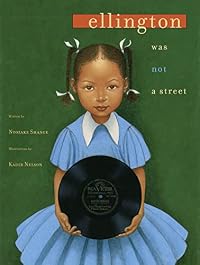
Ellington Was Not a Street won the 2005 Coretta Scott King Award for illustration. Two other Kadir Nelson books have won the award since, and it’s easy to see why. His oil paintings are elegantly composed, gorgeously controlled in their use of color and specific in the details of their portraiture. Yet his art is also enormously appealing to children, possibly because it is subtly informed by comics and imbued with a gentle but pervasive humor. The cute little girl and her brother provide a visual anchor within each two-page spread. When Shange writes “Our house was filled with all kinda folks/our windows were not cement or steel/our doors opened like daddy’s arms/held us safe and loved” Nelson does everything right to illustrate her words. The house, with its beautifully patterned furnishings, becomes more than a setting, but a character, imbued with grace and warmth. Over his career Nelson has used his talents to capture the power of Black heroes and the warmth of loving Black families. He has said “My focus is to create images of people who demonstrate a sense of hope and nobility. I want to show the strength and integrity of the human being and the human spirit.” His art provides a needed entry point for young readers to insert themselves into Shange’s powerful words.
Why should librarians know this book? In addition to being lovely, it’s also useful for assignments and a natural recommendation to give teachers. Although it is in picture book format it could easily be used in high school or even college classes. For librarians not familiar with all of the figures referenced here it provides a brief introduction to them. The biographical details in the back could even help with collection development, serving as a reminder to check our collections to make sure we have adequate information on these great men, as well as good representations of Shange and Nelson’s work in our libraries. You may note that although this is Black History Month that is not the first use of this book that comes to mind. I think that the book itself may be partly behind my questioning of that impulse. Shange’s recollection of a time before Ellington was a street (or there was a Martin Luther King Jr. Boulevard running through every ghetto) seems to me to be a subtle criticism of how America handles the stories and names of Black leaders. Black History Month can be seen as a sort of ghetto itself, an admission that we are not learning or teaching Black History year round. In one short poem she puts forward a powerful and complex idea that I think educators and librarians need to consider: that we need to know more about these men and the ideas and conversations they cared about if we are to present a meaningful narrative of U.S. history and the place of social movements within it. Otherwise we are complicit in collecting names and places like emblems while congratulating ourselves on how far we’ve come. As Raina Kelley wrote in a recent op-ed for Newsweek, “The End of Black History Month? Why I’m Not Ready to Ditch it – Yet? “Black History Month is a measure of how fully or accurately our story is being told and a reminder of the work yet to be done.” Both in terms of the world of publishing and the composition of library collections, I would argue that until we have a lot more books like Ellington Was Not a Street getting written and widely read, we haven’t yet come far enough. Championing books like this through reader’s advisory, book lists, reviews and awards committees are ways that we can help such works find the largest possible audience.
Nelson, Kadir. "About the Artist." The Art of Kadir Nelson. Feb 2010. Web. 15 Feb 2010.
Kelley, Raina.“The End of Black History Month? Why I’m Not Ready to Ditch it – Yet?” Newsweek 29 January Year 2010. Web. 15 February 2010
Shange, Ntozake. Ellington Was Not a Street. Ill. Kadir Nelson. New York: Simon & Schuster Children's Publishing, 2004. show less
Ellington Was Not a Street won the 2005 Coretta Scott King Award for illustration. Two other Kadir Nelson books have won the award since, and it’s easy to see why. His oil paintings are elegantly composed, gorgeously controlled in their use of color and specific in the details of their portraiture. Yet his art is also enormously appealing to children, possibly because it is subtly informed by comics and imbued with a gentle but pervasive humor. The cute little girl and her brother provide a visual anchor within each two-page spread. When Shange writes “Our house was filled with all kinda folks/our windows were not cement or steel/our doors opened like daddy’s arms/held us safe and loved” Nelson does everything right to illustrate her words. The house, with its beautifully patterned furnishings, becomes more than a setting, but a character, imbued with grace and warmth. Over his career Nelson has used his talents to capture the power of Black heroes and the warmth of loving Black families. He has said “My focus is to create images of people who demonstrate a sense of hope and nobility. I want to show the strength and integrity of the human being and the human spirit.” His art provides a needed entry point for young readers to insert themselves into Shange’s powerful words.
Why should librarians know this book? In addition to being lovely, it’s also useful for assignments and a natural recommendation to give teachers. Although it is in picture book format it could easily be used in high school or even college classes. For librarians not familiar with all of the figures referenced here it provides a brief introduction to them. The biographical details in the back could even help with collection development, serving as a reminder to check our collections to make sure we have adequate information on these great men, as well as good representations of Shange and Nelson’s work in our libraries. You may note that although this is Black History Month that is not the first use of this book that comes to mind. I think that the book itself may be partly behind my questioning of that impulse. Shange’s recollection of a time before Ellington was a street (or there was a Martin Luther King Jr. Boulevard running through every ghetto) seems to me to be a subtle criticism of how America handles the stories and names of Black leaders. Black History Month can be seen as a sort of ghetto itself, an admission that we are not learning or teaching Black History year round. In one short poem she puts forward a powerful and complex idea that I think educators and librarians need to consider: that we need to know more about these men and the ideas and conversations they cared about if we are to present a meaningful narrative of U.S. history and the place of social movements within it. Otherwise we are complicit in collecting names and places like emblems while congratulating ourselves on how far we’ve come. As Raina Kelley wrote in a recent op-ed for Newsweek, “The End of Black History Month? Why I’m Not Ready to Ditch it – Yet? “Black History Month is a measure of how fully or accurately our story is being told and a reminder of the work yet to be done.” Both in terms of the world of publishing and the composition of library collections, I would argue that until we have a lot more books like Ellington Was Not a Street getting written and widely read, we haven’t yet come far enough. Championing books like this through reader’s advisory, book lists, reviews and awards committees are ways that we can help such works find the largest possible audience.
Nelson, Kadir. "About the Artist." The Art of Kadir Nelson. Feb 2010. Web. 15 Feb 2010.
Kelley, Raina.“The End of Black History Month? Why I’m Not Ready to Ditch it – Yet?” Newsweek 29 January Year 2010. Web. 15 February 2010
Shange, Ntozake. Ellington Was Not a Street. Ill. Kadir Nelson. New York: Simon & Schuster Children's Publishing, 2004. show less
A beautifully illustrated poem draws the reader into a rich childhood surrounded by titans of culture who shaped the author's young mind as well as the nation's.
I loved this book -- the rhythm of the language, the little girl protagonist, the introduction to historical figures who were actually real people to the little girl, and now, to the reader. I would have wished for more women! But otherwise it was perfect.
This book was originally a free-verse poem called "Mood Indigo" which mourns how we've forgotten the "greats" in Black history. Told from the perspective of a young African-American girl, the book form's tone is much warmer and beautifully humanizes the characters. It shows more and more smiling faces coming to her home until the whole house is full, with the little girl interacting with each of them.
The illustrations of all these great men gently interacting with the tiny girl are really sweet. Making them a natural part of her home makes them really relatable. The short biographies in the back are really informative and engaging. I didn't know some of the people that were included, so it was cool to learn about them.
The illustrations of all these great men gently interacting with the tiny girl are really sweet. Making them a natural part of her home makes them really relatable. The short biographies in the back are really informative and engaging. I didn't know some of the people that were included, so it was cool to learn about them.
In the art of poetic junction and meter, Ntozake Shange pens a poetic masterpiece that vividly tells the story of the contributions of black men in our 2oth century history. Men like Duke Ellington, W.E.B. Dubois, Paul Robeson to mention a few are beautifully depicted in such subtle but poignant illustrations that they leave a mark and tell the story with detail. The book opens with a street sign 'Ellington' and the poem begins 'it hasn't always been this way, ellington was not a street.' You notice first off that not one of the sentences start with a capital letter and my second grade students would be quick to point that out, but I feel this would be a good point to pass into a segment on types of poetic meter and when not to use show more syntax for impact. Each page contained two lines and that was all and in those two lines there was so much context. I would love for my students to see this and be able to practice this as well, by writing two lines that rhyme that would depict best some moment in their life. show less
This book is great for second or third graders. Ellington Was Not a Street does a fabulous job of incorporating prominent black figures and storytelling through the eyes of a young black woman. Her interactions with the constant change seen in her house are representative of her community through predominately visual aid. Many valuable lessons and conversations can be derived from this book without overwhelming younger students.
Members
- Recently Added By
Lists

Jazz Picture Books
36 works; 2 members

Black Authors
381 works; 32 members

SYES Library Wishlist
1,080 works; 4 members
Author Information

38+ Works 5,667 Members
Ntozake Shange was born Paulette Linda Williams in Trenton, New Jersey on October 18, 1948. She received a bachelor's degree from Barnard College in 1970 and a master's degree in American studies from the University of Southern California in 1973. She adopted her African name while in graduate school. She wrote 15 plays, 19 collections of poetry, show more six novels, five children's books, and three essay collections. Her choreopoem, For Colored Girls Who Have Considered Suicide/When the Rainbow is Enuf, opened on Broadway in 1976 and received an Obie Award. She also received an Obie in 1981 for her adaptation of Bertold Brecht's Mother Courage and Her Children. Her trilogy, Three Pieces, won the Los Angeles Times Book Prize for Poetry in 1981. She died on October 27, 2018 at the age of 70. (Bowker Author Biography) show less
All Editions
Awards and Honors
Awards
Distinctions
Common Knowledge
- People/Characters
- Paul Robeson; Duke Ellington; Ray Barretto; Dizzy Gillespie; Kwame Nkrumah; Sonny Tilghman (show all 7); W. E. B. Du Bois
- Important places
- St. Louis, Missouri, USA
Classifications
Statistics
- Members
- 460
- Popularity
- 66,058
- Reviews
- 49
- Rating
- (3.96)
- Languages
- English
- Media
- Paper, Audiobook, Ebook
- ISBNs
- 16
- ASINs
- 2