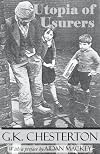
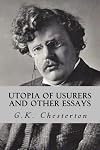
Utopia of Usurers
by G. K. Chesterton
On This Page
Description
British polymath, philosopher and poet G.K. Chesterton takes on capitalism in this wide-ranging collection of essays. Approaching the subject from a moral perspective tinged with Christian ethics, Chesterton presents an array of powerful arguments that are surprisingly fresh, a century after the book's initial publication..
Tags
Recommendations















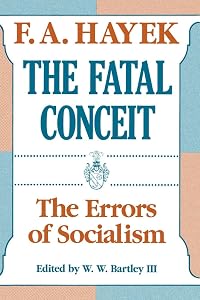

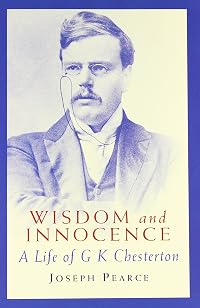



















Member Reviews
Chesterton’s work presented here is an anthology. The first part is the Utopia criticism, and the second part is a series of published essays from the 1912-17 time frame. The parts deserve separate reviews.
Many have viewed Chesterton’s Utopia of Usurers as a criticism of capitalism. I can support that view, but must add two qualifications. Firstly the arguments presented deal mainly with political, social and even religious issues, not with economic ones. Secondly his target includes much more of the banking and financial side than we would usually associate with capitalism. From there, the reader must deal with the arguments presented in context; the context is that of emerging twentieth century government, the death of classical show more liberalism, and the early days of the struggle between individualism and the state. His critique is not so much against capitalism as it is against the modern age, particularly the rise of the Manchester school of industry, and the practices of the ‘new’ British oligarchs of industry. Holding those limits in mind, many of Chesterton’s observations do translate to current struggles, and most are told in his biting and witty style.
The other 18 articles are way too British to fit comfortably for the average American reader. Chesterton refers to events, politicians, and conditions in England of the Irish revolution and World War I. Nevertheless, despite the resulting obscurity, it contains the typical number of very sharp Chesterton observations. For example, during his discussion of the Free Will vs. determinism he notes that: “The question of Fate and Free Will can never attain to a conclusion, though it may attain to a conviction”; and “that working men…will soon be much too busy using their Free Will to stop to prove that they’ve got it”. In discussing the debate over restraint vs. punishment in criminology, Chesterton first calls for common sense and setting aside the formal studies, “which means going to sleep to a lullaby of long words” and using “our own brains a little”. He then concludes that “a man can be punished for a crime because he is born a citizen; while he can be constrained because he is born a slave.”
Only a true Chesterton fan will find most of the matter worth putting up with to gain a few pearls. And if you start reading Chesterton here you are not likely to ever become a fan. show less
Many have viewed Chesterton’s Utopia of Usurers as a criticism of capitalism. I can support that view, but must add two qualifications. Firstly the arguments presented deal mainly with political, social and even religious issues, not with economic ones. Secondly his target includes much more of the banking and financial side than we would usually associate with capitalism. From there, the reader must deal with the arguments presented in context; the context is that of emerging twentieth century government, the death of classical show more liberalism, and the early days of the struggle between individualism and the state. His critique is not so much against capitalism as it is against the modern age, particularly the rise of the Manchester school of industry, and the practices of the ‘new’ British oligarchs of industry. Holding those limits in mind, many of Chesterton’s observations do translate to current struggles, and most are told in his biting and witty style.
The other 18 articles are way too British to fit comfortably for the average American reader. Chesterton refers to events, politicians, and conditions in England of the Irish revolution and World War I. Nevertheless, despite the resulting obscurity, it contains the typical number of very sharp Chesterton observations. For example, during his discussion of the Free Will vs. determinism he notes that: “The question of Fate and Free Will can never attain to a conclusion, though it may attain to a conviction”; and “that working men…will soon be much too busy using their Free Will to stop to prove that they’ve got it”. In discussing the debate over restraint vs. punishment in criminology, Chesterton first calls for common sense and setting aside the formal studies, “which means going to sleep to a lullaby of long words” and using “our own brains a little”. He then concludes that “a man can be punished for a crime because he is born a citizen; while he can be constrained because he is born a slave.”
Only a true Chesterton fan will find most of the matter worth putting up with to gain a few pearls. And if you start reading Chesterton here you are not likely to ever become a fan. show less
Ratings
Members
- Recently Added By
Lists

First published in 1917
132 works; 3 members
Author Information

799+ Works 59,735 Members
Gilbert Keith Chesterton was born in London, England, in 1874. He began his education at St Paul's School, and later went on to study art at the Slade School, and literature at University College in London. Chesterton wrote a great deal of poetry, as well as works of social and literary criticism. Among his most notable books are The Man Who Was show more Thursday, a metaphysical thriller, and The Everlasting Man, a history of humankind's spiritual progress. After Chesterton converted to Catholicism in 1922, he wrote mainly on religious topics. Chesterton is most known for creating the famous priest-detective character Father Brown, who first appeared in "The Innocence of Father Brown." Chesterton died in 1936 at the age of 62. (Bowker Author Biography) show less
Series
Belongs to Publisher Series
Work Relationships
Common Knowledge
- Canonical title*
- L'utopia degli usurai: una collezione sulle forme di parassitismo
- Original title
- The Utopia of Usurers and Other Essays
- Original publication date
- 1917
*Some information comes from Common Knowledge in other languages. Click "Edit" for more information.
Classifications
- Genres
- Nonfiction, Sociology, General Nonfiction, Philosophy, Religion & Spirituality, History
- DDC/MDS
- 306.0941 — Society, government, & culture Social sciences, sociology & anthropology Social Behavior - Dating, Marriage, Divorce Social history Europe British Isles
- LCC
- HN389 .C48 — Social sciences Social history and conditions. Social problems. Social reform Social history and conditions. Social problems. By region or country
- BISAC
Statistics
- Members
- 109
- Popularity
- 297,942
- Reviews
- 3
- Rating
- (3.44)
- Languages
- English, French, Italian, Spanish
- Media
- Paper, Ebook
- ISBNs
- 39
- ASINs
- 4