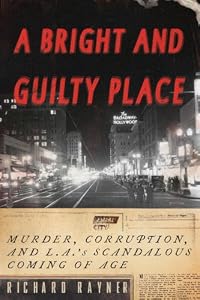
A Bright and Guilty Place: Murder, Corruption, and L.A.'s Scandalous Coming of Age
by Richard Rayner
On This Page
Description
1920s Los Angeles was the fastest growing city in the world, mad with oil fever, get-rich-quick schemes, celebrity scandals, and religious fervor. It was also rife with organized crime, with a mayor and a DA in the pocket of the syndicates. Here, historian Richard Rayner narrates the entwined lives of two men, Dave Clark and Leslie White, who were caught up in the crimes, murders, and swindles of the day. Over a few transformative years, as the boom times shaded into the Depression, the show more adventures of Clark and White would inspire pulp fiction and replace L.A.'s reckless optimism with a new cynicism. Together, theirs is the tale of how the city of sunshine got noir. Key events include the theft of water from the Owens River Valley that let L.A grow, the Teapot Dome scandal, and the emergence of crime writers like Raymond Chandler who helped mythologize L.A.--From publisher description. show lessTags
Recommendations




Member Reviews
This absolutely fascinating book explores Los Angeles and environs from the mid 1920s into the 1930s and details the workings of The System: the intricate web of corruption and wealth that tied together the criminal underworld and police and legal networks. Real crimes--and their cover ups--are described. If this sounds like the stuff of noir authors like Raymond Chandler, Chandler himself was there and plays in own small part in the sordid goings-on. The book goes beyond the reality of graft to show how it inspired a film and literary genre that continues today.
Narrative non-fiction is a rare gift and this book was like Christmas. Rayner makes believable the mystique and mythology of LA noir, which inspired a whole genre of writing (pulp fiction) and film (film noir), through his exhaustive research and the retelling of the lives of two lesser known historical figures whose destinies are interwoven with the glamour and corruption that was LA's messy coming of age.
This was a really fun read. I have grown up in Los Angeles and did not know that this city had so much history. What I like most about this book is the light, pulpy kind of feel to it. It was not dry history - it was actually a page turner.
So why the 3.5 stars? The author has a tendency to wander off on random rabbit trails of facts that don't relate to the main story line. I found this to be somewhat irritating. I found myself scanning forward and skipping paragraphs at times. It did not happen much, but when it did it irked me.
The storyline was fascinating and well documented.
So why the 3.5 stars? The author has a tendency to wander off on random rabbit trails of facts that don't relate to the main story line. I found this to be somewhat irritating. I found myself scanning forward and skipping paragraphs at times. It did not happen much, but when it did it irked me.
The storyline was fascinating and well documented.
Possibly a bit too ambitious for the amount of space he gave himself. Also, the Chandler connection, which suddenly at the end seems so important, felt weak.
Imagine all the corruption, full characters and intertwined stories that read like noir fiction -- but it's real. 1920 - 1930's is told with all the details that seem more like fiction that real life. If llike Chandler or any LA Noir, you will like this book. It is so much easier to understand where the writing comes from and the feeling it leaves you with when the book is closed. It was these real life characters that lead Raymond Chandler to be the writer he was.
A gripping account of an obscure time in Los Angeles' history, the corrupt Twenties.
Ratings
Members
- Recently Added By
Author Information
19+ Works 901 Members
Richard Rayner's work appears in in The New Yorker, The New York Times, the Los Angeles Times and other publications. He lives with his family in Los Angeles.
Awards and Honors
Distinctions
Common Knowledge
- Original publication date
- 2009
- People/Characters
- Charlie Crawford; Leslie White; Dave Clark; E. L. Doheny; Guy McAfee
- Important places
- Graystone Mansion, Beverly Hills, California, USA; Los Angeles, California, USA
- Epigraph
- "Los Angeles - a bright and guilty place." - Orson Welles
- First words
- "Charlie Crawford and Editor Slain!" screamed the headline in the Los Angeles Illustrated Daily News.
- Quotations
- Cities have characters, pathologies that can make or destroy or infect you, states of mind that run through daily life as surely as a fault line. Chandler’s “mysterious something” was a mood of disenchantment, an intens... (show all)e spiritual malaise that identified itself with Los Angeles at a particular time, what we call noir. On the one hand noir is a narrow film genre, born in Hollywood in the late 1930s when a European visual style, the twisted perspectives and stark chiaroscuros of German Expressionism, met an American literary idiom. This fruitful comingling gave birth to movies like Double Indemnity, directed by Vienna-born Billy Wilder and scripted by Raymond Chandler from a James M. Cain novella. The themes—murderous sex and the cool, intricate amorality of money—rose directly from the psychic mulch of Southern California. But L.A. is a city of big dreams and cruelly inevitable disappointments where noir is more than just a slice of cinema history; it’s a counter-tradition, the dark lens through which the booster myths came to be viewed, a disillusion that shadows even the best of times, an alienation that assails the senses like the harsh glitter of mica in the sidewalk on a pitiless Santa Ana day. Noir—in this sense a perspective on history and often a substitute for it—was born when the Roaring Twenties blew themselves out and hard times rushed in; it crystallized real-life events and the writhing collapse of the national economy before finding its interpreters in writers like Raymond Chandler.
"America politics is an arm of business and the aim of business is to make money without care for the law, because politics, controlled by business, can change or buy the law. Politics is interested in profit, not municipal p... (show all)rosperity or civic pride. The spirit of graft and lawlessness is the American spirit.” Each of the cities that Steffens researched was governed by an open alliance with crime, and at the center of that alliance always stood a “boss,” “easier to deal with than the people’s representatives,” a manipulator connecting crime, business, and politics."
With a history of insanity in her family, Bow feared that she’d end up in the madhouse. Maybe all she needed was a rest. After a visit to New York, where she hobnobbed with boxer Jack Dempsey, socialite Jack Whitney, and ga... (show all)ngster Dutch Schultz, she announced that she was returning to L.A. because she wanted to have her nervous breakdown “in the proper surroundings.” The girl from the slums had wit.
Marlowe lived in a beautiful world that had gone wrong, a paradise that would never be restored and in whose existence he had long since ceased to believe. He lived in Los Angeles." - Last words
- (Click to show. Warning: May contain spoilers.)Los Angeles is never just light or dark; it's always both at the same time.
- Canonical DDC/MDS
- 364.1097949409042
- Canonical LCC
- HV6795.L6
Classifications
- Genres
- Nonfiction, History, General Nonfiction, Politics and Government
- DDC/MDS
- 364.1097949409042 — Society, Government, and Culture Social problems and social services Crime Criminal offenses
- LCC
- HV6795 .L6 — Social sciences Social pathology. Social and public welfare. Criminology Social pathology. Social and public welfare. Criminology Crimes and criminal classes
- BISAC
Statistics
- Members
- 157
- Popularity
- 207,906
- Reviews
- 6
- Rating
- (3.71)
- Languages
- English
- Media
- Paper, Audiobook, Ebook
- ISBNs
- 5
- ASINs
- 4