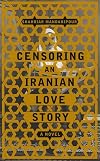
Censoring an Iranian Love Story
by Shahriar Mandanipour
On This Page
Description
Shahriar Mandanipour, a contemporary and controversial Iranian writer, presents his first novel written in English. Seamlessly entwining two related narratives, Mandanipour unfolds the tale of an Iranian writer attempting to pen a love story set in present-day Iran. Similar to Romeo and Juliet, the writer's two lovers struggle to endure against powerful external forces. Unfortunately, though, the Ministry of Culture and Islamic Guidance furiously attempts to censor the writer's work.Tags
Recommendations






















Member Reviews
I loved this book. Some postmodern-style stories within stories are clever but only intellectually engaging. Some stories of oppressive societies are informative but depressing (and many descend into wholesale disacticism). On the other hand, Censoring an Iranian Love Story playfully treads the fine line between these perilous extremes with aplomb, ably abetted by Sara Khalili's effortless translation. Mandanipour transports us to a Tehran where the mystic lyricism of Persia sits juxtaposed with its modern repression and satirises what the Iranian nation has become. Yet there is more than one love story here. . .
Here’s a good novel of an Iranian novelist whose careful writing of a love story must pass inspection from the powerful censor at the Ministry of culture and Islamic Guidance. This novel has an original, playful style. The author addresses his characters directly, but sometimes they have a will of their own. The love story-within-a-story doesn’t amount to much, but it’s clear from this novel’s viewpoint that how could it? Every possible scene of the man and woman trying to get to know each other must be carefully scrutinized and watered down. It’s fun to read the actual assorted typeface in this novel, especially to read through the author’s strikethroughs in his story to see how truly beautiful the story could be if given show more the chance. The (real) author notes state that Mandanipour, now a visiting professor at Harvard, has himself been unable to publish his books in Iran due to censorship. What I found most interesting was the plight of modern Iranians in the oppressive Islamic state. Quite a fascinating read. show less
Censoring an Iranian Love Story actually tells three stories: the (fictional) author's struggle to get his work past the overbearing government censor, the love story that he'd like to write, and the bland and inoffensive work which he actually hands over to the censor in hopes that it may see the light of day. Sara and Dara are the young Iranian couple who inconveniently fall in love - despite the difficulty of writing a romance in Iran, and despite the "censorship" in action by the fundamentalist post-Revolution Iranian society.
Much of this book made me mourn the effects that the Revolution have had; Iran has been creating beautiful and intricate art and culture for much longer than most of the world - think of everything that came show more out of Persia at its peak - and now the entire culture is stifled under the Islamic fundamentalism that governs the country's imposed morality. Censoring an Iranian Love Story teaches a lot about Iranian culture, and crafts a unique method of satire with its storytelling. Great and interesting book. show less
Much of this book made me mourn the effects that the Revolution have had; Iran has been creating beautiful and intricate art and culture for much longer than most of the world - think of everything that came show more out of Persia at its peak - and now the entire culture is stifled under the Islamic fundamentalism that governs the country's imposed morality. Censoring an Iranian Love Story teaches a lot about Iranian culture, and crafts a unique method of satire with its storytelling. Great and interesting book. show less
I’m fascinated by Censoring an Iranian Love Story. There’s an inflection, a way in which the narrator structures his sentences, which I love. Mandanipour’s writing style is distinctively Middle Eastern (in contrast to a Western author writing about the Middle East). There’s a poetic formality to his phrasing, yet at the same time a lightness to his overall prose that keeps the novel from becoming too dense. Shahriar Mandanipour describes his country as only a hometown boy does – with understanding, a tinge of sadness and a hefty dose of irony.
The novel’s premise, and the goal of the book’s narrator – Mandanipour’s thinly veiled alter ego – is to write a love story and see it published in Iran.
" …for reasons that show more like other writers I will probably discover later, I, with all my being, want to write a love story. The love story of a girl who has never seen the man who has been in love with her for a year and whom she loves very much. A story with an ending that is a gateway to light. A story that, although it does not have a happy ending like romantic Hollywood movies, still has an ending that will not make my reader afraid of falling in love. And, of course, a story that cannot be labeled as political. My dilemma is that I want to publish my love story in my homeland… Unlike in many countries around the world, writing and publishing a love story in my beloved Iran are not easy tasks."
To accomplish these tasks he needs to get past the Ministry of Culture and Islamic Guidance, the embodiment of which is the character of Mr. Petrovich. And so a large part of the narrative is taken up by the author examining and second guessing his characters’ actions; deciding what can be said openly and what should be implied. His hope is that though he will need to compromise, it will not be at the expense of artistic integrity. Our narrator believes, naively, that he will be able to reason with the Ministry.
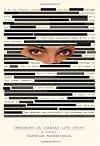
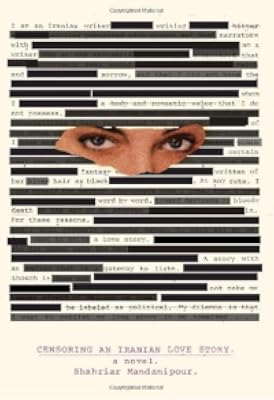
The love story, about an Iranian couple named Dara & Sara, is printed in bold text. It is constantly interrupted by the author’s explanations, protests, insertions of himself into the narrative action and self-censorship. Entire passages are crossed out with black lines (but are still legible for the sake of the reader). Censoring an Iranian Love Story, visually, has a very Tristram Shandy feel to it. And while the love story is poignant: star-crossed lovers separated by government, economics and class; a more complicated metafiction is told over and around it.
One of the things I found unusual about Censoring an Iranian Love Story is the playful way in which Mandanipour deals with what could easily become pretty depressing subject matter. At no point did I doubt the accuracy of his descriptions – I’ve read other books and so I was prepared me for the culture shock of Iran. But this is where irony plays a key role: much like families will tell funny anecdotes about crazy uncles and disastrous vacations, Mandanipour’s narrator describes his homeland with both humor and affection. And while there are obvious fantastical asides, some embroidery of the facts, the novel captures the essence of a country and city that simultaneously inspires and infuriates. Shahriar Mandanipour’s love story is not just about the relationship between his hero and heroine. It is about his love affair with Iran.
Unfortunately, these two love stories seem destined to only end badly. I read that because of this novel Shahriar Mandanipour cannot return to Iran. The obstacles that Dara, Sara and scores of Iranian youth face appear insurmountable. But, despite a gloomy outlook, for two hundred and ninety-five pages the reader is treated to a magical story inhabited by One Thousand and One Nights, flying carpets, a hunchbacked midget, alchemists and ghosts. Again and again Mandanipour’s narrator invites us to “Ask so that I can explain…”
And the explanations are beautiful. There is a delicate intricacy to Censoring an Iranian Love Story which, combined with the tone of the writing and the psychologically complex characters at the novel’s center, will not fail to enchant.
Due out in paperback, from Vintage, on June 1st
For the full review, please visit my blog at Booksexy.wordpress.com show less
The novel’s premise, and the goal of the book’s narrator – Mandanipour’s thinly veiled alter ego – is to write a love story and see it published in Iran.
" …for reasons that show more like other writers I will probably discover later, I, with all my being, want to write a love story. The love story of a girl who has never seen the man who has been in love with her for a year and whom she loves very much. A story with an ending that is a gateway to light. A story that, although it does not have a happy ending like romantic Hollywood movies, still has an ending that will not make my reader afraid of falling in love. And, of course, a story that cannot be labeled as political. My dilemma is that I want to publish my love story in my homeland… Unlike in many countries around the world, writing and publishing a love story in my beloved Iran are not easy tasks."
To accomplish these tasks he needs to get past the Ministry of Culture and Islamic Guidance, the embodiment of which is the character of Mr. Petrovich. And so a large part of the narrative is taken up by the author examining and second guessing his characters’ actions; deciding what can be said openly and what should be implied. His hope is that though he will need to compromise, it will not be at the expense of artistic integrity. Our narrator believes, naively, that he will be able to reason with the Ministry.
The love story, about an Iranian couple named Dara & Sara, is printed in bold text. It is constantly interrupted by the author’s explanations, protests, insertions of himself into the narrative action and self-censorship. Entire passages are crossed out with black lines (but are still legible for the sake of the reader). Censoring an Iranian Love Story, visually, has a very Tristram Shandy feel to it. And while the love story is poignant: star-crossed lovers separated by government, economics and class; a more complicated metafiction is told over and around it.
One of the things I found unusual about Censoring an Iranian Love Story is the playful way in which Mandanipour deals with what could easily become pretty depressing subject matter. At no point did I doubt the accuracy of his descriptions – I’ve read other books and so I was prepared me for the culture shock of Iran. But this is where irony plays a key role: much like families will tell funny anecdotes about crazy uncles and disastrous vacations, Mandanipour’s narrator describes his homeland with both humor and affection. And while there are obvious fantastical asides, some embroidery of the facts, the novel captures the essence of a country and city that simultaneously inspires and infuriates. Shahriar Mandanipour’s love story is not just about the relationship between his hero and heroine. It is about his love affair with Iran.
Unfortunately, these two love stories seem destined to only end badly. I read that because of this novel Shahriar Mandanipour cannot return to Iran. The obstacles that Dara, Sara and scores of Iranian youth face appear insurmountable. But, despite a gloomy outlook, for two hundred and ninety-five pages the reader is treated to a magical story inhabited by One Thousand and One Nights, flying carpets, a hunchbacked midget, alchemists and ghosts. Again and again Mandanipour’s narrator invites us to “Ask so that I can explain…”
And the explanations are beautiful. There is a delicate intricacy to Censoring an Iranian Love Story which, combined with the tone of the writing and the psychologically complex characters at the novel’s center, will not fail to enchant.
Due out in paperback, from Vintage, on June 1st
For the full review, please visit my blog at Booksexy.wordpress.com show less
I highly recommend this one. The book uses a very creative and original (to me anyway) method to tell the story of life in present day Iran, particularly for a writer attempting to write a love story that can be published in Iran. The government reviews all publications. The Ministry of Culture and Islamic Guidance must issue a permit for any work of literature to be published there. The book switches back and forth between the story being written by the author, with the objectionable portions being shown struck-through, but still legible, to show the censorship that is required, and other portions where the author is speaking directly to the reader about the censoring process and discussing Iranian history and other contextual matters. show more Then the story he is writing bleeds into the other portion, in part by the author writing for us what he would want to write but dares not to even show to the government's censor. Also, the story begins later in the book to take on a life of its own, with events occurring that are not within the author's control and the characters taking on a life of their own. show less
sjmccreary provided an excellent review with a great plot summary, (going chronologically, see the review just before mine), so I'll just add a few more points. "Censoring an Iranian Love Story" is very much a book about how writers pursue their craft -- how they develop characters, how they decide what situations to put their characters in, and how they decide the fate of those characters.
But author Shariar Mandanipour is writing in Iran, a country in which one isn't able to speak freely without fear of censorship or reprisal. So his exploration isn't simply of the writing process, but of how people are forced to function under a repressive government.
This makes "Censoring an Iranian Love Story" an intriguing look at the subterfuge show more exercised by ordinary Iranians struggling to have meaningful lives, but also means the novel isn't a rich plunge into the emotions of two would-be lovers. The novel is satisfying and enlightening on an intellectual level; it vividly conjures the sensation of always looking over your shoulder for the thought police and how that cripples the soul -- not just of artists, but of everyone. And it gives a chilling take on the nature of governmental control. But be forewarned, any reader looking for a traditional tale of love and loss will find this novel frustrating. show less
But author Shariar Mandanipour is writing in Iran, a country in which one isn't able to speak freely without fear of censorship or reprisal. So his exploration isn't simply of the writing process, but of how people are forced to function under a repressive government.
This makes "Censoring an Iranian Love Story" an intriguing look at the subterfuge show more exercised by ordinary Iranians struggling to have meaningful lives, but also means the novel isn't a rich plunge into the emotions of two would-be lovers. The novel is satisfying and enlightening on an intellectual level; it vividly conjures the sensation of always looking over your shoulder for the thought police and how that cripples the soul -- not just of artists, but of everyone. And it gives a chilling take on the nature of governmental control. But be forewarned, any reader looking for a traditional tale of love and loss will find this novel frustrating. show less
Novels that tackle important subjects often score more highly for worthiness than pleasure, but in this book Mandanipour makes ample use of humour to highlight the absurdity of the constraints under which Iranians have lived since the revolution of 1979. In bold text are the words of a love story involving a young couple in Tehran. Some of the words and sentences are crossed out to indicate sections removed by the author. Meanwhile, in normal weight text there is a running commentary from the author of this story, spelling out the reasons behind his changes, speculating on what he or his characters will do next, or explaining things that might not be understood by readers outside Iran. It was a relief for once to find a novel within a show more novel appearing in bold font, instead of the old and often annoying practice of using italics to distinguish between one and the other.
Reading this book was both educational and entertaining. I knew very little about Iran before I read it, now I have a much better idea of its contemporary situation, even if only from one viewpoint. show less
Reading this book was both educational and entertaining. I knew very little about Iran before I read it, now I have a much better idea of its contemporary situation, even if only from one viewpoint. show less
Members
- Recently Added By
Lists

Middle East Fiction
179 works; 16 members
Author Information

6 Works 488 Members
Some Editions
Series
Belongs to Publisher Series
A tot vent (538)
Common Knowledge
- People/Characters
- Sara; Dara; Sinbad; Mr. Petrovich
- Important places
- Tehran, Iran
- Epigraph
- The tale of he who a treasure map found that out some gate should you take leave there sits a dome, if your back to the dome you turn and your face fronting Mecca, and an arrow you slight, whither the arrow falls a treasure t... (show all)rove lies. He went and arrows he let fly, so much so that he despaired, he did not find. And this news reached the King. Long-range archers arrows let fly, indeed naught was found. WHen to his Holiness he appealed, unto him it was inspired that we did not bid to pull the bow-string. Arrow in the bow he set, there before him it fell.
Shams Tabrizi (D. 1248) - Dedication
- To Robert Coover, Karen Kennerly, Sara Khalili, James Kimmel, and Jane Unrue, without whose faith and fellowship writing this novel would not have been possible
Classifications
- Genres
- Fiction and Literature, General Fiction
- DDC/MDS
- 891.5533 — Literature & rhetoric Literatures of other languages East Indo-European and Celtic literatures Iranian literatures Modern Persian / Farsi literature (8th century CE to present) Persian fiction 1900–2000
- LCC
- PK6561 .M236 .C46 — Language and Literature Indo-Iranian languages and literatures Indo-Iranian philology and literature Iranian philology and literature New Persian Literature Individual authors or works
- BISAC
Statistics
- Members
- 400
- Popularity
- 78,116
- Reviews
- 23
- Rating
- (3.73)
- Languages
- 8 — Catalan, Dutch, English, French, German, Greek, Italian, Spanish
- Media
- Paper, Audiobook, Ebook
- ISBNs
- 19
- ASINs
- 4