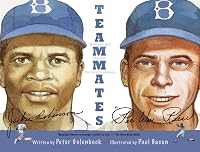
Teammates
by Peter Golenbock
On This Page
Description
Describes the racial prejudice experienced by Jackie Robinson when he joined the Brooklyn Dodgers and became the first black player in Major League baseball and depicts the acceptance and support he received from his white teammate Pee Wee Reese.Tags
Recommendations



Member Reviews
With the opening of another baseball season, and the 67th anniversary this week of Jackie Robinson’s breaking of the modern color barrier in Major League Baseball, the time is most appropriate to read and review the picture book, “Teammates.” Written in 1990 by sports book author Peter Golenbock, and illustrated with watercolors by Paul Bacon and historic photographs, the book explores the relationship between Robinson and one of his Brooklyn Dodgers teammates – shortstop Harold “Pee Wee” Reese.
The publisher lists the book as recommended for young children in grades K-4, and I would agree with that recommendation. I have some quibbles with some of the language in the book and the abruptness of the ending, but I also think show more the book would be a good tool for teachers to introduce young children to the story of segregation in America and Jackie Robinson’s breakthrough.
The book opens with a most welcome history of the Negro Major Leagues where Jackie Robinson first played before being signed by Dodgers president and general manager Branch Rickey. Many great African American players – those who eventually made it to the Major Leagues (like Satchel Paige) and many who did not – spent their best years in the Negro Major Leagues. “Teammates” describes their life in the Negro Leagues in segregated America, contrasting it with the softer and more lucrative life for players in the major leagues. Jackie Robinson’s career in the Negro Leagues is an often overlooked part of his story, and I appreciated its inclusion here.
I found the book too quick to confine the hostility to Robinson arrival in the Major Leagues to Southern-born ballplayers and fans in Southern cities. It is true that some Southern-born Dodger players started a petition to have Robinson kicked off the team (a petition that Pee Wee Reese refused to sign), but the fact is some of Robinson’s harshest treatment came at the hands of fans and players in Northern cities. Robinson himself often recounted that Boston and Philadelphia fans and players were some of the worst offenders.
The focus and climax of the book concerns an incident involving Reese and Robinson said to have occurred during a game in Cincinnati during Robinson’s rookie season of 1947. Fans were jeering Robinson with no let up, and Reese – the man from nearby Louisville – showed his solidarity by walking across the diamond from his shortstop position to Robinson at first base, and put his arm around him. According to the book, Reese’s action resulted in an “audible gasp” and then “silence” from the crowd.
The story has taken on legendary proportions over the years, recounted in detail in the 2013 film about Robinson entitled, “42.” There was even a statue depicting the incident erected in 2005 outside a Coney Island minor league ballpark, dedicated by both Robinson and Reese’s widows.
Nevertheless, there is some dispute about whether the incident happened at all, or whether it happened in 1947 in Cincinnati as described in this book and the recent film. The book’s dust jacket states that the story was told to the author during an oral history interview with another one of Robinson’s Dodger teammates – pitcher Rex Barney, who pitched in Cincinnati that day.
But a 2013 report by ESPN writer Brian Cronin in reaction to the movie explains that there are no contemporary accounts of the incident at all in either the white or Negro press of the day, and Robinson himself and other Dodger teammates did not mention it until years later, and remembered it taking place in 1948 in Boston. Of course, if the actual time and place of the incident was 1948 in Boston, it would still have been significant (racism directed at Robinson certainly did not end during his rookie season), but would not have the same poignancy of taking place in close proximity of Reese’s hometown during Robinson’s rookie season “trial by fire.”
So if we are judging this book in part on its accuracy, what are we to make of these somewhat disputed facts regarding its central story? Well, as I read the book, I could not help thinking of Betsy Ross and George Washington. Betsy Ross did not sew the first American flag, nor did George Washington chop down a cherry tree. Both stories were invented years later by those trying to say something allegorical to children about the United States through these individuals, and contribute something useful to what might be called “the American character” or “American mythology.” As a history teacher, I usually wince at these made-up stories, mainly because they are so often carried by children into adulthood, and obscure facts that are more interesting or more important than the myths.
Yet in the case of “Teammates,” I find myself rather sympathetic to leaving the story and this book for young children alone. The story recounts how one teammate showed kindness to another teammate in the midst of cruelty, and that is not a bad lesson for young children to learn, regardless of any dispute over the fine grain details of the story.
What is not in dispute is that Jackie Robinson was an enormously important cultural figure in the fight for civil rights and integration in the United States– in his own way and given the cultural significance of baseball at the time, perhaps as important as Rosa Parks. And maybe it is not as essential that young children know the exact details of the story of his life, as it is for them to know that he lived, he changed America for the better, and he was helped along the way by a white teammate from Louisville, Kentucky named Pee Wee Reese who accepted him as he was, and became his lifelong friend. show less
The publisher lists the book as recommended for young children in grades K-4, and I would agree with that recommendation. I have some quibbles with some of the language in the book and the abruptness of the ending, but I also think show more the book would be a good tool for teachers to introduce young children to the story of segregation in America and Jackie Robinson’s breakthrough.
The book opens with a most welcome history of the Negro Major Leagues where Jackie Robinson first played before being signed by Dodgers president and general manager Branch Rickey. Many great African American players – those who eventually made it to the Major Leagues (like Satchel Paige) and many who did not – spent their best years in the Negro Major Leagues. “Teammates” describes their life in the Negro Leagues in segregated America, contrasting it with the softer and more lucrative life for players in the major leagues. Jackie Robinson’s career in the Negro Leagues is an often overlooked part of his story, and I appreciated its inclusion here.
I found the book too quick to confine the hostility to Robinson arrival in the Major Leagues to Southern-born ballplayers and fans in Southern cities. It is true that some Southern-born Dodger players started a petition to have Robinson kicked off the team (a petition that Pee Wee Reese refused to sign), but the fact is some of Robinson’s harshest treatment came at the hands of fans and players in Northern cities. Robinson himself often recounted that Boston and Philadelphia fans and players were some of the worst offenders.
The focus and climax of the book concerns an incident involving Reese and Robinson said to have occurred during a game in Cincinnati during Robinson’s rookie season of 1947. Fans were jeering Robinson with no let up, and Reese – the man from nearby Louisville – showed his solidarity by walking across the diamond from his shortstop position to Robinson at first base, and put his arm around him. According to the book, Reese’s action resulted in an “audible gasp” and then “silence” from the crowd.
The story has taken on legendary proportions over the years, recounted in detail in the 2013 film about Robinson entitled, “42.” There was even a statue depicting the incident erected in 2005 outside a Coney Island minor league ballpark, dedicated by both Robinson and Reese’s widows.
Nevertheless, there is some dispute about whether the incident happened at all, or whether it happened in 1947 in Cincinnati as described in this book and the recent film. The book’s dust jacket states that the story was told to the author during an oral history interview with another one of Robinson’s Dodger teammates – pitcher Rex Barney, who pitched in Cincinnati that day.
But a 2013 report by ESPN writer Brian Cronin in reaction to the movie explains that there are no contemporary accounts of the incident at all in either the white or Negro press of the day, and Robinson himself and other Dodger teammates did not mention it until years later, and remembered it taking place in 1948 in Boston. Of course, if the actual time and place of the incident was 1948 in Boston, it would still have been significant (racism directed at Robinson certainly did not end during his rookie season), but would not have the same poignancy of taking place in close proximity of Reese’s hometown during Robinson’s rookie season “trial by fire.”
So if we are judging this book in part on its accuracy, what are we to make of these somewhat disputed facts regarding its central story? Well, as I read the book, I could not help thinking of Betsy Ross and George Washington. Betsy Ross did not sew the first American flag, nor did George Washington chop down a cherry tree. Both stories were invented years later by those trying to say something allegorical to children about the United States through these individuals, and contribute something useful to what might be called “the American character” or “American mythology.” As a history teacher, I usually wince at these made-up stories, mainly because they are so often carried by children into adulthood, and obscure facts that are more interesting or more important than the myths.
Yet in the case of “Teammates,” I find myself rather sympathetic to leaving the story and this book for young children alone. The story recounts how one teammate showed kindness to another teammate in the midst of cruelty, and that is not a bad lesson for young children to learn, regardless of any dispute over the fine grain details of the story.
What is not in dispute is that Jackie Robinson was an enormously important cultural figure in the fight for civil rights and integration in the United States– in his own way and given the cultural significance of baseball at the time, perhaps as important as Rosa Parks. And maybe it is not as essential that young children know the exact details of the story of his life, as it is for them to know that he lived, he changed America for the better, and he was helped along the way by a white teammate from Louisville, Kentucky named Pee Wee Reese who accepted him as he was, and became his lifelong friend. show less
While I am a huge fan of sports and I am knowledgable of many of the instances of integration in other sports like in football and basketball, I never really knew very much at all about one of our nation's most famous instances of the integration of professional sports, Jackie Robinson. I had known of the two league system that was around for 'America's Pastime' back in the 1940's and how the "white league" was much better paid, had nicer accommodations when they travelled, and were placed on trading cards to become world famous. As you could expect, when Jackie Robinson first appeared in a Brooklyn Dodgers Uniform, he received a lot of hatred from both the other team as well as by his fellow teammates. I had no idea of the efforts of show more Pee Wee Reese, the Shortstop for the Dodgers who was being replaced by Jackie Robinson, and how he stuck up for Jackie Robinson. I never really knew the full story of Jackie Robinson, but I am glad I took the time to learn about this powerful moment in history. show less
This is a partial biography about Jackie Robinson. It covers only his first year as a professional baseball player. What makes him special is the fact that he was the first African-American professional baseball player ever. This books starts out explaining how things were different at that time, and how there were two leagues. Once the manager calls Jackie and he agrees to play it discusses all of the different issues he faced. He was segregated from his teammates and at one point they wanted to vote him off the team. One man refused to vote and so they were forced to play with him. In Cincinnati, as the crowd was taunting Jackie and throwing things at him, Peewee Reese walks across the field, shakes his hand, and says "I stand by him, show more this man is my teammate." After this, America became more accepting of Jackie and he opened the opportunity for many other African-American players to join teams.
I loved this book. The simplicity of it was beautiful because it highlighted only the most important facts. The details in the illustrations of how he felt isolated and alone were touching. By the end of the book I was in tears.
In my classroom I would use this book for literature circles. After reading this book, the children will break into small groups and discuss how things have changed since then. How they would feel if it were them, and how this book could help them become more accepting of everyone. When they are done with the discussion they will create a word-poster containing words that are hurtful to others, and words they should be using. show less
I loved this book. The simplicity of it was beautiful because it highlighted only the most important facts. The details in the illustrations of how he felt isolated and alone were touching. By the end of the book I was in tears.
In my classroom I would use this book for literature circles. After reading this book, the children will break into small groups and discuss how things have changed since then. How they would feel if it were them, and how this book could help them become more accepting of everyone. When they are done with the discussion they will create a word-poster containing words that are hurtful to others, and words they should be using. show less
This was a spectacular book about the true story of Jackie Robinson. The book had a strong message about friendship, and accepting others no matter what the color of their skin is.
I enjoyed the historical aspect of this book. This book told the true story of Jackie Robinson, including the most important moments like the the MLB owner approached him and said "I want a man with the courage to not fight back," because he knew how much people would put Jackie through, and Jackie agreed.
I also really liked the message and one of the main supporting characters; Pee Wee Reese. This book wasn't just about accepting others, it was about having the courage to stand up for others when they aren't being accepted or treated equally. This book show more climaxed when fans were all harassing Jackie while he was playing first base. Pee Wee stopped the game, came over to him and embraced him; telling the crowd "this is my teammate, and my friend." This silenced the fans, then even sparked some cheers and allowed the game to proceed. show less
I enjoyed the historical aspect of this book. This book told the true story of Jackie Robinson, including the most important moments like the the MLB owner approached him and said "I want a man with the courage to not fight back," because he knew how much people would put Jackie through, and Jackie agreed.
I also really liked the message and one of the main supporting characters; Pee Wee Reese. This book wasn't just about accepting others, it was about having the courage to stand up for others when they aren't being accepted or treated equally. This book show more climaxed when fans were all harassing Jackie while he was playing first base. Pee Wee stopped the game, came over to him and embraced him; telling the crowd "this is my teammate, and my friend." This silenced the fans, then even sparked some cheers and allowed the game to proceed. show less
Teammates takes the reader back into time through the story of Jackie Robinson, the first black player to try out for a Major League Team. I really liked this book; I thought it was a very informative, yet touching story. Although it was told by a narrater, the story shared a lot of real information and experiences. One way the story did this was by incorporating authentic photographs. The story becomes real when the reader can view actual photographs from that time. For example, a photograph of the Dodgers baseball team was included in the story. In it, the reader can see for themselves that Jackie was the only black player in the entire team, which makes this part of the story more than just a story.
Along with this, I also found the show more story touched on tough issues such as equality for all races. In the story, Jackie experiences abuse and hostility from fans, and even from his own teammates. Finally, one of Jackie's teammates, PeeWee, takes a stand. While everyone is treating Jackie like he shouldn't be allowed to play, PeeWee stands next to him and calls him his "teammate." Overall, this tough issue is exactly what the main idea is about: Treat everyone equal. This was a harsh time period, where people were treated differently just because of their skin color. Young readers can experience the pain this can cause, and also see that it only takes one person to stand against it. With this experience, they can make a change in the world by treating everyone equal regardless of their skin color. show less
Along with this, I also found the show more story touched on tough issues such as equality for all races. In the story, Jackie experiences abuse and hostility from fans, and even from his own teammates. Finally, one of Jackie's teammates, PeeWee, takes a stand. While everyone is treating Jackie like he shouldn't be allowed to play, PeeWee stands next to him and calls him his "teammate." Overall, this tough issue is exactly what the main idea is about: Treat everyone equal. This was a harsh time period, where people were treated differently just because of their skin color. Young readers can experience the pain this can cause, and also see that it only takes one person to stand against it. With this experience, they can make a change in the world by treating everyone equal regardless of their skin color. show less
I liked this book for two main reasons. The first reason was that there were real images included of the people pertaining to the story, like Jackie Robinson and Branch Ricky. I think that it is very interesting and attention capturing for the readers. It makes the story more realistic, because readers are able to visualize the real people that it is about. I also liked that this story addresses the topic of segregation in sports in a way that would make sense to children. I enjoyed the direct quote that was included from the real Peewee Reese which read, " I don't care if this man is black, blue, or striped. He can play and help us win. That's what counts." This quote sends a powerful message from a direct source during this time show more period. The big message in this book is that it is important to stick up for what is right, no matter how much you may be criticized for it. show less
This book was a very straight forward story about how a white player for the Brooklyn Dodgers name PeeWee learns that his teammate Jackie Robinson is a great player who deserves to be on the Dodgers team, regardless of his skin color. I loved how the main characters were portrayed in this book. Jackie remains calm despite being taunted and hated by his teammates and baseball fans across the country. PeeWee stands up for Jackie, though he has always grown up around segregation, because he knows Jackie is a good player and should be treated as an equal. Both characters, especially being professional baseball players, are fantastic role models for readers. I also like that the book included real pictures related to the story along with the show more illustrations. Many books create pictures of what they think the players would look like, so it was a nice to see what the actual players and important people looked like. Overall, I thought this book is a great example of how real professional athletes learned to overcome prejudice and work together. show less
Members
- Recently Added By
Published Reviews
ThingScore 100
[Starred Review] ... [This book is a] graceful, lucid account of the pivotal events that began with Branch Rickey's decision to hire Jackie Robinson as the first Negro League star of a major league team. Golenbock is candid about... the ugly reception Robinson had from both the public and his new team, until--in the book's moving climax--Pee Wee Reese made a public move to stand by Robinson. show more Bacon's skillful, realistic illustrations, used in combination with occasional well-chosen photos, are as eloquent as the simple text. show less
added by CourtyardSchool
Set in 1947, Teammates concerns a little-known episode about Brooklyn Dodgers' second baseman Jackie Robinson and the integration of baseball. When Dodgers shortstop Pee Wee Reese, incensed by the abuse coming from a Cincinnati crowd, determined to "take a stand," he put an arm around his teammate's shoulder; this simple gesture symbolized the end of the "color line'' in major league show more baseball--and the beginning of a great friendship. ... Golenbock's bold and lucid style distills this difficult issue, and brings a dramatic tale vividly to life. Bacon's spare, nostalgic watercolors, in addition to providing fond glimpses of baseball lore, present a haunting portrait of one man's isolation. Historic photographs of the major characters add interest and a touch of stark reality to an unusual story, beautifully rendered. show less
added by CourtyardSchool
Lists

Picture Books About Civil Rights
51 works; 4 members

Mensa for Kids Excellence in Reading Award Program (Nonfiction)
54 works; 4 members
Author Information

41+ Works 3,084 Members
Peter Golenbock is a prolific sports journalist and author. He was born in New York City on July 19, 1946 and raised in Stamford, Connecticut. He graduated from Dartmouth College in 1967 and the New York University School of Law in 1970. While at Dartmouth, he began writing about sports for The Daily Dartmouth, which led to stints with the New show more York Times and the Boston Globe. It was also at Dartmouth where he became friends with Robert Ariel "Red" Rolfe, the former New York Yankees third baseman and the school's athletic director. Rolfe entertained him for hours with stories of the famous Yankees teams of the 1930's, which had a profound impact on Golenbock's unintended career path. After graduating law school, he eventually landed a job in the legal department of Prentice-Hall Publishing. Surprisingly, he was able to convince the head of the trade book division to allow him to write about the Yankees. The resulting book, Dynasty: The New York Yankees 1949-64, became an instant bestseller, the first of many for Golenbock. Among his best-known works to follow include; The Bronx Zoo, Bums: An Oral History of the Brooklyn Dodgers, Balls, with Graig Nettles, Bats, with Davey Johnson, Personal Fouls, a look at corruption in college basketball, and Teammates, a children's book about the relationship between Jackie Robinson and Pee Wee Reese. His latest work is entitled Rage: The Legend of "Baseball Bill" Denehy. (Bowker Author Biography) show less
Awards and Honors
Awards
Common Knowledge
- People/Characters
- Jackie Robinson; Pee Wee Reese
Classifications
- Genres
- Sports and Leisure, Nonfiction
- DDC/MDS
- 796.357 — Arts & recreation Recreation, sports, and performing arts Athletic and outdoor sports and games Ball sports Ball and stick sports Baseball
- LCC
- GV865 .A1 .G64 — Geography, Anthropology and Recreation Recreation. Leisure Recreation. Leisure Sports Ball games: Baseball, football, golf, etc.
- BISAC
Statistics
- Members
- 1,267
- Popularity
- 19,329
- Reviews
- 67
- Rating
- (4.26)
- Languages
- English, Spanish
- Media
- Paper, Ebook
- ISBNs
- 15
- ASINs
- 6