On This Page
Description
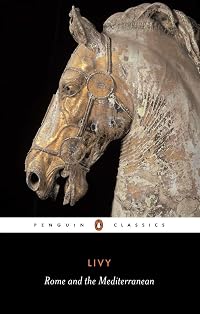
Books XXXI to XLV cover the years from 201 b.c. to 167 b.c., when Rome emerged as ruler of the Mediterranean. For more than seventy years, Penguin has been the leading publisher of classic literature in the English-speaking world. With more than 1,700 titles, Penguin Classics represents a global bookshelf of the best works throughout history and across genres and disciplines. Readers trust the series to provide authoritative texts enhanced by introductions and notes by distinguished show more scholars and contemporary authors, as well as up-to-date translations by award-winning translators. show lessTags
Recommendations












Member Reviews
Titus Livius Patavinus (named for his birthplace, Padua) was originally a teacher of rhetoric and apparently, from casual references in his writing, a friend of the Emperor Augustus. Perhaps the emperor, as part of his program to glorify Rome, suggested that Livy stop teaching and write a history of the city. The project represented a challenge. His only sources were traditions, the official temple annals listing the consuls and the chief events of each year, and personal records, frequently exaggerated, kept by the famous families. In The History of Rome, Livy attempts to narrate the history of nearly eight centuries, from the time of Romulus and Remus to the reign of Tiberius. The work comprised 142 books, of which barely a quarter show more have been preserved: books 1-10 and 21-45, along with some fragments of several others. Even so, this material is enough to fill six volumes in one English translation and thirteen in another.
Like Herodotus, Livy was always attracted to a colorful story. Thomas Macaulay declared in disgust: "No historian with whom we are acquainted has shown so complete indifference to the truth." Probably a truthful chronicle was not what Livy set out to produce. In addition to his patriotic duty, he wanted by his dramatic power and the charm of his style to impress the sophisticated readers of Rome. Accuracy came second. He was no soldier in his battles, no statesman in recording the problems of government; even as a geographer he was most hazy. In an epoch when research was unknown, he was no critical historian. When he found two conflicting accounts, he was likely to choose the more colorful, or include both and let the reader be the judge.
The History of Rome was issued in decades, or units of ten, a volume at a time, the first between 27 and 25 B.C.E., at the time Vergil was writing his Aeneid. The work did what the author intended: painted vividly the grandeur of Rome, even though, like an artist, he sometimes changed details for better composition. Whatever his faults as a historian, Livy the novelist, the dramatist, and the orator left unforgettable pages for readers of later generations.
It is a wonder that so much of Livy’s work has come down to the present; he had many enemies. Pope Gregory I, for example, ordered all available copies burned because of the superstitions they contained, and other Church fathers were also to blame for the hundred books that have disappeared, including those about Livy’s own times. More than one modern historian has wished he could exchange the first ten books available for those in which Livy set down what he had witnessed, rather than heard or read. Few, however, would willingly give up the books dealing with the sixteen years of the Punic Wars, the story of the life and death struggle between Rome and Carthage.
"It would be a satisfaction to me," declares Livy in the preface to the first decade of his history, "that I have contributed my share to perpetuate the achievements of a people, the lords of the world." He determines "neither to affirm nor refute" the traditions antedating the founding of Rome, even though they were "more suited to the fiction of poetry than to the genuine record of history." In writing them down, however, his aim is to acquaint the Romans of his day with the lives and customs of ancestors who might serve as examples in the present low moral status of Rome, "when we can neither endure our vices nor their remedies."
An additional fifteen books of Livy’s history survive, dealing with Roman expansion in Greece and Asia and ending when Macedonia became a Roman province. This story is an anticlimax. No longer were the soldiers fighting for the life of Rome, but the plunder they hoped to acquire, so that the reader does not follow the story with the same interest. Even in these pages, however, the storytelling ability of Livy is still apparent. It is easy to understand why he was called the greatest prose writer of the Age of Augustus. show less
Like Herodotus, Livy was always attracted to a colorful story. Thomas Macaulay declared in disgust: "No historian with whom we are acquainted has shown so complete indifference to the truth." Probably a truthful chronicle was not what Livy set out to produce. In addition to his patriotic duty, he wanted by his dramatic power and the charm of his style to impress the sophisticated readers of Rome. Accuracy came second. He was no soldier in his battles, no statesman in recording the problems of government; even as a geographer he was most hazy. In an epoch when research was unknown, he was no critical historian. When he found two conflicting accounts, he was likely to choose the more colorful, or include both and let the reader be the judge.
The History of Rome was issued in decades, or units of ten, a volume at a time, the first between 27 and 25 B.C.E., at the time Vergil was writing his Aeneid. The work did what the author intended: painted vividly the grandeur of Rome, even though, like an artist, he sometimes changed details for better composition. Whatever his faults as a historian, Livy the novelist, the dramatist, and the orator left unforgettable pages for readers of later generations.
It is a wonder that so much of Livy’s work has come down to the present; he had many enemies. Pope Gregory I, for example, ordered all available copies burned because of the superstitions they contained, and other Church fathers were also to blame for the hundred books that have disappeared, including those about Livy’s own times. More than one modern historian has wished he could exchange the first ten books available for those in which Livy set down what he had witnessed, rather than heard or read. Few, however, would willingly give up the books dealing with the sixteen years of the Punic Wars, the story of the life and death struggle between Rome and Carthage.
"It would be a satisfaction to me," declares Livy in the preface to the first decade of his history, "that I have contributed my share to perpetuate the achievements of a people, the lords of the world." He determines "neither to affirm nor refute" the traditions antedating the founding of Rome, even though they were "more suited to the fiction of poetry than to the genuine record of history." In writing them down, however, his aim is to acquaint the Romans of his day with the lives and customs of ancestors who might serve as examples in the present low moral status of Rome, "when we can neither endure our vices nor their remedies."
An additional fifteen books of Livy’s history survive, dealing with Roman expansion in Greece and Asia and ending when Macedonia became a Roman province. This story is an anticlimax. No longer were the soldiers fighting for the life of Rome, but the plunder they hoped to acquire, so that the reader does not follow the story with the same interest. Even in these pages, however, the storytelling ability of Livy is still apparent. It is easy to understand why he was called the greatest prose writer of the Age of Augustus. show less
Ratings
Members
- Recently Added By
Author Information
700 Works 9,109 Members
Very little is known about the life of Livy (Titus Livius) other than that he was born in Patavium (modern-day Padua) and lived most of his life in Rome. It is clear from his writings that he was familiar with ancient Greek and Latin literature and was, in fact, influenced by Cicero. Although Livy produced several works on philosophy and literary show more criticism, his masterpiece and life work of 40 years was his "History of Rome", which covers a vast sweep of Rome's history from its origins to Livy's own time. Of the original 142 books that made up the work, only 35 are extant---Books 1--10 and 20--45---which treat the years 753--293 b.c. and 218--167 b.c. Fragments of others, however, do remain, and summaries exist of all but one. When he wrote the history, Livy, who extolled the virtues of discipline, piety, and patriotism, believed that Rome was in a state of decline and moral decay. Wealth and luxury, he wrote, had led to "the dark dawning of our modern day, when we can neither endure our vices nor face the remedies needed to cure them." According to modern standards, Livy was neither an impressive nor critical historian. He perpetuated many inaccuracies. This, however, does not greatly minimize the value of his writing. His acumen lay in his vibrant style, his keen eye for character, and his gift for dramatic composition. (Bowker Author Biography) show less
All Editions
Series

Belongs to Publisher Series
Penguin Classics (L318)
Common Knowledge
- Canonical title
- History of Rome, books 31-45
- Original title
- Ab urbe condita, libri XXXI-XLV
- Original publication date
- 1
- Disambiguation notice
- This is Books 31-45 of Livy's History of Rome (Ab Urbe Condita) in translation. Do not combine with an edition of History of Rome with Latin text (dead language exception rule).
Classifications
- Genres
- History, Nonfiction, General Nonfiction
- DDC/MDS
- 937.02 — History & geography History of ancient world (to ca. 499) Italian Peninsula to 476 and adjacent territories to 476 Republic 509-31 B.C.
- LCC
- DG250 .L58213 — History of Europe, Asia, Africa and Oceania City History of Italy Ancient Italy. Rome to 476 History By period Kings and Republic, 753-27 B.C. Republic, 509-27 Conquest of Mediterranean world. 264-133 Wars in the East and in the West.
- BISAC
Statistics
- Members
- 572
- Popularity
- 51,708
- Reviews
- 1
- Rating
- (3.93)
- Languages
- Dutch, English
- Media
- Paper, Ebook
- ISBNs
- 3
- ASINs
- 5