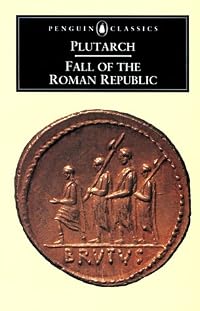
The Fall of the Roman Republic: Six Lives
by Plutarch
On This Page
Description
Brings together biographical sketches of six men who lived during the period of foreign and civil war that marked the collapse of the Roman Republic.Tags
Recommendations









Member Reviews
Very readable translation. I found the book to be interesting, especially with Plutarch's periodic moralizing comments. It was also interesting to see what information in each biography was highlighted, and what wasn't. Main issue is that due to this focusing on the Roman "lives" in Plutarch's "Parallel Lives," and leaving out the Greek, some of Plutarch's summaries of the comparisons could be a little confusing, since the Greek life wasn't there to provide context.
This Penguin Classic covers 6 Roman lives - Marius, Sulla, Crassus, Pompey, Caesar, Cicero -- written by Platonist philosopher Plutarch (AD 46-Ad 120), the great biographer from the ancient world. These were chaotic, bloody times when, fueled by treachery and ruthless violence, the Roman republic fell and was replaced by the Roman Empire. Since all six lives are synopsized exceedingly well by another Goodreads reviewer (https://www.goodreads.com/review/show/723730140?book_show_action=false&page=1), I will focus on one of my all-time favorite people from the ancient world, illustrious Roman philosopher/rhetorician/orator, Marcus Tullius Cicero. Here are quotes from the text along with my comments:
"His natural abilities made him show more altogether remarkable and won him such a name and reputation among the other boys that their fathers used often to go to the schools to see Cicero with their own eyes and to observe the quickness and intelligence which he showed." --------- To be such a virtuoso of language, adults flock to your school to listen to you speak. So telling about the Greco-Roman world: a supreme value on intelligence and verbal acumen. In our modern world, our most immediate association with a youngster having virtuoso talent would be playing a musical instrument, usually violin or piano. The implications of the difference are worth pondering.
"Elocution and delivery were an important element in his powers of persuasion. He used to ridicule those who were given to shouting out their speeches and said that, just as lame men rode on horseback because they could not walk, so these orators shouted because they could not speak." --------- Ha! Think about this the next time you witness a politician or public figure shouting at the top of their lungs. Would the person speak with more subtlety and eloquence if they really had something insightful to say?
"In Rome itself there were most alarming revolutionary tendencies - the result of the unequal distribution of wealth." -------- Ah, the bane of the `civilized' world since we as a human species left hunter-gatherer communities and began agriculture and started accumulating wealth: the haves and the have-nots. It was only a matter of time before a thinker like Marx came along.
"Cicero, more than anyone, made the Romans see how great is the charm which eloquence confers on what is good, how invincible justice is if it is well expressed in words, and how the good and efficient statesman should always in his actions prefer what is right to what will win popularity, and in his words should express the public interest in a manner that will please rather than provide offensive." --------- The dream of having a philosopher as a political leader goes back to Plato. Occasionally, as in the case of Cicero, this much heralded combination was actualized.
"The conspirators, however, were unbalanced characters who seldom met together without wine and women, while Cicero was following their schemes with patient care, with sober judgment, and with exceptional intelligence." --------- Plutarch is a philosopher and his chapter on Cicero serves as a shining example of what a wise person in the political sphere can achieve.
"At this time, Cicero was the most powerful man in Rome. However, he made himself obnoxious to a number of people, not because of anything which he did wrong, but because people grew tired of hearing him continually praising himself and magnifying his achievements." -------- Alas, one with great intellect and strength of character can still have shortcomings; for Cicero it was his habit of continually patting himself on the back. Some things never change: people don't want to hear it. (Plutarch includes a couple dozen of such comebacks -- one of the prime reasons to read his life of Cicero).
"His ability to put things cleverly would often lead him to forget good manners. . . . Wanting to underscore Cicero's humble family origins, an aristocrat by the name of Nepos asked Cicero repeatedly, "Who is your father?" Cicero replied, "I can scarcely ask you the same question since your mother has made it rather a difficult one to answer." - Nepos's mother being a lady whose reputation for chastity was not high." --------- It's one thing having a Jonathan Winters/Robin Williams-like sharp wit, but if you don't want a gaggle of enemies, you would be well to employ your tongue with discrimination.
"He occupied himself also in writing and translating philosophical dialogues and in rendering into Latin the various terms used in logic and in natural science." --------- Not only was Cicero a leader and hero of his country, dedicating a huge portion of his life as a public figure, but he had the ability to render Greek philosophy into Latin and thereby making it accessible to his countrymen for generations.
And how, you may ask, did Cicero's life end? Sorry to say, the Romans periodically turned their country into a bloodbath and poor Cicero was caught up in a political crossfire. show less
Abstracted from the longer Plutarch's Lives, this is six lives charting the fall of the Roman Republic. There is the power struggle between Marius and Sulla to start the six. I couldn't help but think of our current crop of narcissistic populist autocrats:
Also in this depiction of Crassus, famous for battling Spartacus as recounted here.
With Crassus making up the First Triumvirate is Pompey and Julius Caesar. His bloody triumph in Gaul before his dictatorship and assassination is a natural conclusion to this history. Regardless of the eloquent oratory of Cicero, his chapter at the end feels anti-climactic and prevalent enough that it could have been left off. show less
Certainly in his Memoirs he writes that when he considers all those occasions on which he appears to have made wise decisions he finds that the most successful actions were those upon which he entered boldly and on the spur of the moment rather than after due deliberation...
Also in this depiction of Crassus, famous for battling Spartacus as recounted here.
As a politician [Crassus] was singularly inconsistent, neither a steadfast friend nor an implacable enemy. Where his self-interestshow more
was involved he found no difficulty in breaking off an attachment or in making up a quarrel. Indeed it often happened that, in a short space of time, he came forward both as the supporter and as the opponent of the same man and the same measures. He was strong because he was popular and because he was feared - particularly because he was feared.
With Crassus making up the First Triumvirate is Pompey and Julius Caesar. His bloody triumph in Gaul before his dictatorship and assassination is a natural conclusion to this history. Regardless of the eloquent oratory of Cicero, his chapter at the end feels anti-climactic and prevalent enough that it could have been left off. show less
This Penguin Classic covers 6 Roman lives - Marius, Sulla, Crassus, Pompey, Caesar, Cicero -- written by Platonist philosopher Plutarch (AD 46-Ad 120), the great biographer from the ancient world. These were chaotic, bloody times when, fueled by treachery and ruthless violence, the Roman republic fell and was replaced by the Roman Empire. Since all six lives are synopsized exceedingly well by another Goodreads reviewer (https://www.goodreads.com/review/show/723730140?book_show_action=false&page=1), I will focus on one of my all-time favorite people from the ancient world, illustrious Roman philosopher/rhetorician/orator, Marcus Tullius Cicero. Here are quotes from the text along with my comments:
"His natural abilities made him show more altogether remarkable and won him such a name and reputation among the other boys that their fathers used often to go to the schools to see Cicero with their own eyes and to observe the quickness and intelligence which he showed." --------- To be such a virtuoso of language, adults flock to your school to listen to you speak. So telling about the Greco-Roman world: a supreme value on intelligence and verbal acumen. In our modern world, our most immediate association with a youngster having virtuoso talent would be playing a musical instrument, usually violin or piano. The implications of the difference are worth pondering.
"Elocution and delivery were an important element in his powers of persuasion. He used to ridicule those who were given to shouting out their speeches and said that, just as lame men rode on horseback because they could not walk, so these orators shouted because they could not speak." --------- Ha! Think about this the next time you witness a politician or public figure shouting at the top of their lungs. Would the person speak with more subtlety and eloquence if they really had something insightful to say?
"In Rome itself there were most alarming revolutionary tendencies - the result of the unequal distribution of wealth." -------- Ah, the bane of the `civilized' world since we as a human species left hunter-gatherer communities and began agriculture and started accumulating wealth: the haves and the have-nots. It was only a matter of time before a thinker like Marx came along.
"Cicero, more than anyone, made the Romans see how great is the charm which eloquence confers on what is good, how invincible justice is if it is well expressed in words, and how the good and efficient statesman should always in his actions prefer what is right to what will win popularity, and in his words should express the public interest in a manner that will please rather than provide offensive." --------- The dream of having a philosopher as a political leader goes back to Plato. Occasionally, as in the case of Cicero, this much heralded combination was actualized.
"The conspirators, however, were unbalanced characters who seldom met together without wine and women, while Cicero was following their schemes with patient care, with sober judgment, and with exceptional intelligence." --------- Plutarch is a philosopher and his chapter on Cicero serves as a shining example of what a wise person in the political sphere can achieve.
"At this time, Cicero was the most powerful man in Rome. However, he made himself obnoxious to a number of people, not because of anything which he did wrong, but because people grew tired of hearing him continually praising himself and magnifying his achievements." -------- Alas, one with great intellect and strength of character can still have shortcomings; for Cicero it was his habit of continually patting himself on the back. Some things never change: people don't want to hear it. (Plutarch includes a couple dozen of such comebacks -- one of the prime reasons to read his life of Cicero).
"His ability to put things cleverly would often lead him to forget good manners. . . . Wanting to underscore Cicero's humble family origins, an aristocrat by the name of Nepos asked Cicero repeatedly, "Who is your father?" Cicero replied, "I can scarcely ask you the same question since your mother has made it rather a difficult one to answer." - Nepos's mother being a lady whose reputation for chastity was not high." --------- It's one thing having a Jonathan Winters/Robin Williams-like sharp wit, but if you don't want a gaggle of enemies, you would be well to employ your tongue with discrimination.
"He occupied himself also in writing and translating philosophical dialogues and in rendering into Latin the various terms used in logic and in natural science." --------- Not only was Cicero a leader and hero of his country, dedicating a huge portion of his life as a public figure, but he had the ability to render Greek philosophy into Latin and thereby making it accessible to his countrymen for generations.
And how, you may ask, did Cicero's life end? Sorry to say, the Romans periodically turned their country into a bloodbath and poor Cicero was caught up in a political crossfire. show less
Six of Plutarch's archetypal biographies in the highly-readable translation by Rex Warner. Penguin's decision to arrange these Roman lives chronologically (thus removing them from Plutarch's original structure where they are juxtaposed with comparable Greeks) results in a degree of repetition, but this is not the author's fault. Plutarch is a master of bringing his subjects forward as three-dimensional people, highlighting their skills, successes and failures as leaders and providing illuminating details about their lives. Despite the criticisms leveled at him in the notes by Robin Seager, it is Plutarch's assessment of character and the life that he brings to his subjects that has made his work resonate with writers from Montaigne and show more Shakespeare to the present day. Although there is much to be said for keeping critical accretions to a minimum, this edition would have benefited from the inclusion of a map. show less
I read the 1979 version translated by Rex Warner. Overall I thought it was good, as it pulled together the whole story of the 'Fall of the Roman Republic.' I thought the Caesar chapter was exceptionally well done, and it concisely stated the high points of his life. As a relative novice to Roman history, the Marius and Sulla chapters were very informative, although dry at times. I was also interested in how compact the society was, in that Caesar was related to Marius and thought enough of his ancestor to bring his public statues back. The irony of Caesar dying at the feet of the Pompey statue was also significant.
Maps and relevant footnotes would have helped immensely, and I often found myself wondering if a more up to date version of show more this book existed. show less
Maps and relevant footnotes would have helped immensely, and I often found myself wondering if a more up to date version of show more this book existed. show less
I found some of this rather dry, esp. the earlier lives which were very full of military manoeuvres and didn't bring across the subjects very well. The sections on Caesar and Cicero were the most readable, partly because the events were more familiar to me. The overlap between events in the respective accounts could be confusing in places. Overall, this edition could definitely benefit from some commentary, notes and maps, notwithstanding the foreword's remark about the simplicity of the author's style not needing further explanation. As it stands, there is no contextualisation for the non-expert reader.
Members
- Recently Added By
Lists

In Our Time books
4,934 works; 2 members
Author Information

1,619+ Works 25,896 Members
PLUTARCH. c.46--c.125 Considered by many to be the most important Greek writer of the early Roman period, Plutarch was a member of a well-to-do Greek family, a chief magistrate, a priest at Delphi, and an exceptionally well-read individual. His philosophical views were based on those of Plato and, although a Greek, he esteemed the achievements and show more attributes of the Romans. By the time Plutarch's works were published for the first time in the eleventh century, some had already been lost. He wrote innumerable essays on philosophical, historical, political, religious, and literary subjects, 78 of which survive today and are known collectively as the "Moralia." He is known primarily, however, for his Parallel Lives of Greeks and Romans, which consists of 50 biographies---23 of prominent Greeks, 23 of Roman leaders, and 4 separate lives---accompanied at intervals by short comparative essays. Although historical information is included in the work, Plutarch wrote it originally to inspire emulation in youth, so the emphasis is on character, moral choice, and anecdote. Sir Thomas North's 1579 translation into English of Parallel Lives became an important source for William Shakespeare which he used for three plays, Julius Caesar, Antony and Cleopatra, and Coriolanus. (Bowker Author Biography) show less
Some Editions
Awards and Honors
Notable Lists
Series
Belongs to Publisher Series
Penguin Classics (L084)
Common Knowledge
- Canonical title
- The Fall of the Roman Republic: Six Lives
- Original publication date
- 120
- People/Characters
- Gaius Marius; Lucius Cornelius Sulla; Marcus Licinius Crassus; Gnaeus Pompeius Magnus; Julius Caesar; Marcus Tullius Cicero
- Important places
- Rome, Italy
- Important events
- Fall of the Roman Republic
- First words
- (Translator's Introduction by Rex Warner): Plutarch was one of the last of the classical Greek historians; indeed one may almost say he was one of the last of the classical Greeks.
The biography of Marius is one of the least satisfactory of Plutarch's Roman lives from the historian's point of view. - Last words
- (Click to show. Warning: May contain spoilers.)In this way Heaven entrusted to the family of Cicero the final acts in the punishment of Antony.
Classifications
- Genres
- History, Nonfiction, General Nonfiction, Biography & Memoir
- DDC/MDS
- 937 — History & geography History of ancient world (to ca. 499) Italian Peninsula to 476 and adjacent territories to 476
- LCC
- DG260 .A1 .P53 — History of Europe, Asia, Africa and Oceania City History of Italy Ancient Italy. Rome to 476 History By period Kings and Republic, 753-27 B.C. Republic, 509-27 Fall of the Republic and establishment Period of Marius and Sulla (Pompey).
- BISAC
Statistics
- Members
- 1,864
- Popularity
- 11,509
- Reviews
- 8
- Rating
- (3.91)
- Languages
- English, Latin
- Media
- Paper, Ebook
- ISBNs
- 5
- ASINs
- 25