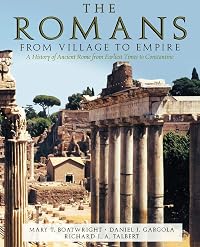
The Romans: From Village to Empire
by Mary T. Boatwright, Daniel Gargola, Richard J. A. Talbert
On This Page
Description
How did a single village community in the Italian peninsula eventually become one of the mightiest imperial powers the world has ever known? In The Romans, Mary T. Boatwright, Daniel Gargola, and Richard J.A. Talbert tackle this question as they guide readers through a comprehensive sweep of Roman history, ranging from the prehistoric settlements to the age of Constantine. Vividly written and attractively designed with almost 100 illustrations, The Romans expertly unfolds Rome's remarkable show more evolution from village, to monarchy and then republic, and finally to one-man rule by an emperor whose po show lessTags
Recommendations






Member Reviews
TW/CW: Death, assassination, talk of incest, talk of cruelty, torture, suicide
REVIEW: I have always had a fascination with the Roman empire, so I decided it was a good time to find some books and read them. Of what my library had, this one seemed to cover the greatest time period (from the Etruscans to Constantine), so I decided to read it first.
This book is very dense and has a lot of information between its pages. It is more text book than regular non-fiction book, and the writing can be dry. There’s a lot of frustration about the source material (for obvious reasons) and the book lays out before each chapter exactly what they’ve been able to find find and what is conjecture. There were things I would have liked to hear more about show more – especially the lives of the women and the the slaves, although I realize that any existing evidence about those two marginalized groups would be very rare, if it exists at all.
This book throws a lot of names and place and battles at you, but if you want the history, it’s definitely here! Obviously it can’t go into depth on everything, but I think it gave me a basic knowledge base to go read other books from now, which is kind of what I was looking for, so this book worked for me! I’d recommend to people who don’t mind reading kind of dry history and are interested in pretty much the entire history of Rome. show less
REVIEW: I have always had a fascination with the Roman empire, so I decided it was a good time to find some books and read them. Of what my library had, this one seemed to cover the greatest time period (from the Etruscans to Constantine), so I decided to read it first.
This book is very dense and has a lot of information between its pages. It is more text book than regular non-fiction book, and the writing can be dry. There’s a lot of frustration about the source material (for obvious reasons) and the book lays out before each chapter exactly what they’ve been able to find find and what is conjecture. There were things I would have liked to hear more about show more – especially the lives of the women and the the slaves, although I realize that any existing evidence about those two marginalized groups would be very rare, if it exists at all.
This book throws a lot of names and place and battles at you, but if you want the history, it’s definitely here! Obviously it can’t go into depth on everything, but I think it gave me a basic knowledge base to go read other books from now, which is kind of what I was looking for, so this book worked for me! I’d recommend to people who don’t mind reading kind of dry history and are interested in pretty much the entire history of Rome. show less
The work provides a broad overview of Roman history up to Constantine. The work covers both the political and military history as well as the cultural developments and contributions in literature and philosophy. Overall, the work provides a very broad summary of the history, focusing more on the broad flow rather than the details and individual reigns of the various emperors. Greater attention is paid to the transition between the late republic and early empire, as the otherwise sparse detail and individual attention expands to a more detailed exploration of this critical transitional period. Considering how much attention is paid to the early Imperial period, a more in depth consideration of the period that laid the foundation of this show more development is a welcome addition to the general negelct of this confusing time. show less
Ratings
Members
- Recently Added By
Author Information
9+ Works 736 Members
Mary T. Boatwright is Professor in the Department of Classical Studies at Duke University.
1 Work 455 Members
20+ Works 1,123 Members
Richard J. A. Talbert is William-Rand Kenan Professor of History at the University of North Carolina, Chapel Hill, author of Rome's World: The Peutinger Map Reconsidered, and editor of the Barrington Atlas of the Greek and Roman World.
Classifications
- Genres
- History, Nonfiction, General Nonfiction
- DDC/MDS
- 937 — History & geography History of ancient world (to ca. 499) Italian Peninsula to 476 and adjacent territories to 476
- LCC
- DG209 .B58 — History of Europe, Asia, Africa and Oceania City History of Italy Ancient Italy. Rome to 476 History General
- BISAC
Statistics
- Members
- 459
- Popularity
- 66,752
- Reviews
- 2
- Rating
- (3.50)
- Languages
- English
- Media
- Paper, Ebook
- ISBNs
- 7
- ASINs
- 4