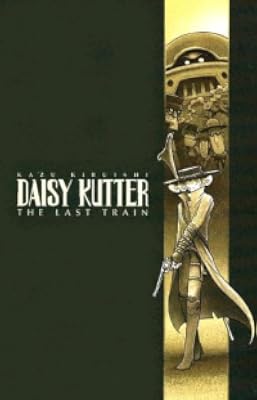
Daisy Kutter: The Last Train
by Kazu Kibuishi
Daisy Kutter: The Last Train (Collections and Selections — Omnibus 1-4)
On This Page
Description
New West gunfighter Daisy Kutter tries to leave her outlaw ways behind and start a new life as the owner of a general store, but her past catches up with her, and she finds herself in the middle of a simple train robbery that turns complicated thanks to some nasty robots.Tags
Recommendations





























Member Reviews
Daisy Kutter used to be train robber. The best there ever was. And she used to be partners (and perhaps more) with Tom. But those days are long past and Tom is now the Sherif and Daisy is owner of local general store...and bored out of her mind. She can't acclimate herself to "normal" life like Tom can. She misses the action and the adventure of being a train robber. But she won't go back to it. Till one night...she loses the store in a poker game to Mr. Withers. And Mr. Withers has a proposition: try to rob his train and test his new security robots. And he's willing to pay, rather well. While Daisy plans the robbery, Tom decides to take a vacation and tag along...just to watch out for her. But everything isn't as it appears to be. And show more Daisy and Tom are fighting to survive.
Set in a steampunk version of the old west, where robots and humans live together, Kibuishi creates a masterful story with a great deal of humor mixed in. You know that classic stoic character in every old west movie? Well that's Daisy. But instead of being played by some curmudgeonly old man who learns something about life by the end of the movie, it's played instead by a young woman...who may or may not learn something by the end of the book. It's a nice change of pace to something that could otherwise be a common story. The characters are written with humanity and they it's easy to relate to them and understand both of their perspectives, even for such a short story. Kazu expertly sets everything up in just a few short pages so it feels like we've known the characters for ever. The story itself has a nice pace to it never making the reader wait to see what happens, but instead keeping them just on the edge of their seat to see what's happening and to see what comes next. While readers might be able to guess what happens at the end of the story, they won't be able to predict what happens in between.
The artwork has the same bit of elegance and detail that can be found in Kibuishi's current series, The Stonekeeper (Amulet, Book 1), but in a bit simpler style. This story is illustrated completely in black and white, with gray tones instead of color, but Kibuishi uses these colors effectively to create a lot of depth and energy to the characters. With just a few simple lines Kibuishi gives us memorable characters that keep us coming back for more. I especially love the close ups of the characters eyes, particularly Daisy's. When those happen we get a real sense of who the character is and the emotion that they're feeling at the time.
Like the title says, this is my favorite graphic novel of all time. It was the first one I ever picked up so yeah it hold some sentimental value, but the combination of a great story and great artwork make this a must read for anyone. My one complaint...no sequel (although there is a short story in Flight volume 6)! show less
Set in a steampunk version of the old west, where robots and humans live together, Kibuishi creates a masterful story with a great deal of humor mixed in. You know that classic stoic character in every old west movie? Well that's Daisy. But instead of being played by some curmudgeonly old man who learns something about life by the end of the movie, it's played instead by a young woman...who may or may not learn something by the end of the book. It's a nice change of pace to something that could otherwise be a common story. The characters are written with humanity and they it's easy to relate to them and understand both of their perspectives, even for such a short story. Kazu expertly sets everything up in just a few short pages so it feels like we've known the characters for ever. The story itself has a nice pace to it never making the reader wait to see what happens, but instead keeping them just on the edge of their seat to see what's happening and to see what comes next. While readers might be able to guess what happens at the end of the story, they won't be able to predict what happens in between.
The artwork has the same bit of elegance and detail that can be found in Kibuishi's current series, The Stonekeeper (Amulet, Book 1), but in a bit simpler style. This story is illustrated completely in black and white, with gray tones instead of color, but Kibuishi uses these colors effectively to create a lot of depth and energy to the characters. With just a few simple lines Kibuishi gives us memorable characters that keep us coming back for more. I especially love the close ups of the characters eyes, particularly Daisy's. When those happen we get a real sense of who the character is and the emotion that they're feeling at the time.
Like the title says, this is my favorite graphic novel of all time. It was the first one I ever picked up so yeah it hold some sentimental value, but the combination of a great story and great artwork make this a must read for anyone. My one complaint...no sequel (although there is a short story in Flight volume 6)! show less
Summary: Daisy Kutter has given up the outlaw life and gone straight - although not as straight as her Tom, her ex-flame and current sheriff. She was the best, but she swears she's gone straight, until she gets an job offer that she can't refuse. But this is it: one last train robbery, and then she's done. However, unsurprisingly, not everything is as it seems, and the heist doesn't quite go according to plan...
Review: I pulled this one off the library shelf on the sole basis of recognizing Kibuishi's name from the Flight anthologies. And: what a find! It's not a straight-up western, but a blend of western and steampunk (there are robots), but the setting (while cool) is not the star. That honor belongs to Daisy herself, and she's a show more fantastic character: tough but not hard, confident but not swaggering, snarky and capable and awesome. The story's a pretty standard heist-western (well, except for the girl train robber and the robots and all), but Kibuishi's style makes the most of the action, and there are little infused touches of emotion throughout. I'd happily read more of Daisy's adventures, but seeing as this book came out in 2006 with no hint since of a sequel, that may be wishful thinking. 4 out of 5 stars.
Recommendation: The sensibility and humor of this story and the blend of sci-fi and western makes fans of Firefly the obvious recommended audience (hooray, Browncoats!), but I think Daisy's got the chops to win over most readers. show less
Review: I pulled this one off the library shelf on the sole basis of recognizing Kibuishi's name from the Flight anthologies. And: what a find! It's not a straight-up western, but a blend of western and steampunk (there are robots), but the setting (while cool) is not the star. That honor belongs to Daisy herself, and she's a show more fantastic character: tough but not hard, confident but not swaggering, snarky and capable and awesome. The story's a pretty standard heist-western (well, except for the girl train robber and the robots and all), but Kibuishi's style makes the most of the action, and there are little infused touches of emotion throughout. I'd happily read more of Daisy's adventures, but seeing as this book came out in 2006 with no hint since of a sequel, that may be wishful thinking. 4 out of 5 stars.
Recommendation: The sensibility and humor of this story and the blend of sci-fi and western makes fans of Firefly the obvious recommended audience (hooray, Browncoats!), but I think Daisy's got the chops to win over most readers. show less
In just four chapters, Kibuishi’s Daisy Kutter: the Last Train unites the western and science fiction genres. Saloons, general stores, outlaws, and sheriffs co-exist with security guard robots, holograms, and remote-controlled heavy artillery machines.
Chapter one introduces us to the intrepid Daisy Kutter whose attempts to go straight have nearly driven her crazy–or at least driven her to the point of plastering everything in her store with darts from one of her store’s dart guns. Daisy’s prospects perk up somewhat when learns of poker night at the nearby saloon. Although she has purportedly given up gunslinging, she’s still game for a bit of Texas Hold’ em. Unfortunately, she literally bets the farm (in this case store) in show more a round where the cards up her sleeve aren’t quite ace enough to match the cards her opponent (aka the book’s bad guy) has up his sleeve.
Chapter two finds Daisy pondering her losses; the result of all this thinking is that she finds herself agreeing to a mysterious offer to pull off one last job to get her store back. She also has a row with her old gunslinging, train-robbing partner, Tom, who is now the town sheriff. Their relationship is full of love and hate–some days it’s the former, some days it’s the latter. In Daisy’s mind, Tom has turned into a real square (a fact made literal when one considers his square face in the illustrations), but they still find themselves drawn to each other and to adventure.
Chapter three displays Daisy planning and implementing the job. Daisy explains to her new human and robot partners, “A simple plan is best. You can count on it getting complicated in the end.” The train heist provides Kibuishi with the opportunity to showcase Daisy’s on-the-job performance prowess while simultaneously wowing us with the way he imbues static images with cinematic effect. Daisy moves with the moving train, and, the plot moves too as the best-laid-plan goes awry.
Chapter four shows the aftermath of the train robbery and Daisy slinging her way to a some sort of resolution. Overall, two aspects of the book standout: the movie-like feel of the train robbery sequence and Daisy’s characterization.
Daisy’s gruff exterior, her sorely in need of anger-management temperament, her quick draw, her poker prowess—these all speak typical western hero. But the emotion written across her face, the alternating shoulder slump and pride in bearing, the complicated relationships, the nuances of her character—these all move her beyond stereotypes. Daisy, like so many others before her, is trying to find her place in the world and trying to decide whether that place is inside of or outside of the law. She’s not black or white. Speaking of black and white, Kibuishi employs a masterful range of black, grey, and white hues throughout the novel’s many panels.
After Daisy’s story closes (although it doesn’t really close and there’s definitely room for many a sequel), Kibuishi provides additional chapters where he illuminates his story and character creation process. He includes many earlier sketches of Daisy that show her overall evolution as a character along with a “how it’s done” series of sketches that illuminate the graphic novel creation process as a whole.
In the extra material, Kibuishi even admits that drawing is not his favorite part of the creative process. Fortunately for use readers, he must grit his teeth and bear it, and he comes up with products like Daisy Kutter: The Last Train—a graphic novel that will have widespread appeal across the western, science fiction, and graphic novel audiences. show less
Chapter one introduces us to the intrepid Daisy Kutter whose attempts to go straight have nearly driven her crazy–or at least driven her to the point of plastering everything in her store with darts from one of her store’s dart guns. Daisy’s prospects perk up somewhat when learns of poker night at the nearby saloon. Although she has purportedly given up gunslinging, she’s still game for a bit of Texas Hold’ em. Unfortunately, she literally bets the farm (in this case store) in show more a round where the cards up her sleeve aren’t quite ace enough to match the cards her opponent (aka the book’s bad guy) has up his sleeve.
Chapter two finds Daisy pondering her losses; the result of all this thinking is that she finds herself agreeing to a mysterious offer to pull off one last job to get her store back. She also has a row with her old gunslinging, train-robbing partner, Tom, who is now the town sheriff. Their relationship is full of love and hate–some days it’s the former, some days it’s the latter. In Daisy’s mind, Tom has turned into a real square (a fact made literal when one considers his square face in the illustrations), but they still find themselves drawn to each other and to adventure.
Chapter three displays Daisy planning and implementing the job. Daisy explains to her new human and robot partners, “A simple plan is best. You can count on it getting complicated in the end.” The train heist provides Kibuishi with the opportunity to showcase Daisy’s on-the-job performance prowess while simultaneously wowing us with the way he imbues static images with cinematic effect. Daisy moves with the moving train, and, the plot moves too as the best-laid-plan goes awry.
Chapter four shows the aftermath of the train robbery and Daisy slinging her way to a some sort of resolution. Overall, two aspects of the book standout: the movie-like feel of the train robbery sequence and Daisy’s characterization.
Daisy’s gruff exterior, her sorely in need of anger-management temperament, her quick draw, her poker prowess—these all speak typical western hero. But the emotion written across her face, the alternating shoulder slump and pride in bearing, the complicated relationships, the nuances of her character—these all move her beyond stereotypes. Daisy, like so many others before her, is trying to find her place in the world and trying to decide whether that place is inside of or outside of the law. She’s not black or white. Speaking of black and white, Kibuishi employs a masterful range of black, grey, and white hues throughout the novel’s many panels.
After Daisy’s story closes (although it doesn’t really close and there’s definitely room for many a sequel), Kibuishi provides additional chapters where he illuminates his story and character creation process. He includes many earlier sketches of Daisy that show her overall evolution as a character along with a “how it’s done” series of sketches that illuminate the graphic novel creation process as a whole.
In the extra material, Kibuishi even admits that drawing is not his favorite part of the creative process. Fortunately for use readers, he must grit his teeth and bear it, and he comes up with products like Daisy Kutter: The Last Train—a graphic novel that will have widespread appeal across the western, science fiction, and graphic novel audiences. show less
Daisy Kutter is retired and running the dry goods store when she's asked if she might be interested in robbing a train. She's retired, she's not and no, she doesn't work with robots. At least that's how the story starts until a poker hand goes wrong and she has no choice...
This is a fantastic and quick read with a well-done female lead. Daisy Kutter is beautifully drawn by Kazu Kibuishi. Better yet, Daisy can more than take care of herself without resorting to a sex-charged guy fantasy or some equally bad other-worldly nonsense. The steampunk setting adds to her story rather than detracts (and shockingly, is not an excuse to put her in 40s pin-up gear).
This is a fantastic and quick read with a well-done female lead. Daisy Kutter is beautifully drawn by Kazu Kibuishi. Better yet, Daisy can more than take care of herself without resorting to a sex-charged guy fantasy or some equally bad other-worldly nonsense. The steampunk setting adds to her story rather than detracts (and shockingly, is not an excuse to put her in 40s pin-up gear).
If you took the Wild West and merged it with steam punk, you'd have the setting of "Daisy Cutter."
Daisy is an gunslinger who has hung up the old way of life in favor of having a store. When she is propositioned by a man and his partner robot to help rob a train at the behest of the train's owner, she turns it down, but when she subsequently loses her store, she is backed into the job.
If there is a flaw of Daisy Kutter, it is that it is too short. Kazu Kibuishi has created a memorable heroine who is taciturn but not distant; tough but not toughened. She is no young miss. She is a woman with a past that she doesn't need to hide and a badass who doesn't have to wear the dark cloak.
Her relationship with Tom, the town's sherriff, is instant show more chemistry and the banter between them is a mix of postmodern and old 40s Hollywood. A true delight.
The story itself is simple. Kibuishi gets points for not overdoing it. He keeps it simple and it works from start to finish. He lets Daisy and her crew handle the incidentals and his artwork deftly shows us the actions of the characters without unnecessary clutter.
I found this at the library while looking for Transmetropolitan and while I didn't find Transmetropolitan, I'm pleased that I found this. Very, very pleased!
Now I just need to find more!
And t show less
Daisy is an gunslinger who has hung up the old way of life in favor of having a store. When she is propositioned by a man and his partner robot to help rob a train at the behest of the train's owner, she turns it down, but when she subsequently loses her store, she is backed into the job.
If there is a flaw of Daisy Kutter, it is that it is too short. Kazu Kibuishi has created a memorable heroine who is taciturn but not distant; tough but not toughened. She is no young miss. She is a woman with a past that she doesn't need to hide and a badass who doesn't have to wear the dark cloak.
Her relationship with Tom, the town's sherriff, is instant show more chemistry and the banter between them is a mix of postmodern and old 40s Hollywood. A true delight.
The story itself is simple. Kibuishi gets points for not overdoing it. He keeps it simple and it works from start to finish. He lets Daisy and her crew handle the incidentals and his artwork deftly shows us the actions of the characters without unnecessary clutter.
I found this at the library while looking for Transmetropolitan and while I didn't find Transmetropolitan, I'm pleased that I found this. Very, very pleased!
Now I just need to find more!
And t show less
Kazu Kibuishi wrote one fun and wild ride. Set in a wild west where robots walk the streets next to people, this quirky tale follows Daisy, a retired heist master, on her last train job. She and her old partner have given up their life of crime, and he has moved on to being the town sherif. After a bad night of cards, Daisy is left with an offer she can't refuse. If she wants her store back, she has to take a very fishy job. Rob the train of the man who has hired her. It’s highly entertaining, kinda sweet, and incredibly well drawn. Definitely worth picking up.
I really enjoyed this graphic novel - it involved an old train robber getting back into the business for one last shot. Had a twist ending and a lot of action.
Members
- Recently Added By
Published Reviews
ThingScore 75
Kibuishi’s best-known for editing Flight, but in this, his first long-form work, the pacing sets this story apart.
added by lampbane
Lists

Recommended Comics / Graphic Novels
595 works; 122 members

Books Read in 2016
4,666 works; 199 members
Author Information

41+ Works 21,671 Members
Kazu Kibuishi is the founder of the Flight Anthologies comic series and writer of "The Last Train", winner of the YALSA Best Books for Young Adult Award. (Bowker Author Biography)
Some Editions
Awards and Honors
Awards
Distinctions
Series

Work Relationships
Common Knowledge
- Canonical title
- Daisy Kutter: The Last Train
- Original title
- Daisy Kutter: The Last Train
- Original publication date
- 2005-03-30
- People/Characters
- Daisy Kutter; Tom McKay; J.C. Winters; Morris; Bloom
- Important places
- Daisy's General Store; Shelly's Tavern; Needles
- First words
- Sigh.
- Quotations
- Maybe if I stand here long enough, something will just come to me.
- Last words
- (Click to show. Warning: May contain spoilers.)That's my favorite part.
- Blurbers
- Powell, James; Clifft, Jeremy; Reade, Craig
Classifications
- Genres
- Graphic Novels & Comics, Teen
- DDC/MDS
- 741.5973 — Arts & recreation Drawing & decorative arts Drawing Comic books, graphic novels, fotonovelas, cartoons, caricatures, comic strips History, geographic treatment, biography North American United States (General)
- LCC
- PN6727 .K48 .D3 — Language and Literature Literature (General) Literature (General) Collections of general literature Comic books, strips, etc.
- BISAC
Statistics
- Members
- 239
- Popularity
- 136,660
- Reviews
- 17
- Rating
- (3.99)
- Languages
- English, French, Italian
- Media
- Paper
- ISBNs
- 6