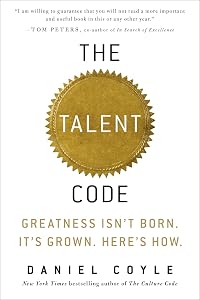
The Talent Code: Greatness Isn't Born. It's Grown. Here's How.
by Daniel Coyle
On This Page
Description
This book shows you how to grow talent by tapping into a newly discovered brain mechanism. Drawing on cutting-edge neurology and firsthand research gathered on journeys to nine of the world's talent hotbeds, author Coyle identifies the three key elements that will allow you to develop your gifts and optimize your performance in sports, art, music, math, or just about anything.--From publisher description.Tags
Recommendations
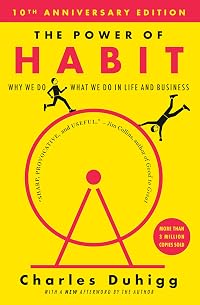
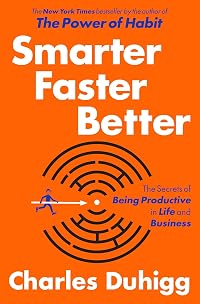


Member Recommendations
Member Reviews
Coyle asks, "...why does it take people so long to learn complex tasks?" Um...because they're complex?
Any time someone opens up with how they'll reveal "revolutionary scientific discoveries", the best advice is to run away. I didn't take my own advice and stubbornly slogged through this collection of anecdotes about "hotbeds" (he loves that term) in which he reaches far, contradicts himself, incredibly co-opts the Tom Sawyer fence whitewashing story to his means (really...guy tosses thousands of years of human psychology for a fad theory), ignores concentrations of "signals" that don't fit his model for hotbed generation...
Coyle is a sports writer proposing a theory that he masquerades as science, but it's mostly pop-psychology BS. show more It's sad that this nonsense is published, sadder that people buy into it.
Why did I read it? A colleague - psychologist - thought I'd really like the "fascinating" book he was listening to on CD. I am continually amazed at the lack of critical thought among PhDs...less so among the soft sciences...even less in the liberal arts, if the dissertations I've read recently are any indication. The logical fallacies in this book are rapant, and the anecdotes too obviously cherry-picked in order to support the pseudo-theory for this to be taken seriously. show less
Any time someone opens up with how they'll reveal "revolutionary scientific discoveries", the best advice is to run away. I didn't take my own advice and stubbornly slogged through this collection of anecdotes about "hotbeds" (he loves that term) in which he reaches far, contradicts himself, incredibly co-opts the Tom Sawyer fence whitewashing story to his means (really...guy tosses thousands of years of human psychology for a fad theory), ignores concentrations of "signals" that don't fit his model for hotbed generation...
Coyle is a sports writer proposing a theory that he masquerades as science, but it's mostly pop-psychology BS. show more It's sad that this nonsense is published, sadder that people buy into it.
Why did I read it? A colleague - psychologist - thought I'd really like the "fascinating" book he was listening to on CD. I am continually amazed at the lack of critical thought among PhDs...less so among the soft sciences...even less in the liberal arts, if the dissertations I've read recently are any indication. The logical fallacies in this book are rapant, and the anecdotes too obviously cherry-picked in order to support the pseudo-theory for this to be taken seriously. show less
The path to greatness is constant improvement
All skills have to be acquired through practice, repetition and automatization, from the basics most of us take for granted from learning to walk and talk and type to more complex skill sets such as playing a sport or musical instrument and integrative thinking, with each higher order level of complexity building on top of all those that came before it. In this very readable book, Daniel Coyle takes us through a series of intriguing case studies to show us how this occurs, and how we can optimize the process.
In Part I, he examines the type of deep practice required for the sustained, long-term improvement that leads to mastery. In Part II, he focuses on the importance of igniting a deep show more passion for the process that provides the motivation needed to sustain the ongoing practice. And Part III discusses the role of mentors and modeling in accelerating the process. All three parts are intriguing and insightful, and add up to a comprehensive model of achieving greatness in any domain.
Some reviewers have complained that his treatment of the neuroscience is superficial or that he doesn't delve deeply enough into specific methods of deep practice. If that's what they want, by all means they should go read other more specialized books on those topics, but that's not the point of this book. The Talent Code is a major inductive integration identifying the principles (and basic underlying neural mechanisms) common to all skill acquisition. I would also recommend The Power of Habit by Charles Duhigg as a nice companion to this.
http://www.amazon.com/review/R3VI5W3ZYKPDDP show less
All skills have to be acquired through practice, repetition and automatization, from the basics most of us take for granted from learning to walk and talk and type to more complex skill sets such as playing a sport or musical instrument and integrative thinking, with each higher order level of complexity building on top of all those that came before it. In this very readable book, Daniel Coyle takes us through a series of intriguing case studies to show us how this occurs, and how we can optimize the process.
In Part I, he examines the type of deep practice required for the sustained, long-term improvement that leads to mastery. In Part II, he focuses on the importance of igniting a deep show more passion for the process that provides the motivation needed to sustain the ongoing practice. And Part III discusses the role of mentors and modeling in accelerating the process. All three parts are intriguing and insightful, and add up to a comprehensive model of achieving greatness in any domain.
Some reviewers have complained that his treatment of the neuroscience is superficial or that he doesn't delve deeply enough into specific methods of deep practice. If that's what they want, by all means they should go read other more specialized books on those topics, but that's not the point of this book. The Talent Code is a major inductive integration identifying the principles (and basic underlying neural mechanisms) common to all skill acquisition. I would also recommend The Power of Habit by Charles Duhigg as a nice companion to this.
http://www.amazon.com/review/R3VI5W3ZYKPDDP show less
This was my first audiobook. I had never listened to an audiobook before and I enjoyed listening to it when I didn't want to read.
Overall, I found the first half of the books to be good. When he actually talks about personal growth and how myelin is the scientific way of how we actually get better at things. I also enjoyed how he deconstructs talent to basically just be practice and ignition (which I understood to be motivation and willpower).
The book kinda drops off when he shifts in talking about coaches and teachers. While they're interesting stories and show how hard work is actually the reason behind successful people, it feels a bit tangential and could've been a chapter or two.
Nonetheless, it was enjoyable and has made me a show more bit of a crusader for hard work rather than preordained 'talent'. show less
Overall, I found the first half of the books to be good. When he actually talks about personal growth and how myelin is the scientific way of how we actually get better at things. I also enjoyed how he deconstructs talent to basically just be practice and ignition (which I understood to be motivation and willpower).
The book kinda drops off when he shifts in talking about coaches and teachers. While they're interesting stories and show how hard work is actually the reason behind successful people, it feels a bit tangential and could've been a chapter or two.
Nonetheless, it was enjoyable and has made me a show more bit of a crusader for hard work rather than preordained 'talent'. show less
Daniel Coyle is upbeat and excitable, like an evangelical determined to share his epiphany with you. But his discovery of the 'code' to human achievement seems rather mild. Those who excel aren't prodigies or random geniuses. They just practise hard, and deeply. They do the little things not so much well as often. And they stick at it. And that's it, enhanced here and there with neurological evidence of skill reinforcement, the gradual buildup of protection around neural pathways. Coyle visits hotbeds of tennis, violin, maths, and so on, running through it all in the usual breezy expenses-no-object New Yorker style. It's not very complex, but just pointing out how we can all learn and progress by simply putting the effort in is show more inspiring, a worthy call to action. show less
An easy and fun read speculating on (with some evidence to back it up) the role of myelination as a chief component of of talent.
As Coyle writes: "Skill is myelin insulation that wraps neural circuits and that grows according to certain signals." It is this insulation that makes those circuits FASTER and more efficient.
Hence, talent, might well be described by circuits that have been well myelinated due to deep practice over many years (Coyle mentions the 10,000 hour hypothesis that one may hear elsewhere, too).
Coyle hypothesizes that Talent is the result of IGNITION (of desire to learn something), followed by DEEP PRACTICE (which requires that one struggle just beyond the limits of one's present capabilities so that mistakes are made show more and corrected), coupled with MASTER COACHING where a mindful coach knows just how to provide the proper feedback that enhances this deep practice. Struggle is necessary and essential.
Note that though my review mentions myelination as does Coyle's book, "The Talent Code" is NOT technical and is a VERY EASY read - I recommend it to anyone!
I first became interested in this book when one of my favorite authors, Dr. Daniel J. Siegel, referred to it in his book, "The Mindful Therapist". Knowing the rigor of Dr. Siegel in his own works, and Dr. Siegel's command of neuroscience, I extrapolate that Daniel Coyle must have done a reasonable job in synthesizing a story on talent and myelination.
How does one do "Deep Practice?"
Coyle suggests three rules:
1. Chuck it up:
Absorb the whole thing.
Break it into chunks.
Slow it down.
2. Repeat it.
3. Learn to feel it.
Read Coyle's book to learn more! show less
As Coyle writes: "Skill is myelin insulation that wraps neural circuits and that grows according to certain signals." It is this insulation that makes those circuits FASTER and more efficient.
Hence, talent, might well be described by circuits that have been well myelinated due to deep practice over many years (Coyle mentions the 10,000 hour hypothesis that one may hear elsewhere, too).
Coyle hypothesizes that Talent is the result of IGNITION (of desire to learn something), followed by DEEP PRACTICE (which requires that one struggle just beyond the limits of one's present capabilities so that mistakes are made show more and corrected), coupled with MASTER COACHING where a mindful coach knows just how to provide the proper feedback that enhances this deep practice. Struggle is necessary and essential.
Note that though my review mentions myelination as does Coyle's book, "The Talent Code" is NOT technical and is a VERY EASY read - I recommend it to anyone!
I first became interested in this book when one of my favorite authors, Dr. Daniel J. Siegel, referred to it in his book, "The Mindful Therapist". Knowing the rigor of Dr. Siegel in his own works, and Dr. Siegel's command of neuroscience, I extrapolate that Daniel Coyle must have done a reasonable job in synthesizing a story on talent and myelination.
How does one do "Deep Practice?"
Coyle suggests three rules:
1. Chuck it up:
Absorb the whole thing.
Break it into chunks.
Slow it down.
2. Repeat it.
3. Learn to feel it.
Read Coyle's book to learn more! show less
For "a helluva good read" of an award-winning journalist as mentioned on the cover, I was very dissappointed by the quality of this book and its limited added value. I read the book because I was curious as to when it would start to get really good. And I follow previous reviews stating that the content could be better summarized in a paper. Content-wise, the quality is also limited and less innovative than it makes it seem. The book sometimes seems to be more about the personal journey the author has made than about scientific research about the subject itself.
This book focuses on what qualities make for top-notch skills in a variety of pursuits. It is very readable, and clear. The steps are few (deep practice, correct mistakes early, ignite interest, provide useful feedback). The biological basis credited with why it works is myelin sheathing of nerve pathways. I found the book to be clear in its premise, filled with examples of the principles in action, and useful. It was also a fascinating read.
Members
- Recently Added By
Published Reviews
added by lemontwist
Lists

Make it Stick's Suggested Books Reading
19 works; 2 members

Books & Films Referenced by Cal Newport's Deep Work
43 works; 1 member

Best Self Help Books
87 works; 18 members
Author Information

18 Works 4,158 Members
Daniel Coyle is a contributing editor for Outside magazine and the author of six books, including the New York Times bestseller, Lance Armstrong's War. His latest book is The Culture Code: The Secrets of Highly Successful Groups, published January 2018. Coyle lives with his wife, Jen, and their four children in Homer, Alaska. (Bowker Author show more Biography) show less
Some Editions
Work Relationships
Common Knowledge
- Original publication date
- 2009-04-28
Classifications
Statistics
- Members
- 1,411
- Popularity
- 16,760
- Reviews
- 23
- Rating
- (3.93)
- Languages
- 5 — Chinese, English, German, Portuguese, Spanish
- Media
- Paper, Audiobook, Ebook
- ISBNs
- 23
- ASINs
- 13