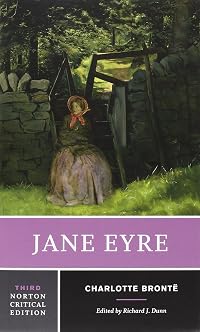
Jane Eyre [Norton Critical Edition]
by Charlotte Brontë, Richard J. Dunn (Editor)
On This Page
Description
"Jane Eyre follows the titular character as she makes her way through Thornfield Hall as the governess and love interest of Mr. Rochester. The text reprinted in this new edition is that of the 1848 third edition text--the last text corrected by Charlotte Bronte. The text is accompanied by explanatory footnotes and an introduction that explores the influences of the novel and its journey to publication. "Contexts" includes excerpts from Charlotte's early writings and diaries from her time as show more a governess and beyond. There are many letters to Emily Bronte, Ellen Nussey, W. S. Williams, and Sonstantin Heger, all of which are supported by excerpts from Elizabeth Gaskell's autobiography of Charlotte Bronte. "Criticism" examines the many themes woven into the novel with work by Virginia Woolf, Sandra Gilbert, Susan Meyer, Carla Kaplan, and Kelly A. Marsh. A Chronology and updated Selected Bibliography are also included" -- show lessTags
Recommendations





Member Reviews
I've been wanting to read all of the Brontës' books this year because they've been on my mind after I wrote a short story about them, so I started with this one, one that I was assigned in freshman English and loved then but had forgotten quite a lot of in the 19 years since.
Well, on this re-read I was happy to find that the book is every bit as marvelous as I remembered. I actually enjoyed it quite a bit more on this reading, for two reasons. One of them is that my feminist identity is fully-formed now, whereas when I was 14 it was still in its nascent stage, so that let me be a lot more receptive to those elements of the book. And then the other reason is that this time I was reading the Norton Critical Edition, and I always love show more those so much! show less
Well, on this re-read I was happy to find that the book is every bit as marvelous as I remembered. I actually enjoyed it quite a bit more on this reading, for two reasons. One of them is that my feminist identity is fully-formed now, whereas when I was 14 it was still in its nascent stage, so that let me be a lot more receptive to those elements of the book. And then the other reason is that this time I was reading the Norton Critical Edition, and I always love show more those so much! show less
Classics are books which, the more we think we know them through hearsay, the more original, unexpected, and innovative we find them when we actually read them. - Italo Calvino, Why Read the Classics?
This is my fourth time reading Jane Eyre. Although the story is known to me, I still find myself overwhelmed with emotions when reading this novel. At times anxious, at times laughing with delight, at times weeping softly. Jane is a very human superwoman. Her understanding, observations, fortitude, and wisdom are for the ages. For me, she is the ultimate heroine.
This is my fourth time reading Jane Eyre. Although the story is known to me, I still find myself overwhelmed with emotions when reading this novel. At times anxious, at times laughing with delight, at times weeping softly. Jane is a very human superwoman. Her understanding, observations, fortitude, and wisdom are for the ages. For me, she is the ultimate heroine.
I can't emphasize this enough: Just jump in and give this book a try, even if it's only so that you might see who Jane Eyre actually is. I've read the book a number of times, and yet can never quite get my head around her! Homely and orphaned, but fiercely smart and fiercely independent, Jane is forever striving to better her situation and her self while maintaining her own self-respect according to her uncompromising morals. Jane is one of a kind -- a woman of great constitution in literature, who moves with stunning competence and level-headedness through the world, despite her losses and the oppressive rules of a society that does not favor her class or sex. Charlotte Brontë has REALLY created someone special here -- not to mention show more the gripping, tragic romance that makes the novel such a compelling read to begin with! show less
The new Norton Critical Edition of _Jane Eyre_ is absolutely fantastic. The addition of contextual information just blew me away when I saw it. I have an old Tor copy of the novel that, while quite good, just doesn't compare to this. Among the contexts are letters from Charlotte during her time as a governess, records from her stay at school (much like Jane's!), and excerpts/descriptions of Bewick's Birds, which plays such an important part in the novel. What a wonderful copy of the book to have!
The story of Jane Eyre itself is quite good, I should add. It is, of course, a common assignment in school, but no wonder when it has so much weight in the 19th Century English-language canon, and so much impact on modern romance novels.
Jane show more Eyre is one of my all-time favorite novels, and I always find something new and intriguing in it. It is well-crafted and leaves nothing of importance out. (Not that one can say the same of the many movie adaptations...) show less
The story of Jane Eyre itself is quite good, I should add. It is, of course, a common assignment in school, but no wonder when it has so much weight in the 19th Century English-language canon, and so much impact on modern romance novels.
Jane show more Eyre is one of my all-time favorite novels, and I always find something new and intriguing in it. It is well-crafted and leaves nothing of importance out. (Not that one can say the same of the many movie adaptations...) show less
#55, 2007
One of the classics that I somehow never read in high school, I finally decided to read this book now, mostly so I could read "The Eyre Affair," and understand any "in-jokes" that might be present.
I enjoyed the book, but didn't love it. Partly, this might be because I knew how it was going to end, since I'd watched the Orson Welles film a few months ago. But it was also in part due to the prose. The story was interesting, although at times I felt there was too much detail, too much density in the text. Just too many words. It took me a long time to read this book, longer than I expected.
Warning: the rest of this review contains SPOILERS
I wasn't always certain that I really liked Jane, but by the end I decided that I did. It's show more not so much a story of a woman learning to be strong - for she was strong from the beginning. What she does learn, I think, is to believe that she deserves love and happiness. She has some scary moments there, near the end, though, when she nearly goes off with the atrocious St. John Rivers. (And while Bronte seems somewhat admiring of him at the end of the book, I found nothing in him whatsoever that appealed to me. That sort of religious fanatacism is distasteful to me in the extreme). Rochester is interesting in that he's really not very appealing, and yet I could understand why Jane fell in love with him, and he with her. It's not often I've read a book which considered love as a meeting of minds, rather than something mostly based on physical attraction. And even so, before the first attempted wedding, Jane was "realistic" (or perhaps "pessimistic") about how long the love would last. No fairy tale happy endings here.
I also enjoyed Diane and Mary, and that whole episode of the book (which was new to me, as was not included in the film). I appreciated the very subtle sense of some divine hand guiding Jane at times - both in causing her to follow the light which led her to their doorstep, and also, later, the episode where she heard Rochester's voice (and she discovered later that he hears hers).
So, there is much to recommend in this book. It was slow-moving, but satisfying. I just found myself at times somewhat bogged down in the excessively descriptive prose, especially of the natural surroundings. I am glad to have read it, though. show less
One of the classics that I somehow never read in high school, I finally decided to read this book now, mostly so I could read "The Eyre Affair," and understand any "in-jokes" that might be present.
I enjoyed the book, but didn't love it. Partly, this might be because I knew how it was going to end, since I'd watched the Orson Welles film a few months ago. But it was also in part due to the prose. The story was interesting, although at times I felt there was too much detail, too much density in the text. Just too many words. It took me a long time to read this book, longer than I expected.
Warning: the rest of this review contains SPOILERS
I wasn't always certain that I really liked Jane, but by the end I decided that I did. It's show more not so much a story of a woman learning to be strong - for she was strong from the beginning. What she does learn, I think, is to believe that she deserves love and happiness. She has some scary moments there, near the end, though, when she nearly goes off with the atrocious St. John Rivers. (And while Bronte seems somewhat admiring of him at the end of the book, I found nothing in him whatsoever that appealed to me. That sort of religious fanatacism is distasteful to me in the extreme). Rochester is interesting in that he's really not very appealing, and yet I could understand why Jane fell in love with him, and he with her. It's not often I've read a book which considered love as a meeting of minds, rather than something mostly based on physical attraction. And even so, before the first attempted wedding, Jane was "realistic" (or perhaps "pessimistic") about how long the love would last. No fairy tale happy endings here.
I also enjoyed Diane and Mary, and that whole episode of the book (which was new to me, as was not included in the film). I appreciated the very subtle sense of some divine hand guiding Jane at times - both in causing her to follow the light which led her to their doorstep, and also, later, the episode where she heard Rochester's voice (and she discovered later that he hears hers).
So, there is much to recommend in this book. It was slow-moving, but satisfying. I just found myself at times somewhat bogged down in the excessively descriptive prose, especially of the natural surroundings. I am glad to have read it, though. show less
Published in 1847 and written by Charlotte Bronte, Jane Eyre is a first-person narrative of the title character, a poor, intelligent, independent and strong-willed orphan. The novel, coming-of-age story, goes through distinct stages in Jane's life: Jane's childhood at Gateshead, where she is abused by her aunt and cousins; her education at Lowood School, where she acquires friends; her time as the governess of Thornfield Manor, where she falls in love with her employer, Edward Rochester; and her time with the Rivers family at Marsh End. I thoroughly enjoyed this novel, and Jane has become one of my favorite characters. The first person narratives serves the story well. 4 out of 5 stars.
This book is one of the best known works of the Bronte sisters. It is very well written and the story is interesting, but I somehow got bored at times. It it surely worth a read, especially for readers who like the time period or Jane Austen's books, for example. Nonetheless, it takes a while to read it and you should know whether you want to dive into a heavy melodrama.
Members
- Recently Added By
Lists

Favourite Books
1,819 works; 316 members
Top-Rated Books on LibraryThing
272 works; 117 members

Best Books Set in Boarding Schools
160 works; 56 members

Blue Pyramid 1,276 Best Books of All Time
1,248 works; 32 members

Books That Changed Me
158 works; 47 members

Sonlight Books
1,487 works; 25 members

To read
38 works; 1 member

Five star books
1,767 works; 110 members

Female Protagonist
1,056 works; 57 members
Female Author
1,234 works; 67 members
Author Information

357+ Works 98,099 Members
Charlotte Bronte, the third of six children, was born April 21, 1816, to the Reverend Patrick Bronte and Maria Branwell Bronte in Yorkshire, England. Along with her sisters, Emily and Anne, she produced some of the most impressive writings of the 19th century. The Brontes lived in a time when women used pseudonyms to conceal their female identity, show more hence Bronte's pseudonym, Currer Bell. Charlotte Bronte was only five when her mother died of cancer. In 1824, she and three of her sisters attended the Clergy Daughter's School in Cowan Bridge. The inspiration for the Lowood School in the classic Jane Eyre was formed by Bronte's experiences at the Clergy Daughter's School. Her two older sisters died of consumption because of the malnutrition and harsh treatment they suffered at the school. Charlotte and Emily Bronte returned home after the tragedy. The Bronte sisters fueled each other's creativity throughout their lives. As young children, they wrote long stories together about a complex imaginary kingdom they created from a set of wooden soldiers. In 1846, Charlotte Bronte, with her sisters Emily and Anne published a thin volume titled Poems by Currer, Ellis, and Acton Bell. In the same year, Charlotte Bronte attempted to publish her novel, The Professor, but was rejected. One year later, she published Jane Eyre, which was instantly well received. Charlotte Bronte's life was touched by tragedy many times. Despite several proposals of marriage, she did not accept an offer until 1854 when she married the Reverend A. B. Nicholls. One year later, at the age of 39, she died of pneumonia while she was pregnant. Her previously rejected novel, The Professor, was published posthumously in 1857. (Bowker Author Biography) show less
Work Relationships
Contains
Common Knowledge
- Canonical title
- Jane Eyre [Norton Critical Edition]
- Original publication date
- 1847
- People/Characters
- Jane Eyre; Edward Rochester; Blanche Ingram; St. John Rivers; Aunt Reed; Helen Burns (show all 11); Adele Varens; Mr. Brocklehurst; Bertha Mason Rochester; Mrs. Alice Fairfax; Bessie Lee
- First words
- There was no possibility of taking a walk that day.
- Last words
- (Click to show. Warning: May contain spoilers.)No fear of death will darken St. John's last hour: his mind will be unclouded; his heart will be undaunted; his hope will be sure; his faith steadfast. His own words are a pledge of this: - 'My Master," he says, 'has forewarned me. Daily he announces more distinctly - "Surely I come quickly!" and hourly I more eagerly respond, -"Amen; even so come, Lord Jesus!"'
- Original language
- English
- Disambiguation notice
- Do Not Combine: This is a "Norton Critical Edition", it is a unique work with significant added material, including essays and background materials. Do not combine with other editions of the work. Please maintain the p... (show all)hrase "Norton Critical Edition" in the Canonical Title and Publisher Series fields.
Classifications
Statistics
- Members
- 1,878
- Popularity
- 11,454
- Reviews
- 16
- Rating
- (4.40)
- Languages
- English, Spanish
- Media
- Paper, Audiobook, Ebook
- ISBNs
- 10
- ASINs
- 9
