On This Page
Description
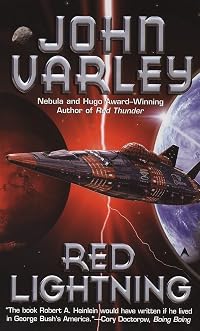
It doesn't matter that Ray Garcia-Strickland's father was one of the first men on Mars. The now overdeveloped planet has lost its hip factor, its luxurious hotels-like the one Ray's father manages-overrun with gravity-dependent tourists from Earth. Ray is over the Red Planet. Soon he gets his own chance at interplanetary adventure, when an unknown object hits Earth and causes a massive tsunami. Ray heads back to Florida to help family and friends who've survived the devastation-and soon show more learns the so-called natural disaster could have unnatural consequences.. show lessTags
Recommendations












Member Reviews
The first half of this sequel to Red Thunder was so good, that I said "OK, no matter what happens in the second half, this is at least 3 stars." The second half did not live up to the first. It wasn't bad, just predictable. It's not surprising that Varley's postscript focus on just the first half. So what happens in the book? This is Red Thunder, the Next Generation. The offspring of the heroes of that first over-packed novel live on Mars, and have a pretty good life, until something moving at near-light speed slams into Earth, causing a tsunami that devastates many coastal regions, in particular, much of the East Coast of the United States, including Florida, where Granny lives. Countless space operas have included similar events, show more using statistics meant to convey impact through large numbers. Yawn. Varley does just the opposite. He moves in close. The family heads to Earth to rescue Granny if possible, or at least find closure. On Earth, they reunite with ex-astronaut Travis Broussard, who conveniently has access to a DUKW, those amphibious wartime vehicles that are still popular at watery tourist areas from Florida to Wisconsin. Their journey into the heart of the disaster zone is what makes this book worth the read. The details of what they see feels right. Their emotions -- and lack of emotions -- feel right. The people they meet feel real. The disaster may be tiny in the scale of the solar system, but it's large in the book. It makes sense how it affects the characters, and the governments of Earth in the second half of the book. That second half though is just average SF. It's back to Mars, which is soon invaded by Earth, and things go off on a straightforward adventure trajectory from that point on, with the magical Squeezer technology becoming even more magical. It's a passable time-filler that covers millions of miles of space, but nothing compared to the preceding journey of maybe 100 miles to one small beach area.
Highly recommended, but feel free to skim after the story returns to Mars. show less
Highly recommended, but feel free to skim after the story returns to Mars. show less
I raced through this book but found it decreasingly interesting. This is, in fact, my least favorite Varley yet. Although it was published this year, it also reads as the most "old school" scifi of all his books. As in many Heinlein or other Grand Master books, his characters spend most of their time either explaining physics to each other or excitedly discussing what's wrong with the political landscape. In either case, the characters themselves are mere mouthpieces for the author. The main character, like many other Grand Master main characters, is smart and self-deprecating, but his relationship with a beautiful, flexible blonde with few inhibitions isn't written believably. Believability is a big problem for this book--I just didn't show more buy the societies or characters Varley created. Superficially interesting, they were all alike and all very artificial.
At the beginning of the book, I was hooked. I wanted to know more about Ray's adventures as a hotelier on Mars (check out Kage Baker's "Empress of Mars" (http://www.asimovs.com/_issue_0406/empressofmars.shtml) for a better read) and I was invested in the disaster relief efforts on Earth. After they returned to Mars, however, the book's weaknesses (and the fact that Varley clearly didn't have much else to say) came to the fore. show less
At the beginning of the book, I was hooked. I wanted to know more about Ray's adventures as a hotelier on Mars (check out Kage Baker's "Empress of Mars" (http://www.asimovs.com/_issue_0406/empressofmars.shtml) for a better read) and I was invested in the disaster relief efforts on Earth. After they returned to Mars, however, the book's weaknesses (and the fact that Varley clearly didn't have much else to say) came to the fore. show less
Once again, John Varley sets out to prove that science fiction doesn't have to be a jumble of made up nonsense. Instead, he focuses on Ray, the son of Manny and Kelly from Red Thunder, and his friends and family, as they deal with the consequences of the first book. Ray has grown up on Mars, and probably the coolest "sci-fi" parts of the book are when Varley examines what people growing up in 1/3 of Earth's gravity would be like (taller, for one thing). The book also eerily examines the fallout from a tsunami disaster hitting the East coast of the US. The author's note says he wrote the tsunami in before the Indonesian disaster (and indeed moved the tsunami to the US after that happened) and before Katrina. He is amazingly accurate in show more his portrayal of the aftermath, especially given what we know happened after Katrina. This takes up the first half of the book, and is the most powerful part. After our friends return to Mars, it's on with the sci-fi, and the plot of evil-doers wanting to control Ray's eccentric Uncle Jubal. Varley does well, for a sequel (and even leaves it open-ended enough for another sequel). show less
Upbeat, half post-apocalyptic, libertarian, pro-gun rights young adult novel. Strange but also hard to put down because of the likable characters.
This one's a sequel to Red Thunder, the story of how good, ol' American ingenuity beat the Chinese to Mars. (Well, okay, it was American ingenuity backed by the nigh magical invention of an idiot savant.) It's some twenty years later and two of those first humans on Mars have settled onto the Red Planet. They run a hotel. Humanity is reaching for the stars, while the less adventurous settle for an interplanetary vacation. The story, however, really doesn't deal with that. The focus of Red Lightning is Earth. Earth has just suffered a great disaster--an object travelling at near light speed has skipped off the northern Atlantic Ocean and kicked up the most devastating tsunami the planet has ever seen. We're then privy to the adventures show more of the Garcia-Strickland clan as they deal with the disaster and its repercussions. Some of the latter are expected, some are, well, going off on a tangent. It doesn't make for great literature--it is a sequel, after all--but it's enjoyable enough.
--J. show less
--J. show less
Mars's autonomy is threatened in a story that borrows some elements from the US's response to 9/11. The second book in the sequence, following [b:Red Thunder|48682|Red Thunder (Red Thunder, #1)|John Varley|http://d.gr-assets.com/books/1309206903s/48682.jpg|47625]. Similar to Heinlein's late juvenile and transitional novels in scope and tone (with more, though mostly not shown, sex, drugs, and swearing, and a lot more liberalism). It's easy to see some of the themes Varley returned to in [b:Slow Apocalypse|13542400|Slow Apocalypse|John Varley|http://d.gr-assets.com/books/1345756315s/13542400.jpg|19106689]. There's some hard science, though it's not the focus even when it's important to the plot. The emotional centers of the book are show more interpersonal and societal.
I knew immediately what was in the box, but not quite how it had been managed. show less
I knew immediately what was in the box, but not quite how it had been managed. show less
A disappointing sequel to Red Thunder. The book is told from the viewpoint of Ramon, the son of two of the characters from the first book, who has grown up on Mars. When an unknown object hits the North Atlantic and generates a huge tsunami, the family goes back to Earth to try to help their relatives in Florida. When they return to Mars, they have to deal with an invasion by forces searching for Jubal, the genius who invented the Squuezer technology that provides energy to Earth and makes cheap space travel possible. The book is enjoyable enough, but very little really happens in it. It feels like two novellas that were stuck together to make a full novel, which leaves it with very little of an overall plot. Especially in the first show more section, the book barely feels like science fiction. Despite having had a free energy technology for over twenty years, Earth is basically no different than it is today. Ultimately, there is not much resolution to the story, it just kind of ends with a set up for more sequels. show less
Members
- Recently Added By
Author Information

82+ Works 16,000 Members
Awards and Honors
Awards
Series

Belongs to Publisher Series
Science Fiction Book Club (1211294)
Work Relationships
Is contained in
Common Knowledge
- Canonical title
- Red Lightning
- Original publication date
- 2006
- Important places
- Mars; Earth
- Dedication
- This book is dedicated to the memory of
Don and Mary Stilwell,
and to Jim, John, Jane, Joe, Janice, and Jerry. - First words
- Mars sucks.
- Last words
- (Click to show. Warning: May contain spoilers.)"Hail Mary, Full of Grace, The Lor
Classifications
Statistics
- Members
- 653
- Popularity
- 44,211
- Reviews
- 14
- Rating
- (3.55)
- Languages
- English
- Media
- Paper, Audiobook, Ebook
- ISBNs
- 9
- UPCs
- 1
- ASINs
- 5