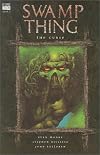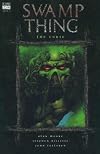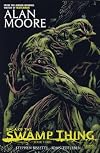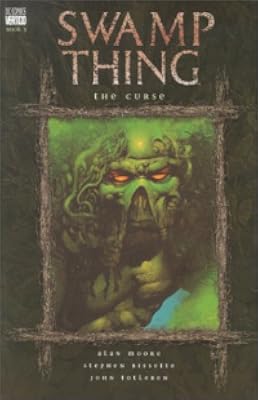
Swamp Thing Vol. 3: The Curse
by Alan Moore (Writer)
Swamp Thing (Vol.2 #35-42), Swamp Thing (1982-1996) (Swamp Thing Collected Volumes — V3)
On This Page
Description
Continuing Alan Moore's award-winning run on The Saga Of The Swamp Thing, this third volume is brimming with visceral horrors including underwater vampires, a werewolf with an unusual curse, the hideous madman called Nukeface. Best of all, this volume features the comics debut of John Constantine, Hellblazer, who launches Swamp Thing on a voyage of self-discovery that will take him from the darkest corners of America to the roots of his own long-hidden heritage.Tags
Recommendations






Member Reviews
I det tredje bind af Swamp Thing er der ryddet op, og det giver Alan Moore og hans tegnere plads til at koncentrere sig om stærke historier. Serien toner nu rent flag som en gyserserie eller – som der stod på de originale forsider – ’sophisticated suspense’. Til gengæld er Swamp Things plantenatur rykket lidt i baggrunden, og selvom det var interessant, så var det spor måske også ved at være opbrugt.
De to første numre fortæller historien om en omvandrende vagabond, der uden at vide det lever af radioaktivt affald. Nu er han tvunget væk fra sit hjem i Pennsylvania, fordi permanente underjordiske brande i kulminer, som i øvrigt er ægte fænomen, har gjort det umuligt at opbevare atomaffald der. I stedet bliver det show more dumpet i Louisianas sumpe, og nu trækker han et spor af radioaktiv ødelæggelse efter sig.
Dernæst gennemspilles en række klassiske gysertemaer i nye variationer. Undervandsvampyrer plager den lille by Rosewood i Illinois, hvor det stillestående vand viser sig at være et ideelt levested, varulve fortolkes som et kvindeligt oprør mod patriarkatet og i den sidste historie kombineres et hjemsøgt hus med en tung arv fra slavetiden og lokale woodoo-traditioner.
I alle tilfælde er der tale om originale fortolkninger af velkendte temaer, og de er interessante, fordi de trækker på samtidens vigtigste spørgsmål. Miljøbelastning og bekymringen for atomindustrien bærer den første historie, og under andre lurer kampen for ligestilling mellem mænd og kvinder og mellem sorte og hvide.
Bagved det hele binder figuren John Constantine numrene sammen i en større fortælling, der vel skal endeligt forløses i næste bind. Det kan være svært at finde en god balance mellem enkeltnumre og samlefortælling, men i dette tilfælde er det meget vellykket – bl.a. fordi Moore ikke bruger energi på at forvirre læserne unødigt.
Det spiller selvfølgelig også ind, at illustrationerne fortsat er fremragende. I indledningen lægger Stephen Bissette ikke skjul på, at det var et stort pres at levere hver måned, men redaktionen har haft en heldig hånd med de to vikarer i dette bind. Både Rick Veitch og Stan Woch formår at tegne sig ind i Bissettes stil, så det ikke mærkes som et afbræk i læsningen. show less
De to første numre fortæller historien om en omvandrende vagabond, der uden at vide det lever af radioaktivt affald. Nu er han tvunget væk fra sit hjem i Pennsylvania, fordi permanente underjordiske brande i kulminer, som i øvrigt er ægte fænomen, har gjort det umuligt at opbevare atomaffald der. I stedet bliver det show more dumpet i Louisianas sumpe, og nu trækker han et spor af radioaktiv ødelæggelse efter sig.
Dernæst gennemspilles en række klassiske gysertemaer i nye variationer. Undervandsvampyrer plager den lille by Rosewood i Illinois, hvor det stillestående vand viser sig at være et ideelt levested, varulve fortolkes som et kvindeligt oprør mod patriarkatet og i den sidste historie kombineres et hjemsøgt hus med en tung arv fra slavetiden og lokale woodoo-traditioner.
I alle tilfælde er der tale om originale fortolkninger af velkendte temaer, og de er interessante, fordi de trækker på samtidens vigtigste spørgsmål. Miljøbelastning og bekymringen for atomindustrien bærer den første historie, og under andre lurer kampen for ligestilling mellem mænd og kvinder og mellem sorte og hvide.
Bagved det hele binder figuren John Constantine numrene sammen i en større fortælling, der vel skal endeligt forløses i næste bind. Det kan være svært at finde en god balance mellem enkeltnumre og samlefortælling, men i dette tilfælde er det meget vellykket – bl.a. fordi Moore ikke bruger energi på at forvirre læserne unødigt.
Det spiller selvfølgelig også ind, at illustrationerne fortsat er fremragende. I indledningen lægger Stephen Bissette ikke skjul på, at det var et stort pres at levere hver måned, men redaktionen har haft en heldig hånd med de to vikarer i dette bind. Både Rick Veitch og Stan Woch formår at tegne sig ind i Bissettes stil, så det ikke mærkes som et afbræk i læsningen. show less
The Swamp Thing is getting better now. A few stories kinda had me yawning, but most of them were fantastic.
The most standout, at least for me, was The Curse. That one had me laughing out loud and fist pumping. This is the first one that I can say was truly brilliant. Woman Power!!! :)
The close second is the rest of the stores with Constantine playing guide and snarky teacher to Swamp Thing, which could have been hokey but instead just lets us enjoy a bit of a power up. :) It's nice not being so... limited, anymore. I mean, he's supposed to be one big plant connected to the Green, right? Not just some entity eating a bunch of fertilizer, right? Open your mind, greenie, open your mind.... :)
I didn't like nukeface so much, though. I found show more my mind wandering. *sigh* But at least that gave greenie the chance to explore some possibilities, so I'm not gonna complain so much.
Definitely starting to shape up in a very nice way. I can finally see the potential that everyone keeps talking about. I hope it only gets better, and I'm pretty sure it will. show less
The most standout, at least for me, was The Curse. That one had me laughing out loud and fist pumping. This is the first one that I can say was truly brilliant. Woman Power!!! :)
The close second is the rest of the stores with Constantine playing guide and snarky teacher to Swamp Thing, which could have been hokey but instead just lets us enjoy a bit of a power up. :) It's nice not being so... limited, anymore. I mean, he's supposed to be one big plant connected to the Green, right? Not just some entity eating a bunch of fertilizer, right? Open your mind, greenie, open your mind.... :)
I didn't like nukeface so much, though. I found show more my mind wandering. *sigh* But at least that gave greenie the chance to explore some possibilities, so I'm not gonna complain so much.
Definitely starting to shape up in a very nice way. I can finally see the potential that everyone keeps talking about. I hope it only gets better, and I'm pretty sure it will. show less
The Swamp Thing has fully shed its past and the complicated threads of Alec Holland's old life. What has been born now is something different from before - the story of a girl in love with a monster, or rather, a plant. Here is the richness of the swamp in all of its glory, and the Swamp Thing beginning to realize the truth of what he is and what he is capable of. He is the environment turned sentient, the vast superorganism of all the plants in the world. Like the plants he is made up of, he is capable of regeneration, of growth, and of harnessing far more power than one might think possible. After all, the earth itself creates the mountains, why shouldn't it be capable of moving them? Roots run deep, after all...
This volume sees John show more Constantine introduced and along with him the threat of something... something without a name coming. Is it Satan, Cthulu, or something far more? All that we know is that strange things are beginning to rear their ugly heads. Vampires living underwater, a female werewolf who's change is tied up in her own menstrual cycle, and zombies unable to sleep for how horrific the past was for them. This was a surprisingly relevant comic that treated complex issues in a way reminiscent of the best of the old Twilight Zone episodes.
Needless to say, this comic was fantastic. I can understand fully how this run garnered so much praise and fond memory. It deserves every bit of it and to be well-remembered indeed. show less
This volume sees John show more Constantine introduced and along with him the threat of something... something without a name coming. Is it Satan, Cthulu, or something far more? All that we know is that strange things are beginning to rear their ugly heads. Vampires living underwater, a female werewolf who's change is tied up in her own menstrual cycle, and zombies unable to sleep for how horrific the past was for them. This was a surprisingly relevant comic that treated complex issues in a way reminiscent of the best of the old Twilight Zone episodes.
Needless to say, this comic was fantastic. I can understand fully how this run garnered so much praise and fond memory. It deserves every bit of it and to be well-remembered indeed. show less
At the heart of the Alan Moore's run writing Swamp Thing lies the American Gothic - a maxi-series of interlinked stories that sees the creation of John Constantine (who then becomes one of the most popular dark character in the DC extended universe) and changes to the Swamp Thing that open the character for almost any story and connect future and past.
The volume start with a two-issues story about the risks of radioactive trash and how bad can dumping of chemicals be. Technically this story is not part of the American Gothic storyline but it can be read as a prelude because it establishes two things - first that the love story between Abby and the Swamp Thing is here to stay (and it will have repercussions down the road but for the show more immediate future it gives a reason for the Swamp Thing to always return) and second - that the titular hero can actually die. But even without those links, the story is haunting and even now, 30 years later, it is as valid as ever - humans are doing all the could to destroy the nature for money and for profit.
And then the American Gothic starts. The Swamp Thing cannot really die in its own title - but he is at a point where he cannot learn anything about himself on his own. And Alan Moore invents John Constantine - that blonde mystery man that always has a suit and a cigarette on and who talks in half-truths and leads only. This story ties with the framing story from the reprint issue of a while ago (back in volume 2) - the Swamp Thing is not just created because of the chemicals that killed Alex Holland - he had turned into a Plant Elemental - so he can grow his body anywhere he wants and in this way to travel without traveling - in a way he is the spirit of the green and as long as there is greenery, he can just show up. And this is what John Constantine convinces the Swamp Thing to do - travel around the country and help people. Of course, it is not that straight forward and the Swamp Thing does i only because he is promised more information but this is what it ends up being - a travel through USA and its nightmares.
The first story in the arc connects the older issues (pre- Alan Moore) of the comic and the current run by returning the Swamp Thing to Rosewood, Illinois where he believes he had helped the town before. Except that he had not really finished the work and the bad thing is bad. Moore's take on vampires in this story is pretty interesting and not so common - and it is a great start of the journey. Which then leads to Kennescook, Maine where old legends, Indians, woman's mind and desires and werewolves are joined together in a story which I am still trying to decide if I like or not. It can be read as a compliment to women (and as with the vampire story before that, it is an interesting look at werewolves) but it also can be read as a bit of an anti-women propaganda material... But then back in the days, comics were not really for girls - and horror stories like that was always marketed to boys.
The last two issues in this volume are some of the most disturbing ones in the whole run so far - the mix of racism, slavery, zombies and voodoo is powerful. And exactly as with the radioactive dump story, even 30 years later it rings way too close to the reality. Of course that story need to be set in the South and the home of the Swamp Thing in Louisiana is as perfect place as any.
The introduction of this volume is written by Stephen Bissette - one of the original illustrators of the run and his insight into a lot of what is happening is interesting. Don't read it before the comics though - unless you had the read the stories before - although it does help understand some moments better.
So - vampires, werewolves, zombies and voodoo. Let's see what else will the Swamp Thing see while traveling across the country. show less
The volume start with a two-issues story about the risks of radioactive trash and how bad can dumping of chemicals be. Technically this story is not part of the American Gothic storyline but it can be read as a prelude because it establishes two things - first that the love story between Abby and the Swamp Thing is here to stay (and it will have repercussions down the road but for the show more immediate future it gives a reason for the Swamp Thing to always return) and second - that the titular hero can actually die. But even without those links, the story is haunting and even now, 30 years later, it is as valid as ever - humans are doing all the could to destroy the nature for money and for profit.
And then the American Gothic starts. The Swamp Thing cannot really die in its own title - but he is at a point where he cannot learn anything about himself on his own. And Alan Moore invents John Constantine - that blonde mystery man that always has a suit and a cigarette on and who talks in half-truths and leads only. This story ties with the framing story from the reprint issue of a while ago (back in volume 2) - the Swamp Thing is not just created because of the chemicals that killed Alex Holland - he had turned into a Plant Elemental - so he can grow his body anywhere he wants and in this way to travel without traveling - in a way he is the spirit of the green and as long as there is greenery, he can just show up. And this is what John Constantine convinces the Swamp Thing to do - travel around the country and help people. Of course, it is not that straight forward and the Swamp Thing does i only because he is promised more information but this is what it ends up being - a travel through USA and its nightmares.
The first story in the arc connects the older issues (pre- Alan Moore) of the comic and the current run by returning the Swamp Thing to Rosewood, Illinois where he believes he had helped the town before. Except that he had not really finished the work and the bad thing is bad. Moore's take on vampires in this story is pretty interesting and not so common - and it is a great start of the journey. Which then leads to Kennescook, Maine where old legends, Indians, woman's mind and desires and werewolves are joined together in a story which I am still trying to decide if I like or not. It can be read as a compliment to women (and as with the vampire story before that, it is an interesting look at werewolves) but it also can be read as a bit of an anti-women propaganda material... But then back in the days, comics were not really for girls - and horror stories like that was always marketed to boys.
The last two issues in this volume are some of the most disturbing ones in the whole run so far - the mix of racism, slavery, zombies and voodoo is powerful. And exactly as with the radioactive dump story, even 30 years later it rings way too close to the reality. Of course that story need to be set in the South and the home of the Swamp Thing in Louisiana is as perfect place as any.
The introduction of this volume is written by Stephen Bissette - one of the original illustrators of the run and his insight into a lot of what is happening is interesting. Don't read it before the comics though - unless you had the read the stories before - although it does help understand some moments better.
So - vampires, werewolves, zombies and voodoo. Let's see what else will the Swamp Thing see while traveling across the country. show less
Not as stunning as Vol. 2, but still more than worth your time. Moore's brilliance is stunted a bit by length constraints of a monthly comic, but his sociological approaches to vampires, zombies and werewolves would make George Romero proud. It's all just warm up to the galactic-occult-biosphere awesomeness that is Vol. 4: A Murder of Crows.
If this site had half-stars then I would use them to say not-very-important things like: this volume is kind of a mess compared to the previous two, and yet it's still unusually good. Moore has devised an overall plot that's basically an excuse to travel around and encounter different kinds of monsters, often accompanied by some very unsubtle social commentary, while also setting up an extremely creepy parallel story that really tests the limits of how far you can string people along without telling them anything to explain who these people are or what this one gross image is about. We also lose the throughline of the Bissette/Totleben art team at this point, but that actually works out well since the guest artists are well chosen for show more the tones of the various issues. There's some pretty solid horror here, and then there's Moore's first full-on venture into non-horror fantasy as Abby and Swamp Thing participate in psychedelic love trips, setting up the transcendentalist side of the series in a big way (while also unfortunately reminding us that Abby has had very little character development).
For more thoughts, here's a blog post. show less
For more thoughts, here's a blog post. show less
The introduction of John Constantine in this volume keeps things interesting and allows for more gothic opportunities of horror but in my opinion Constantine, although great, is the least interesting aspect of these books. Moore continues to hone a style that belongs exclusively to this medium with panel layout and narrative structure in constant dialogue. The stories here can get a little dated (the werewolf characters could probably use some updating) but Moore's storytelling instincts are always fresh and intelligent. I highly recommend this volume, particularly if you have been reading them from the beginning of Alan Moore's run.
Members
- Recently Added By
Lists

Best Fantasy Novels
821 works; 357 members

Recommended Comics / Graphic Novels
595 works; 122 members
Author Information

Multiple award-winning author Alan Moore is universally considered the best writer of graphic novels in the medium's history. Among his many awards are the Hugo Award, the Bram Stoker Award, the Eisner Award, and the International Horror Guild Award
All Editions
Some Editions
Series

Swamp Thing
47 works (Vol.2 #35-42)

Swamp Thing (1982-1996)
171 works (Swamp Thing Collected Volumes — V3)
Belongs to Publisher Series
Work Relationships
Contains
Common Knowledge
- Canonical title*
- Swamp Thing Vol. 3: The Curse
- Original title
- Swamp Thing, Vol. 3: The Curse
- Alternate titles
- Saga of the Swamp Thing, Book Three
- Original publication date
- 1985 (original issues) (original issues)
- People/Characters
- Alec/Swamp Thing; Swamp Thing; Abby Cable; Nukeface; John Constantine; Diagonal Bob (show all 25); Wallace Monroe; Treasure Monroe; Officer Mike Bernhardt; Widow Morel; Billy Hatcher; Judith; Benjamin Cox; Sister Anne-Marie; Emma [Hellblazer]; Invunche; Deanna; Frank North; Phoebe; Roy; Richard Deal; Angela Lamb; Billy Carlton; Dennis Linder; Alice
- Important places
- the Swamp, Lousiana, USA; Houma, Louisiana, USA; Elysium Lawns, Houma, Louisiana, USA; Rosewood; London, England, UK; Wisconsin, USA (show all 13); Kennescook, Maine, USA; Washington, D.C., USA; New York, New York, USA; Jackson Plantation, Lousiana, USA; Rosewood, Illinois, USA; Chicago, Illinois, USA; Springville, Arkansas, USA
- First words
- Prologue: While his lover sleeps, the swamp creature sits in the smoldering pink dusk and overlooks his territories.
- Last words
- (Click to show. Warning: May contain spoilers.)"Is it that late already?"
(Click to show. Warning: May contain spoilers.)Jeez... is it that late already?
*Some information comes from Common Knowledge in other languages. Click "Edit" for more information.
Classifications
- Genres
- Graphic Novels & Comics, Horror
- DDC/MDS
- 741.5973 — Arts & recreation Drawing & decorative arts Drawing Comic books, graphic novels, fotonovelas, cartoons, caricatures, comic strips History, geographic treatment, biography North American United States (General)
- LCC
- PN6728 .S93 .M6678 — Language and Literature Literature (General) Literature (General) Collections of general literature Comic books, strips, etc.
- BISAC
Statistics
- Members
- 915
- Popularity
- 29,196
- Reviews
- 17
- Rating
- (4.24)
- Languages
- 5 — Czech, English, Finnish, Portuguese (Brazil), Spanish
- Media
- Paper, Ebook
- ISBNs
- 11
- UPCs
- 1
- ASINs
- 2